

What if the most important factor in the horse pellets vs powder supplements NZ debate isn't the physical form of the feed, but the biological chemistry of the soil beneath your horse's hooves? Many New Zealand horse owners spend hundreds of dollars on premium minerals only to be met with dull coats, crumbling hooves, and the constant anxiety of grass-affected behaviour. It's disheartening to follow a complex feeding plan yet see no visible return on your investment, especially when metabolic concerns like laminitis feel like a constant shadow over your daily management.
We understand that you're looking for more than just a bucket filler; you're seeking the peace of mind that comes from evidence-based wellness and a simplified routine that actually delivers results. This guide will help you navigate the choice between pellets and powders by focusing on the nutritional science specific to our unique environment. We'll examine how different formats impact nutrient absorption, why precise mineral ratios are the true key to foundational health, and how the right selection can transform your horse's vitality from the inside out.
Key Takeaways
- Understand why the biological form of minerals, such as chelated organics, is more critical for systemic health than the physical volume of the supplement.
- Evaluate the practical trade-offs in the horse pellets vs powder supplements NZ debate, balancing the concentration of powders against the palatability of pellets.
- Learn to address the unique pasture deficiencies found in New Zealand by establishing a forage-first foundation supported by a consistent mineral base.
- Discover how to simplify your daily feeding routine while ensuring your horse receives the precise ratios required for optimal metabolic function.
- Identify the visible indicators of nutritional success, from enhanced coat colour to improved hoof structural integrity, that signal internal balance.
The Pellet vs Powder Dilemma: Why Form Factor Matters for Your Routine
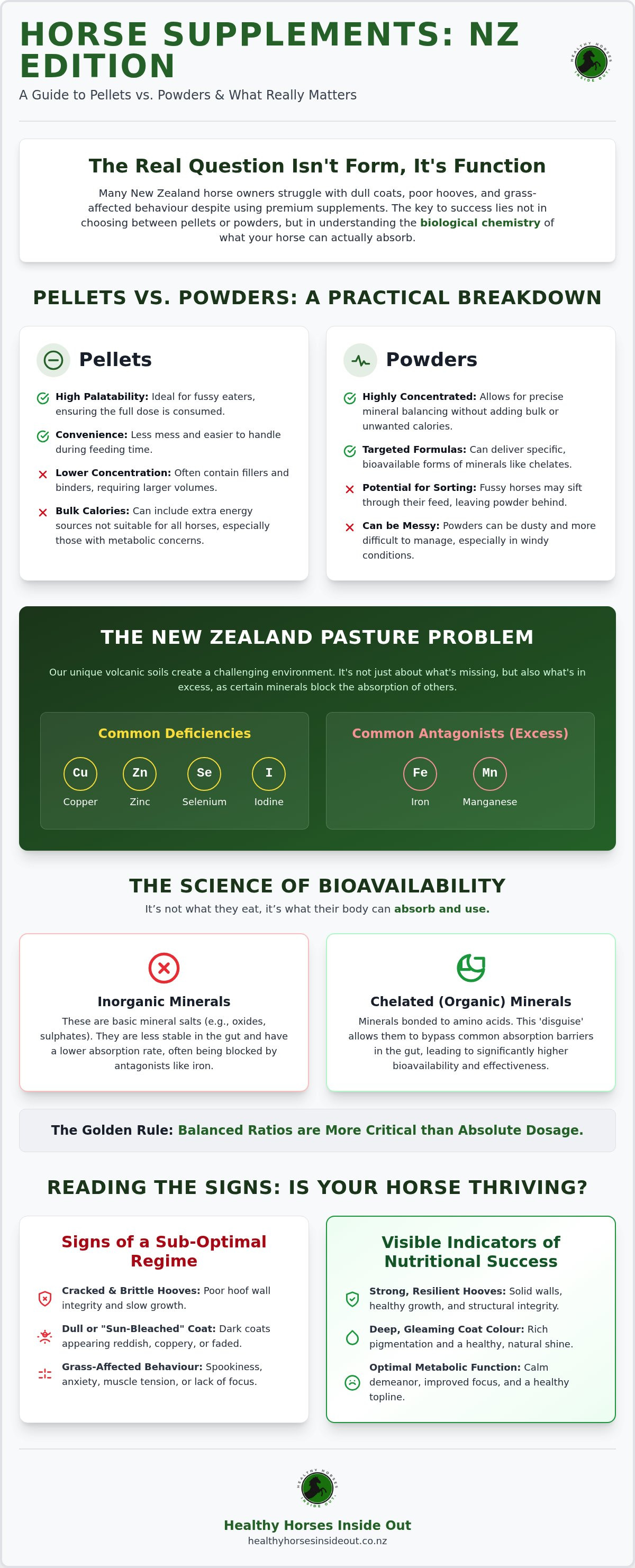
Many New Zealand tack rooms hide a graveyard of half-used bags and dusty tubs. This "trial and error" approach to equine nutrition is a common frustration for owners who feel they're constantly guessing. Choosing between horse pellets vs powder supplements NZ isn't just about convenience; it's about understanding why your horse's system might be struggling despite your best efforts. A standard "complete feed" pellet is typically designed as a bulk calorie source with a broad mineral profile. In contrast, a concentrated supplement focuses on mineral balancing without the extra energy, allowing for more precise control over the diet.
True effectiveness isn't measured by the volume in the bucket, but by the level of biological absorption. We advocate for an "Inside Out" philosophy where external beauty is viewed as a direct consequence of internal mineral balance. A gleaming coat and resilient hooves aren't achieved through topical oils; they're the result of a system that's nutritionally supported from the core. Understanding Equine nutrition requires looking past the marketing and into the mineral chemistry that drives every physiological process. The horse pellets vs powder supplements NZ choice becomes clearer when you realise that powders often offer higher concentration, while pellets ensure the horse actually ingests the full dose rather than leaving it at the bottom of the bin.
The Reality of New Zealand Soil and Forage Chemistry
New Zealand's volcanic and sedimentary soils present unique challenges for the modern horse owner. Deficiencies in Selenium, Iodine, Copper, and Zinc are widespread across the country. It isn't just about what's missing, though. High levels of Iron or Manganese, often found in our bore water and lush rye-grass pastures, act as mineral antagonists. These elements physically compete for absorption sites in the gut, effectively blocking the uptake of the very minerals you're trying to supplement. Seasonal shifts in our temperate climate further complicate this, as spring flushes can rapidly change the mineral ratios in your paddock and affect how your horse processes their feed.
Identifying the Signs of a Sub-Optimal Regime
Look for physical indicators like brittle, cracking hoof walls or a "sun-bleached" appearance in dark coats that should be deep black or bay. These aren't just aesthetic issues; they're cries for help from the internal system. Behavioural signals are equally telling. "Grass-affected" spookiness, muscle tension, or a sudden lack of focus are frequently linked to Magnesium imbalances exacerbated by NZ's high-potassium pastures. Many owners find that generic "complete" feeds are insufficient because the sheer volume of forage consumed daily dilutes the relatively low concentration of minerals included in the bag, leaving the horse nutritionally short-changed despite being well-fed.
The Science of Bioavailability: What Makes a Supplement Truly Effective?
Bioavailability is the proportion of a nutrient that enters the circulation to have an active effect. While many owners compare horse pellets vs powder supplements NZ based on price or ease of use, the biological reality is that a supplement is only as good as its absorption rate. Simply "filling a gap" in a diet isn't enough; true health requires optimising a biological system where every mineral works in concert. To achieve this, we prioritise chelated (organic) minerals. Unlike inorganic salts, chelated minerals are bonded to amino acids, allowing them to bypass common absorption barriers in the gut and reach the tissues where they're needed most. Whether you are weighing up horse pellets vs powder supplements NZ, the goal remains the same: systemic health that starts at the cellular level.
In the New Zealand environment, the absolute dosage of a mineral is often less important than the ratio in which it's delivered. High levels of specific pasture minerals can compete for uptake, making a generic guide to horse vitamins and minerals a helpful starting point, but one that requires local adjustment. When ratios are balanced, the body functions with systemic efficiency, leading to the visible results we all strive for. This methodical approach ensures your horse isn't just eating minerals, but actually utilising them.
The Critical Zinc to Copper Ratio
Zinc and Copper are the architects of the equine body, yet they exist in a delicate tug-of-war. For optimal keratin production in hoof walls and hair follicles, a ratio of 3:1 or 4:1 Zinc to Copper is required. Adding more Zinc in isolation can inadvertently create a secondary Copper deficiency, as the two minerals compete for the same transport proteins. Maintaining this specific balance supports the equine immune system and ensures that dark coats retain their deep, rich colour without the telltale "rusting" at the ends of the mane and tail. When these two minerals are in harmony, the external results are undeniable.
Selenium and Iodine: The NZ Safety Balance
New Zealand soils are notoriously Selenium-deficient, yet this trace element has a remarkably narrow safety margin. Precision is vital; too little leads to muscle weakness and poor immunity, while too much can be toxic. Similarly, Iodine plays a non-negotiable role in thyroid function and metabolic regulation, especially for horses grazing on our unique pasture profiles. Effective equine nutrition must be formulated with these local soil data points in mind to ensure safety and efficacy. Understanding these nuances is why many owners choose to explore specialised mineral balancing to provide their horses with a scientifically sound foundation.
Horse Pellets vs Powder Supplements NZ: A Practical Breakdown
Deciding between horse pellets vs powder supplements NZ often comes down to the daily reality of your feeding routine. Powdered supplements are typically praised for their high concentration and lack of binders, allowing for surgical precision when adjusting a diet. However, they present challenges with palatability; a picky eater can easily sift through their feed, leaving expensive minerals at the bottom of the bin. Pellets, on the other hand, solve the waste problem by ensuring every gram is consumed. While they offer superior convenience, the trade-off is often the inclusion of fillers required to hold the pellet together. Choosing the right format requires balancing these practicalities with your horse's specific needs.
The "More is Better" myth remains a persistent danger in equine circles. Many owners believe that doubling the dose of a generic supplement will yield faster results, but this can lead to dangerous toxicity levels, particularly with fat-soluble vitamins or minerals like Selenium. A methodical approach to Nutritional Management for Horses involves understanding that high-concentration supplements are more cost-effective than bulky, filler-heavy alternatives. You aren't just buying weight; you're buying active ingredients. Investing in a concentrated product ensures you aren't paying for the transport of grain by-products that your horse doesn't actually need.
The Problem with Fillers and Carriers
Many pelleted products use soy hulls, wheat middlings, or molasses as carriers. While these are common, they can trigger inflammatory responses or sensitivities in metabolic horses or those prone to laminitis. This is why understanding horse supplement ingredients NZ is vital for savvy owners. Ingredient transparency is non-negotiable; you deserve to know exactly what is entering your horse's system. By avoiding unnecessary fillers, you reduce the risk of systemic irritation and focus purely on the nutritional optimisation of the animal.
Targeting Health Goals with Bundles
Identifying what supplements does my horse need NZ helps you move from generic support to targeted health objectives. The logic behind supplement bundles is rooted in synergy, where specific ingredients are curated to work together, enhancing the overall effect on the horse's physiology. For instance, a bundle might combine foundational minerals with specialised gut support. We believe that gut health should be the cornerstone of any programme; if the digestive tract isn't functioning optimally, even the highest quality horse pellets vs powder supplements NZ won't be fully utilised by the body.
Designing Your Strategy: How to Organise an Effective Feeding Programme
Constructing a successful nutritional regime requires a shift from reactive supplementation to proactive balancing. Instead of reaching for a new tub every time a symptom appears, you should build a framework that addresses the horse's foundational needs first. This methodical approach ensures that every dollar spent contributes to systemic health. When considering horse pellets vs powder supplements NZ, the choice should be dictated by how well the product integrates into a forage-heavy diet. By establishing a solid base, you create a baseline for health that makes it easier to identify when specific, targeted support is actually necessary.
Step 1: The Forage-First Audit
Your horse's paddock is the primary source of their nutrition; therefore, any audit must begin with the grass. New Zealand pastures vary significantly, with ryegrass and clover mixes presenting different mineral challenges compared to sub-tropical species. High-sugar ryegrass can often lead to metabolic volatility, making mineral balancing even more critical. Salt is a non-negotiable daily requirement for the working NZ horse, as it drives the thirst response and supports vital electrolyte balance. If you're unsure about your forage quality, testing your hay is a prudent step that can save you hundreds in unnecessary supplementation by revealing exactly which gaps need filling.
Step 2: Balancing the Bucket Feed
Once you understand your forage, you can select a foundational mineral base. Many owners find success by combining everyday horse supplements with a low-glycaemic carrier like beet pulp or oil-based chaff. This avoids the "double-up" trap where multiple products provide overlapping nutrients, which can lead to imbalances or even toxicity. Consistency is the hallmark of a professional routine. Feeding "every other day" or only after a ride disrupts the steady-state mineral levels required for biological optimisation. A daily, measured dose ensures the system remains supported without the peaks and troughs that hinder progress.
Visible changes in hoof structural integrity and coat depth don't happen overnight. You should monitor your horse's condition over an 8 to 12 week period, as this allows for a full cycle of cellular turnover and growth. If you've established a balanced base and still see specific issues, you can then layer targeted support for joints or hooves. This layered strategy prevents the common mistake of over-supplementing a system that's already nutritionally sound. To begin your journey toward a more streamlined and effective routine, browse our range of specialised mineral solutions designed specifically for the New Zealand environment.
The HHIO Approach: Bridging the Gap with Science-Based Solutions
The challenge of balancing an equine diet in the New Zealand environment requires a partner who understands the biological nuances of our soil and water. When weighing up horse pellets vs powder supplements NZ, the HHIO philosophy offers a streamlined path to systemic health that bypasses the guesswork of traditional retail. We believe in intentionality. Our formulations aren't designed to follow market trends; they're built to address the documented mineral imbalances that affect horses grazing on NZ pastures. By choosing a methodical approach, you move away from the frustration of half-used supplement tubs and toward a regime rooted in clinical authority.
Our commitment to integrity means we prioritise high-quality, bioavailable ingredients that the horse's system can actually utilise. This focus on internal, systemic health is the primary driver of the external performance and beauty you see in the paddock. When you provide the body with the precise ratios it requires for metabolic function, you aren't just feeding; you're optimising a biological system. This creates a sense of confidence and security, offering you the peace of mind that your horse is nutritionally supported from the inside out.
Why HHIO Pellets are the Logical Starting Point
HHIO Pellets serve as a high-spec delivery system designed specifically to counter the mineral antagonists found in local forage. While standard rations often ignore the high-iron nature of many NZ water sources, our pellets are formulated with the correct Zinc to Copper ratios to ensure absorption isn't blocked. This makes them the ideal foundational base for any horse. The ease of use is a significant advantage; a single daily dose provides the essential minerals required for long-term metabolic health and "Inside Out" vitality. It's a simplified routine that eliminates the mess and waste often associated with the horse pellets vs powder supplements NZ debate.
Achieving Visible Results with Targeted Bundles
Once a strong mineral foundation is established, you can layer targeted support to meet specific health goals. The synergy of a horse joint supplement NZ is significantly enhanced when the horse's internal environment is already balanced. We've seen countless success stories where horses have transitioned from being dull, itchy, or "grass-affected" to becoming vibrant, shiny athletes with resilient hooves. This transformation is a symptom of internal balance achieved through science-led nutrition. To start your horse on a path to better health, Shop the range of effective NZ horse supplements at HHIO and experience the difference that methodical mentoring makes.
Building a Foundation for Long-Term Equine Vitality
Achieving a vibrant, healthy horse in the New Zealand environment requires moving beyond the surface-level debate of horse pellets vs powder supplements NZ. True success is found in the biological details; specifically, the precise mineral ratios that counter our unique soil deficiencies and the high-spec bioavailability that ensures nutrients actually reach the bloodstream. By prioritising a forage-first audit and establishing a consistent mineral base, you eliminate the guesswork that leads to wasted investment and nutritional anxiety.
Our range is formulated specifically for New Zealand pasture conditions, using high-spec mineral ratios to deliver visible results you can see in every hoof and hair follicle. Trusted by owners across the country for Inside Out equine wellness, these solutions provide the intentionality and integrity your horse deserves. You have the power to transform your feeding routine into a methodical, science-based programme that offers true peace of mind. Maximise your horse’s health with HHIO’s science-led supplements and start seeing the results of internal balance today. Your horse’s journey to optimal health is a marathon, not a sprint, and we're here to guide you every step of the way.
Frequently Asked Questions
How long does it take to see results from an effective horse supplement?
You should expect to see the first visible results within 8 to 12 weeks of starting a consistent regime. While some behavioural improvements linked to magnesium balance might appear sooner, structural changes like hoof strength and coat depth require a full cycle of cellular growth. Hoof walls grow at a rate of roughly one centimetre per month, so long-term resilience is a marathon that rewards patience and nutritional consistency.
Can I over-supplement minerals like Selenium in New Zealand?
Yes, you can certainly over-supplement Selenium, and doing so is dangerous due to its remarkably narrow safety margin. New Zealand soils are notoriously deficient, but toxicity leads to severe issues like hoof sloughing or hair loss. It's vital to use products formulated with local soil data in mind. Always calculate the total intake from all feed sources to ensure you stay within safe, therapeutic levels for your horse.
Does my horse need a supplement if they are only on grass?
Most horses grazing exclusively on New Zealand pasture require supplementation because our grass is rarely a complete nutritional source. While the forage provides calories, it often lacks essential trace minerals or contains imbalances like high iron that block nutrient uptake. Providing a balanced mineral base ensures your horse isn't just surviving on grass but is thriving with the systemic support needed for long-term health and performance.
What is the difference between a vitamin and a mineral supplement?
Minerals are inorganic elements like Zinc and Copper that serve as the structural building blocks for bones, hooves, and enzymatic reactions. Vitamins are organic compounds that support metabolic processes and immune function. In the context of horse pellets vs powder supplements NZ, most local horses primarily need mineral balancing to counter pasture deficiencies, as they often receive sufficient vitamins from fresh, green forage during the growing season.
Are HHIO Pellets suitable for horses with metabolic issues like laminitis?
HHIO Pellets are specifically designed to be suitable for horses with metabolic sensitivities, including those prone to laminitis. They provide a high-spec mineral foundation without the high-sugar fillers or grain by-products often found in standard commercial feeds. By focusing on "Inside Out" vitality and correct mineral ratios, these pellets help support stable metabolic function and systemic health, providing a safe option for horses requiring a low-glycaemic diet.
How do I know if my horse’s supplement is being properly absorbed?
You can monitor absorption by observing external indicators of internal health over a period of several months. A horse properly absorbing their minerals will display a deep, rich coat colour without "rusting" and resilient hoof walls that hold shoes well. Behavioural changes, such as improved focus and reduced spookiness, also suggest that the nervous system is receiving the magnesium and trace elements it requires to function optimally.
Why is the Zinc to Copper ratio so important for NZ horses?
The Zinc to Copper ratio is critical because these two minerals compete for the same absorption pathways in the gut. For New Zealand horses, maintaining a 3:1 or 4:1 ratio is essential for the production of keratin, which forms the hooves and hair. Because many NZ water and soil sources are high in iron, which further blocks uptake, providing these minerals in the correct, balanced ratio is the only way to ensure they reach the tissues.
Can I feed everyday supplements alongside specific joint or gut support?
You can certainly feed everyday supplements alongside specific support for joints or gut health, provided the foundational base is correctly balanced. The key is to avoid the "double-up" trap where you inadvertently provide excessive amounts of the same nutrient. When weighing horse pellets vs powder supplements NZ, starting with a comprehensive mineral pellet allows you to layer targeted bundles on top, ensuring a streamlined and effective nutritional strategy without unnecessary overlap.


