

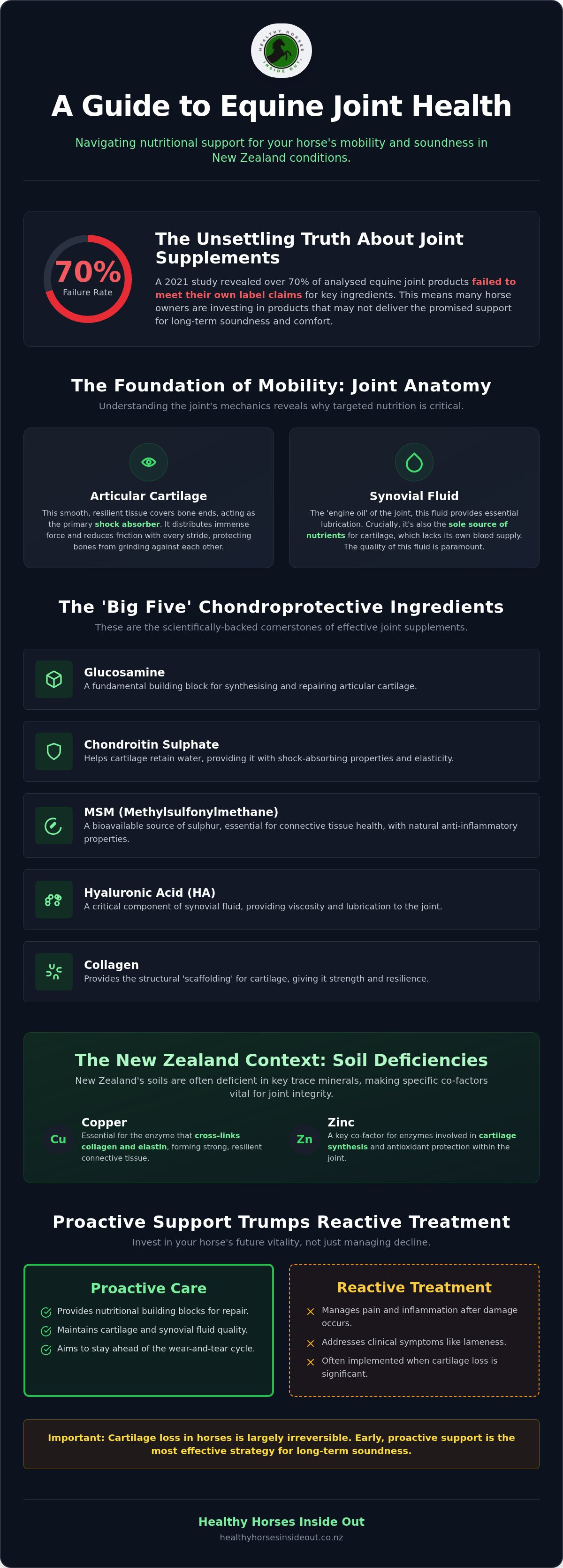
Did you know that a 2021 study revealed over 70 per cent of analysed equine joint products failed to meet their own label specifications for key ingredients like glucosamine? It is deeply unsettling to realise that the horse joint supplement NZ you have carefully chosen might not actually contain what it claims, especially when your horse's long-term soundness and comfort are at stake. You want to protect them from the inevitable wear and tear of work and age, yet the conflicting marketing jargon often leaves you feeling more confused than confident.
We believe that true peace of mind comes from understanding the nutritional science behind every scoop. This guide will help you discover the biological mechanisms of equine joint health and learn how to select the most effective nutritional support tailored for New Zealand conditions. We will break down the complexities of joint anatomy, explain the logic of specific chondroprotective ingredients, and provide you with the tools to read supplement labels with clinical precision. By focusing on foundational, systemic health, you can move away from the frustration of wasted investments and toward a future of improved mobility for your horse.
Key Takeaways
- Understand the vital roles of articular cartilage and synovial fluid in maintaining shock absorption and lubrication within the equine limb.
- Learn how to assess ingredient bioavailability when selecting a horse joint supplement NZ to ensure the nutrients are effectively absorbed and utilised.
- Discover the critical link between New Zealand’s soil mineral deficiencies and the need for specific co-factors like Copper and Zinc for collagen cross-linking.
- Master the ability to read supplement labels with confidence by identifying the 'Big Five' ingredients and their proven scientific benefits.
- Explore how a healthy gut-joint axis and foundational nutrition support systemic health to improve your horse's long-term mobility and comfort.
Understanding Equine Joint Anatomy: The Foundation of Mobility
To understand why a horse joint supplement NZ is a vital consideration for your team, we must first look at the mechanical architecture of the equine limb. The joint is a high-performance system designed to withstand immense force, yet its internal components are surprisingly delicate. At the heart of this system is articular cartilage, a smooth, resilient tissue that covers the ends of the bones. This cartilage acts as a primary shock absorber, distributing weight and reducing friction during every stride. Without this protective layer, the bones would grind against each other, leading to rapid degradation and pain.
Surrounding the cartilage is the synovial membrane, which produces synovial fluid. You can think of this fluid as the 'engine oil' of the joint. It provides essential lubrication to ensure smooth movement, but it also serves a secondary, more critical purpose. Unlike most tissues in the body, articular cartilage is poorly vascularised, meaning it lacks a direct blood supply. It relies entirely on a process called diffusion to receive oxygen and nutrients from the synovial fluid. This biological reality makes the nutritional profile of that fluid the single most important factor in joint health.
When this system is compromised, we see the onset of the inflammatory cascade. This process leads to Osteoarthritis, a degenerative condition where the joint environment becomes acidic and enzymes begin to eat away at the cartilage matrix. Recognising this shift early is the key to maintaining long-term soundness.
The Biological Cycle of Wear and Repair
Healthy horses are constantly undergoing micro-damage during exercise. During periods of rest, the body naturally works to repair these tissues and reinforce the cartilage matrix. However, there is a tipping point where the rate of degradation outpaces the body's natural repair capacity. When this threshold is crossed, you will likely notice subtle changes in your horse's way of going. Early warning signs include localised heat, slight swelling around the joint capsule, or a 'shortness' of stride that takes longer to warm out of than usual. Using a high-quality horse joint supplement NZ during these early stages can help provide the building blocks the body needs to stay ahead of this cycle.
Why Proactive Support Trumps Reactive Treatment
Cartilage loss is largely irreversible in horses. Once the protective 'cushion' has worn away to the point of bone-on-bone contact, the path to recovery becomes significantly more difficult. While various equine lameness treatments are available to manage pain and reduce inflammation, they are often reactive measures. The most effective strategy is to provide nutritional support before clinical lameness occurs. This is especially important for horses with conformational challenges or those in high-impact disciplines, as these factors place disproportionate stress on the joint structures. By maintaining the integrity of the synovial fluid and cartilage matrix through targeted nutrition, you are investing in your horse's future vitality rather than just managing a decline.
The Nutritional Toolkit: Evaluating Joint Supplement Ingredients
Selecting an effective horse joint supplement NZ requires more than just looking at a flashy label. It demands an understanding of how specific molecules interact with equine physiology to support long-term soundness. While the market is flooded with options, the most effective formulations focus on the 'Big Five' ingredients: Glucosamine, Chondroitin, MSM, Hyaluronic Acid, and Collagen. However, the presence of these names on a tub doesn't guarantee efficacy. You must account for the risks of supplement use, particularly the lack of regulation that often leads to products containing high levels of 'fillers' like dextrose or rice flour. These additives add weight but offer no structural support to the joint matrix.
Bioavailability is the true measure of a supplement's value. It doesn't matter how high the dose is if the horse's gut cannot absorb the molecule or if the molecular weight is too high to reach the joint capsule via diffusion. This is where synergy becomes critical. Certain ingredients, when paired, enhance each other's uptake and biological activity. This creates a result greater than the sum of their parts, ensuring your investment translates into visible comfort for your horse.
Glucosamine and Chondroitin: The Structural Building Blocks
Glucosamine is a precursor for glycosaminoglycans (GAGs), the essential components that stimulate the production of new cartilage matrix. When combined with Chondroitin sulphate, which serves as the primary component of connective tissue, these building blocks help maintain the integrity of the articular surface. Purity is paramount here. Low-grade sources often contain contaminants that can trigger digestive upset, which is why we prioritise high-purity, science-led sourcing in every horse joint supplement NZ we recommend.
MSM and Hyaluronic Acid: Managing Inflammation and Lubrication
Methylsulphonylmethane (MSM) provides a bioavailable source of organic sulphur, which is necessary for the cross-linking of collagen fibres that give cartilage its strength. It works alongside Hyaluronic Acid (HA) to address the fluid environment of the joint. Hyaluronic Acid functions as a vital lubricant within the synovial fluid, where high molecular weight variants are essential for maintaining the shock-absorbing viscosity required during high-impact movement. This combination helps manage the inflammatory response while ensuring the 'engine oil' of the joint remains thick and protective.
The Emerging Role of Collagen in Equine Soundness
While often overlooked in older formulations, Type II Collagen is the actual framework that holds cartilage together. Hydrolysed collagen provides the specific amino acids needed to support not just the joints, but the surrounding tendons and ligaments as well. Integrating these targeted proteins into a performance horse supplements NZ routine ensures a comprehensive approach to soundness that addresses the entire musculoskeletal system. If you're looking for a methodical way to support your horse's vitality, exploring our specific horse supplements can provide a simplified, evidence-based path to peace of mind.
The New Zealand Context: How Local Conditions Impact Joint Longevity
New Zealand’s lush, green landscapes are often perceived as an equine paradise, yet the soil beneath our feet tells a different story. For horse owners, understanding the unique geological profile of our islands is essential when selecting a horse joint supplement NZ. Our soils are notoriously deficient in several trace minerals that are non-negotiable for skeletal development and maintenance. When these minerals are missing, the structural integrity of the joint is compromised before the horse even begins its athletic career.
Copper and Zinc are perhaps the most critical co-factors in this equation. They are required for the activation of lysyl oxidase, an enzyme responsible for the cross-linking of collagen and elastin fibres. Without these cross-links, cartilage remains weak and prone to premature wear. Selenium also plays a protective role by forming part of the glutathione peroxidase enzyme system. This system acts as a biological shield, neutralising the oxidative stress and free radicals that accumulate in joint tissues during strenuous exercise. In a country where Selenium levels are naturally low, supplementing this mineral is a fundamental step in preventing long-term tissue damage.
Pasture-Driven Inflammation and Joint Stress
The 'flush' of New Zealand pasture, particularly during the transition between seasons, presents a unique challenge for joint health. High-sugar grasses can trigger systemic inflammation, creating a biochemical environment where joint discomfort is exacerbated. Additionally, mycotoxins—fungal metabolites often found in our paddocks—can lead to subtle changes in a horse's gait and muscle tension. These issues often masquerade as simple joint stiffness, yet they are actually symptoms of a high 'inflammatory load' within the body. Balancing the diet to mitigate these environmental triggers is just as important as providing direct joint support.
Foundational Nutrition vs. Targeted Supplementation
A common pitfall in equine management is attempting to solve a joint issue with a targeted product while ignoring the base diet. If a horse is deficient in foundational minerals, even the most advanced horse joint supplement NZ will struggle to produce visible results. The body simply lacks the raw materials required to utilise those specialised ingredients effectively. This is why everyday horse supplements are so vital; they ensure the horse's systemic health is optimised first. By providing a consistent baseline of minerals tailored to New Zealand conditions, you create a fertile environment for targeted joint support to work. This methodical approach ensures your horse has the resilience to handle seasonal grass changes and the physical demands of their workload.
Implementing a Proactive Joint Care Strategy for Your Horse
A proactive joint care strategy is not a one-size-fits-all solution; it requires a meticulous assessment of your horse's unique biological profile. You should consider their breed, as heavier drafts face different load-bearing stresses than athletic Thoroughbreds, alongside their age and current workload. For instance, a horse jumping on hard summer ground in Canterbury needs a different approach than a retired pony in a muddy Waikato paddock. When you introduce a new horse joint supplement NZ, the 'loading dose' is a non-negotiable first step. This initial period of higher intake serves to saturate the joint tissues and synovial fluid, providing a therapeutic baseline that maintenance doses then sustain.
Consistency is the cornerstone of success. Sporadic feeding disrupts the steady-state concentration of active ingredients in the synovial fluid, which often leads to the perception that a supplement isn't working. In reality, the biological 'repair' signal has simply been lost. Monitor your horse's comfort levels through regular gait analysis. Look for a more relaxed topline, a willingness to track up, and a reduction in the time needed to warm out of stiffness. These visible results are the indicators that your nutritional strategy is working from the inside out.
Selecting the Right Product for Each Life Stage
Your horse's nutritional requirements evolve as they age. For the growing horse, the focus is on building bone density and a resilient cartilage matrix to prevent future issues. The active adult horse requires protection against the oxidative stress of competition and training. For the veteran horse, the priority shifts toward managing existing stiffness and maintaining quality of life. Tailoring senior horse supplements NZ to these older individuals can help maintain the 'cushion' within the joint capsule, allowing them to remain comfortable in their golden years.
Complementary Management Strategies
Nutrition is a powerful tool, but it must work in tandem with physical management. Correct shoeing and hoof balance are essential for proper joint alignment, as even a minor imbalance can create uneven wear on the articular surfaces. Similarly, structured warm-up and cool-down protocols protect synovial structures by ensuring they are properly lubricated before high-impact work. Weight management is another critical factor; every extra kilo adds exponential stress to the lower limb joints. If you are struggling to maintain condition without adding unnecessary weight, see our guide on horse weight gain supplements NZ for managing poor doers without over-stressing their frame. To simplify your horse's routine while ensuring they receive targeted support, consider our horse supplement bundles which are designed to provide comprehensive, science-led care.
Supporting Mobility from the Inside Out: The HHIO Philosophy
At Healthy Horses Inside Out, we view the equine body as an integrated system where no tissue operates in isolation. This 'Inside Out' philosophy is fundamental to achieving long-term joint comfort. While many owners look for a horse joint supplement NZ as a reactive fix for stiffness, we prioritise the internal environment that allows those supplements to thrive. Central to this is the gut-joint axis. Scientific research continues to highlight how digestive health influences systemic inflammation; an imbalanced hindgut can trigger inflammatory markers that eventually migrate to the synovial structures. By ensuring the digestive system is stable, you effectively lower the 'noise' of inflammation throughout the entire body.
Our HHIO Pellets serve as the cornerstone of this systemic approach. They provide a precise mineral foundation that addresses the New Zealand-specific deficiencies we discussed earlier, such as Copper and Zinc. These minerals are the essential co-factors for skeletal integrity. When the foundation is solid, targeted support becomes far more effective. To simplify this process for owners, we have developed specific horse supplement bundles. These bundles take the guesswork out of complex nutritional needs by combining foundational pellets with targeted support, ensuring your horse receives a comprehensive, science-led protocol.
The Methodical Mentor Approach to Equine Wellness
We operate as a methodical mentor, valuing substance and transparency above all else. Our goal is to empower you with the knowledge to make intentional choices for your horse's health. This means providing therapeutic levels of ingredients and clear labelling, rather than relying on marketing jargon. We believe that when you understand the 'why' behind the nutrition, you gain a sense of peace of mind that comes from evidence-based care. We don't believe in quick fixes; we believe in building a foundation for lifelong vitality.
Next Steps: Building Your Horse's Joint Protocol
Your journey toward better mobility begins with an audit of your current feeding regime. Look for mineral gaps that might be hindering repair and consider the inflammatory load of your pasture. Depending on your horse's age and workload, you can then decide between everyday maintenance or more intensive support. We invite you to explore our range of science-led horse joint supplements NZ to find the right fit for your horse's internal health and external performance. By choosing a path rooted in nutritional science, you are becoming a serious partner in your horse's long-term soundness.
Securing Your Horse's Future Soundness
Achieving lasting mobility requires a shift from reactive treatments to a methodical, systemic approach. We have explored how the integrity of articular cartilage depends on a precise balance of nutrients and how New Zealand's unique soil profile makes foundational mineral support a necessity rather than an option. By addressing the gut-joint axis and providing the specific co-factors needed for collagen cross-linking, you are no longer just managing wear and tear; you are actively optimising your horse's biological resilience.
Our specialised HHIO Pellets provide the foundational skeletal support your horse needs, formulated specifically to counter local mineral deficiencies. We prioritise expert guidance and equine welfare through evidence-based nutrition, ensuring every ingredient serves a clear physiological purpose. When you choose a horse joint supplement NZ backed by clinical logic, you gain the peace of mind that comes from true intentionality.
Shop our intentional, science-led horse joint supplements NZ
Your horse's comfort is a direct reflection of their internal health. By committing to a science-led protocol today, you are protecting their ability to move with ease for many years to come. We are here to guide you as you build a foundation for lifelong vitality.
Frequently Asked Questions
How long does it take to see results from a horse joint supplement?
You should expect to see visible changes in your horse's comfort and mobility within four to six weeks of consistent feeding. This timeline allows the active ingredients to reach therapeutic concentrations within the synovial fluid and joint tissues. If you are using a high-quality horse joint supplement NZ, the initial 'loading dose' phase typically accelerates this process, though systemic repairs to the cartilage matrix are a gradual biological progression.
Can I feed a joint supplement to a young horse as a preventative?
Feeding joint support to young horses is a highly effective preventative strategy, particularly during rapid growth phases or the start of under-saddle training. Providing the building blocks for articular cartilage early helps ensure the skeletal system develops with maximum resilience. It's about creating a robust foundation to withstand the future stresses of an athletic career, rather than waiting for micro-damage to occur.
What is the difference between Glucosamine HCl and Glucosamine Sulphate?
Glucosamine Hydrochloride (HCl) is generally preferred over Glucosamine Sulphate because it is more stable and contains a higher percentage of actual glucosamine per gram. While the sulphate version provides a small amount of sulphur, the HCl form is more concentrated and often more bioavailable for the equine digestive tract. This allows for a smaller, more potent serving size while delivering the same structural benefits to the joints.
Does my horse really need MSM if they are on good NZ pasture?
Even on lush NZ pasture, many horses benefit from supplemental MSM because it provides a highly bioavailable source of organic sulphur required for collagen cross-linking. Pasture quality fluctuates seasonally, and the therapeutic anti-inflammatory properties of MSM often exceed what can be obtained from grass alone. It acts as a vital co-factor that supports both the joint capsule and the surrounding soft tissues during exercise.
Can joint supplements be used alongside veterinary treatments like injections?
Joint supplements are excellent complementary tools to use alongside veterinary treatments like intra-articular injections. While medical interventions address acute inflammation or localised pathology, nutritional support maintains the daily 'engine oil' of the joint. This dual approach helps extend the interval between veterinary treatments by providing the constant raw materials needed for ongoing tissue maintenance and synovial lubrication.
Is it better to feed a liquid or a powder joint supplement?
The choice between liquid and powder depends more on the specific ingredient's bioavailability than its physical form. Some liquids may offer slightly faster absorption for certain molecules, but high-quality powders are often more shelf-stable and easier to measure accurately. As long as the horse joint supplement NZ uses refined, therapeutic-grade ingredients, the body will utilise the nutrients effectively regardless of whether they are suspended in a liquid or mixed as a powder.
How do I know if my horse's stiffness is joint-related or muscular?
Joint-related stiffness typically presents as 'cold' lameness that improves or 'warms out' as the horse moves and synovial fluid circulates. In contrast, muscular stiffness often persists throughout the session and may be accompanied by sensitivity to touch or a reluctance to engage the hindquarters. A methodical observation of how your horse's gait changes during a twenty-minute warm-up will often reveal the underlying source of the discomfort.
Are there any side effects to long-term joint supplementation in horses?
Long-term supplementation with evidence-based ingredients like glucosamine and chondroitin is considered very safe for horses. There is no evidence of a 'negative feedback loop' where the body stops its own natural repair processes. The primary consideration is ensuring the product is free from unnecessary fillers or sugars that could upset the hindgut, which is why we prioritise purity and intentionality in our formulations.


