

Is your horse’s daily supplement regime actually building foundational health, or are you simply funding the most expensive manure in the paddock? It’s incredibly frustrating to squint at labels filled with complex chemical names while worrying if your horse is actually absorbing the nutrients required to thrive on our unique New Zealand soils. You want to do right by your horse, yet the gap between a glossy marketing claim and biological reality often feels like a chasm. Understanding horse supplement ingredients NZ doesn't have to be a daunting task reserved for clinical nutritionists; it's a skill every savvy owner can master.
We promise that by the end of this guide, you’ll have the clarity to read any supplement label with absolute confidence. You’ll learn which minerals are critical for horses grazing on local pastures and how to identify the most bioavailable forms to ensure every cent spent is an investment in longevity. We'll preview the essential science behind NZ soil profiles, explain the logic of high-quality pellets, and show you how to create a streamlined, evidence-based feeding routine that delivers visible results from the inside out.
Key Takeaways
- Discover why New Zealand’s unique soil profiles create a "pasture paradox" where lush green grass often lacks essential trace elements.
- Master the art of understanding horse supplement ingredients NZ by learning to distinguish between high-value active nutrients and low-cost fillers.
- Learn how organic, chelated minerals significantly increase bioavailability to ensure nutrients are absorbed rather than wasted.
- Identify the critical synergies between ingredients, such as why biotin requires zinc and copper to effectively support hoof integrity.
- Streamline your daily routine by using a concentrated base pellet as a scientifically sound foundation for all your nutritional goals.
The NZ Context: Why Local Soil Dictates Your Ingredient List
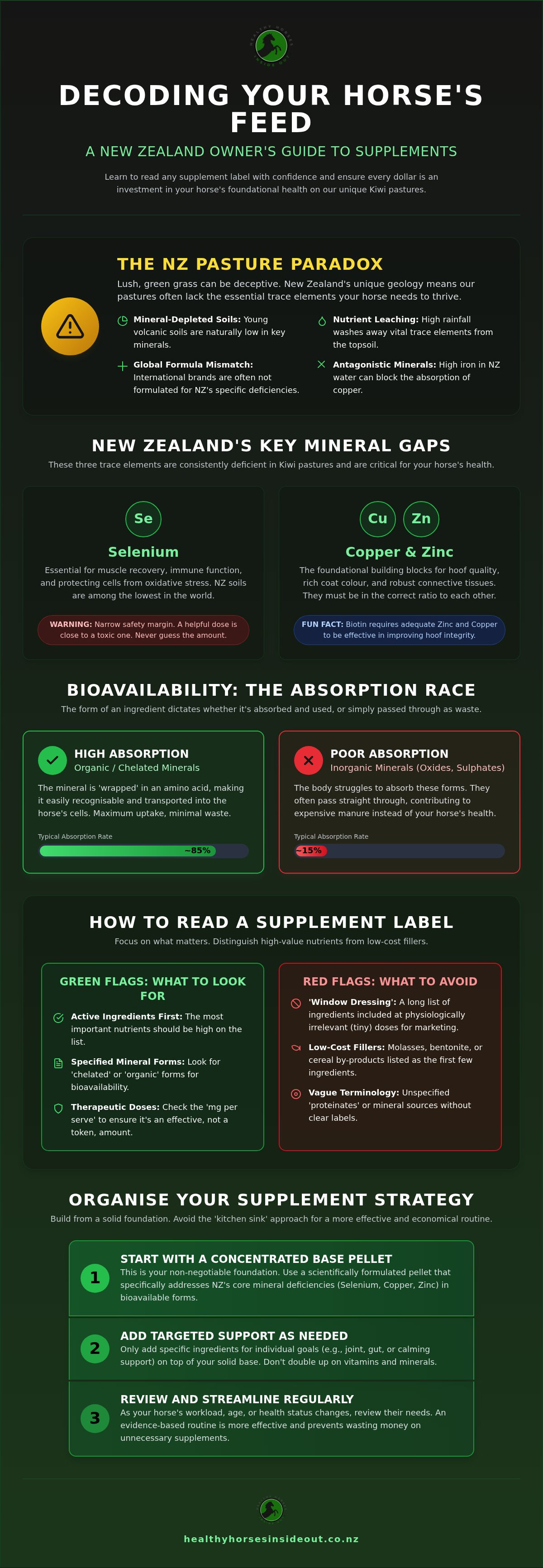
New Zealand’s rolling green hills are often deceptive. To an untrained eye, a lush paddock looks like a buffet of wellness, yet many Kiwi horses are effectively starving of trace elements while standing in knee-deep grass. This is the NZ Pasture Paradox. Our geological history, shaped by relatively young volcanic activity and high rainfall, has left our soils notoriously deficient in several key minerals. When you're focussed on understanding horse supplement ingredients NZ, you have to realise that a one size fits all global approach simply doesn't work here. Most international brands formulate based on Northern Hemisphere soil profiles, which differ significantly from our own mineral-depleted landscape.
The Big Three missing links in our local environment are Selenium, Copper, and Zinc. Because our horses often rely on forage as their primary calorie source, these soil deficiencies translate directly into nutritional gaps. If these gaps aren't bridged with precision, the horse's internal systems begin to compensate, leading to sub-clinical issues that eventually manifest as brittle hooves, dull coats, or poor muscle development. A methodical approach to supplementation starts with acknowledging that what works in Kentucky or Newmarket won't necessarily support a horse in Waikato or Canterbury.
The Selenium Struggle in New Zealand
Selenium is perhaps the most famous black hole in our local geography. It's a non-negotiable requirement for muscle recovery, immune function, and protecting cells against oxidative stress. However, New Zealand’s soil levels are among the lowest in the world. The challenge for owners is the incredibly narrow margin between a helpful dose and a toxic one. Relying on guesswork can be dangerous. For a deeper dive into the clinical signs of a shortfall, our guide on horse selenium deficiency NZ provides a comprehensive look at regional risks and how to manage them safely.
Copper and Zinc: The Foundation of Structural Integrity
While Selenium gets the spotlight, Copper and Zinc are the quiet workhorses of foundational health. In New Zealand, the problem isn't just a lack of these minerals; it's the presence of antagonists like Iron and Manganese. These elements are often found in high concentrations in our soil and water, effectively blocking the horse's ability to absorb Copper. This interference can lead to faded coats, poor hoof quality, and developmental issues in young horses. Equine nutrition basics confirm that minerals must exist in specific ratios to be effective. If your supplement doesn't account for these local imbalances, your horse isn't getting the support they need for long-term structural integrity. Identifying the correct ratio of these minerals on a label is the first step toward a scientifically sound feeding routine.
Decoding the Label: Vitamins, Minerals, and Amino Acids
Reading a tub can feel like deciphering a foreign language. When understanding horse supplement ingredients NZ, the first thing you must do is look past the front-of-pack promises and focus on the ingredient list hierarchy. Active nutrients are what you're paying for; carriers or fillers like bentonite, molasses, or excessive cereal by-products are simply there to provide bulk. If the list of inactive ingredients is longer than the active ones, you're likely funding a product that lacks biological impact. A methodical approach requires checking that the nutrients are present in therapeutic levels rather than just being listed for marketing purposes.
Vitamins are categorised by how the equine body absorbs and stores them. Fat-soluble vitamins, specifically A, D, E, and K, are stored in the horse's fat tissues and liver. While they're essential, they don't need to be replaced in massive daily quantities, and over-supplementing can lead to toxicity. In contrast, water-soluble vitamins like the B-complex group and Vitamin C aren't stored. The body utilises what it needs and excretes the rest through urine. While fresh pasture usually provides these, horses under stress or in heavy work often require a steady, supplemental supply to maintain metabolic efficiency.
Beware of the common industry tactic known as "window dressing". This occurs when a popular ingredient, such as Biotin or certain probiotics, is included on the label but at a concentration so low it has zero physiological effect. Don't be swayed by a long list of ingredients; instead, check the actual milligrams per serve to ensure the dose aligns with proven clinical requirements. It's about quality and concentration, not just the number of items on the list.
Trace Minerals vs. Macro Minerals
Macro minerals like Calcium, Phosphorus, and Magnesium are required in gram amounts rather than milligrams. The most critical figure on your label is the Calcium-to-Phosphorus ratio. For most adult horses, this should sit between 1.5:1 and 2:1. An imbalance here is risky; if Phosphorus levels exceed Calcium, the body will actually pull minerals from the bones to compensate. Magnesium is equally vital for the "grass-affected" NZ horse. High potassium levels in our rye-grass and clover pastures often interfere with magnesium absorption, which can lead to the spookiness and muscle tension many owners find so frustrating.
Amino Acids: More Than Just Muscle
Amino acids are the foundational building blocks of every protein in the horse's body. Lysine is what we call the "limiting amino acid". If your horse runs out of Lysine, their body cannot utilise any other amino acids to build muscle or repair tissue, regardless of how much protein is in the bucket. For hoof integrity, Methionine is the key player, as it provides the sulphur bonds required to create a resilient hoof wall. To ensure your horse isn't missing these vital components, you might consider a high-quality everyday horse supplement that balances these ratios scientifically for local conditions.
Bioavailability: Why Organic Ingredients Win the Absorption Race
Bioavailability is a term frequently used in equine nutrition, yet it remains misunderstood by many. Essentially, it refers to the percentage of an ingredient that successfully reaches the bloodstream to perform its biological function. Without high bioavailability, even the most expensive powder is destined to become "expensive manure." This is the core of our "Inside Out" philosophy: true health isn't about what you put in the bucket, but what the horse's gut actually absorbs and utilises. When understanding horse supplement ingredients NZ, you'll encounter two main categories of minerals: inorganic and organic.
Inorganic minerals, such as sulphates and oxides, are often the default in budget formulations. While they look impressive on a nutritional analysis sheet, they are poorly absorbed because they are prone to binding with other elements in the digestive tract. Organic minerals, however, are bonded to amino acids or proteins, allowing them to bypass these chemical "traffic jams" and enter the bloodstream more efficiently. Choosing the cheapest supplement often becomes a false economy; if the absorption rate is low, you're paying for volume rather than actual nutritional support.
The Science of Chelated Minerals
Chelated minerals use a clever biological "cloaking" mechanism to ensure uptake. By wrapping a mineral in an amino acid, the horse's body recognises the compound as a protein rather than a raw element. This is particularly crucial for horses on high-iron NZ paddocks, as excess iron typically blocks the absorption of inorganic copper and zinc. Chelation is the bonding of a mineral to an organic molecule for superior uptake. This precise delivery system ensures that vital nutrients reach the tissues where they are needed most, rather than being excreted through the waste system.
Identifying Quality on the Ingredient List
To ensure your investment is working, you need to look for specific terminology on the label. High-quality formulations will list ingredients as "Amino Acid Chelate," "Proteinates," or "Organic Selenium Yeast." These terms indicate a commitment to superior bioavailability and long-term health. Conversely, seeing "Zinc Oxide" or "Calcium Carbonate" as the primary sources is a red flag; these are often less effective and harder on the digestive system. Additionally, the inclusion of probiotics and prebiotics can further optimise the environment for nutrient uptake, ensuring the gut remains a healthy, efficient gateway for systemic wellness.
Targeted Ingredients for Specific Health Outcomes
Once you have established a solid mineral foundation, you can begin to address specific performance or health concerns through targeted nutrition. When understanding horse supplement ingredients NZ, it's vital to recognise that nutrients rarely work in isolation. For instance, many owners reach for Biotin to fix crumbling hooves, yet Biotin is merely a co-enzyme. It requires a biological scaffold of Zinc and Copper to synthesise the keratin proteins that form a resilient hoof wall. Without these minerals and the sulphur-bearing amino acid Methionine, Biotin alone cannot resolve structural weaknesses. A methodical approach ensures you're providing the entire toolkit, not just a single tool.
Joint and digestive support also require a discerning eye for therapeutic dosages. Many joint supplements contain Glucosamine, Chondroitin, and MSM, but often in amounts too small to impact the inflammatory response or cartilage repair. Similarly, digestive aids vary significantly in their mechanism. Yeast cultures help stabilise the hindgut pH, while direct-fed microbials (probiotics) introduce beneficial bacteria. Identifying these differences on a label allows you to choose a product that addresses your horse's specific internal requirements rather than a generic "one size fits all" solution.
The "Inside Out" Approach to Coat and Skin
A horse's coat is a direct window into their internal mineral status. If your dark-coloured horse develops a "sun-bleached" orange tint on their mane or coat, it's rarely just the sun; it's often a sign of Copper deficiency. Copper is essential for the production of melanin, the pigment that protects the hair from UV damage. By pairing Copper and Zinc with Omega-3 fatty acids, you support the skin’s lipid barrier, resulting in a resilient, deeply coloured coat that shines because it is healthy from the inside out. If you're ready to move beyond superficial fixes, you can explore our specific horse supplements designed for these precise outcomes.
Managing the NZ "Grass-Fizzy" Horse
New Zealand’s pasture growth cycles present unique challenges for equine behaviour. During spring flushes, our grasses are often high in potassium and nitrates, which can interfere with Magnesium absorption. This metabolic spike frequently leads to "grass-fizzy" behaviour, characterised by muscle tension, spookiness, and an over-reactive nervous system. Supplementing with bioavailable Magnesium, often paired with Thiamine (Vitamin B1) to support nerve function, helps restore systemic calm. For a structured approach to managing these seasonal shifts, refer to our Everyday Horse Supplements Guide, which outlines routine nutritional management for local conditions.
Organising Your Supplement Strategy: The HHIO Method
Many owners find themselves with a feed room cupboard overflowing with half-empty tubs, each purchased to solve a specific problem in isolation. This reactive approach often leads to nutritional imbalances, as overlapping ingredients can inadvertently push certain minerals toward toxic levels. Transitioning to a methodical strategy simplifies your daily routine while ensuring your horse’s internal systems are supported with precision. Understanding horse supplement ingredients NZ is the first step; the second is organising those nutrients into a logical, foundational regime that addresses the root cause rather than just the symptoms.
Consistency is the cornerstone of equine wellness. Biological shifts don't happen overnight, and the most profound results are seen when a horse receives a steady, balanced supply of bioavailable nutrients over several months. By moving away from "quick fix" powders and adopting an intentional feeding plan, you provide your horse with the stability required for optimal metabolic function. This streamlined approach not only saves money by eliminating redundant products but also provides the peace of mind that comes from evidence-based care.
The Foundation: HHIO Pellets
HHIO Pellets serve as the essential starting point for any NZ-based feeding programme. We formulated these pellets specifically to bridge the geological gaps found in our local pastures, providing a concentrated, mess-free alternative to traditional loose minerals. Because they are cold-pressed into a palatable form, they eliminate the common issue of horses "sorting" through their feed and leaving expensive powders at the bottom of the bucket. This "set and forget" foundation ensures that every bite contains the precise ratio of minerals and amino acids required to support foundational health from the inside out.
Targeted Solutions with HHIO Bundles
Once your foundation is secure, you can layer specific support without the risk of contradiction. Our Horse Supplement Bundles are designed to be complementary, allowing you to address multifaceted issues like gut sensitivity or immune challenges alongside your daily mineral requirements. This structured layering ensures that you aren't double-dosing on certain elements while missing others entirely. It is a sophisticated way to manage complex health goals with total confidence in the science behind the scoop. To begin building your horse's ideal regime, you can explore our range of NZ-formulated horse supplements and bundles today.
Empowering Your Horse’s Long-Term Vitality
You now possess the analytical tools required to look past marketing jargon and see the true nutritional value on any equine label. By prioritising organic, chelated minerals that bridge the specific gaps in New Zealand soil, you ensure your horse receives the precise support required for systemic health. Mastering the art of understanding horse supplement ingredients NZ allows you to move away from a reactive feeding routine toward a proactive, evidence-based strategy that delivers visible results. Whether you're managing a "grass-fizzy" youngster or supporting a senior’s joint integrity, the focus must remain on high bioavailability and foundational balance.
Our formulations are meticulously designed based on regional soil deficiency data to provide professional nutritional support that manifests in your horse’s coat, hooves, and overall vitality. We invite you to browse our science-led horse supplements designed for NZ conditions and discover the difference that intentional nutrition makes. Your journey toward a healthier horse starts from the inside out, and we're here to act as your partner in achieving that peace of mind. Your horse deserves a regime as unique as the landscape they graze upon.
Frequently Asked Questions
How do I know if my horse actually needs a supplement in NZ?
Most horses grazing on New Zealand pasture require some form of supplementation because our soils are geologically deficient in critical trace elements. You may notice sub-clinical signs such as a dull coat, brittle hooves, or unexplained muscle tension, which indicate that the forage alone isn't meeting their internal biological requirements. A methodical assessment of your horse's condition and a basic understanding of regional soil gaps will help you determine the right level of support.
What is the difference between chelated and inorganic minerals?
Chelated minerals are organic compounds where the mineral is bonded to an amino acid, whereas inorganic minerals are raw elements like oxides or sulphates. This chemical "cloaking" allows chelated minerals to be absorbed much more efficiently by the gut. By choosing chelated forms, you ensure the nutrients bypass the mineral antagonists, such as iron or manganese, that are frequently found in high concentrations in local paddocks.
Can I over-supplement my horse with Selenium in New Zealand?
Yes, Selenium has a notoriously narrow safety margin, and toxicity can be just as detrimental as deficiency. While understanding horse supplement ingredients NZ is vital for every owner, we always recommend blood testing before adding high-dose Selenium to an existing regime. This evidence-based approach ensures you're bridging a genuine gap rather than risking selenium poisoning through accidental over-supplementation.
Why does my horse have a bleached coat even though they are on grass?
A bleached or "orange" tint on a dark coat is typically a clinical sign of Copper deficiency rather than simple sun damage. Copper is a non-negotiable requirement for melanin production, which provides the pigment that protects hair from UV fading. When Copper levels are low, or when high iron levels in the soil block its uptake, the coat loses its structural integrity and depth of colour.
Do I need to feed a separate hoof supplement if I use a multi-mineral?
In many cases, a separate hoof supplement is redundant if your primary multi-mineral provides therapeutic levels of Zinc, Copper, and Methionine. These three ingredients form the essential scaffold that Biotin requires to function effectively. By using a high-quality, balanced base, you can often streamline your feed room and avoid the unnecessary expense of multiple "targeted" tubs that contain overlapping ingredients.
What are "fillers" in horse supplements and should I avoid them?
Fillers are inactive bulking agents, such as bentonite, molasses, or various cereal by-products, used to add weight and volume to a product. While some carriers are necessary to keep ingredients stable, you should avoid supplements where these fillers make up a large percentage of the total weight. Focus instead on concentrated formulations where the majority of the scoop is dedicated to active, bioavailable nutrients that drive health outcomes.
How long does it take to see results from a new supplement ingredient?
You'll typically see changes in coat quality and internal vitality within three to six weeks, but structural changes like hoof growth take much longer. Because the hoof wall must grow down from the coronary band, it can take six to nine months of consistent supplementation to see the full impact of improved nutrition. Patience and consistency are essential when waiting for biological systems to repair and regenerate.
Is it better to feed pellets or powdered supplements?
Pellets are generally superior for ensuring your horse actually consumes the precise dose of nutrients you've paid for. Many horses are experts at "sorting" through their hard feed and leaving fine powders at the bottom of the bucket, which leads to inconsistent dosing and wasted money. Pellets provide a palatable, mess-free solution that integrates seamlessly into any feeding routine while guaranteeing that no nutrient is left behind.


