

What if your horse’s brittle hooves, bleached summer coat, or subtle dip in stamina aren’t unfixable mysteries, but quiet signals from an unbalanced ration? It’s deeply frustrating to scrutinise feed tags and marketing claims, left second-guessing whether persistent coat dullness or poor horn quality stem from an underlying condition or simple grazing gaps. Long before severe pathology develops, the equine body communicates distress internally; learning to spot early horse nutritional deficiency symptoms gives you the clarity needed to intervene before minor imbalances become chronic welfare concerns.
You shouldn't have to navigate equine nutrition through guesswork. In this guide, you’ll learn to recognise subtle physical and behavioural signs of specific vitamin and mineral shortfalls, while gaining a clear understanding of typical pasture deficiencies across national grazing. We’ll examine the biological mechanisms behind these telltale indicators and provide a practical, evidence-based roadmap to balance your forage diet, restoring your horse's foundational health from the inside out.
Key Takeaways
- Recognising subtle horse nutritional deficiency symptoms early, such as faded coat pigment, compromised hoof walls, or sluggish muscle recovery, allows you to address cellular deficits before structural damage occurs.
- Essential trace minerals including copper, zinc, and selenium function as vital metabolic co-factors that native and improved pastures simply cannot supply in adequate or balanced ratios.
- Subclinical deficiencies quietly undermine immune resilience, tissue repair, and everyday stamina long before clinical, veterinary-level pathology becomes visible.
- A methodical evaluation protocol combining physical symptom logging with forage nutritional profiling eliminates costly feed-tag guesswork.
- Restoring long-term physiological equilibrium requires anchoring your horse's ration with bioavailable daily support, such as HHIO Pellets, to establish consistent mineral balance from the inside out.
Early Warning Signs: Recognising Subtle Horse Nutritional Deficiency Symptoms
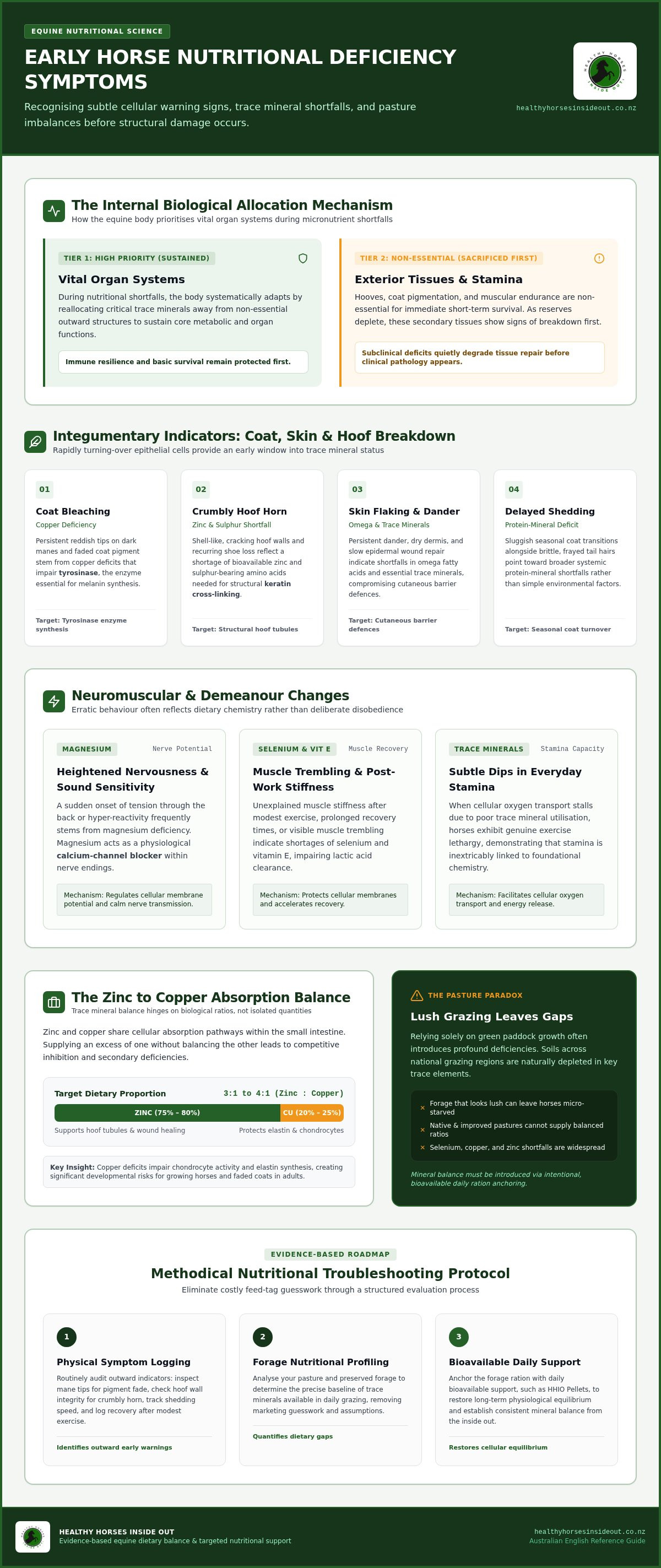
Severe clinical pathology rarely appears overnight. Before a horse shows acute veterinary distress, the body systematically adapts to micronutrient shortfalls, reallocating critical trace minerals away from outward tissues to sustain vital organ systems. Because hooves, coat pigmentation, and muscular resilience are non-essential for immediate survival, they deteriorate first. Conducting routine physical audits helps owners identify subtle horse nutritional deficiency symptoms long before structural damage compromises the joints, tendons, or performance longevity.
Mastering equine nutrition basics allows you to look past surface-level assumptions and evaluate the cellular drivers of physical wellbeing. When daily grazing lacks complete mineral balance, horses produce subtle warning signs across two primary physiological areas.
Integumentary Indicators: Coat, Skin, and Hoof Degradation
The condition of a horse's exterior offers a direct window into metabolic health. Epithelial tissues turn over rapidly, making them exceptionally sensitive to depleted reserves.
- Coat Bleaching: Persistent reddish tips on dark manes or faded coat pigments often stem from copper deficits, which impair tyrosinase, the enzyme required for melanin synthesis.
- Crumbly Hoof Horn: Shell-like, cracking hoof walls or recurring shoe loss frequently indicate inadequate bioavailable zinc and sulphur-bearing amino acids, both essential for structural keratin cross-linking.
- Skin Flaking: Persistent dander, slow epidermal wound repair, and dry dermis signal deficiencies in omega fatty acids and essential trace minerals.
- Delayed Shedding: Sluggish seasonal coat transitions or brittle, frayed tail hairs point toward broader systemic protein-mineral shortfalls.
Neuromuscular and Demeanour Changes in Deficient Horses
Metabolic gaps affect temperament and physical stamina just as quickly as they impact the coat. Micronutrients regulate cellular membrane potential, nerve conduction, and lactic acid clearance across the muscular system.
Subtle deficits often emerge as erratic behaviour rather than deliberate disobedience. A sudden onset of heightened nervousness, sound sensitivity, or tension through the back frequently reflects inadequate dietary magnesium, which functions as a physiological calcium-channel blocker within nerve endings. Similarly, unexplained muscle trembling, stiffness after modest work, or poor recovery times highlight cellular shortages of selenium and vitamin E. When cellular oxygen transport stalls due to poor trace mineral utilisation, horses exhibit genuine exercise lethargy, demonstrating that behaviour is inextricably linked to foundational dietary chemistry.
Key Micronutrient Deficits: Selenium, Copper, Zinc, and Vitamins
Trace minerals serve as indispensable co-factors for thousands of enzymatic reactions governing equine cellular metabolism. When managing pasture-fed horses, relying solely on green paddock growth often introduces significant nutritional gaps. Soils across national grazing regions are naturally depleted in key trace elements, meaning forage that looks lush can still leave horses micro-starved. To accurately identify early horse nutritional deficiency symptoms, carers must evaluate the specific physiological roles of each trace element and vitamin.
When you learn to systematically diagnose nutritional problems, it becomes clear that mineral balance hinges on biological ratios rather than isolated quantities.
Copper and Zinc Deficiencies in Forage-Fed Horses
Zinc and copper share cellular absorption pathways within the small intestine, requiring a careful dietary ratio of approximately 3:1 to 4:1. Zinc deficiency compromises cutaneous barrier defences, slows wound healing, and weakens structural hoof tubules. Copper shortfalls impair chondrocyte activity and elastin synthesis, presenting serious developmental risks for growing horses and leading to faded coat hair in adults. Reviewing understanding horse supplement ingredients NZ clarifies how bioavailable, organic mineral chelation bypasses absorption blocks to protect connective tissues.
Selenium and Vitamin E Shortages: Protecting Muscular Health
Selenium and vitamin E function as an essential biological tandem, neutralising oxidative free radicals generated during regular muscle contraction. While green spring pasture provides ample alpha-tocopherol, vitamin E degrades rapidly once forage is conserved as hay or chaff. Compounding this, widespread soil deficiencies mean horses frequently graze selenium-deficient swards.
Subclinical deficits produce chronic back stiffness, subtle tying-up episodes, poor muscle tone, and prolonged recovery after normal exertion. For pasture-reliant equines, introducing balanced everyday horse supplements ensures safe, non-toxic mineral repletion without risking over-supplementation.
Macro-Minerals and Essential Amino Acids: Calcium, Magnesium, and Lysine
Beyond trace elements, everyday forage often presents imbalances across major building blocks:
- Calcium and Phosphorus: An inverted ratio disrupts bone mineralisation, forcing the parathyroid gland to resorb skeletal calcium to support cardiac muscle function.
- Magnesium: Suboptimal forage intake prompts muscular tension, erratic spookiness, and cellular insulin dysregulation.
- Lysine and Methionine: As rate-limiting amino acids, deficits directly restrict topline development, regardless of how much crude bulk protein a horse consumes.
If recurring coat fading or hoof crumbling suggests these common gaps, exploring targeted options at Healthy Horses Inside Out provides a methodical way to restore systemic nutritional equilibrium.
Clinical vs Subclinical Deficiencies: Why Grazing Alone Leaves Gaps
A widespread misconception in equine management is that a well-covered horse grazing green pasture cannot suffer from malnutrition. In reality, clinical disease represents only the end-stage tipping point of severe deprivation. Long before veterinary intervention is required, insidious subclinical states degrade soft tissue resilience, cellular repair, and overall trainability. Lush paddocks reliably supply abundant calories, bulk fibre, and moisture, yet they consistently leave critical trace micronutrient requirements unmet.
The Myth of the Self-Sufficient Grass-Only Diet
Pasture composition fluctuates dramatically across seasonal growth cycles. Rapidly growing ryegrass and clover swards create a dilution effect, where rapid vegetative growth outpaces the plant's capacity to draw trace elements from the soil. Even where minerals exist within soil profiles, chemical binding often locks these elements away from root uptake entirely.
Spring and autumn pasture flushes also introduce high levels of potassium and nitrates. When ingested, elevated potassium actively inhibits magnesium absorption across the gastrointestinal barrier, while surplus plant nitrogen increases metabolic strain. The horse appears visibly round and energized by soluble sugars, but cellular trace mineral deficits quietly compound beneath the surface.
Secondary Deficiencies Triggered by Mineral Antagonisms
Identifying horse nutritional deficiency symptoms requires looking beyond simple dietary absence. Secondary deficiencies emerge when an excess of one mineral actively blocks the biological absorption of another at shared mucosal receptor sites.
Common mineral antagonisms illustrate why simply adding more feed rarely solves the problem:
- Iron Overload: Abundant iron in soil splash and roughage competes directly with copper and zinc, reducing their uptake and accelerating coat fading.
- Sulphate Interference: Bore water containing elevated sulphates binds to copper and selenium, precipitating insoluble compounds that pass straight through the gut unabsorbed.
- Calcium-Phosphorus Displacement: Pastures heavy in unbuffered oxalates lock up dietary calcium, precipitating acute skeletal calcium resorption.
Consulting our guide on what supplements does my horse need NZ helps clarify how to audit the complete intake profile rather than attempting trial-and-error supplementation. Methodically assessing these competitive pathways is the only reliable way to explain why horses grazing ample forage continue to exhibit distinct horse nutritional deficiency symptoms.
How to Systematically Troubleshoot Your Horse’s Nutritional Status
Resolving persistent dietary deficits demands an objective, structured investigation rather than haphazard feed changes. When owners spot early horse nutritional deficiency symptoms, the instinct is often to add multiple commercial premixes simultaneously. This reactionary approach clouds clinical observation and frequently worsens underlying mineral antagonisms. Restoring equilibrium requires a methodical diagnostic protocol carried out over twelve weeks.
Executing this diagnostic progression brings clarity to your management plan:
- Step 1: Document Physical Presentation: Photograph hooves, dermatological health, and muscular development under uniform lighting to establish an indisputable baseline.
- Step 2: Profile Pasture and Forage: Evaluate pasture species composition and test conserved hay batches to quantify base mineral intake.
- Step 3: Integrate Veterinary Diagnostics: Work alongside your attending veterinarian to run targeted serum assays.
- Step 4: Consolidate the Feed Room: Strip out redundant, unfortified grains and overlapping tubs of single-ingredient supplements.
- Step 5: Track Twelve-Week Recovery: Re-evaluate structural hoof horn growth and muscular recovery against your baseline records.
Step 1 & 2: Documenting Physical Symptoms and Forage Profiles
High-resolution monthly photographs create an accurate visual ledger that human memory cannot replicate. Capture clean hoof walls from ground level, document coat pigmentation along the flank, and record topline definition across the wither and loin. Next, document seasonal transitions in your grazing sward. Fast-growing seasonal grasses shift dietary cation-anion balances, making forage testing or regional pasture data an essential tool for cross-referencing your horse's observed physical markers.
Step 3 & 4: Veterinary Diagnostics and Diet Consolidation
Targeted veterinary blood profiling provides vital diagnostic clarity, though owners must interpret laboratory panels with a scientific eye. Serum selenium and plasma alpha-tocopherol (vitamin E) tests are exceptionally reliable indicators of systemic antioxidant reserves. In contrast, blood tests for calcium, iron, or magnesium can prove misleading because homeostatic mechanisms continuously draw minerals from bone and organ tissue to keep circulatory concentrations stable. Blood may appear normal even while skeletal reserves are progressively depleted.
Once clinical data is gathered, eliminate overlapping additives. Feeding three or four different off-the-shelf formulas invariably creates competitive mineral binding in the small intestine. If you are ready to remove the confusion of multi-tub feeding, explore the targeted mineral ranges at Healthy Horses Inside Out to build a clean, unified nutritional foundation tailored for forage-fed horses.
Restoring Equilibrium: Building a Methodical, Science-Led Diet
Quick fixes cannot solve long-term cellular deficits. Sustainable equine recovery demands a structured nutritional architecture that anchors itself to forage rather than masking gaps with heavily sweetened concentrates. When managing horse nutritional deficiency symptoms, our primary objective is to restore underlying metabolic equilibrium by methodically supplying what your pasture lacks, using ingredients designed for optimal bioavailability.
Establishing an Unshakeable Base with Daily Equine Pellets
Powdered mineral balancers often present practical feeding hurdles in everyday management. Picky eaters frequently sift dry mineral powders to the bottom of the feed bowl, while pasture-fed horses lose valuable micronutrients to paddock breezes. This uneven consumption prevents the steady cellular repletion required to reverse subclinical deficiencies.
Signature HHIO Pellets provide an effortless foundation for daily mineral balance. Formulated specifically to balance typical pasture mineral deficiencies across national grazing, these pelleted rations guarantee uniform daily intake across every life stage. Each pellet delivers a calibrated profile of essential trace elements and vitamins, ensuring your horse absorbs their complete nutritional allocation in a palatable, low-waste vehicle without fuss.
Targeted Specific Supplements and Streamlined Bundles
Once you secure a consistent daily foundation, distinct physiological stressors may still demand focused support. Rather than haphazardly stacking random tubs, targeted nutrition delivers concentrated co-factors to support specific body systems:
- Targeted Support: Deploy specific horse supplements to address pronounced hoof wall crumbling, persistent coat fading, or elevated muscular tension without duplicating baseline nutrients.
- Methodical Systems: Utilise curated horse supplement bundles to resolve multi-symptom nutritional deficits systematically across your entire paddock.
- Digestive Synergy: Prioritise bioavailable formulations that support hindgut function alongside trace element delivery, enhancing systemic nutrient utilisation.
You can discover this full range of science-led everyday horse supplements and foundational options at Healthy Horses Inside Out. Building an intentional, forage-focused ration provides the quiet peace of mind that comes from knowing your horse’s vitality is supported from the inside out.
Achieving True Equine Vitality Through Targeted Forage Balance
Spotting subtle changes in coat pigment, hoof wall resilience, and post-exercise recovery allows you to intervene long before cellular deficits produce lasting physical damage. Because even the greenest grazing regularly masks critical trace element shortfalls, learning to interpret horse nutritional deficiency symptoms gives you the confidence to manage equine wellbeing proactively rather than reacting to chronic health problems down the track.
True dietary balance doesn't require complex guesswork or a feed room crowded with competing tubs. By anchoring your horse's ration with formulations tailored specifically to national pasture profiles, you supply bioavailable, highly palatable nutrients that deliver visible, enduring results. Partnering with science-grounded nutritional mentorship ensures your horse thrives through every season. Explore our science-led equine supplements to balance your horse’s diet from the inside out, securing genuine physiological resilience and lasting peace of mind.
Frequently Asked Questions
What are the most common horse nutritional deficiency symptoms seen in pasture-fed horses?
The most common horse nutritional deficiency symptoms in pasture-fed horses manifest across the coat, feet, and musculature. Carers frequently observe faded or bleached hair tips, slow hoof growth, crumbling wall horn, and recurring shoe loss. Sluggish recovery after work, persistent muscle stiffness, and an inability to develop a smooth topline despite adequate forage bulk also signal underlying trace mineral shortages, particularly copper, zinc, and selenium.
Can a horse on lush green pasture still suffer from vitamin or mineral deficiencies?
Yes, horses grazing vibrant pasture frequently experience significant micronutrient shortfalls. While green grass offers abundant digestible energy, bulk fibre, and moisture, its mineral density depends entirely on underlying soil fertility. Many pastures naturally lack adequate zinc, copper, and selenium. Rapid vegetative growth cycles also dilute trace mineral concentrations, meaning a horse can carry ideal body condition while remaining subclinically deficient at a cellular level.
How long does it take to see improvements after correcting a dietary mineral deficiency?
Recovery timelines depend on the specific physiological tissue being rebuilt. Neuromuscular improvements, energy stability, and coat sheen typically become noticeable within three to six weeks after establishing dietary balance. Structural hoof improvements take considerably longer; because hoof horn grows from the coronary band down at approximately six to ten millimetres monthly, growing a completely replenished, resilient hoof capsule requires eight to twelve months of consistent, balanced nutrition.
Is it possible to over-supplement minerals while trying to correct a nutritional deficiency?
Yes, over-supplementation presents genuine physiological risks. Certain trace elements, particularly selenium and iodine, carry narrow safety margins where excessive intake leads to toxicity, hair loss, and coronary band damage. Stacking multiple premixes can also create competitive mineral blocks, such as surplus zinc suppressing copper absorption. Correcting deficits safely requires evaluating the horse's total baseline diet and introducing calibrated formulations rather than randomly adding single-ingredient tubs.
How do I know whether my horse needs everyday supplements or targeted support?
Most grazing horses require everyday horse supplements or balanced HHIO Pellets as an unshakeable nutritional baseline to offset regional soil shortfalls. If your horse displays pronounced, isolated challenges such as acute hoof cracking, severe coat bleaching, or intense muscular stiffness under work, adding targeted specific horse supplements or curated supplement bundles provides the concentrated co-factors required to address those specific physiological stress points alongside their foundational ration.
Can equine nutritional deficiencies cause behavioural problems like anxiety or spookiness?
Nutritional deficits directly affect equine temperament and neurological stability. Magnesium functions as a natural modulator of nerve impulses; when levels run low, horses become hyper-reactive to sudden sound, defensive under touch, and physically tense through the back. Subclinical muscular soreness caused by low vitamin E or selenium can also make a horse anxious under saddle, turning recognizable horse nutritional deficiency symptoms into perceived behavioural defiance.
What is the difference between a primary and a secondary equine mineral deficiency?
A primary deficiency occurs when the horse’s diet physically lacks an essential nutrient, such as grazing pasture grown on selenium-depleted soils. A secondary deficiency happens when adequate minerals exist in the feed, but other dietary factors block their biological uptake. For instance, high iron levels in bore water or excessive pasture potassium actively compete with and inhibit the intestinal absorption of copper, zinc, and magnesium.


