

A lush-looking paddock doesn’t prove your horse’s full ration is balanced. This equine vitamin and mineral supplement NZ buying guide starts with a more useful question: what is your horse already getting from forage, hard feed and other supplements, and where might a genuine gap remain?
It’s understandable to feel uncertain. Product labels can be difficult to compare, and adding a broad-spectrum supplement without reviewing the existing ration may duplicate nutrients already in the feed. The longest ingredient list isn’t necessarily the best fit. Start with what your horse eats, then look for an option that suits the whole diet and the horse’s individual circumstances.
This guide explains how to record the ration, compare labels and choose between everyday support, a more targeted option or a bundle. Forage, other feeds, life stage and workload all influence the decision. You’ll also learn what to check when ingredients overlap, and how Healthy Horses Inside Out’s everyday and specific supplements, bundles and HHIO Pellets fit into a considered feeding routine. The aim is a clearer choice based on the whole ration, not a product claim in isolation.
Key Takeaways
- Choose an equine vitamin and mineral supplement NZ by assessing the whole ration, including forage, hard feed, workload and existing supplements.
- Compare the full declared composition and feeding directions with what your horse already eats, rather than relying on headline claims.
- Weigh up broad-spectrum, targeted and bundled options according to your horse’s dietary needs and the ingredients already in the feed routine.
- Use a four-step checklist to record the ration, review labels, compare suitability and monitor your feeding routine.
- Explore Healthy Horses Inside Out’s everyday and specific supplements, bundles and HHIO Pellets with your ration assessment in mind.
Why choose an equine vitamin and mineral supplement in NZ?
An equine vitamin and mineral supplement is designed to complement, not replace, a horse’s overall ration. Whether one is suitable depends on what the horse already eats. Forage, hard feed, treats and other supplements all contribute to nutrient intake. Life stage and workload matter too: a growing horse, an adult in light work and a horse in regular training may have different nutritional requirements.
Start with the ration rather than a broad assumption about what New Zealand horses need. Diets vary with the pasture and forage available, the feeds offered and how each horse is managed. A supplement that suits one horse may add little to another’s routine, or may duplicate nutrients already supplied by feed. Identify a reason for adding a product, then check that it fits the complete diet.
Nutritional support can complement a balanced ration, but it isn’t a treatment for a diagnosed condition. If a health concern is driving your search, treat that as a separate question from everyday dietary support.
What vitamins and minerals contribute to the overall ration
Vitamins and minerals take part in normal body processes, including metabolism and the maintenance of body tissues. A horse’s requirement for a nutrient and the amount it receives are not the same thing. Intake depends on the whole diet, while requirements vary between horses. For a wider overview of horse nutrition, consider how nutrients fit alongside forage, energy and protein. A dedicated ingredient guide can explore individual nutrients in more depth.
A nutrient appearing on a label doesn’t, by itself, show whether your horse needs more of it. Compare the declared composition and feeding directions with the existing ration, including any other products fed. Assessing a supplement on its own can make it easy to overlook unnecessary overlap.
Why grazing and feed matter in New Zealand
Pasture can be an important part of a New Zealand horse’s diet, but its composition isn’t identical everywhere or at every time. Don’t assume all grazing has the same nutrient profile, or that every horse on pasture has the same dietary gap. Consider the actual forage and supplementary feed together, as both contribute to the ration.
Before choosing an equine vitamin and mineral supplement, make a simple inventory: note the forage or grazing, hard feed, treats and current supplements. Record how much is fed and use the labels’ serving directions when comparing products. Then consider whether an everyday option fits the overall ration or whether a specific dietary objective calls for closer comparison. Healthy Horses Inside Out’s everyday horse supplements are one category to explore after this assessment.
This whole-ration view gives you a practical basis for comparing labels. It’s more useful than selecting a product because its headline claims sound comprehensive.
How to compare an equine vitamin and mineral supplement label
A label is useful when you can relate it to the amount fed and the rest of the diet. Look beyond front-of-pack phrases such as “complete” or “daily balance”: those words don’t show, on their own, whether a product suits your horse. A useful comparison starts with composition, serving size and the whole ration.
When comparing an equine vitamin and mineral supplement, check the full declared composition alongside the feeding directions and stated intended use. Compare those details with the horse’s current hard feed and other supplements. A product may contain a nutrient you’re looking for but still be a poor fit if it duplicates another feed or doesn’t match your purpose.
Read the composition and feeding directions together
Look for the nutrient declarations, the recommended amount for the horse’s circumstances and any stated intended use. Compare products on an equivalent feeding basis rather than assuming a larger serving or longer ingredient list is automatically better. An ingredient’s presence alone doesn’t establish suitability. For more detail on individual ingredients, use a dedicated horse supplement ingredients guide; the Nutritional Requirements of Horses resource also provides background on equine nutrient needs.
Note how the directions relate to bodyweight or feeding situation, where the label specifies this. If two products list nutrients in different ways, or you’re unsure how their contribution compares with the existing ration, don’t guess. Keep the product labels and a record of the current feed together, then review total intake with an equine nutrition professional. This can be particularly useful when several products contain overlapping nutrients.
Check fit, format, and everyday practicality
Consider how the product fits the horse’s established feeding routine. A powder, pellet or other format may be easier to incorporate depending on the feeds already offered and whether the horse accepts it. Convenience can make a routine simpler to maintain, but it doesn’t demonstrate nutritional superiority. Judge suitability by composition, directions and dietary fit first.
Next, decide whether you’re looking for general ration support or have a defined nutritional objective. An everyday supplement may be worth comparing when you’re assessing the broader ration; a targeted product may be more relevant when there’s a specific dietary reason. Neither category is automatically right. Check whether the stated use matches your purpose and whether the product overlaps with nutrients from other feeds or supplements.
- Composition: What nutrients are declared, and how does that compare with the current ration?
- Serving size: What amount do the directions recommend for the horse’s feeding situation?
- Intended use: Does the label’s stated purpose match the reason you’re considering the product?
- Routine: Can the format be fed consistently alongside the horse’s normal feed?
Keep the labels and feeding amounts together as you compare options. You can also browse everyday and specific horse supplements using this label-reading framework, so the product category follows the ration assessment rather than replacing it.
Broad-spectrum, targeted, or bundled: which option fits?
These approaches answer different feeding questions. A broad-spectrum supplement may be considered for general ration support after reviewing the horse’s forage, feeds and current supplements. A targeted product is a more focused choice, while a bundle groups products for convenience. None is automatically the better option. Suitability depends on the horse’s diet and the purpose of the feeding plan.
| Approach | May suit when | What to assess |
|---|---|---|
| Broad-spectrum | You’re considering general ration support. | Whether its composition fits the whole ration without unnecessary overlap. |
| Targeted | There’s a clearly identified nutritional objective. | Whether the stated purpose and composition match that objective. |
| Bundle | Several products suit the feeding routine. | Whether each included product has a role and fits alongside existing feed. |
When a broad-spectrum supplement may be worth considering
Review what the horse receives from grazing or forage, hard feed and existing supplements. If that assessment points towards general ration support, a broad-spectrum option may make comparison more straightforward: assess its declared composition and serving directions against the diet. It isn’t a universal fit, and the label shouldn’t be taken to mean every horse, or every New Zealand pasture, needs the same support.
The key test is whether the product suits the feeding plan without needlessly repeating nutrients already supplied elsewhere. A horse receiving fortified feed, for example, has a different starting point from one whose ration contains fewer supplementary feeds. Compare the full routine, not one product in isolation.
When targeted products or bundles may make sense
Consider a targeted product in response to a defined nutritional objective, rather than treating it as an automatic upgrade from an everyday option. Be clear about the aim, then assess the product’s intended use, composition and directions against the ration. If you can’t identify a reason for adding it, pause before adding another layer to the feeding plan.
A bundle can make a routine more convenient when its contents suit the horse, but convenience doesn’t make every included product necessary. Review each item separately, including how it fits with other feeds and supplements. If two products contribute similar nutrients, the bundle deserves closer consideration rather than being treated as a single, indivisible choice. Use a supplement bundle as a practical format only where its individual components make sense for the ration.
More products don’t necessarily mean a more balanced ration. Adding another supplement can increase overlap without addressing the original feeding question. When comparing options, choose the simplest product that matches an identified purpose and fits the whole diet. If the combined contribution of several products is difficult to assess, review total intake with an equine nutrition professional before changing the routine.
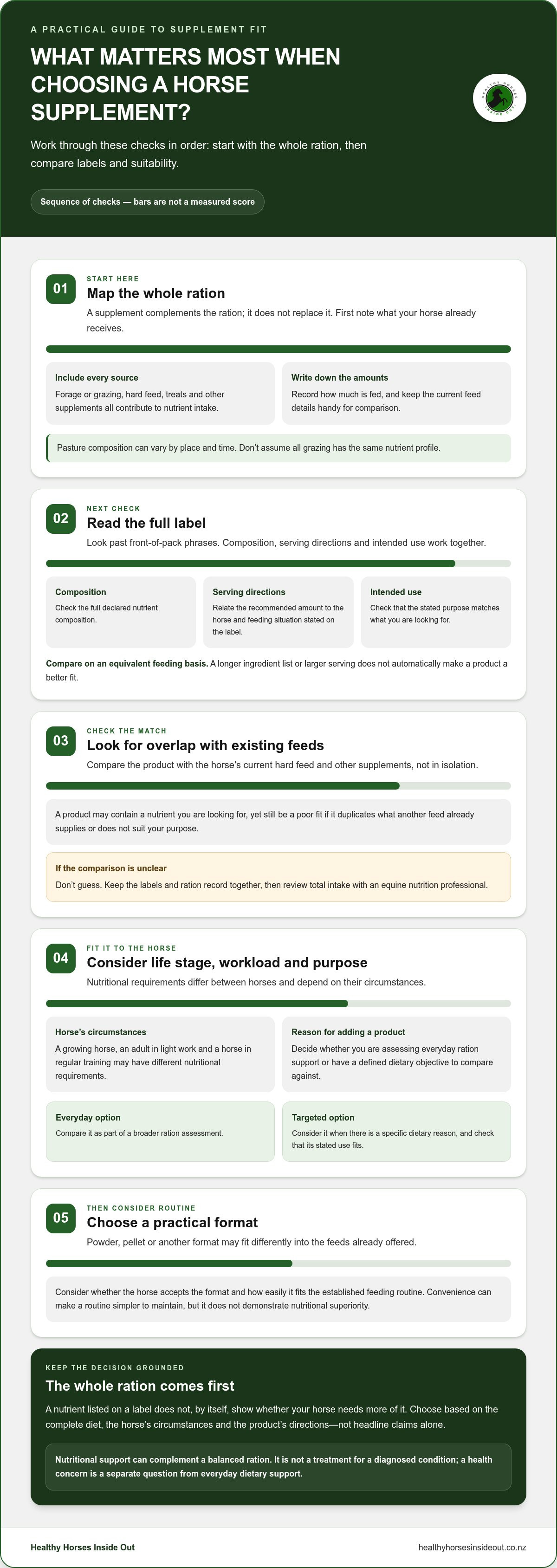
A practical NZ checklist for choosing and using a supplement
A consistent process makes it easier to see whether a supplement has a clear role in your horse’s diet. Work through these steps in order, keeping notes so you can compare the current routine with any proposed change.
Build a useful picture of the horse’s current diet
Start with an inventory, not an estimate. Include what the horse can graze, the forage and concentrates offered, treats and every supplement currently fed. Record feeding amounts as you normally measure them, along with any changes to the routine. Note relevant context such as life stage and workload, without trying to diagnose a health concern from appearance or behaviour alone.
If you’re unsure whether a supplement has a role, your diet record gives you a useful starting point for exploring what supplements a horse may need.
- Record the ration. Write down grazing access, forage, hard feed, treats and all current supplements. Include recent or planned changes that could affect what the horse receives.
- Review the labels. Read the full composition, intended use and feeding directions for the feeds and supplements in the routine. Keep the labels or take clear notes so you can compare nutrient contributions.
- Compare the fit. Consider whether the product addresses a defined dietary objective, suits the horse’s circumstances and duplicates anything already being fed. If the total contribution is hard to assess, seek advice from a qualified equine nutrition professional.
- Monitor the routine. Follow the product label and keep a record of what you introduce or change. Note feeding consistency and relevant observations, but don’t assume a change in appearance or behaviour proves a supplement is responsible.
Introduce a choice carefully and review the routine
Make changes methodically. Avoid starting several new products at once, as it becomes difficult to identify what changed and whether the feeding plan remains appropriate. Check for overlapping nutrient contributions before combining products, and don’t exceed or adapt label directions based on guesswork. There’s no universal timeframe for visible changes, so don’t judge suitability by an assumed deadline.
For diagnosed conditions, medication, persistent health concerns or a complex ration, involve your veterinarian or a qualified equine nutrition professional before changing the plan. A supplement isn’t a substitute for assessing or treating a health problem. Professional guidance can also help make sense of several feeds and products when their combined contribution is unclear.
Use this checklist before choosing an equine vitamin and mineral supplement NZ horse owners are considering: the ration record clarifies what is already provided, while label review helps you choose with a defined purpose. To apply that approach, explore Healthy Horses Inside Out’s equine supplement options and compare them with your horse’s feeding routine.
Explore Healthy Horses Inside Out’s equine nutrition options
Once you’ve reviewed the ration and identified what you want a supplement to do, compare the relevant product categories. Healthy Horses Inside Out offers everyday horse supplements, specific horse supplements, horse supplement bundles and HHIO Pellets. These are different ways to explore options, not a ranking from basic to best. Start with the category that aligns with your horse’s diet and your reason for considering a change.
Match the product category to the feeding objective
Everyday supplements and specific supplements serve different roles in a buyer’s comparison. An everyday option may be relevant when you’re considering general support as part of the routine; a specific option is worth exploring when the feeding plan has a defined objective. Neither label alone confirms suitability. Compare product information and feeding directions with the forage, hard feed and supplements already in the ration before deciding whether the category fits.
- Everyday supplements: Consider these in the context of the horse’s regular feeding routine and the overall ration you’ve recorded.
- Specific supplements: Use the stated purpose as a starting point, then assess whether it matches your identified feeding objective.
- Horse supplement bundles: Bundles can simplify selection where their contents suit the plan. Review each included product and consider its contribution alongside existing feed.
- HHIO Pellets: Include this category in your comparison by reviewing its product information and considering how it fits the horse’s routine.
A bundle may be convenient, but convenience doesn’t establish that every component is needed. Likewise, a category name helps you browse, but it doesn’t replace checking product details. If two options seem relevant, compare their declared compositions and directions with each other and with the full ration. A simpler feeding routine can be useful when it remains appropriate for the horse; adding more products doesn’t automatically make the diet more balanced.
Take the next step with a considered choice
Before settling on an option, return to three checks: whole ration, label fit and practical routine. The ration record accounts for what the horse already receives. The label shows the product’s stated composition, intended use and feeding directions. The routine check asks whether the option can be fed consistently as directed and considered alongside other products.
This approach grounds the decision in the horse’s existing diet, rather than in a product claim or category alone. If a diagnosed condition, medication or complex ration is part of the picture, seek appropriate professional guidance before changing the feeding plan. For everyday dietary decisions, use current product label information to make a measured comparison.
Explore equine nutrition options from Healthy Horses Inside Out with your ration notes in hand. Whether you’re comparing an equine vitamin and mineral supplement, a specific supplement, a bundle or HHIO Pellets, let the horse’s full diet guide the choice.
Make your next feeding choice with confidence
Your horse’s feeding routine can change as management, workload or access to feed shifts. Let those changes prompt a fresh look at whether the current choice still has a clear purpose, rather than continuing or adding products out of habit. Thoughtful nutrition is an ongoing practice, not a one-off purchase.
If you’re considering an equine vitamin and mineral supplement, use your ration notes to guide the decision. Healthy Horses Inside Out offers everyday and specific supplements, bundles and HHIO Pellets for horse owners across New Zealand. Consider how each option fits your horse’s circumstances and current routine.
Explore Healthy Horses Inside Out’s equine nutrition range and take a considered next step for your horse. A clear purpose and an informed choice can bring greater confidence to everyday feeding.
Frequently Asked Questions
Does every horse in New Zealand need a vitamin and mineral supplement?
No. There is no single equine vitamin and mineral supplement NZ formula that suits every horse, because diets and management vary. A horse receiving forage and fortified feed may have a different nutrient intake from one on another feeding plan. Consider the horse’s actual ration before adding anything. If you’re unsure whether it meets their needs, a qualified equine nutrition professional can help assess the diet.
Can I feed a vitamin and mineral supplement with fortified horse feed?
Possibly, but check both labels before combining them. Fortified feed may already contribute vitamins and minerals, and a separate supplement could duplicate some of those nutrients. Compare the declared composition and feeding directions with the amount of feed your horse actually receives, not just the product name. If the combined contribution is unclear, seek guidance from an equine nutrition professional before changing the ration.
How do I know whether my horse’s current diet is balanced?
You can’t confirm balance from appearance or behaviour alone. Start by recording the feeds and amounts offered, including forage, grazing, concentrates, treats and supplements, then compare their labels and directions. Changes in workload or life stage can also affect the ration being assessed. If the diet is complex or you need a detailed evaluation of nutrient intake, a qualified equine nutrition professional can help interpret the information.
What is the difference between a broad-spectrum and targeted horse supplement?
A broad-spectrum supplement is intended for general nutritional support, while a targeted option is considered for a more defined feeding objective. These descriptions don’t prove that either is suitable for a particular horse. For example, a broad-spectrum product may overlap with fortified feed, while a targeted one may not match the reason you’re considering it. Compare the label and intended use with the full feeding plan.
Can I feed more than one equine supplement at the same time?
Sometimes, but combining products calls for a check of their ingredients, directions and shared nutrient contributions. Two supplements may have overlapping components, even if they’re marketed for different purposes. Keep a record of everything fed, including amounts, and avoid adding several new products at once; otherwise, it’s harder to track changes to the routine. For complex combinations, ask a qualified equine nutrition professional to review the overall plan.
Should I ask a vet before changing my horse’s supplements?
Yes, involve your vet if a diagnosed condition, medication or health concern is part of the decision. A supplement is dietary support, not a substitute for veterinary assessment or treatment. For a routine change in a healthy horse’s feeding plan, carefully review the product label and the rest of the ration; seek qualified equine nutrition advice if the combined intake is difficult to assess. Don’t change prescribed treatment without veterinary guidance.


