

The boldest claim on a tub isn’t necessarily the best guide to what your horse needs. Choosing an equine respiratory support supplement can feel difficult when ingredient lists, feeding directions and promises vary, especially if you’re worried about your horse’s breathing.
It’s understandable to look for a practical way to support your horse’s wellbeing. A supplement provides nutritional support, not a way to diagnose or treat respiratory symptoms. If you notice a change in your horse’s breathing or condition, speak with your veterinarian about what you’ve observed and whether further assessment is needed.
This guide will help you compare options calmly and make a considered choice. You’ll learn how to assess ingredient transparency, interpret product claims, check feeding directions and consider a supplement’s place in your horse’s broader care. The aim is to match a clear, appropriate nutritional formulation to your horse, rather than chase a quick fix.
Key Takeaways
- Choose an equine respiratory support supplement by checking whether its stated purpose suits your horse, rather than relying on broad promises.
- Compare full ingredient lists, declared amounts and feeding directions to understand what each formulation provides.
- Consider your horse’s history, diet and workload when weighing nutritional support alongside veterinary assessment and management changes.
- Use a simple checklist to set a clear goal, review the label, follow directions and keep routine observations.
- Explore targeted nutrition as part of a considered whole-horse routine. Healthy Horses Inside Out offers supplements for horse owners across New Zealand.
What does an equine respiratory support supplement realistically do?
Choosing a supplement can feel difficult when respiratory concerns are involved. You want to help your horse, but confident wording on a tub can make it hard to judge what nutritional support may realistically offer. An equine respiratory support supplement contributes nutrients as part of the diet. It cannot identify why a horse is showing signs, treat an illness or guarantee a particular result.
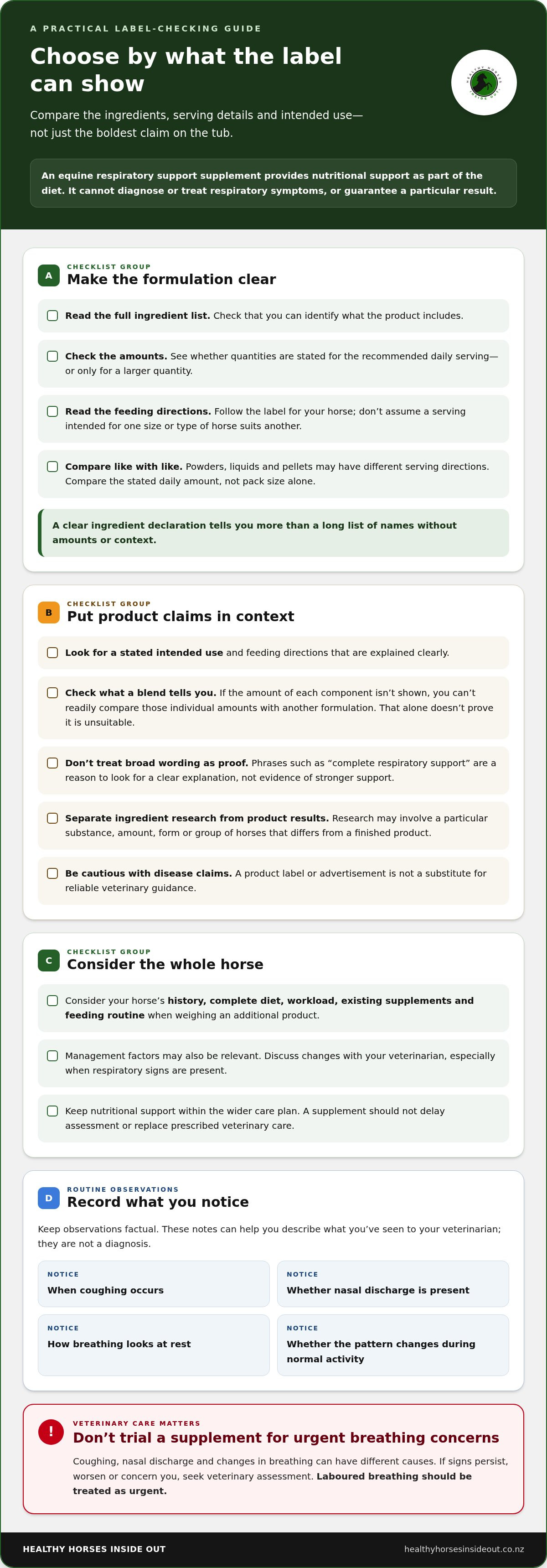
Coughing, nasal discharge and changes in breathing can have different causes. A sign alone doesn’t explain what is happening, so avoid trying to diagnose the problem from its appearance or timing. If signs persist, worsen or concern you, seek veterinary assessment. Laboured breathing should be treated as urgent, not managed by trialling a supplement.
Supplements do not replace diagnosis or prescribed veterinary care.
How the equine respiratory system supports normal breathing
Air travels through the nose and upper airways, down the windpipe and branching airways, and into the lungs. There, oxygen passes into the bloodstream and carbon dioxide is removed. Because the respiratory system has several structures and functions, no single nutritional product should be assumed to address every respiratory concern. A concise overview of equine respiratory system anatomy can help put those parts into context.
The airways also have a built-in cleaning mechanism called mucociliary clearance. Mucus traps inhaled particles, while tiny hair-like cilia move that mucus towards the throat so it can be cleared. This is part of normal airway defence. It isn’t proof that a particular supplement can improve clearance or resolve symptoms. Healthy breathing is a function; coughing, discharge or altered breathing effort are observations that may need professional interpretation.
When nutritional support is only one part of the picture
Nutrition belongs within the wider care plan. Your horse’s complete diet, existing supplements and feeding routine all matter when you’re considering an additional product. Management factors may also be relevant, but discuss changes with your veterinarian, especially when respiratory signs are present. A supplement shouldn’t delay assessment or be used to mask a change in your horse’s condition.
Keep observations factual. Note when coughing occurs, whether discharge is present, how breathing looks at rest and whether the pattern changes during normal activity. These notes can help you describe what you’ve seen to your veterinarian. They are not a diagnosis, and one observation cannot confirm a cause. Follow professional advice about next steps rather than drawing conclusions from a product label.
For broader context on nutrition and general resilience, the equine immune support supplement guide explores another aspect of nutritional support. It doesn’t change the central distinction: diet may contribute to a horse’s overall care, while persistent or concerning respiratory symptoms call for appropriate assessment.
Which ingredients and formulation details should you compare?
A useful comparison starts with information you can assess, not the number of ingredients on the label. For each equine respiratory support supplement, check the full ingredient list, the amount of each ingredient where stated, the recommended daily serving and the product’s intended use. These details help you understand what you’d actually be feeding and whether the directions fit alongside your horse’s existing diet.
A clear ingredient declaration tells you more than a long list of names without amounts or context.
How to read an equine supplement ingredient panel
Start with the recommended serving, then check whether ingredient amounts are given for that serving or only as part of a larger quantity. Note the product format too: powders, liquids and pellets may have different serving directions, so compare the stated daily amount rather than pack size alone. Follow the label’s instructions for your horse. Don’t assume a serving intended for one size or type of horse suits another.
Look for a label that explains the intended use and feeding directions clearly. If a product lists a blend without showing how much of each component it contains, you can’t readily compare those individual amounts with another formulation. That doesn’t prove the product is unsuitable, but it limits what you can conclude from the label. Treat broad phrases such as “complete respiratory support” as a reason to look for a clear explanation, not as evidence of stronger support.
How to judge claims and evidence without overpromising
Evidence about an ingredient isn’t automatically evidence that a finished product produces a particular result. Research may examine a specific substance, amount, form or group of horses, while a commercial formulation may differ in its combination and feeding rate. Check whether a claim explains what was studied and how that relates to the product’s stated use. Ingredient names alone don’t establish that every component has proven respiratory effects.
Be especially cautious with language that promises to prevent, diagnose or treat a disease. A label or advertisement isn’t a substitute for reliable veterinary guidance, and a product claim shouldn’t determine how you respond to a health concern. If you’re unsure what a claim means, focus on the stated ingredients and directions, and seek suitable professional advice before relying on it.
- Ingredients: Can you identify what is included?
- Amounts: Are quantities clear for the recommended daily serving?
- Directions: Is the serving guidance understandable for your horse?
- Claims: Is the intended use explained without promising a cure?
For broader label-reading principles, the horse supplement ingredients guide can help you assess what a formulation tells you. Once you know what information matters, apply the same careful approach while browsing targeted horse nutrition options as part of your horse’s wider feeding routine.
How do respiratory support supplements compare with other care options?
These options have different roles. Veterinary assessment helps establish what may be affecting a horse and informs appropriate care. Management changes address the horse’s surroundings and routine where relevant. A supplement may contribute nutritional support within the wider feeding plan, but it can’t take the place of assessment or suitable management.
A supplement’s role depends on the horse and does not replace veterinary assessment. There’s no single option that suits every horse, and adding a product shouldn’t be treated as a way to prevent or resolve respiratory disease. The appropriate approach depends on the horse’s history, current diet, workload and professional advice.
What supplements can and cannot contribute
An equine respiratory support supplement is one possible part of a broader feeding plan, not a stand-alone care strategy. Before adding one, review what your horse already eats, including forage, hard feed and other supplements. This helps you consider the total diet and avoid stacking products without a clear reason. Your veterinarian can help put the horse’s health history and nutritional context into the discussion.
Be cautious about expecting a particular change in symptoms or a set time to see results. Without reliable evidence for the specific finished product and its use, neither can be promised. If a horse is already under veterinary care, discuss proposed dietary additions in that context rather than changing or stopping prescribed care.
Why the horse’s environment and history matter
A horse’s daily conditions can help shape which management questions are worth discussing. Bring practical details to your veterinarian, such as the type of forage and bedding, ventilation in stables or shelters, time spent indoors, turnout routine and workload. These are discussion points, not a way to identify a cause on their own. Any management change should suit the individual horse and the realities of its care.
History adds useful context too. Note whether concerns are new or recurring, and whether they appeared alongside a change in routine, housing or workload. Clear observations can help your veterinarian consider the whole picture and advise whether diet, environment or another aspect should be reviewed. Avoid making several changes at once without guidance, as it can become harder to understand what may be relevant.
- Veterinary assessment: Helps interpret signs and guide health decisions.
- Management review: Considers the horse’s surroundings and routine.
- Nutritional support: May have a role within the overall diet when appropriate.
Seasonal routines can also affect how horses are housed and fed. If winter brings changes to your horse’s daily care, the winter horse care supplement guide offers broader seasonal context. For a considered approach to feeding, you can also explore targeted horse nutrition options as part of your horse’s overall routine.
How can you choose and introduce a supplement responsibly?
A clear process helps turn product browsing into a considered decision. Before choosing an equine respiratory support supplement, write down why you’re considering it, what your horse currently eats and what you want to discuss with your veterinarian. This keeps the focus on the horse’s needs, rather than the product’s most persuasive claim.
A practical checklist before choosing
Work through these steps in order. They help you assess whether a supplement fits the wider feeding plan without treating it as a substitute for professional advice.
- Clarify the goal. Note what prompted your search and any relevant changes to your horse’s routine, environment or workload. If respiratory signs are involved, seek veterinary advice rather than relying on a supplement to explain them.
- Review the whole diet. List forage, hard feed and existing supplements, including their daily amounts. This gives you and your veterinarian a useful overview before adding another product.
- Assess the label. Compare the intended use, ingredient declaration, stated amounts, recommended daily serving and feeding directions. If key details are difficult to interpret, pause rather than assuming a longer ingredient list means a better fit.
- Check for overlap. Compare the new product with current feeds and supplements. Similar ingredients or nutrients may appear in more than one part of the ration, so consider the combined intake with suitable professional guidance.
- Choose a way to monitor. Record your horse’s usual routine and general observations before making a change. A simple baseline makes it easier to describe what changes, without treating your notes as a diagnosis.
How to monitor a change thoughtfully
If a supplement is appropriate, follow its label and any veterinary guidance. Don’t adjust the serving yourself to try to speed up a result, and avoid adding several new products at once where practical. Introducing one change at a time makes your notes more useful because you can see what changed and when.
Keep a brief record of the start date, amount fed, appetite, routine and observations such as coughing or nasal discharge. Write down what you notice, not what you think it means. These notes can support a conversation with your veterinarian, but they can’t identify the cause of a sign or confirm that a supplement is working.
If signs persist, worsen or change, contact your veterinarian instead of experimenting with another product or changing the serving. Seek urgent veterinary care for marked difficulty breathing. A supplement shouldn’t delay assessment when your horse’s condition raises concern.
Once you’ve reviewed the goal, diet and label, you can explore Healthy Horses Inside Out’s equine nutrition range as one part of a considered feeding routine.
How Healthy Horses Inside Out fits into a considered supplement plan
Choosing well starts with the horse, not the product category. Healthy Horses Inside Out is a New Zealand equine nutrition retailer offering everyday and targeted supplements, supplement bundles and HHIO Pellets to horse owners nationally. Its range gives owners a place to explore nutritional options alongside their horse’s full feeding routine, using the label and suitability criteria outlined in this guide.
That distinction matters for respiratory concerns. Browsing a nutrition range can help you compare options, but it can’t determine what is causing a horse’s signs or whether a supplement is appropriate. Keep veterinary advice at the centre of health decisions, and use nutrition choices to support the wider plan rather than replace it.
What a considered nutrition approach looks like
A purposeful choice has a clear reason behind it and fits the horse’s existing diet. Before considering a product, think about what your horse already receives, what you hope to add nutritionally and whether the intended use is relevant. Then assess the ingredient declaration and daily directions, rather than assuming more ingredients or stronger wording means a better match.
Healthy Horses Inside Out’s everyday and targeted supplements are part of a broader nutrition offering, not a promise of a particular respiratory outcome. The guide to choosing horse supplements provides wider context for considering a horse’s needs and deciding whether an additional product has a clear place in its routine.
Keep the decision practical. A supplement should make sense alongside the horse’s forage, hard feed and other products, and its directions should be workable within daily care. If the purpose is unclear, the label is difficult to interpret or respiratory signs are concerning, pause and seek appropriate veterinary guidance rather than relying on a product claim.
A low-pressure next step for horse owners
As you browse, return to four questions: Are the ingredients clearly stated? Are the feeding directions suitable and understandable? Are the claims realistic and explained? Does the choice fit with veterinary advice and the horse’s wider diet? These checks help keep the decision grounded, whether you’re reviewing an everyday supplement or exploring targeted nutrition.
There’s no need to rush towards a product to feel you’re taking action. A calm review of the horse’s routine, clear label information and professional context can help you decide whether nutritional support belongs in the plan. If symptoms persist or worsen, veterinary care remains the priority.
Use the criteria in this guide as you explore Healthy Horses Inside Out’s nutrition range and consider which options, if any, fit your horse’s broader feeding routine.
Make your next step a considered one
Choosing an equine respiratory support supplement doesn’t need to be rushed. Let your horse’s needs, professional advice and the information on the label guide your decision, and revisit it if your horse’s routine or circumstances change. A thoughtful choice fits the bigger picture rather than promising certainty from a single product.
Healthy Horses Inside Out is a New Zealand business serving horse owners nationally, with everyday and targeted equine supplements, bundles and HHIO Pellets. Explore the range with your comparison criteria in mind, and consider how any nutritional option fits your horse’s broader feeding routine.
Explore Healthy Horses Inside Out’s horse nutrition range. Take your time, keep your horse’s wellbeing at the centre of each decision, and seek veterinary guidance whenever symptoms cause concern. A calm, informed approach is a positive next step.
Frequently Asked Questions
Can an equine respiratory support supplement treat a horse’s cough?
No. An equine respiratory support supplement provides nutritional support; it can’t identify why a horse is coughing or guarantee a treatment outcome. Coughing can arise in different circumstances, so note when it happens, how often and whether it occurs at rest or during work. If it persists, worsens or concerns you, arrange veterinary assessment. Discuss any product with your veterinarian and follow its label rather than changing the serving yourself.
How do I choose a respiratory support supplement for my horse?
Start by writing down why you’re considering a supplement, and seek veterinary advice if your horse seems unwell. Compare the product’s intended use, full ingredient list, declared amounts and feeding directions. For example, check whether amounts are given for the recommended daily serving, then compare them with feeds and supplements already in the ration. Choose based on clear, relevant information and your horse’s circumstances, not bold promises or ingredient count alone.
What ingredients should I look for in an equine respiratory supplement?
There isn’t one ingredient list that suits every horse. Evidence can vary between individual ingredients and finished products, so an ingredient’s presence doesn’t guarantee a particular result. Read the complete label and check stated amounts against the recommended serving and feeding directions. If a blend doesn’t explain its components clearly, you may have less information for comparison. Discuss suitability with your veterinarian, particularly if your horse has a health condition or receives other products.
Can I give my horse a respiratory supplement with other supplements?
Possibly, but consider the whole ration before adding anything. Check whether the proposed product repeats ingredients or nutrients already supplied by hard feed, forage or other supplements, and compare each product’s serving directions. Where practical, avoid starting several new products together so you can keep track of what changed. If your horse has a health concern, takes medication or follows a carefully managed diet, discuss the combination with your veterinarian first.
How long does an equine respiratory support supplement take to work?
There’s no reliable timeframe that applies to every product and horse. Formulations, feeding directions and individual circumstances differ, so avoid assuming a set number of days will bring a result. Don’t wait for a supplement to take effect if a sign is unexplained or getting worse. Follow the label and your veterinarian’s advice, keep a simple record of your horse’s routine and general condition, and ask your veterinarian when to review the plan.
Should I call a vet before using a respiratory support supplement?
Seek veterinary advice if respiratory signs are persistent, worsening, unusual or affecting your horse’s wellbeing. A veterinarian can assess possible causes and help decide whether nutritional support has a place alongside appropriate care. Don’t let a supplement delay that assessment or replace prescribed treatment. If your horse has an existing condition, share the full ingredient list before adding a product so its suitability can be considered in light of the horse’s care.
Explore Healthy Horses Inside Out’s horse nutrition range and use the label, your horse’s wider diet and veterinary guidance to inform your next step.


