

What if the lush, emerald-green pasture your horse is grazing on is actually the hidden cause of their crumbly hooves and sun-bleached coat? Meeting grazing horse mineral requirements is more complex than simply providing enough grass, as our unique soil profiles often lack the essential elements needed for systemic vitality. It’s a frustrating reality for many owners who provide what looks like a perfect paddock, yet still struggle with invisible deficiencies that manifest as poor physical condition. You aren't alone in feeling confused by conflicting labels or worrying that your horse isn't truly thriving despite the abundance of forage.
This guide will help you move past the guesswork. You’ll discover how to identify critical mineral imbalances and learn to organise a methodical supplementation plan that supports your horse’s foundational health from the inside out. We will explore a science-led approach to pasture nutrition, focusing on how specific mineral ratios drive visible results in hoof strength and coat colour. This methodical perspective provides the peace of mind that comes from a truly balanced, evidence-based diet, ensuring your horse receives exactly what they need to flourish.
Key Takeaways
- Understand why visually lush pastures often fail to meet grazing horse mineral requirements due to modern grazing restrictions and inherent soil deficiencies.
- Identify the critical biological roles of macro minerals like Calcium and Magnesium in supporting skeletal integrity and a settled nervous system.
- Learn how high levels of Iron in the local environment can create "invisible" deficiencies by blocking the absorption of essential Copper and Zinc.
- Discover a methodical two-step framework to evaluate your current forage and organise a supplement routine tailored to your horse's specific life stage.
- Explore how an "inside out" nutritional philosophy translates internal systemic balance into visible improvements in hoof strength and coat colour.
Why Grazing Alone Often Fails to Meet Your Horse's Mineral Requirements
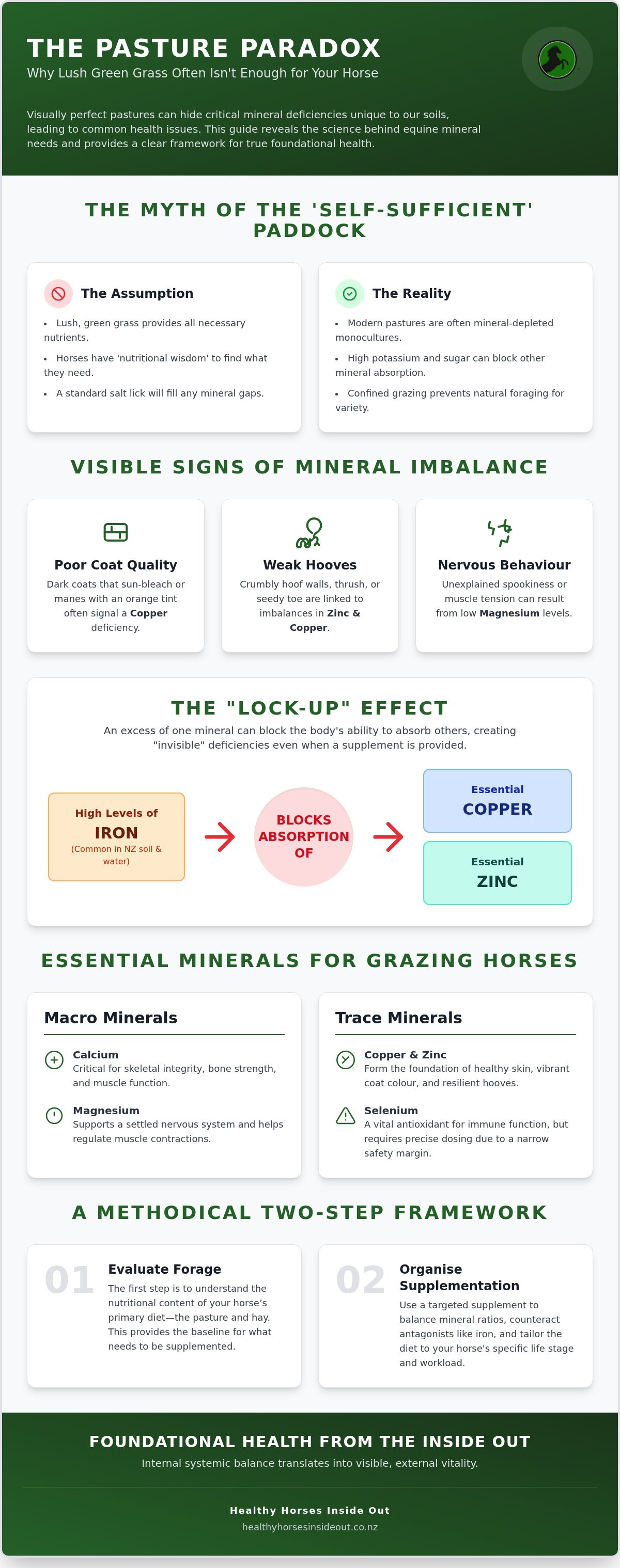
While it's easy to assume that a lush, green paddock provides everything a horse needs, the reality is often quite different. Horses evolved as opportunistic foragers, roaming across vast, diverse landscapes and consuming hundreds of different plant species. This variety naturally filled their nutritional gaps. Today, most horses are confined to restricted paddocks that often feature monocultures of improved pasture grasses. This shift has fundamentally changed how we must view grazing horse mineral requirements. A mineral requirement is the biological baseline needed to prevent systemic dysfunction. Without reaching this baseline, internal processes begin to falter long before we see physical signs of illness.
Modern pastures, particularly those dominated by perennial rye grasses, present unique challenges. These grasses are often bred for rapid livestock weight gain, meaning they are frequently high in sugar and potassium. These factors can actively interfere with the absorption of other minerals. High potassium levels, for instance, are known to inhibit the uptake of magnesium, leading to metabolic and behavioural issues. Understanding the complexities of Equine nutrition is essential for any owner who wants their horse to do more than just survive.
The Myth of the 'Self-Sufficient' Paddock
Decades of intensive grazing and hay production have depleted the natural mineral reserves in many soils. Because the soil is the source of all nutrients for the grass, if the soil is lacking, the forage will be too. It’s a common misconception that horses possess the 'nutritional wisdom' to self-select what they need from a simple salt lick. In reality, most horses will only use a lick for the salt content, leaving critical trace minerals like Copper, Zinc, and Selenium untouched and imbalanced. Relying on a paddock to be self-sufficient often results in a diet that meets calorie needs but fails at a cellular level.
Visible Signs Your Horse is Missing Key Minerals
When grazing horse mineral requirements aren't met, the horse's body prioritises vital organ function over external aesthetics. This leads to several common 'red flags' that owners often overlook:
- Coat Quality: Dark coats that sun-bleach easily or manes that turn a tell-tale 'orange' hue often indicate a copper deficiency.
- Hoof Health: Persistent thrush, seedy toe, or crumbly hoof walls that struggle to hold a shoe are frequently linked to imbalances in Zinc and Copper.
- Behaviour: Unexplained 'spookiness' or muscle tension can be the result of magnesium levels being suppressed by high-potassium grass.
The Essential Macro and Trace Minerals Your Grazing Horse Needs
Achieving systemic health requires a move away from generic "multi-vitamins" toward a precise understanding of biological synergy. While pasture provides the primary caloric intake, meeting grazing horse mineral requirements involves balancing a complex web of interactions where the presence of one element often dictates the effectiveness of another. Minerals don't function in isolation; they act like a finely tuned machine. When one part is missing or overwhelmed, the entire system begins to compensate, often at the expense of long-term soundness and vitality.
One of the most critical concepts in equine nutrition is the "lock-up" effect, or mineral antagonism. This occurs when an excess of one mineral prevents the absorption of another. A common example in New Zealand is high levels of Iron in soil or water blocking the uptake of Copper and Zinc. Providing targeted horse vitamins and minerals ensures these internal mechanisms remain optimised rather than merely functional, preventing the invisible deficiencies that lead to poor performance and external dullness.
Trace Minerals: The Tiny Keys to Big Health
Trace minerals are required in minute quantities, yet they are the architects of your horse's external brilliance. Copper and Zinc form the foundation of healthy skin, vibrant coat colour, and resilient connective tissue. In the local environment, Selenium is a vital antioxidant that supports immune function, but it carries an exceptionally narrow safety margin. Precise dosing is non-negotiable to avoid toxicity. Additionally, Iodine is essential for supporting thyroid function and maintaining a healthy metabolic rate, especially for the spelling horse or those on restricted grazing. Without these "Big Four" trace minerals, the "Inside Out" health philosophy cannot be fully realised.
Electrolytes and Macro Minerals in Pasture
Sodium is unique because it's the only mineral horses will actively seek out due to a natural physiological drive. Providing plain, loose salt is a foundational step in any feeding routine. In contrast, macro minerals like Calcium and Phosphorus must be provided in a specific ratio, usually around 2:1, to ensure skeletal integrity and bone density in both growing youngsters and senior horses. Lush paddocks during a spring flush are often high in Potassium, which can actively inhibit Magnesium absorption. This imbalance often leads to muscle tension and nervous behaviour, making it vital to provide a methodical base of Everyday Horse Supplements to restore internal equilibrium.
Identifying Mineral Deficiencies in New Zealand Pastures
New Zealand’s geological history is a complex tapestry of volcanic activity and sedimentary deposits. While this creates picturesque landscapes, it presents a challenging environment for meeting grazing horse mineral requirements. Much of our soil is relatively young and naturally lacks the deep mineral reserves found in older continental landmasses. Consequently, forage grown here often presents a "hollow" nutritional profile that looks vibrant but lacks essential trace elements. Regional soil testing is the first step in a science-led nutrition plan.
A significant hurdle in local paddocks is the "Iron Problem." High levels of iron in both the soil and bore water are common across many regions. This excess creates a biological blockade, preventing the absorption of Copper and Zinc. When a horse consumes too much iron, it effectively starves the body of these essential minerals, regardless of how much is technically "present" in the grass. This is why Quality Horse Nutrition must account for local environmental antagonists rather than relying on generic global feed charts.
Selenium deficiency is another nationwide concern that demands a methodical response. Because our soils are naturally low in this element, the grass cannot provide the levels required for optimal muscle health and antioxidant protection. This deficiency can lead to poor recovery after exercise, muscle stiffness, and a weakened immune system. Because the gap between "enough" and "too much" is narrow, precision in your supplementation routine is vital for animal welfare.
The Role of Soil pH and Fertilisation
Managing a paddock involves more than just controlling weeds. Applying lime to adjust soil pH can inadvertently "lock up" certain trace minerals, making them unavailable to the grass. Similarly, intensive nitrogen fertilisation, common on "improved" dairy pastures, prioritises rapid leaf growth over mineral density. These pastures are designed for high-production cattle, not for the balanced mineral needs and slower-release energy required by a leisure horse. This mismatch often leaves the horse calorie-rich but nutrient-poor.
Seasonal Fluctuations in Forage Quality
Forage quality is never static. During the winter, vitamin E levels in grass plummet, and mineral concentrations fluctuate as the plant goes dormant. Conversely, the spring flush brings high sugar and high potassium levels, which actively flush magnesium out of the horse's system. Using winter horse care supplements NZ helps bridge these seasonal gaps. This approach ensures internal stability and peace of mind when the environment is at its most volatile.
How to Organise a Methodical Mineral Supplementation Strategy
Moving from the "why" to the "how" requires a shift in perspective. To effectively meet grazing horse mineral requirements, you must move away from reactive feeding and adopt a structured, four-step approach. This prevents the common mistake of "stacking" supplements, which often leads to expensive waste or, worse, mineral imbalances. A methodical plan starts with a clear assessment of what is already entering the horse's system before any new products are introduced.
- Evaluate current intake: If you're feeding a commercial "complete" mix at half the recommended rate, your horse is likely receiving only half the minerals listed on the label.
- Match to workload: A spelling pony has different physiological demands than a mare in late gestation or a horse in consistent training.
- Select high-integrity products: Look for formulas that fill the gaps in local forage without providing unnecessary fillers or doubling up on trace elements.
- Track progress: Monitoring visible health markers, such as hoof wall integrity and coat quality, is the final piece of the puzzle in managing grazing horse mineral requirements successfully.
Choosing Between Pellets and Powders
The delivery method is just as important as the formula itself. HHIO Pellets offer a significant advantage for horses kept at grass; they can be fed directly from the hand or a bucket without the need for a dampened hard feed base. This eliminates the risk of powders blowing away or sifting to the bottom of the bin. For horses with specific metabolic challenges, such as those prone to laminitis, targeted powders allow for precise dosing of specific nutrients without any added sugars or grains. This ensures your horse receives their daily dose without compromising their metabolic health.
The 'Golden Rules' of Supplementation
Consistency is the engine of nutritional success. Because many minerals and vitamins are water-soluble, they aren't stored in the body for long periods; missing even a few days can disrupt the internal balance you're trying to build. It's also vital to respect the upper limits of trace elements. While it's tempting to think more is better, minerals like Selenium carry a risk of toxicity if over-supplemented. To avoid these pitfalls, consulting a guide such as what supplements does my horse need NZ is a vital step toward a tailored nutrition plan.
To streamline your routine and ensure your horse has a solid nutritional base, view our range of Everyday Horse Supplements designed specifically for local conditions.
Foundational Health from the Inside Out: The HHIO Solution
Addressing grazing horse mineral requirements effectively requires more than a reactive approach to symptoms like dull coats or brittle hooves. It demands a commitment to foundational nutrition that works from the inside out. The HHIO philosophy is built on the principle that external brilliance, such as a deep coat colour and resilient hoof walls, is the natural byproduct of internal systemic balance. When the horse's metabolic and physiological systems are supported by precise, evidence-based nutrition, the need for "quick fix" topical treatments often disappears.
HHIO Pellets simplify this daily routine by providing a science-led base formulated specifically for the New Zealand environment and soil profile. Instead of guessing which individual minerals are missing from your paddock, you can rely on a methodical system that accounts for local environmental challenges. This approach offers the peace of mind that comes from knowing your horse’s nutritional baseline is covered with integrity, allowing you to focus on the joy of riding and companionship.
Why HHIO Pellets are the Methodical Choice
The formulation of HHIO Pellets is a direct response to the specific mineral gaps and antagonists found in local forage. By prioritising specialised Copper and Zinc ratios, these pellets help combat the "lock-up" effect caused by high iron levels in the soil and water. This ensures these vital trace minerals are actually absorbed and utilised rather than simply passing through the horse's system. Additionally, the Selenium levels are carefully calibrated for safe daily use, providing essential antioxidant support without the risk of over-supplementation. We exclude unnecessary fillers and "extras," ensuring your horse receives only what is required for optimal health.
Taking the Next Step in Your Horse's Nutrition
Transitioning your horse onto a methodical supplement plan is a straightforward process that begins with evaluating their current forage and workload. For many owners, the move to a pellet-based system provides an immediate sense of security; it's easier to ensure the horse is actually consuming their requirements when the delivery is palatable and waste-free. If you find yourself facing complex nutritional questions or metabolic challenges, expert support is available to help you refine your strategy. Investing in a science-led routine today creates the internal stability your horse needs for a long, healthy future. Explore the everyday horse supplements designed for NZ horses to find the right foundation for your paddock-based companion.
Commit to Foundational Equine Wellness Today
Achieving optimal health starts with moving past the assumption that a green paddock is a complete one. By understanding the unique challenges of local soil profiles, such as the high iron levels that frequently block essential trace elements, you can take control of your horse's internal stability. Meeting grazing horse mineral requirements isn't about guesswork or reactive feeding; it's about establishing a methodical baseline that supports every biological system from the inside out.
This science-based approach ensures your horse has the building blocks for resilient hooves, a vibrant coat, and a settled temperament. Our formulas are created specifically for the New Zealand environment, providing a high-integrity solution that prioritises animal welfare over marketing jargon. This commitment to transparency and nutritional precision is why owners across the country trust us to help their horses thrive.
Discover the HHIO range of science-led horse supplements online and begin your journey toward evidence-based wellness. You now have the tools to transform your horse's health through intentional, methodical nutrition.
Frequently Asked Questions
Does my horse really need minerals if they look healthy and have plenty of grass?
Yes, because visual condition isn't always a reliable indicator of internal health. Lush grass often lacks essential trace elements like Selenium and Copper due to New Zealand's unique soil profile. Meeting grazing horse mineral requirements ensures that foundational systems, such as the immune response and bone density, remain supported. Waiting for visible signs like a dull coat or crumbly hooves often means the horse has been struggling with a deficiency for months already.
Can I just use a multi-mineral salt lick for my grazing horse?
Relying on a salt lick is rarely effective for comprehensive nutrition. Horses possess a natural physiological drive for sodium, but they don't have the "nutritional wisdom" to self-select trace minerals like Zinc or Copper. Most licks contain high levels of iron, which can actually block the absorption of other essential minerals. A methodical approach using HHIO Pellets ensures your horse receives a precise, guaranteed daily dose of the nutrients they actually require.
What are the most common mineral deficiencies in New Zealand horses?
New Zealand pastures are most frequently deficient in Selenium, Copper, Zinc, and Iodine. Selenium deficiency is a nationwide concern because our volcanic and sedimentary soils are naturally low in this vital antioxidant. Additionally, high levels of iron in many regions act as an antagonist, actively blocking the uptake of Copper and Zinc. This "lock-up" effect makes it difficult for horses to thrive on a pasture-only diet without targeted, science-led supplementation.
How long does it take to see the results of mineral supplementation?
Internal biological improvements begin almost immediately, but visible changes take longer to manifest. You might notice a deeper coat colour and improved skin condition within three to six weeks as the new hair grows in. However, because hooves grow slowly, it typically takes six to twelve months to see a complete cycle of stronger, more resilient hoof wall. Consistency in your feeding routine is essential to maintain these long-term foundational improvements.
Is it possible to over-supplement my horse with minerals?
Yes, over-supplementation is a serious risk, particularly with minerals like Selenium and Iodine which have narrow safety margins. Excessive intake can lead to toxicity, causing issues like hair loss or hoof sloughing. Methodically managing grazing horse mineral requirements involves choosing a high-integrity supplement that balances specific gaps in the diet without providing dangerous excesses. This approach prevents the "more is better" trap while ensuring foundational health and safety.
What is the best way to feed minerals to a horse that isn't on hard feed?
Feeding minerals to horses on grass-only diets can be challenging with traditional powders. The most effective solution is using HHIO Pellets, which can be fed directly from your hand or a bucket. This delivery method ensures there is no waste from wind or sifting, and it removes the need for a high-calorie hard feed base. It is a simple, stress-free way to ensure your horse's daily requirements are met every single day.
Do senior horses have different mineral requirements than younger horses?
Senior horses often require more support because their digestive efficiency naturally declines with age. They may struggle to absorb minerals as effectively as younger horses, making high-quality, bioavailable supplements even more critical. Older horses also benefit from precise ratios of Calcium and Phosphorus to maintain bone density, alongside increased antioxidant support to manage systemic inflammation. Adjusting their intake based on their specific life stage is a key part of an "inside out" health philosophy.
Why is the Copper to Zinc ratio so important for horse health?
Copper and Zinc must be provided in a specific ratio, typically between 1:3 and 1:4, because they compete for the same absorption pathways in the gut. If one is significantly higher than the other, it can induce a deficiency in its partner mineral. This balance is fundamental for the production of keratin and collagen, which directly influences the strength of hoof horn, the elasticity of tendons, and the overall vibrancy of the coat.


