

The persistent dampness of a New Zealand winter often brings more than just mud; it reveals the hidden gaps in your horse's internal health. While many owners focus on heavier rugs or topical creams, the reality is that external issues like brittle hooves and skin irritations are frequently symptoms of systemic mineral imbalances. Choosing the right winter horse care supplements NZ is not about adding unnecessary "extras" to the feed bucket. Instead, it's about a methodical approach to correcting the specific deficiencies found in our leached, volcanic soils.
It's understandable to feel overwhelmed by complex mineral ratios or to worry that your current regime isn't quite hitting the mark as the temperature drops. You want the peace of mind that comes from knowing your horse is supported from the inside out. This guide explains how to navigate New Zealand’s unique pasture profiles using scientifically-led supplement bundles that eliminate guesswork and prevent wasted spend on ineffective quick fixes. We'll examine how targeted nutrition maintains a healthy body condition score and a resilient coat, ensuring your horse remains thriving and comfortable until the spring flush arrives.
Key Takeaways
- Understand why winter care requires a systemic approach to metabolic heat and internal health rather than relying solely on rugs.
- Identify the critical New Zealand soil deficiencies, such as Selenium and Zinc, that impact your horse’s condition during the wet season.
- Discover how to use winter horse care supplements NZ in synergistic bundles to provide comprehensive nutrition more cost-effectively.
- Learn why addressing internal mineral balances is the most effective way to manage external issues like mud fever and soft hooves.
- Establish a clear monitoring programme to track visible improvements in your horse’s coat and body condition over a 12-week period.
The Challenges of Winter Horse Care in New Zealand
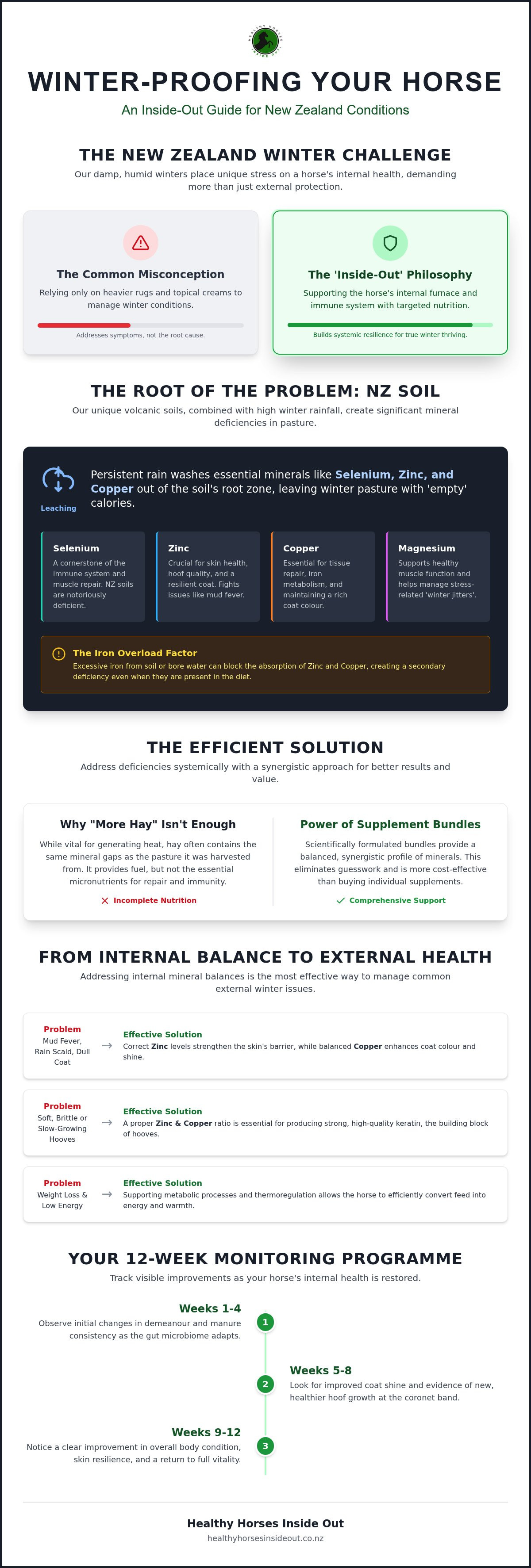
In New Zealand, winter horse care is frequently misunderstood as a simple matter of providing shelter and thicker rugs. True winter care is a holistic endeavour that focuses on maintaining metabolic heat and systemic health from within. Unlike the dry, snowy winters of the Northern Hemisphere, our season is characterised by high rainfall, persistent humidity, and significantly reduced light levels. These conditions create a unique physiological stress on the horse. While a rug acts as a physical shield against the elements, it's the horse's internal furnace that determines how well they truly cope with the cold. Without the correct nutritional foundation, horses often succumb to the "winter scruffies," a state marked by weight loss, a dull, staring coat, and a general lack of vitality.
Adopting an "inside out" philosophy means recognising that external symptoms are almost always reflections of internal status. A horse with a balanced mineral profile is better equipped to regulate its own temperature and maintain a resilient immune system. Utilising targeted winter horse care supplements NZ can bridge the gap between simply surviving the season and actually thriving through it. When we ignore these internal requirements, we find ourselves fighting a losing battle against rain scald and poor hoof quality with topical fixes that never address the underlying biological cause.
Why "More Hay" Isn’t Always the Full Answer
It's a common belief that simply increasing hay intake is enough to see a horse through the colder months. Forage is indeed vital for thermoregulation; the fermentation of fibre in the hindgut generates significant internal heat. This process is one of the foundational principles of equine nutrition, serving as the horse's primary heat source. However, hay alone often contains the same micronutrient gaps as the pasture it was harvested from. While it provides the "slow burn" fuel for warmth, it rarely provides the zinc, copper, or selenium required for tissue repair and immune function. Maintaining a healthy gut microbiome during these dietary shifts is also essential, as the microbes responsible for fibre fermentation require a stable, nutrient-rich environment to function efficiently.
Identifying Winter Nutritional Gaps
The transition into winter brings a sharp decline in daylight hours, which directly impacts vitamin D synthesis and overall metabolic rate. This lack of light, combined with wet paddocks that leach minerals from the soil, means the grass your horse consumes is often "empty" calories. Essential trace elements are washed away or become locked in the soil, making them unavailable to the plant and, subsequently, the horse. Winter necessitates a higher dietary mineral concentration because the dormant pasture lacks the nutrient density of spring growth, and persistent rain frequently leaches vital trace elements from the soil profile.
New Zealand Soil Deficiencies: The Science of Winter Pasture
New Zealand’s geological history provides a unique set of challenges for the modern horse owner. Our soils are volcanic and relatively young, which often results in a profile that is naturally deficient in several essential trace elements. During the colder months, this issue is exacerbated by high rainfall that leaches soluble minerals from the root zone of our pastures. This seasonal nutrient crash is exactly why selecting appropriate winter horse care supplements NZ is a biological necessity rather than a luxury. When pasture growth slows, the concentration of minerals like copper and zinc often drops below the threshold required for maintenance, leaving the horse vulnerable.
The interaction between soil and plant is complex. In certain regions, New Zealand horses also face the challenge of iron overload from soil ingestion or bore water. Excessive iron intake can physically block the absorption of copper and zinc, creating a secondary deficiency even if those minerals are present in the base diet. Magnesium also plays a pivotal role during this time. It supports healthy muscle function and helps manage the "winter jitters" often seen when horses are confined or facing the metabolic stress of persistent cold snaps. By providing a balanced mineral profile, you offer your horse the internal stability required to navigate these environmental shifts.
Selenium: The Critical NZ Factor
Selenium is perhaps the most discussed mineral in New Zealand equine circles, and for good reason. It is a cornerstone of the immune system and essential for muscle repair, yet New Zealand soils are notoriously deficient in this element. While a lack of selenium can lead to poor performance and muscle stiffness, it is a mineral with a narrow safety margin. This is why science-led ratios are paramount; you must provide enough to bridge the gap without reaching toxic levels. For a deeper understanding of how this fits into a broader regime, you can consult The Ultimate Guide to Everyday Horse Supplements for New Zealand Conditions. Following the standards supported by the New Zealand Veterinary Association ensures that your supplementation strategy remains safe and effective for our specific local conditions.
Copper and Zinc for Winter Resilience
Copper and zinc are the primary architects of your horse’s external resilience. These minerals are required to build the first line of defence within the skin and the hoof wall. A deficiency in these areas often manifests as mud fever or rain scald, as the skin’s structural integrity is compromised, allowing opportunistic bacteria to take hold in wet conditions. By addressing these gaps mid-winter, you aren't just treating current issues. You are also optimising the hair follicles for the next season, effectively starting the process of a brilliant summer shine as early as July. If you are looking to simplify this process, exploring targeted supplement options can help ensure these ratios are perfectly balanced for the unique demands of a Kiwi winter.
Why Horse Supplement Bundles are the Efficient Choice for NZ Owners
Efficiency in the winter feed room isn't just about speed; it's about nutritional accuracy. The "Synergy Principle" dictates that certain minerals require specific partners to be absorbed and utilised effectively by the equine body. For instance, the relationship between copper and zinc is delicate; feeding an excess of one can inadvertently trigger a deficiency in the other by blocking absorption sites. This biological balancing act is supported by Massey University research on NZ horse nutrition, which emphasises the complexities of managing horses on a pasture-based system where soil profiles vary significantly. By utilising winter horse care supplements NZ in a pre-formulated bundle, owners avoid the risk of creating these imbalances through guesswork.
From a practical financial perspective, the cost-benefit analysis of bundles is compelling. Purchasing individual tubs of vitamins, minerals, and amino acids frequently leads to significant waste, as owners often pay for overlapping ingredients or unnecessary "filler" components. A curated bundle provides exactly what is required to bridge the gaps in the New Zealand winter profile, ensuring every dollar spent contributes directly to the horse's systemic health. This approach also drastically reduces "supplement clutter," replacing a confusing array of half-empty containers with a streamlined, intentional system that is far easier to manage during the short, cold days of the season.
Individual Products vs. Curated Bundles
Mixing different brands often leads to "doubling up" on certain fat-soluble vitamins or trace minerals, which can be detrimental to long-term health. There is a specific, evidence-based logic behind the horse supplement bundle deals NZ owners prefer; they are designed to address the full spectrum of local deficiencies without redundancy. This methodical approach ensures no "forgotten" minerals, such as iodine or boron, are left out of the winter diet. It provides the peace of mind that comes from knowing the horse's internal foundation is complete, regardless of how poor the pasture quality becomes.
Streamlining Your Winter Feed Routine
Winter mornings in New Zealand are often dark, wet, and time-pressured. Managing a complex feed routine for multiple horses in these conditions is a recipe for error. A simplified routine allows for a more methodical approach to "hard feeding" even when horses are fed in the paddock. Using HHIO Pellets as a concentrated base provides the perfect carrier for winter minerals, ensuring the full dose is consumed rather than sifted to the bottom of the bucket. For fussy eaters, the consistent palatability of a bundle-led regime helps maintain intake when the weather turns sour and appetites might otherwise flag. This ensures your winter horse care supplements NZ actually reach the horse's system rather than being wasted on the ground.
Targeted Support for Common Winter Equine Issues
Addressing winter-specific ailments requires a transition from reactive care to proactive prevention. While many owners reach for topical ointments at the first sign of skin irritation, these solutions often ignore the biological reality that external resilience is built from the inside. Integrating targeted winter horse care supplements NZ into the daily routine provides the internal architecture required to withstand the environmental pressures of a wet, mud-laden season. By focusing on systemic health, you can manage common issues like weight loss and immune fragility before they become visible problems.
The Internal Cure for Mud Fever
Mud fever and rain scald are frequently viewed as purely environmental issues, yet they are primarily failures of the skin's natural barrier. When a horse is nutritionally compromised, the integrity of the epithelial layer weakens, allowing pathogens to penetrate the skin more easily. Utilising horse wellbeing supplements NZ owners trust ensures that the body has the raw materials necessary to fortify this defence. Zinc plays a fundamental role in this process; it acts as a critical catalyst for protein synthesis and the rapid regeneration of skin cells, which is vital for maintaining a robust epithelial barrier against persistent moisture. This internal reinforcement is far more effective than topical treatments, which only fix half the problem by addressing the surface infection without strengthening the underlying tissue.
Maintaining Hoof Integrity in Wet Paddocks
Hoof health is another area where New Zealand’s high rainfall takes a visible toll. Constant exposure to wet grass and mud leads to the hoof wall absorbing excess moisture, causing it to expand and soften. This makes the hoof prone to crumbing, flaring, and seedy toe as the structural bonds within the horn begin to fail. To combat this, the diet must provide a steady supply of biotin, zinc, and copper to ensure the new horn growth is dense and resilient. Winter horse care supplements NZ designed for local conditions help maintain this structural integrity even when the ground is at its most challenging. HHIO Pellets are particularly effective in this regard, as they provide the essential structural amino acids that serve as the primary building blocks for keratin production. Maintaining a healthy body condition score also plays a part, as a horse in poor condition will often prioritise vital organ function over hoof quality when nutrients are scarce. If you're ready to strengthen your horse's internal defences, you can browse our range of targeted winter solutions.
Implementing Your Winter Supplement Plan with HHIO
Implementing a new nutritional regime requires a steady, intentional hand. You shouldn't simply overhaul the feed bucket overnight; instead, introduce your chosen winter horse care supplements NZ gradually over a period of seven to ten days. This allows the horse's delicate hindgut microbiome to adapt to the new mineral concentrations without digestive upset. During this transition, it's vital to ensure your horse has access to clean, drinkable water. Many horses drink less when the water is near freezing, which can hinder the uptake of minerals and slow down metabolic processes. Sourcing your equine supplements online NZ ensures you receive products with maximum potency and freshness, specifically formulated for our local soil profiles.
Monitoring the efficacy of your plan is a methodical process. You should look for specific physiological markers at various stages to confirm the internal balance is being restored:
- 4 Weeks: You'll likely notice a brighter eye and a more settled temperament as the magnesium and trace minerals begin to stabilise the nervous system and muscle function.
- 8 Weeks: Changes in the coat's texture become apparent, and you may see the first signs of stronger, more resilient horn growth appearing at the coronet band.
- 12 Weeks: The systemic support is fully established, reflected in a stable body condition score and a noticeable resistance to common winter skin irritations like mud fever.
Starting the HHIO Journey
Choosing the right path depends on your horse's current status and workload. You might opt for everyday support if your horse is a "good doer" or a specific winter bundle if they frequently struggle with the wet and cold. Use the HHIO "Inside Out" checklist to evaluate progress: assess the depth of coat colour, the strength of the hoof wall, the clarity of the eyes, and general energy levels. If you're unsure which path fits your specific paddock conditions, consulting with the HHIO team provides personalised, science-led advice tailored to your region's unique soil challenges.
Preparing for the Spring Flush
Winter supplementation isn't just about surviving the cold; it's the secret to managing the upcoming spring flush. By building a nutritional "buffer" now, you ensure your horse isn't depleted when the high-sugar spring grass arrives, which is a common trigger for metabolic issues in horses that have struggled through winter. Methodical nutrition provides the peace of mind that your horse is foundationally secure, regardless of the season. This proactive approach ensures a seamless transition into spring, with a horse that is vibrant, balanced, and ready for the performance demands of the year ahead.
Strengthening Your Horse’s Internal Foundation
Success during a New Zealand winter requires a shift from reactive, topical treatments to a proactive internal strategy. By addressing the root causes of seasonal challenges, such as leached soils and dormant pastures, you provide your horse with the systemic resilience needed to maintain condition and health. We've seen how the "Inside Out" philosophy transforms external symptoms like mud fever or poor hoof quality into opportunities for targeted nutritional correction, ensuring your horse remains comfortable throughout the wettest months.
Choosing high-quality winter horse care supplements NZ allows you to provide expert nutritional support through highly concentrated formulas that contain less filler and deliver more visible results. These bundles are specifically formulated for New Zealand soil profiles, ensuring your horse isn't just surviving the cold but is foundationally supported for long-term wellness. Explore our scientifically-led Horse Supplement Bundles for NZ Winters to see how a methodical approach can bring you peace of mind and visible vitality. Your horse’s journey to a healthier season starts with the right internal balance, and we're here to guide you every step of the way.
Frequently Asked Questions
Do horses really need more supplements in winter than in summer?
Yes, horses often require a higher concentration of minerals in winter because dormant pastures lack the nutrient density found in active spring and summer growth. High rainfall also leaches soluble minerals from the soil, making them unavailable to the plant. Providing winter horse care supplements NZ owners can trust ensures that these seasonal gaps are bridged, supporting the horse’s metabolic heat production and immune function when environmental stress is at its highest.
Can I feed a winter supplement bundle if my horse is on a hay-only diet?
Absolutely, and it is often highly recommended for maintaining systemic health. Hay is essentially dried grass and typically carries the same mineral deficiencies as the soil it was grown in, particularly regarding copper, zinc, and selenium. A bundle provides the micronutrients that forage alone cannot supply, ensuring your horse maintains a balanced internal profile even when fresh pasture is unavailable during the colder months.
How long does it take to see the effects of a winter hoof supplement?
You should expect to see the first visible changes at the coronet band within eight to twelve weeks of consistent supplementation. Because the hoof wall grows slowly, it takes time for the reinforced horn to travel down toward the ground. However, the internal systemic support begins immediately, helping to stabilise the structural bonds that prevent crumbing and seedy toe in wet conditions.
Is it possible to over-supplement Selenium in New Zealand?
Yes, selenium has a narrow range between the required dose and toxicity, making science-led ratios essential for safety. While New Zealand soils are notoriously deficient, over-supplementing can lead to serious health complications. It is vital to use a balanced supplement that accounts for the horse’s total intake and to consult with a professional if you are unsure about your horse’s current blood levels.
Will a winter supplement help my horse with mud fever?
Yes, a targeted supplement supports the skin’s natural barrier function from the inside out. While mud fever is triggered by wet environments, it often takes hold because of a deficiency in minerals like zinc and copper, which are critical for skin cell regeneration. Strengthening this epithelial layer makes the horse far more resilient to the opportunistic bacteria found in muddy paddocks.
How do I choose the right horse supplement bundle for my senior horse?
Selecting a bundle for a senior horse involves looking for formulas that prioritise high bioavailability and digestive efficiency. Older horses often have a reduced ability to absorb nutrients, so a concentrated, science-led bundle is ideal. Focus on options that support immune resilience and gut health, ensuring the senior horse can maintain its body condition score despite the metabolic demands of winter.
Can I feed HHIO Pellets alongside my current grain mix?
Yes, HHIO Pellets are designed to be a concentrated base that can be added to your existing hard-feed routine. They provide a consistent carrier for minerals and vitamins, ensuring your horse receives its full daily dose without sifting. This combination works well for horses with higher energy requirements who still need the precise mineral balancing provided by our specialised New Zealand formulations.
Is it better to buy horse supplements online or from a local saddlery in NZ?
Purchasing winter horse care supplements NZ online often ensures you receive the freshest batches directly from the source. This direct model allows for better quality control and provides you with access to expert nutritional advice that may not be available in a general retail environment. It also ensures the potency of the vitamins and minerals remains at its peak when they arrive at your stable.


