

What if the reason your horse isn't gaining weight has nothing to do with a lack of calories, but rather a metabolic handbrake triggered by the very ground they stand on? It's deeply disheartening to spend hundreds of NZ dollars on premium high-fat feeds only to see your horse remain unthrifty and ribby. You aren't alone in this frustration; many owners find that the traditional approach of simply feeding more fails to address the underlying nutritional gaps. When searching for effective supplements for poor doer horses NZ, the answer often lies in the specific mineral deficiencies, such as low selenium and zinc, found in New Zealand’s unique volcanic and sedimentary soils.
We believe that internal health is the primary driver of external condition, and this guide will help you bridge the gap between clinical science and daily care. You'll discover how addressing these hidden soil links can transform your horse's metabolic efficiency, leading to a shiny coat and covered ribs without the need for a complicated or expensive feed room. We will outline a simplified, evidence-based approach to nutrition that offers you peace of mind and your horse a foundation for long-term vitality. By the end of this article, you'll understand how to bypass the quick fix marketing and implement a feeding routine that truly works for the New Zealand environment.
Key Takeaways
- Learn to recognise the physiological markers of a poor doer beyond just visible ribs, focusing on the lack of muscle topline and metabolic health.
- Understand the link between New Zealand’s young, mineral-deficient soils and why high-calorie feeds often fail to produce results.
- Discover why specific supplements for poor doer horses NZ are essential for activating the enzymatic reactions that drive weight gain and muscle development.
- Establish a simplified, two-step nutritional strategy that maximises forage while correcting the systemic deficiencies unique to local pastures.
- Gain peace of mind by learning how a scientifically balanced, grain-free base can transform your horse's condition from the inside out.
Defining the Poor Doer Horse in the New Zealand Context
A poor doer is traditionally defined as a horse that fails to maintain an ideal Body Condition Score (BCS) even when provided with a caloric intake that should be more than sufficient. While many owners immediately reach for higher volumes of hard feed, this often ignores the biological reality of how a horse processes energy. In the New Zealand context, the "poor doer" label frequently masks systemic nutritional gaps that are exacerbated by our unique seasonal grass shifts. Identifying the right supplements for poor doer horses NZ requires looking past the feed bucket and into the foundational health of the animal. It's about distinguishing between a lack of energy and a lack of the biological tools needed to use that energy.
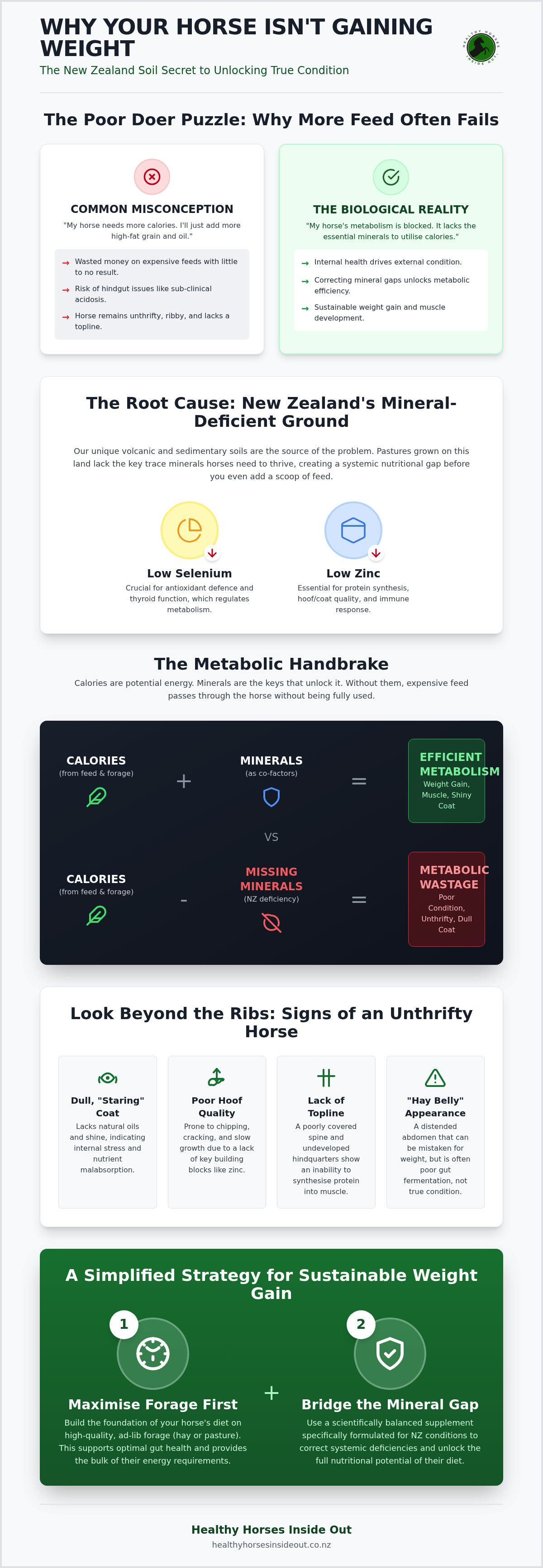
Effective Equine nutrition relies on the body's ability to convert raw materials into muscle and fat. If the internal machinery is compromised by mineral imbalances, no amount of extra grain will result in a covered ribcage. A poor doer is a horse with a metabolic handbrake caused by nutrient gaps.
The "Unthrifty" Appearance: More Than Just Ribs
Visible ribs and a tucked-up flank are the most obvious indicators of a horse in poor condition, but they rarely tell the whole story. An unthrifty horse often displays secondary signs of internal stress, such as a dull, "staring" coat that lacks its natural oils or hooves that are prone to chipping and slow growth. These external markers are direct reflections of the horse's internal status. Many owners mistake a "hay belly," which is distension caused by forage bulk and potentially poor fermentation, for genuine muscle mass. True condition is seen in the topline; a well-covered spine and rounded hindquarters indicate that the horse is successfully synthesising protein and storing energy effectively.
Common Misconceptions in NZ Equine Weight Gain
A frequent mistake in New Zealand paddocks is the belief that "adding more oil" or simply increasing grain rations will solve every weight issue. While fats are energy-dense, they don't address the underlying reason why the horse was unable to maintain weight on a standard diet in the first place. Over-feeding grain to a horse with a compromised hindgut can actually lead to sub-clinical acidosis, further hindering nutrient absorption and making the horse look even more unthrifty. Before increasing the volume of expensive hard feed, it is vital to check for the Signs of Mineral Deficiency in Horses NZ: The Essential 2026 Checklist to ensure you aren't trying to fill a bucket that has a hole in the bottom. True weight gain starts with a balanced system, not just a higher calorie count.
The Science of Weight Retention: Why Minerals Matter More Than Calories
When a horse struggles to hold condition, the instinctive response is often to increase the volume of fat and protein in the bucket. However, calories are merely potential energy; they require a functional metabolic system to be converted into muscle, fat stores, and cellular repair. Minerals act as essential co-factors for thousands of enzymatic reactions that drive this metabolism. Without a precise balance of these micronutrients, the horse’s body simply cannot process its diet efficiently. It’s a biological bottleneck that leads to metabolic wastage, where expensive feed passes through the horse without being fully utilised. This is why high-quality supplements for poor doer horses NZ focus on internal chemistry rather than just caloric density.
Specific minerals like Magnesium and Chromium play a pivotal role in regulating blood sugar and insulin sensitivity. When these are deficient, the horse may struggle to move glucose into the cells where it's needed for energy and growth. This can lead to a horse that looks "tucked up" and lacks stamina despite being on a high-energy diet. By addressing these systemic gaps, we can help the horse's body transition from a state of survival to one of thriving. Since Selenium levels in soil are low in many parts of New Zealand, many horses are already starting from a point of metabolic disadvantage before they even reach for their hay.
Protein Synthesis and the Role of Trace Minerals
Building a strong topline requires more than just protein; it requires the trace minerals that facilitate protein synthesis. Zinc and Copper are essential for creating the structural proteins found in muscle, skin, and connective tissue. If these minerals are out of balance, the horse will struggle to "hold" condition, especially during the colder months when metabolic demands increase. A common issue in New Zealand is mineral antagonism, where an excess of one mineral, like Iron or Manganese in the water or soil, can block the absorption of Copper and Zinc. This creates a secondary deficiency that prevents the horse from building the very muscle mass you are trying to provide through expensive feeds.
Metabolic Efficiency vs. Caloric Density
There is a significant difference between a "high-octane" diet and a "balanced-foundation" diet. While high-fat supplements can provide a temporary boost, they don't fix the underlying metabolic inefficiency. HHIO prioritises foundational minerals to "unlock" the calories already present in your forage, making your entire feeding routine more cost-effective. You can learn more about this in The Ultimate Guide to Everyday Horse Supplements for New Zealand Conditions. By focusing on the internal environment, you ensure that every mouthful of grass or hay is working toward a healthier body condition. If you're ready to stop the cycle of wasted feed, consider optimising your horse's foundational health with a science-led approach.
New Zealand Soil Mineral Deficiency: The Root of the Problem
New Zealand’s pastures often look lush and inviting, yet they frequently hide a geological secret that directly impacts equine vitality. Our soils are geologically young, primarily volcanic or sedimentary in origin, and they are notoriously deficient in several trace elements essential for a horse’s metabolic function. This isn't a minor gap; it is a foundational flaw that means even the most abundant grazing can leave a horse nutritionally starved. When selecting supplements for poor doer horses NZ, it's critical to understand that products formulated for the Northern Hemisphere often miss the mark because they don't account for our specific soil chemistry.
Selenium: The Critical NZ Trace Element
Selenium deficiency is perhaps the most well-documented issue across both the North and South Islands. Because pasture levels are often less than 0.01mg/kg of dry matter, horses are frequently unable to meet the daily requirement of approximately 1mg for a 500kg animal. When a horse is deficient in selenium, they may exhibit muscle soreness, a weakened immune system, and a general sense of lethargy that owners often mistake for "laziness" or simply "being a poor doer." However, selenium is an element where balance is everything. While deficiency causes muscle weakness, over-supplementation can lead to toxicity. This is why we advocate for veterinary blood testing to confirm levels before embarking on high-dose supplementation, ensuring your approach is as safe as it is effective.
The Iron-Copper-Zinc Antagonism
Beyond selenium, New Zealand horses face a significant challenge known as mineral antagonism. Our soils and water sources are often exceptionally high in iron, which acts as a biological "lock" in the horse's gut. High iron intake significantly inhibits the absorption of copper and zinc, two minerals that are vital for building the protein structures in muscle and skin. The visible results of this lock-up include sun-bleached coats, cracked or brittle hooves, and a persistent inability to build a healthy topline regardless of how many calories are fed. Generic supplements for poor doer horses NZ often provide these minerals in ratios that are too low to overcome this iron-induced blockage. Effective supplementation requires higher, more targeted ratios of copper and zinc to ensure these nutrients actually reach the horse's system rather than being wasted in the digestive tract.
Relying on international "off the shelf" supplements can be a costly mistake for Kiwi owners. These products are typically designed for soil profiles in the UK or USA, where iron levels may be lower and other deficiencies exist. By choosing a solution specifically formulated for New Zealand conditions, you are addressing the root cause of your horse's condition rather than just masking the symptoms with extra calories. This targeted approach provides the foundational support needed to turn an unthrifty horse into a thriving one.
Organising a Nutritional Strategy for Sustainable Weight Gain
Transforming a poor doer requires a methodical shift from "feeding for weight" to "feeding for health." Instead of reacting to visible ribs with a haphazard mix of mueslis and oils, we recommend a structured five-step approach. This strategy ensures that your investment in supplements for poor doer horses NZ isn't wasted on a system that is biologically unable to process them. Success is found in the sequence of your interventions, ensuring the horse's internal environment is ready to utilise the calories you provide.
- Step 1: Maximise high-quality forage to provide the essential caloric base.
- Step 2: Introduce a high-spec mineral balancer to correct the soil-related gaps discussed previously.
- Step 3: Optimise gut health to ensure nutrient absorption is actually occurring.
- Step 4: Add targeted calories, such as fats or digestible fibres, only once the mineral foundation is secure.
- Step 5: Monitor progress and adjust the ration based on a Body Condition Score (BCS) assessment every four weeks.
Forage First: The Foundation of Every Poor Doer’s Diet
Ad-lib forage is non-negotiable for any horse struggling to hold condition. In New Zealand, forage is often our most accessible calorie source, yet it is frequently under-utilised in favour of expensive hard feeds. Lucerne is an excellent choice for poor doers due to its high protein and calcium content, which supports muscle development and provides a natural buffer for the stomach. Meadow hay or baleage provides the essential long-stem fibre needed to maintain a healthy hindgut microbiome. Without sufficient fibre, the delicate balance of bacteria in the large colon is disrupted, leading to poor fermentation and a significant loss of potential energy from the horse's daily intake.
Gut Health: The Absorption Engine
Even the most scientifically advanced diet will fail if the horse's "absorption engine" is compromised. Sub-clinical issues like "leaky gut" or gastric ulcers can prevent a horse from utilising nutrients effectively, regardless of the quality of the feed. A calm, acidic-balanced digestive tract is vital for optimal nutrient uptake. If the hindgut is too acidic, the efficiency of supplements for poor doer horses NZ drops dramatically as the microbial population struggles to survive. Ensuring the digestive environment is stable allows the horse to extract every possible megajoule of energy from their forage. For a deeper look at selecting the right vehicle for these nutrients, see our Choosing the Best Horse Pellets in NZ: A Science-Led Buying Guide.
Sustainable weight gain isn't about a quick fix; it's about building a resilient system that can withstand seasonal changes. By following a structured plan, you move away from the anxiety of "trying everything" and toward a sense of confidence in your horse's long-term wellness. If you are ready to implement a strategy that prioritises foundational health, you can explore our range of NZ-specific equine supplements today.
Foundational Support: How HHIO Pellets and Bundles Bridge the Gap
Addressing the needs of an unthrifty horse requires a shift from fragmented supplementation to a cohesive, systemic approach. At HHIO, our "Inside Out" philosophy is built on the understanding that external condition is a direct reflection of internal metabolic health. Rather than offering a "kitchen sink" list of ingredients, we provide targeted supplements for poor doer horses NZ that address the specific biological bottlenecks found in our local environment. This methodical approach ensures your horse receives the precise ratios of minerals required to activate their metabolism without the unnecessary fillers that often complicate equine diets.
Choosing a science-led solution is significantly more cost-effective than purchasing individual ingredients and attempting to balance them yourself. When owners buy separate bags of minerals, they often inadvertently create new imbalances by over-supplementing certain elements while leaving others deficient. Our formulations take the guesswork out of the equation, providing a balanced foundation that supports the horse’s ability to thrive on their existing forage base. This creates a streamlined feeding routine that offers you peace of mind and your horse a clear path to recovery.
The HHIO Pellet Advantage for Poor Doers
Our signature HHIO Pellets serve as a concentrated, grain-free base designed to deliver high-spec minerals in a highly digestible format. For a poor doer, the digestive system is often already under stress; therefore, we utilise low-dose feeding rates that provide maximum nutritional impact without overwhelming the hindgut with bulk. These pellets are formulated specifically to counteract the New Zealand soil mineral deficiency profile we explored earlier, ensuring that the "lock-up" caused by high iron is bypassed. By providing the correct ratios of copper, zinc, and selenium, the pellets support muscle development and coat shine simultaneously, helping your horse hold their condition even through the challenging winter months.
Bundling for Success: Taking the Guesswork Out
To further simplify the path to optimal health, we have organised our most effective products into targeted supplement bundles. These bundles are designed to address the multifaceted nature of poor condition by combining mineral balancing with essential gut support. For many Kiwi owners, the Everyday Care Bundle provides a comprehensive starting point, ensuring that the foundational gaps in New Zealand pasture are filled from day one. By combining these elements into a single, science-backed routine, you ensure that every part of the horse's metabolic engine is supported.
Transforming your horse's health doesn't have to be a complex or confusing process. When you align your feeding routine with the unique requirements of the New Zealand environment, the results become both visible and sustainable. You can explore our science-led HHIO Supplement Bundles today to find the right combination for your horse's specific needs.
Empower Your Horse to Thrive with Evidence-Based Nutrition
Helping an unthrifty horse regain their vitality is a journey that requires both patience and scientific precision. We've explored how the traditional "more calories" approach often fails because it ignores the metabolic handbrake caused by New Zealand's unique soil deficiencies. By prioritising high-spec minerals and gut health, you enable your horse to extract maximum value from every mouthful of forage. This foundational shift is the key to seeing covered ribs and a gleaming coat that lasts through every season, regardless of the pasture's fluctuations. True condition isn't bought in a bag of grain; it's built through a balanced internal system.
Selecting the right supplements for poor doer horses NZ is about more than just filling a bucket; it's about choosing a partner in your horse's long-term wellness. Our science-led "Inside Out" approach ensures each formulation is specifically balanced for local pasture profiles, a strategy trusted by NZ horse owners for 2026 vitality. You can Shop the HHIO range for poor doer support and begin your horse's transformation today. Your commitment to evidence-based nutrition is the greatest gift you can provide for your horse’s comfort and performance. We're here to guide you every step of the way toward a healthier, happier horse.
Frequently Asked Questions
What are the best supplements for a poor doer horse in NZ?
The best supplements for poor doer horses NZ are those that provide high-spec mineral ratios specifically balanced for New Zealand pastures. These should include elevated levels of copper and zinc to counteract high iron intake, along with essential selenium. By focusing on a mineral balancer rather than just extra calories, you address the enzymatic deficiencies that prevent your horse from maintaining a healthy body condition. This targeted approach ensures that your feeding routine is both cost-effective and scientifically sound.
Can mineral deficiency cause a horse to lose weight?
Yes, mineral deficiencies can directly lead to weight loss by disrupting the enzymatic reactions that drive a horse's metabolism. Minerals act as essential co-factors; without them, your horse cannot efficiently convert forage or grain into muscle mass and fat stores. This metabolic handbrake means that even a horse on a high-calorie diet can remain unthrifty and ribby because their internal systems are unable to process the energy provided.
How long does it take for supplements to show results in a poor doer?
You can typically expect to see internal metabolic shifts within two to three weeks, while visible changes in coat quality and weight usually take four to eight weeks. The timeline depends on the severity of the initial deficiency and the horse's overall gut health. Consistency is vital during this period, as the body needs time to repair cellular structures and build muscle topline. Regular monitoring every four weeks helps you track these gradual but significant improvements.
Why is my horse still thin even though I feed him plenty of hay and grain?
Your horse may remain thin despite high caloric intake if there is a metabolic bottleneck or an absorption issue in the digestive tract. If the diet lacks the specific minerals required for energy conversion, the extra grain simply passes through the system without being utilised. This metabolic wastage is common in New Zealand, where soil gaps prevent horses from reaching their full physical potential regardless of how much hay is provided in the paddock.
Is Selenium deficiency common in New Zealand horses?
Selenium deficiency is extremely common in New Zealand because our geologically young soils often contain less than 0.01mg/kg of this essential trace element. Most horses grazing on local pastures are unable to meet their daily requirement of 1mg without targeted supplementation. Deficiency often manifests as muscle weakness, lethargy, and poor immunity, all of which contribute to the "poor doer" profile. However, it's vital to confirm levels via veterinary blood testing before starting a high-dose programme.
Should I use a high-fat feed or a mineral balancer for weight gain?
You should prioritise a high-spec mineral balancer to establish a nutritional foundation before adding high-fat feeds. While fat provides dense energy, a horse needs balanced minerals to metabolise that energy into actual body condition. Feeding high-fat mueslis without correcting mineral gaps is often an expensive and ineffective strategy. Once the metabolic system is functioning correctly, you can then add targeted fats if the horse requires additional caloric support.
How do I know if my horse has a gut health issue preventing weight gain?
Common indicators of gut health issues include a distended "hay belly" combined with visible ribs, poor coat quality, and a lack of response to premium feeds. If your horse seems irritable during grooming or lacks the muscle topline you expect, their hindgut may be too acidic for optimal nutrient uptake. Addressing the digestive environment ensures that your investment in supplements for poor doer horses NZ actually reaches the horse's bloodstream rather than being lost.
Are HHIO Pellets suitable for horses with metabolic sensitivities?
HHIO Pellets are specifically formulated to be safe for horses with metabolic sensitivities, as they are grain-free and contain negligible levels of sugar and starch. The low-dose feeding rate provides a concentrated source of essential minerals without the "fizz" associated with traditional conditioning feeds. This makes them an ideal choice for sensitive poor doers that require foundational support without the risk of triggering laminitis or other metabolic complications.


