

A higher MSM dose doesn’t automatically make a better choice. If you’re comparing an msm horse supplement nz, conflicting claims and dense ingredient panels can make it hard to tell what MSM contributes, or whether a single-ingredient powder or broader formula better suits your horse.
This guide explains MSM’s role and its limits, then sets out practical ways to compare ingredients, feeding directions and safety information. It also looks at HHIO Restore, a multi-ingredient formula that includes MSM and L-arginine. Horses with EHV should avoid L-arginine supplementation. You’ll find Restore’s weight-based loading and maintenance schedule, why it’s important to stay within the recommended ranges, and what to consider alongside your horse’s current diet. The aim is clear guidance, not a quick-fix promise, so you can make an informed choice with your horse’s wellbeing in view.
Key Takeaways
- MSM means methylsulfonylmethane, a source of dietary sulphur. Knowing that helps put supplement claims in context.
- Claims about joints, muscles or mobility describe intended nutritional support, not a diagnosis or guaranteed treatment outcome.
- When comparing an msm horse supplement nz, consider your horse’s needs, read the full label and follow that product’s directions. Don’t transfer doses between formulas.
- HHIO Restore is a multi-ingredient option manufactured by a leading New Zealand animal-supplement maker. Assess its full ingredient profile and cautions against your horse’s circumstances.
What is MSM in horse supplements, and what does it contribute?
If you’re considering an MSM supplement, the useful question is what the ingredient may contribute, rather than how many benefits appear on the label. MSM is a source of dietary sulphur, but its presence alone can’t tell you whether a product suits your horse or predict an individual response.
What does MSM mean on a horse supplement label?
MSM stands for methylsulfonylmethane, an organosulphur compound used in dietary supplements. The name indicates that it contains sulphur, an element found in compounds involved in normal body structures and processes. That context helps explain why equine products may mention connective tissue, joints or muscles, but it doesn’t establish a clinical outcome for a particular horse. Keep the distinction clear: MSM is an ingredient, not a complete feeding plan. For a clearer view of how ingredients fit together in a formula, explore this horse supplement ingredients guide.
Why do MSM products mention sulphur and connective tissue?
Product descriptions may connect dietary sulphur with connective tissue, cartilage, hooves or muscle support. This explains the nutritional reasoning behind an ingredient choice; it isn’t proof that feeding MSM will change a horse’s comfort, movement or tissue health. The methylsulfonylmethane (MSM) reference provides background on the compound and its common use in supplements, not evidence of a guaranteed equine result.
When comparing an msm horse supplement nz, separate three questions: what the ingredient is, what the product claims it supports, and whether the whole formula fits your horse. Check the label and feeding directions, and treat signs such as pain or lameness as a reason to seek veterinary assessment, not to rely on a supplement claim.
How to assess MSM claims for joints, muscles and mobility
Words such as “supports joint comfort” or “promotes mobility” describe a product’s intended nutritional role, not a guaranteed treatment outcome. A label can explain why an ingredient is included, but it can’t establish the cause of stiffness or predict how a particular horse will respond. A broad benefit list can’t forecast an individual horse’s results.
How can owners read joint and muscle support claims critically?
Separate what an ingredient is from what a product claims your horse may experience. A reference to connective tissue, muscles or movement gives you a starting point for assessing a formula, not proof that it will resolve a health problem. Look for clear ingredient information and feeding directions, then consider whether the product’s stated purpose matches your horse’s needs.
Persistent pain, lameness or a sudden change in movement needs veterinary assessment. A supplement shouldn’t be used to diagnose or treat a joint condition, or to delay investigating a change in your horse’s comfort or way of going.
Why does the whole formula matter?
A standalone MSM product and a formula combining MSM with other ingredients aren’t automatically interchangeable. The amount of each ingredient, the complete composition and the product’s directions all matter when assessing it. Don’t judge a combined formula by its MSM content alone, or assume that a longer ingredient list makes it a better fit.
For a practical comparison, read the label as a whole: identify the ingredients and their amounts, note the intended support areas, then review feeding directions and cautions against your horse’s situation. This is especially useful when comparing an msm horse supplement nz with broader joint-support products. The horse joint supplements guide offers further context for weighing different approaches.
Once you’ve considered the claims and the full formula, you can compare the equine supplements from Healthy Horses Inside Out with your horse’s needs.
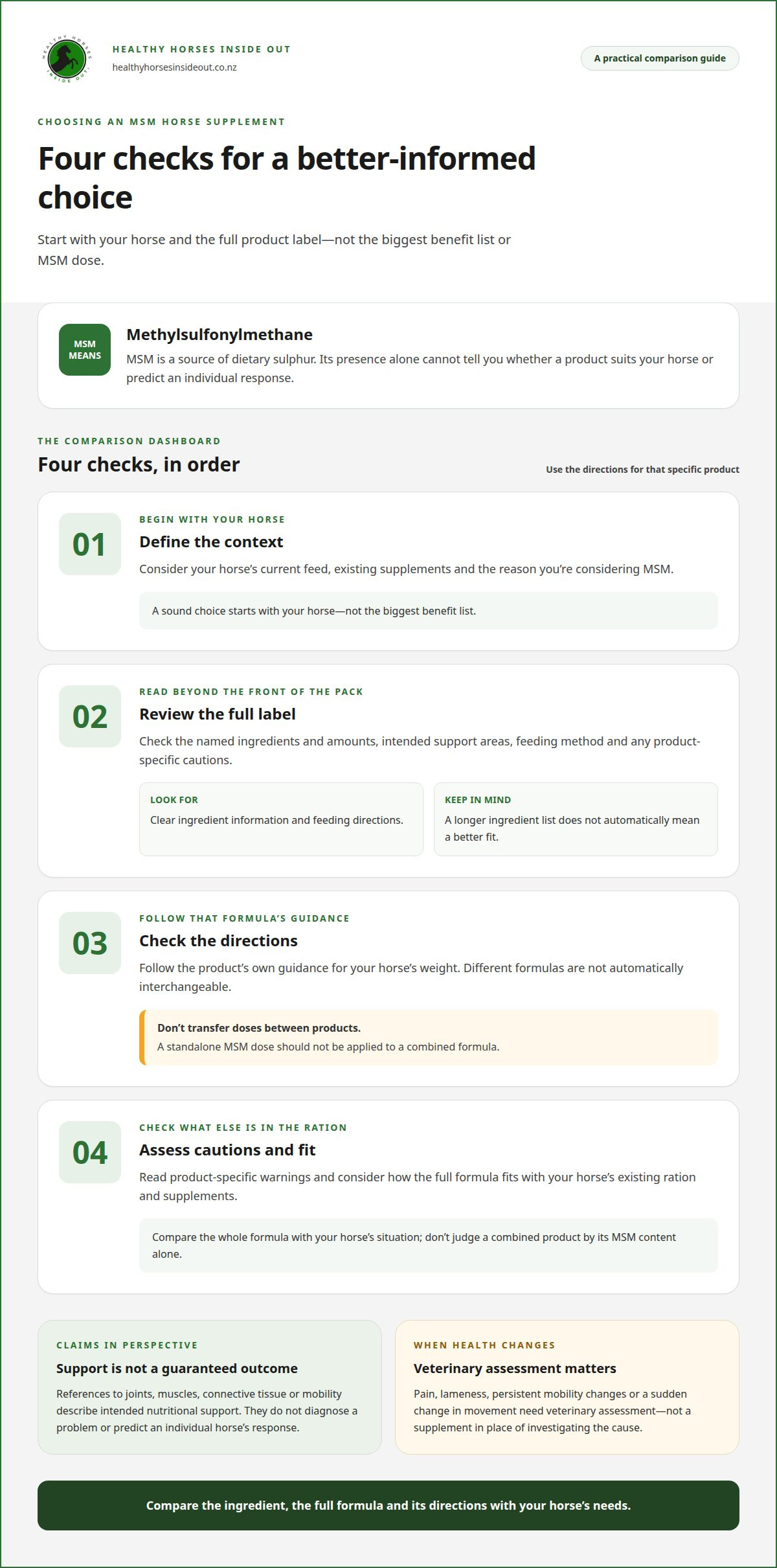
How to choose and use an MSM horse supplement in New Zealand
A sound choice starts with your horse, not the biggest benefit list. Use this sequence to assess an msm horse supplement nz and its place in the ration:
- Define your horse’s context. Consider their current feed, existing supplements and the reason you’re considering MSM.
- Review the full label. Note the named ingredients, amounts, intended support areas and feeding method.
- Check the directions. Follow the guidance for that specific product and your horse’s weight. Never transfer a standalone MSM dose to a combined formula.
- Assess cautions. Read product-specific warnings and consider how the formula fits with your horse’s existing ration and supplements.
What should you compare on an MSM supplement label?
Look beyond the front-of-pack claims. Check whether the label identifies ingredients and amounts, explains how to feed the product, and states any product-specific cautions. Compare those details with what your horse already receives. More ingredients don’t automatically make a better fit, particularly if a formula duplicates nutrients in the existing ration or doesn’t match the reason you’re considering a supplement.
When should a horse owner seek veterinary guidance?
If your horse has a diagnosed condition, takes medication or develops new symptoms, seek veterinary advice before changing their supplement routine. Pain, lameness or persistent changes in mobility need assessment, not a supplement trial in place of investigating the cause. Follow the product’s own warnings, and don’t use directions from a different MSM product as a substitute.
Once you’ve clarified your horse’s needs and checked the label, explore HHIO’s horse supplement range as part of your comparison. Reviewing the full formula is more useful than choosing on an ingredient name alone.
HHIO Restore: an MSM formula with clear dose guidance and an EHV caution
HHIO Restore is a targeted, multi-ingredient formula containing MSM, L-arginine, natural Vitamin E and other listed ingredients. Horses with EHV should avoid L-arginine supplementation. Restore isn’t a standalone MSM powder, so assess its full ingredient profile and follow its own feeding directions rather than applying guidance from another product. It is manufactured by a leading New Zealand animal-supplement maker, not formulated in-house by HHIO.
What is the listed HHIO Restore dose?
The schedule has a seven-day loading period followed by maintenance. Dose according to your horse’s weight:
- Loading, for seven days: over 350 kg, 80 g daily; under 350 kg, 40 g daily.
- Maintenance: over 350 kg, 40 g daily; under 350 kg, 20 g daily.
Follow the product directions and don’t exceed these recommended ranges. Higher levels of MSM can impact absorption of copper and selenium. The 2.4 kg bag provides 60 doses of 40 g each; other sizes are also available.
Who should avoid HHIO Restore?
Restore includes L-arginine, and horses with EHV should avoid L-arginine supplementation. Restore isn’t appropriate for horses diagnosed with Equine Herpes Virus (EHV). If your horse has a health condition, takes medication or develops new symptoms, seek veterinary advice before changing their feeding routine. A supplement doesn’t replace assessment of pain, lameness or ongoing mobility changes.
If you’re weighing up an msm horse supplement nz for your horse, use the dose schedule and EHV caution alongside the full product information. Explore HHIO Restore as one option, considering its ingredients and feeding guidance in the context of your horse’s individual needs.
Make your next choice with confidence
Before adding a supplement, consider how it fits your horse’s overall feeding routine and individual needs. A thoughtful choice isn’t about expecting a guaranteed change; it’s about selecting a clearly described formula and using it as directed.
For owners considering Restore, its loading and maintenance directions set out a clear feeding schedule, and the formula is manufactured by a leading New Zealand animal-supplement maker. Keep its specific cautions in view as you decide whether it suits your horse.
Choosing an msm horse supplement nz is ultimately about fit, informed by the full product information and your horse’s circumstances. Explore HHIO Restore and the equine supplement range to compare options for your horse.
A considered approach helps you make feeding decisions with greater clarity and care.
Frequently Asked Questions
What is MSM in horse supplements?
MSM is short for methylsulfonylmethane, a sulphur-containing compound used in dietary supplements. Its dietary-sulphur context helps explain why it appears in equine products, but it doesn’t show that a horse is deficient or predict a health outcome. Check the amount and other ingredients on the label rather than using the ingredient name alone to judge whether the product fits.
Can MSM help support a horse’s joints?
Some supplement labels describe MSM as supporting joint health or mobility, but those statements aren’t a promise of results for an individual horse. A change in movement may have different causes, so persistent pain or lameness needs veterinary assessment rather than reliance on a supplement. Note when the change began and what you’ve observed; that context can help inform the discussion with your veterinarian.
Can I use a standalone MSM dose for a combined horse supplement?
No. Doses are specific to each product and its complete formula, so don’t transfer a standalone MSM serving to a supplement that combines MSM with other ingredients. When comparing an msm horse supplement nz, follow the directions on the exact product label and match them to your horse’s weight. If your horse already receives other supplements, consider the full ration before adding another formula.
Can horses with EHV have HHIO Restore?
No. HHIO Restore contains L-arginine, and If your horse has been diagnosed with Equine Herpes Virus, don’t feed Restore. This specific caution takes priority over general information about MSM or directions intended for a different product. If you’re uncertain how a diagnosis affects the feeding plan, seek veterinary advice before making a change.
Is HHIO Restore a standalone MSM supplement?
No. HHIO Restore is a multi-ingredient formula containing MSM, L-arginine, natural Vitamin E and other listed ingredients. If you’re comparing Restore with a product made up of MSM alone, assess it as a complete formula, not just by its MSM content. Review its ingredient list and product-specific directions to decide whether it suits your horse’s feeding context.


