
So, if you’re asking how much it costs to feed a horse in NZ in 2026, the annual figure depends on what your horse gets from pasture and how much supplementary feed it needs.
It’s easy to focus on the price of hay or a bag of chaff, but the full picture includes forage, grains, commercial feeds and supplements. This guide explains how those choices shape the yearly budget, when extra feed may be needed, and why fruit and vegetables are occasional treats rather than a dietary foundation. You’ll come away with a clearer basis for planning feeding costs around your horse’s needs and workload.
Key Takeaways
- Build your annual feed budget around your horse’s pasture access, workload and condition, as these affect how much supplementary feed may be needed.
- Keep fruit and vegetables as occasional treats; large amounts of fermentable foods, including fallen apples, can be toxic.
- Prioritise high-fibre, low-energy forage, and remove twine or wrapping from hay before feeding.
- Use grains and commercial feeds thoughtfully, since too much high-energy, high-sugar feed can contribute to obesity and laminitis.
Annual feed and supplement budget
Build an annual budget around forage, hard feed and supplements, rather than counting only the daily bucket.
Annual feed and supplement planning
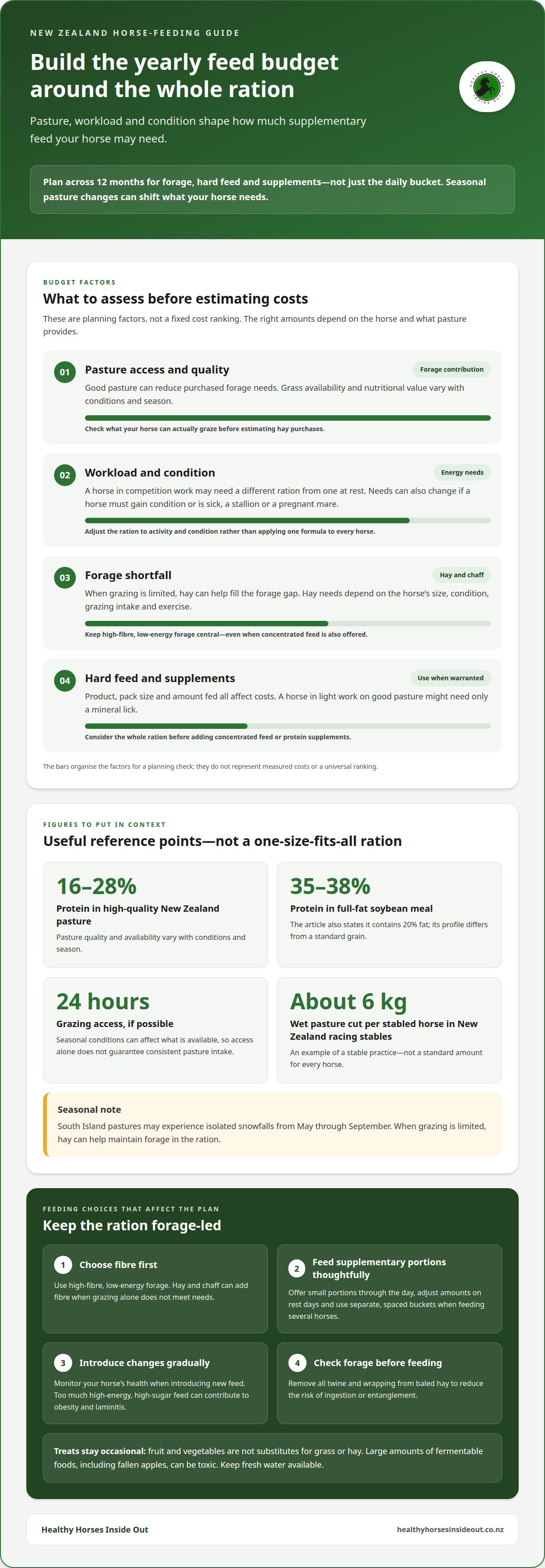
An annual feed budget estimates the cost of forage, hard feed and supplements over the year. Planning across twelve months helps you account for seasonal pasture changes and shifts in feeding needs, instead of treating each purchase as a separate expense.
Your total depends on how much pasture contributes and whether your horse needs extra feed. A horse in competition work may have different energy needs from one at rest, while a horse on good pasture may need less supplementary feed.
Providing supplementary feed
Supplementary feed adds to a horse’s usual forage when pasture quality or the horse’s needs call for it. It may be appropriate when pasture is poor, the horse uses extra energy, needs to gain condition, or is a stallion, pregnant mare or sick horse.
Offer supplementary feed in small portions throughout the day rather than as one large meal. Adjust the amount on rest days to reflect the horse’s reduced workload. If feeding several horses, use separate, spaced buckets so each gets its intended portion.
Feed and supplement types
Hay provides forage, while hard feed supplies concentrated nutrition when a horse’s needs warrant it. A horse in light work on good pasture might need only a mineral lick. Consider salt as part of the whole ration and workload, since its cost varies by product and use.
Protein supplements are another option, but the horse’s diet determines whether they are appropriate. Full-fat soybean meal contains 35-38% protein. Feed choices should reflect the horse’s condition and activity, rather than adding products automatically. Fresh water should remain available, and any new feed should be introduced gradually while monitoring the horse’s health.
What about fruits and vegetables?
The monthly cost of feeding on pasture versus hay depends on grazing availability and how much forage you need to buy. Pasture can reduce purchased forage costs, while reliance on hay increases its share of the budget.
Pasture quality changes what it contributes to the diet. High-quality New Zealand pasture contains 16-28% protein, but grass availability and nutritional value vary with conditions and season. A horse’s workload matters too: feeding should reflect its activity and pasture intake, rather than applying one formula to every horse.
Access to grazing for 24 hours is suitable if possible, but seasonal conditions can affect what is available. South Island pastures may experience isolated snowfalls from May through September. During periods when grazing is limited, hay can help maintain forage in the ration, with the amount depending on pasture access and the horse’s needs.
Stabled horses may receive cut grass instead of grazing directly. New Zealand racing stables often cut about 6kg of wet pasture for each stabled horse. This is an example of a stable feeding practice, not a standard amount for every horse; workload, pasture and the rest of the ration all influence feeding decisions.
Fruit and vegetables are best treated as occasional extras, not substitutes for grass or hay. Large amounts of fermentable foods, including fallen apples, can be toxic. Offer treats sparingly, and keep the main diet centred on forage. For planned support where pasture intake leaves a nutritional gap, explore horse supplement options.
Forage, hay and chaff
Forage supports normal gut function and should remain central to a horse’s diet. Hay and chaff can add fibre when grazing alone does not meet the horse’s needs.
Forage, hay and chaff choices
Forage includes pasture and preserved grasses such as hay; chaff is chopped forage offered as part of a feed. Choose low-energy, high-fibre options, including hay made from low-sugar grasses, to help balance the ration.
Even horses receiving concentrated feed need enough high-fibre, low-energy food. This supports gut function and helps reduce the risk of colic and gastric ulcers. When pasture is limited, hay can supply some of that forage, while chaff offers another way to add chopped fibre.
Before feeding baled hay, remove all twine and wrapping. Horses may ingest it or become entangled, so this preparation step is important for safe feeding.
Daily hay intake
There is no single daily hay amount that suits every horse. The amount depends on the horse’s size, condition, grazing intake and exercise. Hay needs to fill the gap between available pasture and the horse’s forage requirements.
A horse with little grazing may need more of its forage from hay than one on good pasture. Assess the whole ration: concentrated feed does not replace sufficient high-fibre, low-energy food.
Apply the same principle when planning hay purchases. Consider how much pasture your horse can actually eat, then adjust the hay offered as grazing changes. For example, if poor pasture reduces grass intake, make up the shortfall with forage.
Hay costs depend on how much you buy and the supply available, so a fixed daily figure cannot describe every New Zealand horse. Plan for regular access to forage, and remove any remaining bale ties before the next feed.
Grains and commercial feeds
Grains and commercial feeds add concentrated energy or nutrients to a horse’s ration. Their suitability depends on the horse’s workload and the rest of its diet.
Grains and commercial feed types
Oats, pellets and other commercial feeds differ in composition, so they aren’t interchangeable by name alone. Full-fat soybean meal contains 35-38% protein and 20% fat, making its nutrient profile distinct from a standard grain. Consider the whole ration before adding a concentrated feed, rather than choosing by ingredient alone.
Large amounts of high-energy, high-sugar feed can contribute to obesity and laminitis. Introduce new feed gradually and monitor your horse during the change. This is especially important when changing the diet of a horse in regular work, as the full ration should reflect its needs.
Prices for hard feed, pellets and chaff
In New Zealand, the cost of hard feed, pellets and chaff varies by product, pack size and how much your horse receives. There is no single monthly price for every horse: the total depends on the types and quantities of feed used.
For budgeting, track purchased hard feed separately from forage and supplements, then factor in how much you feed. A horse receiving little concentrated feed will have a different hard-feed bill from one regularly eating pellets. Chaff is another separate purchase, so include it if it is part of the daily ration.
Pellets are one commercial-feed format. If you’re considering pellet-based nutritional support, explore pellet options and assess how they fit alongside the horse’s existing ration.
Healthy Horses Inside Out
Healthy Horses Inside Out offers supplement options to support horse owners planning nutrition alongside forage, pasture and hard feed. Everyday Horse Supplements, Specific Horse Supplements, Horse Supplement Bundles and HHIO Pellets provide different ways to include supplementary nutrition in a horse’s feeding plan.
Consider these options when budgeting for supplements or assessing how they fit with your horse’s existing ration. The right choice depends on your horse’s needs and what its current diet provides, so treat supplements as part of a considered plan rather than an automatic addition.
Explore the supplement options from Healthy Horses Inside Out to find a suitable next step for your horse’s feeding plan.
Make your feeding plan work for your horse
Turn your budget into a practical plan by matching feed choices to your horse’s needs and reviewing them as those needs change. Keep a simple record of what you feed, how your horse responds and any changes in condition to support more considered decisions over time.
Thinking about how much it costs to feed a horse in NZ in 2026 is a useful starting point, but the next step is building a ration that makes sense for your own horse. If you’d like support considering supplementary nutrition alongside the rest of the diet, contact Healthy Horses Inside Out.
Small, thoughtful adjustments can make feeding decisions clearer. Keep your horse’s individual needs at the centre of the plan, and review it when circumstances change.
Frequently Asked Questions
How much does it cost to keep a horse?
Keeping a horse involves more than feed: budget separately for accommodation, farrier care, routine health care and, if relevant, insurance. Livery options also differ.
How can I reduce horse ownership costs?
Before buying extra feed, review the ration against your horse’s workload and pasture intake. A horse in light work on good pasture might need only a mineral lick, while supplementary feed may be reduced on rest days. Avoid adding concentrated feed without a clear dietary reason, and plan forage purchases around available pasture. Recording feed use can help identify avoidable purchases and track changing needs.
What is the average monthly cost to feed a horse in New Zealand in 2026?
If you’re estimating how much it costs to feed a horse in NZ in 2026, treat this as a guide for those feed categories, not every horse’s exact bill. Pasture access, purchased forage and the need for concentrated feed or supplements all affect spending. Track each category separately to make your monthly budget more useful.
How much does hay cost per bale or tonne in New Zealand in 2026?
Hay costs depend on forage type and quality, bale weight and purchase quantity. A bale and a tonne aren’t directly comparable unless you know the bale’s weight, so compare costs using the same unit. For a clearer estimate of how much it costs to feed a horse in NZ in 2026, account for how much pasture the horse eats and how much hay is needed to meet its remaining forage needs.
How much does pasture grazing reduce a horse’s feed costs in NZ?
Pasture can reduce the amount of hay you need to buy, depending on how much suitable grazing your horse can use. Strong pasture access may lower forage purchases, while limited grazing means more hay is needed. Grazing does not remove every feed cost: workload, condition and the overall ration still affect whether supplementary feed is appropriate.
How much do feed costs vary by region and season in New Zealand?
Feed spending changes with pasture availability and the amount of forage purchased. South Island pastures may experience isolated snowfalls from May through September, which can affect grazing access and increase reliance on stored forage. Seasonal pasture changes also influence hay needs. A horse’s budget therefore reflects local growing conditions and its feeding requirements, rather than a single national seasonal rate.


