

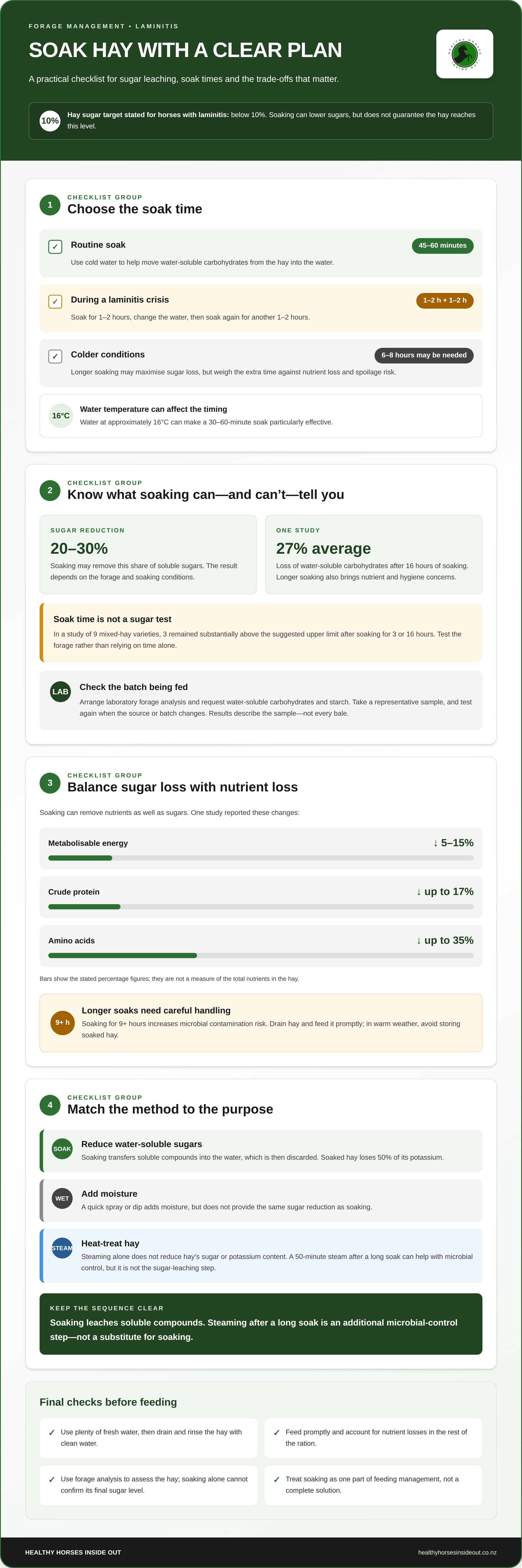
Wetting hay isn't the same as soaking it. For hay soaking for laminitic horses, soak in cold water for 45-60 minutes to help leach water-soluble sugars. During a laminitis crisis, the recommendation is to soak for 1-2 hours, change the water, then soak again for another 1-2 hours. Soaking can lower sugar levels, but it doesn't ensure the hay falls below the 10% level recommended for equines with laminitis.
When managing a horse prone to laminitis, it makes sense to want a clear forage routine. The challenge is reducing sugar without overlooking nutrients that can leach into the water, and understanding how soaking differs from simply wetting or steaming hay.
This guide explains how soaking time affects sugar loss, why longer soaking is not always better, and how soaking compares with wetting and steaming. It also covers practical factors that affect the process, helping you weigh its benefits and limitations when making feeding decisions.
Key Takeaways
- Choose soaking over simply wetting or steaming when the aim is to leach water-soluble sugars from hay.
- Use plenty of fresh water and rinse the hay after soaking to help remove sugary water.
- Allow for nutrient losses as well as sugar reduction when planning the rest of your horse’s ration.
- Hay analysis can help you judge whether soaking is likely to bring a particular forage in line with your horse’s needs.
Hay soaking duration and sugar leaching
Soaking moves water-soluble carbohydrates from hay into the water. The appropriate duration depends on the horse’s needs, the water temperature and the forage itself.
For a routine soak, use cold water for 45-60 minutes. During a laminitis crisis, soak for 1-2 hours, replace the water, then soak for another 1-2 hours. In colder weather, 6-8 hours may be needed to maximise sugar loss. One study found an average 27% loss of water-soluble carbohydrates after 16 hours, but longer soaking also increases nutrient and hygiene concerns.
Water temperature and soaking time
Water temperature influences how quickly sugars leach from hay, so it matters when choosing a soaking period. Water at approximately 16°C can make a 30-60-minute soak particularly effective. Colder conditions may call for longer soaking, while extending the time should be weighed against nutrient loss and spoilage risk. For laminitic horses, duration is a practical balance, not a guarantee of a particular sugar level.
Nutrient loss and bacterial growth
Soaking can remove nutrients as well as sugars, and wet hay can spoil or support bacterial growth if left standing. In one study, metabolisable energy decreased by 5-15%, crude protein by up to 17%, and amino acids by up to 35%. Soaking for 9+ hours increases microbial contamination risk. Drain the hay and feed it promptly; in warm weather, avoid storing soaked hay, as warmth can accelerate spoilage.
Testing hay sugar and starch levels
Hay testing measures sugar and starch in a forage sample, helping New Zealand horse owners assess a batch instead of relying on soaking alone. Arrange laboratory forage analysis and request results for water-soluble carbohydrates and starch. Take a representative sample of the hay being fed, especially when buying a large quantity from one source. Test again when the source or batch changes: results describe the sampled forage, not every bale.
Reducing sugars in hay for horses prone to laminitis
Soaking aims to leach water-soluble carbohydrates from forage, which may help lower sugar intake for horses prone to laminitis. It alters the hay, but does not establish its final sugar level.
Reducing sugars in hay
Water-soluble carbohydrates include sugars that can move from hay into soaking water. Soaking may remove 20-30% of soluble sugars, but the result depends on the forage and soaking conditions. A study of 9 mixed-hay varieties found that three remained substantially above the suggested upper limit after soaking for 3 or 16 hours. Time alone can’t show whether a particular batch is suitable.
For horses with laminitis, the recommended upper level stated for hay is 10% sugar. Soaking doesn’t guarantee a result below that level, even when the hay is soaked for longer. Testing the forage helps distinguish a lower-sugar batch from one that remains above the target after soaking. This matters especially when a large quantity comes from one source.
Veterinary and nutrition guidance
For laminitic horses, the practical feeding target is hay below 10% sugar, alongside an overall ration suited to the horse. That target helps frame forage choices, but soaking alone can’t confirm the result. A forage analysis gives a more specific basis for assessing the hay being fed, while the horse’s condition and full ration inform how it fits into daily feeding.
Keep forage as the foundation rather than responding to sugar concerns by restricting hay access, particularly for horses not grazing. Straw should not be the sole forage, as doing so can increase gastric-ulcer risk. A 50:50 mix of straw and haylage has shown benefits for insulin-dysregulated horses, but it isn’t a universal substitute for a suitable ration. For help considering wider nutritional support alongside forage, explore Everyday Horse Supplements.
Soaking compared with wetting or steaming
These methods affect hay differently. Soaking transfers water-soluble compounds into the water, wetting adds moisture, and steaming applies heat. For a horse that needs lower-sugar forage, soaking is the method that leaches soluble compounds.
During soaking, water-soluble carbohydrates pass from the forage into the water. That water is then discarded, taking some soluble material with it. Soaking also removes potassium, with hay losing 50% of its potassium. The change is not simply that the hay feels wetter. Soluble components have moved out of the forage.
A quick spray or dip does not provide the same sugar reduction as soaking. Steaming alone also does not reduce hay’s sugar or potassium content. Damp or heat-treated hay may look different, but its appearance does not show whether soluble sugars have leached away. If reducing hay sugars is the goal, wetting or steaming alone will not achieve it.
Steaming can still follow a soak for a separate reason. A 50-minute steam after a long soak can help with microbial control. In that sequence, soaking is the sugar-leaching step, while steaming supports microbial control. Don’t treat steam as a substitute for soaking when sugar reduction is the goal. Nor does steaming remove the need to handle soaked hay promptly.
First identify the purpose: reducing sugar, adding moisture or controlling microbes. To reduce sugar, soak the hay rather than relying on a brief wetting or steaming alone. If you steam hay after a long soak, treat steaming as an additional step, not the leaching process. Keeping these purposes distinct helps you choose a method that fits the feeding goal.
Soaking hay for horses with laminitis
Soaking is generally a short-term measure, not a routine requirement for every healthy horse. It may be useful for horses with chronic laminitis, but careful forage handling remains essential. Hay soaking for laminitic horses is one part of feeding management, not a complete solution.
Draining and rinsing soaked hay
Drain soaked hay thoroughly, then rinse it with clean water to remove sugary water clinging to the forage. Use plenty of water for the amount of hay: a small tub can become saturated quickly, limiting the transfer of soluble material. Use fresh water for each soak rather than reusing it. This helps keep the process consistent and prevents leached material from returning to the hay.
Feeding soaked hay safely
Feed drained hay promptly rather than leaving it to dry. Soaking causes dust spores to swell, making them more likely to be swallowed than inhaled; drying can reduce this dust-control benefit. Wet forage can also spoil, so avoid leaving it out after preparation. In warm weather, soak close to feeding time and do not let the hay sit around.
Consider the whole forage ration. Soaking removes soluble sugars, but it also leaches minerals, including phosphorus, potassium, magnesium, manganese, zinc, copper and iron. This matters particularly if soaked hay is fed regularly. If the horse should not lose weight, also consider its energy intake, since soaking can reduce hay’s metabolisable energy.
Do not respond to laminitis risk by restricting hay access, particularly for a horse that is not grazing. Consider the forage, the horse’s condition and the complete ration together. The value of hay soaking for laminitic horses depends on how it fits into a balanced feeding plan. It is generally unnecessary for healthy horses without a relevant issue.
Healthy Horses Inside Out
Healthy Horses Inside Out offers nutritional support to complement careful forage management, not replace hay testing or veterinary care. If soaking changes your horse’s forage intake, consider how the rest of the ration meets its nutritional needs.
Healthy Horses Inside Out offers Everyday Horse Supplements, Specific Horse Supplements, Horse Supplement Bundles and HHIO Pellets for different nutritional requirements. The right option depends on the horse’s complete diet and needs, particularly because soaking can also remove nutrients from hay. Supplements are not a substitute for suitable forage or a balanced feeding plan, but can form part of broader dietary support.
Explore Healthy Horses Inside Out’s nutritional products to consider support for your horse’s overall ration.
Make the next feeding decision with care
A considered approach to hay soaking for laminitic horses treats forage as one part of the wider ration. Keep the horse’s condition, forage source and nutritional balance in view as feeding decisions change. This helps avoid relying on one preparation method to meet every need.
As you plan your next step, consider whether the horse’s overall diet provides appropriate nutritional support alongside its forage. Healthy Horses Inside Out offers Everyday Horse Supplements, Specific Horse Supplements and Horse Supplement Bundles to complement dietary planning. These products do not replace suitable forage or veterinary care, but may be relevant when reviewing the ration as a whole.
For a conversation about nutritional support for your horse, contact Healthy Horses Inside Out. A thoughtful feeding plan can give you a clearer basis for each decision.
Frequently Asked Questions
Why soak hay for horses?
Soaking can reduce water-soluble carbohydrates in forage, which may be useful for horses with metabolic concerns or overweight horses on calorie-restricted diets. It modifies forage rather than removing it from the ration. For example, you can soak a batch of hay before feeding, then account for nutrient losses when considering the horse’s complete diet.
Does soaking hay reduce sugar and water-soluble carbohydrates for laminitic horses?
Yes, soaking can reduce soluble sugars, but it doesn’t ensure the hay reaches a particular level. A typical reduction is 20-30% of soluble sugars, and the result varies with the hay and soaking conditions. A batch can still exceed the recommended 10% sugar level after soaking, so forage analysis provides a more reliable basis for assessing its suitability.
How long should hay be soaked for a laminitic horse?
For routine soaking, use cold water for 45-60 minutes. During a laminitis crisis, soak for 1-2 hours, replace the water, then soak again for another 1-2 hours. Colder weather may require 6-8 hours to maximise sugar loss, but extended soaking can increase nutrient losses and spoilage risk. Drain the hay and feed it promptly after soaking.
What water temperature and hay-to-water ratio should be used when soaking hay?
Water at approximately 16°C can make a 30-60-minute soak particularly effective. Use enough water to submerge the hay fully, rather than packing it into a small tub where the water can become saturated quickly. One study used 25 litres of tap water to submerge its hay samples; that amount describes the study setup, not a fixed ratio for every batch.
How much sugar does hay soaking remove, and how consistent is the reduction?
Soaking removes around 20-30% of soluble sugars, but the reduction isn’t consistent across all forage. Hay variety, water temperature, duration and the amount of water affect the result. In a comparison of 9 mixed-hay varieties, three remained substantially above the suggested upper limit after soaking. Treat a general reduction estimate as a guide, not a measurement of your hay.
What alternatives to soaking hay are suitable for horses with laminitis?
Wetting or steaming hay alone does not reduce its sugar or potassium content, so neither is an alternative to soaking for leaching sugar. A practical starting point is to analyse the forage and choose hay based on its measured composition. Keep suitable forage available rather than restricting access in response to laminitis concerns, particularly for a horse that is not grazing. Straw alone is not an appropriate forage replacement.


