

The obvious answer may not be the right one: a single “calming” ingredient is unlikely to explain or resolve every fizzy spell. If you’re searching for the best feed for fizzy thoroughbred NZ horses, look beyond one bag or supplement and consider the whole ration, including pasture, forage, workload and body condition.
It’s understandable to wonder whether feed is influencing your Thoroughbred’s behaviour. Labels can make energy sources difficult to compare, and you don’t want a diet change to affect condition or performance. Feed can be one influence, but temperament, management and health matter too. A measured assessment is more useful than expecting an ingredient to be a quick fix.
This guide explains how to review the ration, compare feeds by their energy sources and nutritional role, and make changes gradually while tracking your horse’s response. Use it to assess what may suit your individual Thoroughbred and when the feeding plan needs a closer look.
Key Takeaways
- Assess behaviour alongside workload, routine, health and environment rather than treating “fizzy” as a diagnosis or fixed Thoroughbred trait.
- Compare fibre, starch and fat as energy sources, then consider whether the ration matches your horse’s work and body condition.
- Compare feeding directions and intended use with your horse’s current ration, rather than relying on marketing claims when choosing the best feed for fizzy thoroughbred NZ horses.
- Record feed, forage, workload, behaviour and body condition before making a gradual, measured change.
- Consider HHIO Pellets and supplements within the overall feeding plan, without expecting them to be a quick fix for behaviour.
Best feed for a fizzy Thoroughbred in NZ: start with the whole picture
“Fizzy” is an everyday description, not a diagnosis. It might mean a Thoroughbred seems unusually alert, restless, quick to react or harder to settle in familiar situations. Those observations are worth taking seriously, but they don’t identify a cause on their own. If you’re looking for the best feed for fizzy thoroughbred NZ horses, first consider what else could be influencing the behaviour.
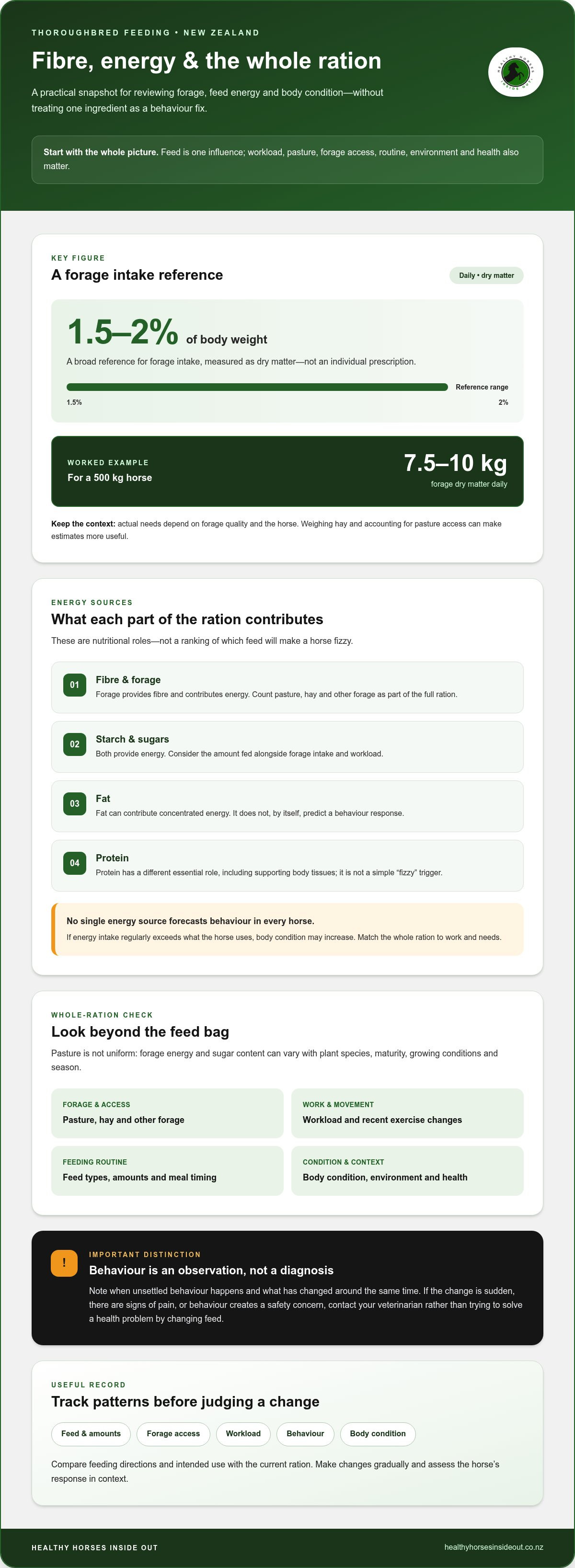
Feed is one part of the picture. Workload, turnout, forage access, feeding routine, environmental changes and health can all affect how a horse behaves. A horse doing less work than usual, for example, may have a different energy requirement. A change in routine or discomfort could also affect how settled it seems. Look for possible links rather than assuming a particular nutrient is responsible.
What does fizzy behaviour tell you about a Thoroughbred?
Look for observable changes, such as increased alertness, restlessness, tension or difficulty settling during handling, exercise or downtime. Behaviour alone can’t establish a nutritional cause, so note when it occurs and what has changed around the same time. A basic understanding of Horse nutrition can help put feeding in context, but it can’t replace an individual assessment.
Separate a one-off event from a repeated pattern. A horse that is unsettled once may have responded to an unfamiliar situation. If the behaviour recurs around a particular feed time or routine change, track it more closely. Brief notes on the date, circumstances, feed and any changes in work or management are more useful than conclusions based on a single incident.
Which parts of the horse’s routine belong in the assessment?
Review the everyday details together: workload and recent changes in exercise, turnout, access to pasture or hay, feed types and amounts, and meal timing. Include changes such as a new grazing arrangement, a different schedule or a break from usual work. This context makes a later feed review more meaningful.
Also record body condition and whether your horse is maintaining, gaining or losing condition. This gives you a practical reference point, because feeding decisions need to support the horse’s overall needs, not just address behaviour. A routine ration review can help organise what the horse receives, but it can’t diagnose pain or illness.
Act promptly if the change is sudden, you notice signs of pain, or behaviour creates a safety concern. Contact your veterinarian for an assessment rather than trying to solve a health problem by changing feed. Once urgent concerns are addressed, a clear record of routine and ration can help inform a measured discussion about feeding choices.
How fibre, starch and fat contribute energy to a Thoroughbred’s diet
Energy supports normal body functions, movement and work. The goal isn’t to minimise it, but to match the ration to the horse’s needs. If daily energy intake regularly exceeds what the horse uses, body condition may increase. A Thoroughbred in hard work and one in light work can need different rations, even if they’re similar in size.
Fibre, starch, sugars and fat can all contribute energy, but they aren’t interchangeable measures of how a horse will behave. Consider a feed’s composition alongside the amount fed, the forage eaten and the horse’s workload. No single energy source predicts the same response in every horse, so don’t treat a label’s headline ingredient as a forecast of behaviour.
Fibre and forage: the foundation to assess first
Count pasture, hay and other forage as part of the full ration, not as background. Forage provides fibre, and its energy and sugar content can vary with plant species, maturity, growing conditions and season. New Zealand pasture isn’t uniform, and a paddock’s contribution can change. “Grass-fed” alone doesn’t tell you exactly what a horse is consuming.
As a broad reference, forage intake is often recommended at 1.5% to 2% of body weight daily, measured as dry matter. For a 500 kg horse, that equates to 7.5-10 kg of forage dry matter. This is a guide, not an individual prescription: the actual ration depends on forage quality and the horse’s needs. Weighing hay and accounting for pasture access can make estimates more useful. For greater precision, forage analysis and advice from a qualified nutrition professional may help.
Starch, sugars and fat: compare energy sources carefully
Starch and sugars provide energy, while fat can also contribute concentrated energy. These describe nutritional roles, not guaranteed effects on temperament. If a horse receives more energy than its workload requires, the whole ration may need review, but that doesn’t mean one ingredient caused a behaviour change. Protein has a different essential role in the diet, including supporting body tissues, so it shouldn’t be labelled a simple “fizzy” trigger.
Compare the amount fed and the feeding directions with the forage already available. For example, if you add a bucket feed without accounting for pasture and hay, the key question is the total daily intake, not the new feed in isolation. Choosing the best feed for fizzy thoroughbred NZ horses means considering energy sources alongside workload, condition and the rest of the ration. If your horse’s needs are complex, a forage analysis and advice from a qualified equine nutrition professional can help clarify the picture.
Once you’ve assessed the ration, products such as horse supplements and HHIO Pellets can be considered as part of a feeding routine, rather than as a standalone answer to behaviour.
How to compare feeds for a fizzy Thoroughbred without relying on marketing claims
A feed label is most useful when you read it as part of a comparison, not as a promise about behaviour. Words such as “cool” or “calming” may sound reassuring, but they don’t guarantee that a horse will become less excitable. The practical question is whether the feed’s nutritional role and recommended amount fit your Thoroughbred’s current ration, workload and body condition.
There isn’t one universally best option. Feeds promoted for similar horses can differ in ingredients, energy sources and intended use. Compare the details rather than ranking them by a claim on the bag.
Which feed-label details help you make a fair comparison?
Read the ingredient list, nutrient analysis and feeding directions together. Check what type of horse or workload the manufacturer intends the feed for, then compare the suggested amount with the forage and other feeds your horse already receives. Use the same criteria for each option and assess the whole day’s ration, not just the bucket feed.
| What to compare | Questions to ask |
|---|---|
| Forage contribution | Does the feed replace, complement or add to pasture, hay or other forage? |
| Energy sources | What do the ingredient list and nutrient analysis tell you about fibre, starch, sugars and fat? |
| Intended use | Which horse type or workload does the manufacturer describe? |
| Feeding directions | How does the recommended amount fit with the horse’s existing feed and forage? |
Use the table to compare options against your horse, not against a marketing slogan. For example, a feed intended for a particular workload may not suit a horse doing substantially less work, even if its label sounds appropriate. Pasture and forage in New Zealand can vary by paddock and season, so account for what the horse actually eats. If a label doesn’t provide enough information for a sound comparison, qualified nutrition advice can help you interpret the ration.
Does a Thoroughbred need a low-starch feed?
Breed alone can’t determine the right starch or energy level. Consider the individual horse’s workload, body condition, forage intake and overall ration. A lower-starch option may be worth comparing in some feeding plans, but “low starch” isn’t a guaranteed solution for excitable behaviour. Match the feed to nutritional needs, then assess any change in the context of the horse’s broader management.
The search for the best feed for fizzy thoroughbred NZ horses is best approached as a reasoned comparison, not a hunt for a magic label. Choose based on nutritional fit and feeding directions. Avoid changing several parts of the ration at once if you want to understand how your horse responds.
A measured feed-change plan for a fizzy Thoroughbred in New Zealand
A feed change is easier to assess when you know what “normal” looks like first. Before adjusting the ration, record what your Thoroughbred eats, how much and when, including pasture, hay, other forage, feeds and supplements. Note workload, turnout and recent routine changes, alongside behaviour and body condition. This baseline gives you a fair comparison later and can help a qualified equine nutrition professional understand the whole picture.
Keep the record simple enough to maintain. A notebook or spreadsheet can capture the same details each day. Brief notes about behaviour are more useful than trying to recall a general impression weeks later.
What should you record before adjusting the ration?
Choose a few consistent situations to observe, such as handling at feed time or settling after work. Describe what you see rather than labelling the horse as “fizzy”, and note any health concerns or management changes. Record body condition and whether it appears stable, increasing or decreasing. These notes help distinguish a feeding pattern from changes in exercise, environment or wellbeing.
- Feed types, approximate amounts and feeding times.
- Forage access, including changes in pasture or hay.
- Workload, turnout and routine changes.
- Behaviour in comparable situations and body-condition trends.
How can you review whether a change is working?
Where practical, adjust one element at a time so you can interpret what follows. Transition gradually, following the relevant product directions and qualified advice rather than making an abrupt switch. Set a review point that suits the change and any professional guidance; there isn’t one timeframe that fits every feed or horse. Continue recording the same observations so you’re comparing like with like.
Use an ordered review:
- Write down the change, when it began and the transition instructions you’re following.
- Keep other parts of the routine as consistent as practical, and note any unavoidable changes.
- Compare behaviour and body condition with your baseline, without assuming every difference is caused by feed.
- Reassess the plan if condition or behaviour worsens. Seek veterinary input for new symptoms, signs of pain or marked behaviour changes.
Consistency matters, but safety comes first. Don’t wait for a planned review if you notice a sudden deterioration or a health concern. A measured process helps you assess whether the ration still suits the horse’s needs, rather than chasing an immediate change in temperament.
If your review suggests a supplement may have a place in the overall ration, explore horse supplements and HHIO Pellets as options for a considered feeding plan, not as a guaranteed behaviour fix. The best feed for fizzy thoroughbred NZ horses is an individual decision guided by the full ration, workload, condition and careful observation.
Where HHIO Pellets and supplements fit into a considered feeding plan
Consider pellets and supplements after reviewing the whole ration and identifying a nutritional role that needs attention. They aren’t a shortcut for changing behaviour. A product may form part of an individual feeding plan, but its suitability depends on what your Thoroughbred already receives, its workload, body condition and overall needs.
Before adding anything, compare its directions with the horse’s forage and existing feed. Review the recommended amount and product information alongside the rest of the ration. If you’re considering more than one product, check their labels together. Ingredients or nutrients may overlap, and adding several products at once can make it harder to understand what each contributes.
When might pellets or supplements be considered?
Start with a clear question: what nutritional role is this product intended to serve in the horse’s ration? Then consider whether that role is already covered by the forage, feed or supplements being provided. Choose a product based on that assessment, not on a promise that it will make a horse calmer or less reactive.
Complex health concerns or uncertainty about the ration call for advice from a veterinarian or qualified equine nutrition professional. A feeding product shouldn’t be used to diagnose or treat a medical condition, and ration changes shouldn’t delay assessment when a health issue is suspected.
Explore HHIO’s New Zealand horse nutrition range
Healthy Horses Inside Out offers HHIO Pellets, everyday and specific horse supplements, and supplement bundles. Consider these within an informed nutrition routine, based on the horse and the wider ration. Follow the relevant product directions and assess each option alongside forage, current feed and the horse’s needs. No HHIO product should be treated as a guaranteed answer to fizzy behaviour or as a treatment for a behavioural or medical condition.
Before adding a product, record why you’re considering it, what it contributes to the plan and how you’ll review the ration afterwards. This keeps the decision purposeful, rather than allowing extra products to accumulate without a clear reason. If the horse’s health or nutritional needs are complicated, get professional guidance before making changes.
The best feed for fizzy thoroughbred NZ horses isn’t a single pellet or supplement. It’s a considered plan built around the individual, with products selected for a defined nutritional purpose and reviewed as the horse’s circumstances change. When you’re ready to explore options for that plan, explore HHIO’s horse nutrition range.
Make your next nutrition decision with confidence
Your next step doesn’t need to be a complete ration overhaul. Choose one practical question to guide your review, such as whether the current plan still matches your Thoroughbred’s work or whether a proposed addition has a clear nutritional purpose. Keeping the question focused makes it easier to assess the plan and discuss it with a qualified equine nutrition professional if you need support.
The search for the best feed for fizzy thoroughbred NZ horses is most useful when it leads to a thoughtful, individual decision, not pressure to buy a quick fix. As your horse’s workload and circumstances shift, revisit whether the feeding plan remains appropriate. Small, considered steps can help you make choices with greater clarity and care.
If you’re considering products as part of that process, explore Healthy Horses Inside Out’s New Zealand horse nutrition range, including everyday and specific supplements, HHIO Pellets and curated supplement bundles. Explore HHIO’s horse nutrition range and take your next step at a pace that suits your horse.
Frequently Asked Questions
Does feeding oats make every Thoroughbred fizzy?
No. Oats don’t make every Thoroughbred fizzy. They contribute starch and energy, but an individual horse’s response depends on its overall ration, amount fed, workload and other circumstances. If oats are part of the diet, record the quantity and note behaviour in comparable situations rather than assuming they’re the cause. A nutrition professional can help assess whether the feed amount and energy intake suit the horse’s work.
Can a Thoroughbred still be fizzy on a low-starch feed?
Yes. Low starch doesn’t guarantee a quieter horse, and a horse can still receive more total energy than its workload requires from the whole ration. Behaviour may also be affected by changes such as a disrupted routine or unfamiliar surroundings. If you’re considering the best feed for fizzy thoroughbred NZ horses, use starch level as one comparison point, not as a prediction of temperament or a substitute for checking the wider situation.
Is a high-fibre feed always the best choice for a fizzy horse?
No. A high-fibre feed may suit some feeding plans, but “high fibre” alone doesn’t show whether the feed meets an individual horse’s energy and nutritional needs. For example, a horse in demanding work may have different requirements from one in light work, while a horse needing to manage its condition may need another approach. Compare the feed’s intended use and directions with the complete ration, and seek qualified advice if unsure.
Can pasture contribute to excitable behaviour in horses?
Pasture can contribute energy and sugars, and its composition can vary with growth stage, conditions and season. That doesn’t mean lush or green grass will make every horse excitable. If behaviour seems to change after grazing conditions shift, note pasture access and timing alongside other routine details. Where the amount or composition of forage is difficult to estimate, forage analysis can provide more specific information than judging it by appearance alone.
Should I feed a Thoroughbred differently when it is spelling?
Possibly, because a spell can reduce workload and change energy requirements, but it doesn’t automatically mean removing feed or making a large ration change. Keep the horse’s overall nutritional needs and body condition in view, and check whether the existing feed directions still fit its current work. If an adjustment is appropriate, make it gradually and monitor condition as well as behaviour. Get qualified advice if the horse’s needs are complex.
Can pain or another health issue make a horse seem fizzy?
Yes. Pain or another health problem can change a horse’s behaviour, so don’t assume a new or marked change is caused by feed. Watch for signs such as reluctance to move, sensitivity during handling or a sudden change in usual responses, and contact your veterinarian for assessment. Avoid trying to manage possible pain by altering the ration alone, particularly if the change is sudden or creates a safety concern.
How long should I monitor a horse after changing its feed?
There isn’t one monitoring period that suits every feed change. Follow the product’s transition directions and any guidance from a qualified professional, then review at a point appropriate to the change. Keep observations consistent, such as noting behaviour around the same routine and checking condition regularly. If your horse develops new symptoms or worsens, don’t wait for the review date; seek veterinary advice.


