

A calmer horse doesn’t always need a calming supplement. Equine calming starts with understanding what may be driving the behaviour, such as discomfort, a change in routine, the horse’s environment or training. A supplement may have a role in some cases, but it can’t identify or resolve every underlying cause.
If your horse seems tense, reactive or unusually unsettled, it’s natural to look for something that might help. Yet similar behaviours can have different causes, and confident product claims can make it difficult to judge what’s appropriate, especially if you’re concerned about alertness, performance or safety. A new or persistent behaviour change deserves careful attention rather than guesswork.
This guide explains when to seek veterinary assessment, how management and nutrition may influence a horse’s ability to settle, and what nutritional support can and can’t reasonably do. It also covers what to check before considering a supplement, including competition requirements if your horse competes, so you can choose a thoughtful next step rather than rely on a quick fix.
Key Takeaways
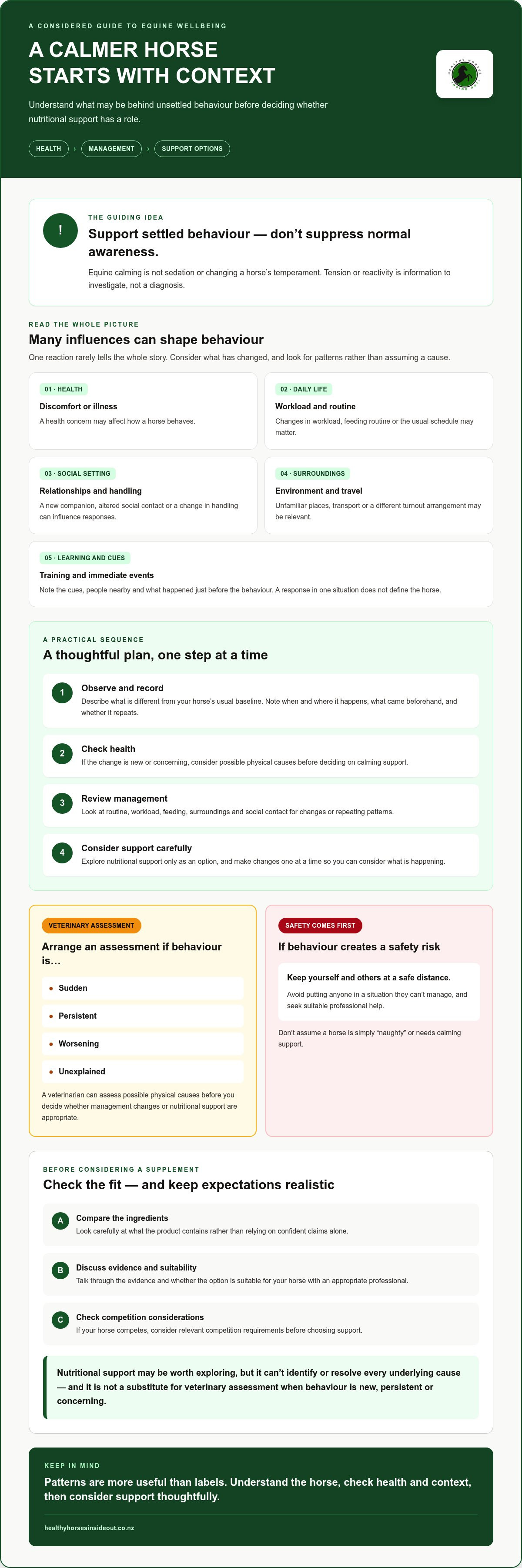
- Think of equine calming as supporting settled behaviour, not suppressing normal awareness or changing your horse’s temperament.
- Consider behaviour in context: changes in health, workload, routine, social setting or surroundings may all matter.
- Compare supplement ingredients carefully, and discuss their evidence, suitability and any competition considerations with an appropriate professional.
- Use a clear plan: observe and record patterns, check your horse’s health, review management, then consider support options one change at a time.
- Nutritional support may be worth exploring, but it isn’t a substitute for veterinary assessment when behaviour is new, persistent or concerning.
Equine calming: what unsettled behaviour can tell you
Equine calming means supporting a horse to feel settled while preserving normal awareness and responsiveness. It doesn’t mean sedating the horse or changing its temperament. A horse that appears tense or reactive is giving you information, not a diagnosis. Before looking for ways to change the behaviour, consider what’s happening around the horse and how their response compares with what’s usual for them.
A new environment, transport, a change in handling or an altered daily routine may affect how a horse responds. Other influences may be less obvious. For example, a horse may be more watchful in an unfamiliar paddock or unsettled after a change to its usual schedule. These observations can help you ask better questions, but they don’t identify a single cause.
Repeated behaviours such as weaving or stall-walking also need to be considered in context. An overview of stable vices describes these behaviours, but seeing one doesn’t establish why a particular horse is doing it. Record what you observe and consider the wider picture before drawing conclusions.
What does a settled horse look like in context?
Start with your horse’s baseline: how they typically respond to familiar people, routine tasks and everyday changes. Then describe what’s different. Is your horse more alert than usual, holding tension or reacting more strongly to a familiar cue? These are useful observations, not proof of anxiety, discomfort or any other specific problem.
One behaviour alone can’t reveal its cause. A horse that startles, resists handling or seems unusually quiet may be responding to the immediate setting, but other explanations may need consideration. Note when the behaviour occurs, what happened beforehand and whether it repeats. Patterns are more useful than labels.
When should a behaviour change prompt professional advice?
Arrange veterinary assessment if a change is sudden, persistent, worsening or unexplained. Discomfort or another health concern may affect behaviour, and a veterinarian can assess possible physical causes before you decide whether management changes or nutritional support are appropriate. Don’t assume that a horse is simply “naughty” or needs calming support.
Act promptly if the behaviour creates a safety risk for the horse or the people handling it. Keep yourself and others at a safe distance, avoid putting anyone in a situation they can’t manage, and seek suitable professional help. Equine calming starts with understanding what you’re seeing, then choosing a safe, considered next step.
Why horses may seem anxious: the role of health, environment, and the nervous system
A horse’s nervous system helps them notice changes, respond to potential threats and return to a settled state. This response is influenced by more than temperament. Pain or illness, workload, social relationships, feeding routine and surroundings may all play a part. A horse’s behaviour can reflect several interacting influences, so one reaction rarely tells the whole story.
A brief response to a sudden noise or unfamiliar setting may pass once the horse feels secure again. A pattern that repeats, worsens or appears without an obvious trigger deserves closer attention. Equine calming is best approached by looking for possible contributing factors, rather than assuming a supplement can treat anxiety or explain what the horse is experiencing.
How context and routine can influence behaviour
Keep a simple record of where and when the behaviour occurs, who is nearby and what happened beforehand. Note changes such as different turnout arrangements, a new companion, travel, a heavier workload or a shift in the daily routine. This can help you see whether the response is linked to a particular situation or also occurs in familiar settings. One difficult episode doesn’t define a horse as difficult.
Look for patterns, not just incidents. For instance, note whether tension appears during travel, around feeding or after a change in social contact. These details don’t prove a cause, but they give you and your veterinarian a more useful starting point than a broad label such as “nervous”.
Why health checks come before supplement decisions
Discomfort or illness can affect how a horse behaves. If a change is sudden, persistent, worsening or unexplained, arrange a veterinary assessment before considering a calming supplement. Share a clear timeline, the situations in which the behaviour occurs and any changes you’ve noticed in routine or workload. Your veterinarian can assess possible health concerns. Nutrition support is separate from diagnosis, treatment and prescribed care.
That distinction matters when assessing supplement claims. A veterinary overview of calming supplements and drugs for horses offers another perspective to discuss with your veterinarian. Information about an ingredient’s proposed role doesn’t establish that it will resolve a particular horse’s behaviour.
Once health concerns have been considered, reviewing the horse’s diet and management can form part of a broader plan. For general background on equine nutrition and supplement considerations, explore horse supplement guidance, while keeping decisions specific to your horse’s needs.
Equine calming supplements compared: ingredients, evidence, and realistic expectations
Calming products may contain magnesium, thiamine (vitamin B1) or tryptophan, sometimes alongside other ingredients. Their presence on a label doesn’t prove that a product will help your horse, that the amount is appropriate or that the response will be predictable. Equine calming support should never replace investigation of pain, illness or management factors.
Assess each ingredient and the finished product rather than relying on phrases such as “supports focus” or “promotes calm”. The table lists questions to take to your veterinarian or an equine nutrition professional. It isn’t a recommendation to supplement.
| Ingredient | Stated purpose | Evidence to verify | Questions for a professional |
|---|---|---|---|
| Magnesium | Often included in products marketed for calm or relaxation. | Whether evidence in horses supports the specific behaviour claim, and whether the horse’s overall diet is relevant. | Is there a nutritional reason to add it, and what is the total dietary intake? |
| Thiamine (vitamin B1) | Often described as nutritional support for normal nervous system function. | Whether research in horses supports the product’s claimed outcome and use in this context. | Is intake from the existing diet adequate, and is extra thiamine appropriate? |
| Tryptophan | Included in some formulations with claims relating to calm behaviour. | Whether horse-specific evidence supports the claim for this ingredient, dose and formulation. | Could it suit this horse, and are there interactions or other considerations? |
How to assess calming ingredient claims
Read the full ingredient list, amount per serve, feeding directions and product warnings. Look for evidence relevant to horses and to the precise outcome being claimed, not just a general explanation of how an ingredient may work. If the evidence or amounts aren’t clear, note what needs checking and ask a professional. A result reported for one horse or formula doesn’t guarantee the same response in another.
Could calming support affect alertness or performance?
Responses can vary, and an ingredient name alone can’t tell you whether your horse’s alertness, behaviour or performance will change. Discuss intended use with your veterinarian, particularly for a performance horse, and avoid first trying a new product in a situation where an unexpected response could compromise safety.
If your horse competes, check the current rules of the relevant event and governing body before using any supplement. Don’t assume an ingredient is permitted or that a product’s claims establish competition eligibility. A considered choice starts with a clear purpose, reliable information and advice suited to the individual horse.
A practical plan for supporting a horse that seems unsettled
A clear process makes it easier to spot patterns and judge whether a change is helping. Work through these steps in order, while seeking veterinary advice sooner if the behaviour is sudden, worsening or unsafe.
- Observe. Describe what your horse does without labelling the behaviour. Note whether it’s a change from their usual responses.
- Record the context. Write down when and where it happens, how long it lasts, who or what is nearby, and what occurred immediately beforehand.
- Check health. If the change is persistent, unexplained or concerning, contact your veterinarian and share your observations.
- Review management. Consider whether turnout, companions, workload, feeding routine, travel or other parts of daily care have changed.
- Assess support options. Once health and management have been considered, discuss whether nutritional support is appropriate for this horse.
What to record before making a change
A simple log can be more useful than relying on memory. Include the behaviour, timing, setting, duration and what happened just before it began. Note relevant changes in workload, feed, turnout, travel or social environment, along with any action you take. If concerns continue, share the record with your horse’s veterinarian. It can help clarify whether the behaviour follows a particular situation or appears across different settings.
How to introduce and review nutritional support
Before adding a supplement, check its suitability with your veterinarian or a qualified equine nutrition professional. Read the full label, follow its feeding directions and any professional advice, and avoid combining products with overlapping ingredients unless you’ve checked that this is appropriate. If you can, avoid changing several parts of the diet or routine at once.
Where practical, change one factor at a time. Record what changed and whether you notice a difference in the same situations. Agree on a review point, and seek professional guidance if the behaviour persists or worsens. This measured approach won’t prove that a particular change caused an improvement, but it can make your observations more useful and help you avoid guesswork.
For general information as you consider nutrition within your horse’s wider care, explore equine supplement guidance. Healthy Horses Inside Out offers everyday and specific equine supplements, but its range should not be assumed to include a calming-specific product. Use product information and professional advice to assess whether an option fits your horse’s needs.
Choosing a thoughtful equine calming approach for long-term wellbeing
A supplement may be worth discussing if veterinary concerns have been assessed, management has been considered and there’s a clear nutritional reason to explore support. It shouldn’t be the first response to a sudden or unexplained behaviour change, or a substitute for investigating possible pain or illness. Equine calming is a considered process, not a promise that a product will change behaviour.
Before choosing anything, be clear about what you hope to support and whether that outcome is realistic for your horse. Ask:
- What specific outcome am I looking for, and is this product appropriate for my horse?
- Are the ingredients and amounts clearly stated, and do the feeding directions suit my horse’s current ration?
- Could the ingredients overlap with other feeds or supplements already being given?
- Has a veterinarian or qualified equine nutrition professional reviewed its suitability?
Healthy Horses Inside Out offers everyday and specific equine supplements, supplement bundles and HHIO Pellets. Don’t assume that a product in its general range is intended to calm a horse. Any supplement choice should be based on your horse’s needs, clear product information and appropriate professional advice.
Use nutrition guidance as a starting point
For a foundation in everyday feeding considerations, read the guide to everyday horse supplements. To think through individual requirements, the guide to supplements your horse may need can help you frame questions to discuss with a professional. Neither replaces veterinary assessment or advice specific to your horse.
If you’re considering a particular ingredient, understanding horse supplement ingredients can help you assess what a label tells you and what still needs checking. Ingredient information is useful, but it doesn’t establish that a product will produce a predictable behavioural response.
Take your time, keep observing your horse and seek veterinary input if behaviour persists, worsens or raises concern. Once you’ve considered suitability and limitations, you can explore Healthy Horses Inside Out’s general supplement range as one possible part of a broader, horse-centred plan.
Take a thoughtful next step for your horse
Equine calming starts with understanding what your horse’s behaviour may be signalling. Consider changes in context and routine, keep clear observations, and seek veterinary assessment for sudden, persistent, worsening or unexplained behaviour. If nutritional support may be appropriate, check ingredient claims and suitability with a veterinarian or qualified equine nutrition professional. A supplement isn’t a substitute for investigating health or management concerns.
Healthy Horses Inside Out is a New Zealand business serving horse owners nationally, with everyday and specific supplements, bundles and HHIO Pellets. Choose from its general range with your horse’s individual needs in mind, rather than expecting a quick fix.
Explore the Healthy Horses Inside Out equine nutrition range as one resource for considering nutrition within your horse’s wider care. With careful observation and informed advice, you can make a steady, horse-centred plan and feel more confident about what to do next.
Frequently Asked Questions
What is equine calming?
Equine calming means supporting settled behaviour while preserving a horse’s normal awareness and responsiveness. It isn’t about sedating a horse or changing their temperament. A horse’s behaviour is an observation, not a diagnosis, so consider what’s happening around them and what’s normal for that individual. If a change is sudden, persistent, worsening or unexplained, seek veterinary advice rather than assuming the horse simply needs calming support.
Can calming supplements help a nervous horse?
Some horses may benefit from nutritional support, but a supplement isn’t a guaranteed solution for nervous behaviour. The effect depends on the individual horse, the product and whether there’s a relevant nutritional reason to use it. First consider possible health concerns and management factors, and discuss suitability with a veterinarian or qualified equine nutrition professional. Track behaviour objectively, as a change after starting a supplement doesn’t by itself prove the product caused it.
What ingredients are commonly found in equine calming supplements?
Magnesium, thiamine (vitamin B1) and tryptophan are among the ingredients commonly mentioned in calming supplement products. Some formulas also contain herbs or other nutrients. An ingredient’s presence doesn’t establish that the finished product is effective or suitable for your horse. Check the full ingredient list, amount per serve, feeding directions and warnings, then ask a professional whether the ingredients fit your horse’s diet and needs.
How long do calming supplements take to work in horses?
There’s no single timeframe that applies to every calming supplement or horse. Products differ in ingredients and feeding directions, and individual responses can vary, so don’t rely on a promised quick result. Follow the product label and professional advice, and record behaviour and context before and after any change. If the behaviour persists or worsens, seek veterinary guidance rather than increasing the amount or adding another supplement without advice.
Are calming supplements safe for horses in competition?
Don’t assume a calming supplement is permitted in competition just because it’s sold as a supplement or contains natural ingredients. Rules depend on the event and governing body, and prohibited-substance lists can change. If competing under FEI or affiliated national rules, check the current Equine Prohibited Substances List and seek advice about every ingredient. The Person Responsible is accountable for substances found in the horse, so verify before use.
Should I use a calming supplement before asking a vet about a behaviour change?
No. Ask a veterinarian first about a sudden, persistent, worsening or unexplained behaviour change, as discomfort or illness may be involved. Keep a brief record of what you observe, when it happens and any recent changes to routine, workload or surroundings. Once health concerns have been assessed, you can discuss whether management adjustments or nutritional support are appropriate. A supplement shouldn’t replace diagnosis, treatment or prescribed care.


