

What if the high-tech joint gel you are carefully syringing into your horse’s mouth is merely a temporary fix for a much deeper nutritional deficit? Many owners find themselves asking what is better than 4CYTE for horses when they notice recurring stiffness or clicking joints that refuse to clear up, even with premium supplementation. It is disheartening to invest in expensive treatments only to see your horse struggle to move freely in the paddock. We agree that your horse deserves a sustainable path to soundness that does not involve a confusing cocktail of additives or high monthly costs.
In this guide, you will discover why foundational nutrition and systemic mineral balance often provide more robust support than isolated joint ingredients alone. By focusing on the biological building blocks of connective tissue, you can achieve reduced inflammation and genuine long-term joint integrity. We will examine the clinical link between trace minerals and cartilage health; this approach helps you transition from reactive fixes to a simplified, science-led feeding routine that truly supports your horse from the inside out.
Key Takeaways
- Learn why true mobility depends on the structural integrity of tendons and ligaments, requiring a broader focus than isolated joint-specific gels.
- Discover what is better than 4CYTE for horses by shifting from targeted extracts to a comprehensive mineral protocol that addresses systemic deficiencies.
- Understand the critical role of copper and zinc in maintaining cartilage health and how to identify nutritional gaps in your horse's current forage base.
- Simplify your daily feeding routine using HHIO Pellets to provide a concentrated mineral foundation that supports long-term soundness and peace of mind.
Understanding 4CYTE for Horses: The Current Gold Standard?
4CYTE has established itself as a prominent fixture in many stable tack rooms, often regarded as a high-potency benchmark for joint care. This reputation is built upon its unique formulation, which combines Epiitalis, a patented plant extract, with Green Lipped Mussel and Marine Cartilage. These components are selected for their ability to influence the biochemical pathways within the joint capsule. Specifically, the formulation aims to suppress the production of inflammatory mediators while potentially stimulating the repair of damaged chondrocytes. It is a targeted approach designed to interrupt the cycle of degradation that often leads to chronic discomfort.
The mechanism behind these ingredients is focused on reducing the heat and swelling that accompany joint wear. By inhibiting prostaglandin E2 and other inflammatory cytokines, the supplement provides a chemical "brake" on the processes that break down cartilage. This focus on the joint capsule is highly effective for providing relief, which explains why it is frequently utilised by veterinarians when Understanding Equine Lameness becomes a priority in clinical settings. However, viewing the joint as an isolated island can lead to a narrow management strategy that ignores the systemic needs of the horse.
Many owners eventually find themselves asking what is better than 4CYTE for horses as they encounter practical challenges. The high cost of premium gels can become a significant financial burden over years of maintenance. Palatability is another common hurdle; some horses simply refuse the specific taste or texture, leading to expensive waste. Beyond these logistical issues, there is a growing desire for a more holistic management strategy. Owners are increasingly seeking solutions that address the underlying nutritional causes of tissue breakdown rather than solely managing the resulting inflammation.
When 4CYTE is typically recommended
Clinical application usually centres on acute injury recovery or post-operative support protocols where rapid inflammation control is paramount. It is also a staple for managing visible osteoarthritis symptoms in senior horses who require a higher level of comfort for daily mobility. For performance horses, its non-swabbable status makes it a convenient choice for those competing under strict regulations. These scenarios benefit from the concentrated "boost" that a targeted extract provide during periods of high physical stress.
The "Extract vs. Foundation" debate
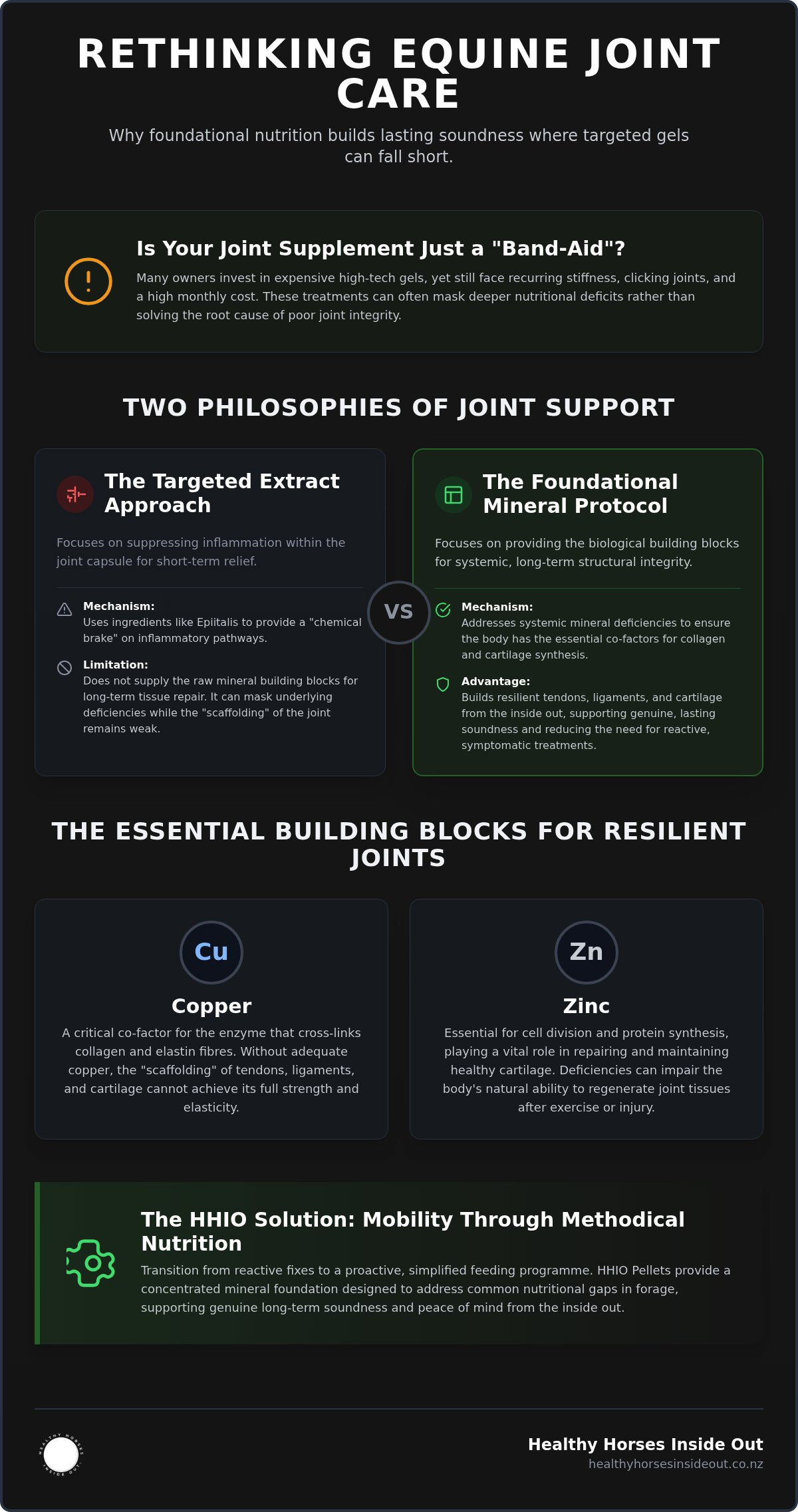
There is a significant distinction between a targeted extract and a foundational nutrient. While extracts provide a concentrated stimulus to specific biological pathways, they do not provide the raw materials required for long-term structural integrity. When owners explore what is better than 4CYTE for horses, they often discover that extracts can mask symptoms while underlying mineral deficiencies persist. If a horse lacks the copper and zinc necessary for collagen cross-linking, the joint's "scaffolding" remains weak. Success requires intentionality in your horse’s nutritional programme, ensuring that systemic balance supports every stride from the inside out.
The Science of Equine Joint Health: An Inside Out Perspective
Movement is a holistic biological process. A joint does not function in a vacuum; it relies entirely on the structural integrity of the surrounding tendons, ligaments, and the underlying bone density. If these supporting tissues are compromised by nutritional gaps, even the most advanced joint extracts will struggle to maintain long-term soundness. This is the core of the "Inside Out" philosophy. By addressing the systemic health of the horse, we ensure that the mechanical load of exercise is distributed across resilient, well-nourished structures rather than placing undue stress on the cartilage alone.
Systemic inflammation is a silent driver of joint degradation that often originates far from the limbs. When a horse’s body is in a pro-inflammatory state, the synovial fluid can become thin and less effective at protecting the cartilage surfaces. Many owners investigating what is better than 4CYTE for horses find that shifting focus toward foundational mineral balance offers a more sustainable path to soundness. The Science on Joint Supplements often highlights that while specific molecules like glucosamine are popular, they cannot compensate for a diet that lacks the essential co-factors required for tissue repair.
The Mineral Co-factors for Collagen and Cartilage
To build resilient joints, the body requires specific minerals that act as catalysts for tissue synthesis. Without these, the "repair crew" within the horse's body cannot function effectively:
- Copper: This is the essential element required for the lysyl oxidase enzyme, which cross-links collagen and elastin fibres to give tendons and ligaments their strength.
- Zinc: Vital for protein synthesis and cellular repair; zinc ensures that connective tissues can recover from the micro-trauma of daily work.
- Manganese: A key player in the production of chondroitin sulphate, which is the primary component of the "shock absorber" matrix within the joint.
In many regions, pastures are notoriously deficient in these specific minerals, leaving horses with a fragile foundation that is prone to early wear and tear.
The Gut-Joint Axis: Why Digestion Matters
The connection between the hindgut and joint comfort is increasingly recognised in equine science. Hindgut imbalances, such as acidosis or dysbiosis, can trigger the release of endotoxins into the bloodstream, leading to systemic inflammatory responses that manifest as joint heat or stiffness. Utilising high-quality prebiotics for horses NZ helps maintain a stable microbiome, which in turn reduces this inflammatory load. A healthy gut also ensures the efficient absorption of the very minerals required for structural repair. If you are looking for long-term results, optimising your horse's diet through a balanced approach is often the most effective strategy for lasting mobility.
Is a Mineral Protocol Better Than 4CYTE?
Determining "better" requires a shift in perspective. While targeted extracts provide a concentrated response to inflammation, a mineral-led protocol offers a sustainable, foundational alternative that addresses the root cause of tissue vulnerability. When owners investigate what is better than 4CYTE for horses, they are often searching for a way to break the cycle of expensive, reactive treatments. A science-led mineral approach is not simply another supplement; it is a fundamental shift in how we support the equine body's natural repair mechanisms.
Movement relies on a complex network of biological signals. When asking what is better than 4CYTE for horses, the answer often lies in the definition of success: is it masking a symptom or resolving an underlying deficiency? Minerals such as copper, zinc, and manganese do not operate in isolation. When you provide a concentrated mineral base, the benefits extend far beyond the synovial fluid. You will likely observe improvements in hoof wall density, coat depth, and overall metabolic efficiency. This is because the body uses these trace elements to synthesise the proteins and enzymes required for every structural tissue. By fortifying the entire horse, you reduce the likelihood of weak links in the kinetic chain that eventually lead to joint stress.
HHIO Pellets vs. Targeted Joint Gels
HHIO Pellets are designed to provide the essential raw materials your horse needs to build its own structural integrity from the inside out. In contrast, joint gels typically provide exogenous compounds, which are external substances intended to reduce existing inflammation. For the grass-fed horse, the pellets offer a more robust solution because they correct the specific mineral imbalances common in our pastures. While a gel might suppress heat, the pellets ensure the tendons and ligaments have the tensile strength to prevent that heat from returning. This creates a synergistic effect where the body is actually capable of maintaining its own repair pathways.
Cost-Benefit Analysis for the Long Term
The daily cost of high-end joint gels can be substantial, often making them a difficult long-term commitment for many owners. A comprehensive mineral base provides a more cost-effective strategy by reducing the need for multiple, overlapping additives. There is also an undeniable value in peace of mind, knowing that your horse's entire nutritional profile is balanced and evidence-based. Systemic mineral balance is the ultimate joint insurance policy because it fortifies the entire biological framework before the first sign of wear occurs.
Building a Superior Joint Support Routine
Establishing a superior routine begins with a shift from reactive to proactive care. Instead of waiting for the first sign of a shortened stride, we recommend a methodical approach that fortifies the horse's entire biological framework. When owners investigate what is better than 4CYTE for horses, they often discover that a structured, four-step routine provides more consistent results than a single additive. This process ensures that the horse is not merely surviving on its diet, but thriving with the specific nutrients required for tissue resilience.
- Step 1: Assess the forage base. Identify common pasture deficiencies by understanding the mineral profile of your grazing. Most New Zealand and Australian soils are notoriously imbalanced, often being high in iron or manganese which can block the absorption of critical joint-repair minerals.
- Step 2: Establish a mineral foundation. Utilise high-quality everyday horse supplements to balance the ratios in the daily hard feed. This provides the constant "background" support your horse needs for every cell in its body.
- Step 3: Add targeted support. For horses in heavy competition, those with old injuries, or senior horses, integrate Specific Horse Supplements during high-workload periods to manage acute inflammatory pressure.
- Step 4: Monitor indicators of success. Track your horse's mobility, the depth of colour in their coat, and the quality of new hoof growth. These are the external signs that your internal nutritional strategy is working.
Addressing New Zealand Pasture Challenges
New Zealand soil presents unique challenges for equine health; it is frequently deficient in the Zinc and Copper necessary for collagen cross-linking. Without these minerals, the "scaffolding" of the joint remains weak regardless of how much cartilage-specific gel is applied. Selenium also plays a vital role in protecting muscle and joint tissue from oxidative stress, particularly for horses in active work. You can improve horse health NZ wide by balancing the grass-fed diet with these missing elements, ensuring the body has the tools it needs for daily maintenance.
Transitioning from 4CYTE to a Foundational Approach
If you are currently using 4CYTE and wish to transition to a mineral-led protocol, we suggest a gradual introduction. Start by adding a small amount of HHIO Pellets to the feed to allow picky eaters to adjust to the new mineral profile. It is perfectly safe to maintain your current joint support at a reduced dose during this transition period while the mineral levels build up in the horse's system. Ultimately, what is better than 4CYTE for horses is a routine that ensures every biological requirement is met, allowing the horse to maintain its own soundness. To begin your journey toward systemic wellness, explore the range of HHIO Pellets designed specifically for the grass-fed horse.
The HHIO Solution: Mobility Through Methodical Nutrition
The transition from reactive joint management to a science-led nutritional strategy represents a commitment to your horse's long-term vitality. When searching for what is better than 4CYTE for horses, owners often find that the answer lies in a range that prioritises systemic integrity over isolated symptom relief. The HHIO range is developed with this "Inside Out" philosophy at its core, offering a methodical alternative to traditional joint care. By focusing on the biological requirements of the entire horse, we provide a pathway to soundness that is both sustainable and deeply rooted in equine physiology.
Movement should be effortless. When you provide the body with the correct ratios of trace elements, you aren't just supporting a single joint capsule; you're fortifying the tendons, ligaments, and bone density that make movement possible. This approach provides the peace of mind that comes from knowing you've addressed the foundational causes of wear and tear. It simplifies your daily routine while maximising the visible results you see in the paddock and the arena.
Why HHIO Pellets are the Base Your Horse Needs
HHIO Pellets serve as the essential cornerstone of a balanced diet, providing a concentrated source of the minerals often missing in the New Zealand paddock. Our formulation eliminates the guesswork that often plagues multi-supplement feeding routines, ensuring that your horse receives precise levels of copper, zinc, and selenium without the risk of mineral imbalances. This reflects our "Methodical Mentor" approach to wellness, where we prioritise education and evidence-based nutrition over marketing hype. By establishing this robust mineral base, you allow the horse's internal repair systems to function with peak efficiency, creating a resilient framework that can withstand the demands of work.
Targeted Support for Performance and Veterans
While a mineral foundation is critical, some horses require additional assistance during periods of high physical stress or as they enter their senior years. Combining foundational minerals with specific horse supplements allows you to provide targeted anti-inflammatory support without disrupting the systemic balance you've worked hard to achieve. This dual-action strategy is often what is better than 4CYTE for horses that have plateaued on traditional joint gels alone.
Achieving a show-ring shine and fluid, comfortable movement happens naturally when the horse is nourished from the inside out. If you're ready to take the next step in your horse's wellness journey, our guide to the Best horse supplements New Zealand offers a deeper look into achieving optimal vitality. By choosing a methodical, science-led solution, you are leading your horse toward a lifetime of soundness and genuine well-being.
Investing in Sustainable Equine Soundness
Transitioning your horse to a mineral-led protocol is more than just a change in feed; it's a commitment to biological integrity. By addressing the specific deficiencies found in local pastures, you provide the essential raw materials for tissue repair that isolated extracts simply cannot replace. When considering what is better than 4CYTE for horses, the answer lies in this "Inside Out" philosophy that fortifies every tendon, ligament, and cartilage surface.
HHIO offers science-led nutritional formulas specialised for New Zealand pasture conditions, providing you with direct-to-consumer expert support to simplify your daily routine. This methodical approach ensures your horse remains resilient and comfortable for the long term. Explore the HHIO range for a foundational approach to joint health and discover the peace of mind that comes with evidence-based wellness. Your horse’s future mobility starts with the foundation you build today.
Frequently Asked Questions
Is there a natural alternative to 4CYTE for horse joints?
A foundational mineral protocol serves as a powerful natural alternative by supporting the horse's innate repair mechanisms. While 4CYTE utilises plant and marine extracts to suppress inflammation, HHIO Pellets provide the essential trace minerals like copper and zinc that act as the biological building blocks for cartilage. By correcting common pasture deficiencies, you enable the horse to maintain its own structural integrity naturally, rather than relying solely on external extracts to manage symptoms.
Can I use HHIO Pellets alongside 4CYTE?
It is perfectly safe to use HHIO Pellets in conjunction with 4CYTE. Many owners find that establishing a solid mineral foundation actually improves the efficacy of targeted joint supplements by ensuring the body has the co-factors required to utilise them. As your horse's systemic mineral balance reaches an optimal state, you may eventually find that you can reduce the dosage of the joint gel or transition away from it entirely as the horse's comfort improves.
How long does it take to see results from a mineral-based joint protocol?
Visible improvements in coat depth and hoof quality often appear within three to four weeks, while joint comfort and fluidity of movement typically take six to eight weeks to manifest. This timeline is dictated by the rate of cellular turnover in connective tissues. Because a mineral protocol focuses on growing stronger, more resilient tendons and ligaments from the inside out, the results are cumulative and contribute to long-term soundness rather than providing a short-term fix.
Does 4CYTE contain anything that a balanced mineral supplement doesn’t?
4CYTE contains specific ingredients like Epiitalis, Green Lipped Mussel, and Marine Cartilage, which are designed to target inflammatory pathways within the joint capsule. In contrast, a balanced mineral supplement focuses on providing raw elements like copper, zinc, and manganese required for structural synthesis. When owners ask what is better than 4CYTE for horses, they often discover that while the ingredients differ, the mineral approach provides more robust support for the entire musculoskeletal system.
Is 4CYTE safe for horses with metabolic issues or ulcers?
4CYTE is generally safe for metabolic horses because it lacks high levels of non-structural carbohydrates. However, for horses with gastric sensitivities or active ulcers, some marine-based ingredients can occasionally lead to palatability issues or digestive discomfort. A concentrated mineral pellet like HHIO Pellets is often a more suitable choice for sensitive horses, as it provides foundational wellness and supports gut health without the use of marine-derived compounds that might irritate the stomach lining.
Why is Copper and Zinc so important for a horse’s joints?
Copper and zinc are the essential catalysts for the enzymes responsible for building and repairing every joint structure. Copper is required for the cross-linking of collagen and elastin, which provides the tensile strength needed for healthy tendons and ligaments. Zinc is vital for protein synthesis and cellular repair. Without these minerals, the joint's physical "scaffolding" remains weak and susceptible to injury, making their supplementation a priority for maintaining genuine mobility and long-term soundness.
What is the best joint supplement for a senior horse in NZ?
For a senior horse in NZ, the most effective strategy involves a combination of a high-quality mineral base and targeted support for chronic inflammation. Older horses often have a reduced ability to repair tissue, making the concentrated minerals in HHIO Pellets essential for daily maintenance. This foundational approach ensures the senior horse has the building blocks for repair, while Specific Horse Supplements can be added to manage age-related stiffness and provide the comfort they deserve.
Can mineral deficiencies cause lameness in horses?
Chronic mineral deficiencies are a significant underlying cause of lameness because they lead to structural weaknesses in bone and soft tissue. If a horse lacks the nutrients to maintain its ligaments and cartilage, the physical stress of exercise eventually causes micro-trauma and inflammation. Addressing these gaps is a critical part of discovering what is better than 4CYTE for horses, as it treats the systemic cause of the lameness rather than merely masking the resulting pain.


