

What if the lush, green New Zealand pasture your horse grazes every day is actually the hidden source of their brittle hooves and erratic behaviour? It’s a common paradox for owners who see plenty of grass but struggle with visible health issues that suggest something vital is missing. You likely recognise that our unique volcanic and sedimentary soils don't always provide a balanced diet, yet the sheer volume of conflicting advice on mineral ratios can make finding a solution feel overwhelming.
Providing a high-quality horse feed balancer NZ horses require is about more than just adding vitamins; it’s about correcting systemic imbalances to achieve true equine vitality. Discover how to bridge these nutritional gaps to support peak performance and a calm, focused temperament through evidence-based wellness. We’ll examine the biological link between specific mineral levels and external results, providing a clear, scientifically-backed routine that replaces guesswork with peace of mind. By focusing on foundational health, you can move away from expensive, filler-heavy feeds and embrace a methodical approach that delivers visible improvements from the inside out.
Key Takeaways
- Understand why lush New Zealand pasture often masks critical mineral deficiencies and requires a high-concentration, low-intake supplement to bridge the gap.
- Learn how to select a horse feed balancer NZ horses can actually absorb by prioritising bioavailable minerals that respect complex nutritional ratios.
- Recognise the subtle physical and behavioural indicators, such as poor hoof quality or spooky behaviour, that suggest your horse’s current diet is lacking essential support.
- Compare the practical benefits of different formats, including HHIO Pellets, to simplify your daily routine while ensuring palatability for fussy eaters.
- Discover how an evidence-based approach to systemic health drives visible external results, leading to improved muscle tone and a calm, focused temperament.
Understanding the Role of a Horse Feed Balancer in NZ
A horse feed balancer NZ horses benefit from is a highly targeted nutritional tool. It's not a bucket of grain or a simple energy source; it's a concentrated delivery system for essential minerals, vitamins, and amino acids. These products are designed for low-intake feeding, typically requiring only a few hundred grams per day to meet a horse's baseline requirements. This intentional design allows you to provide foundational support without the risk of oversupplying calories or starch. It acts as a daily insurance policy for your horse's internal health, ensuring that even if their forage varies, their micronutrient intake remains steady.
The Problem with "Grass-Only" Diets in New Zealand
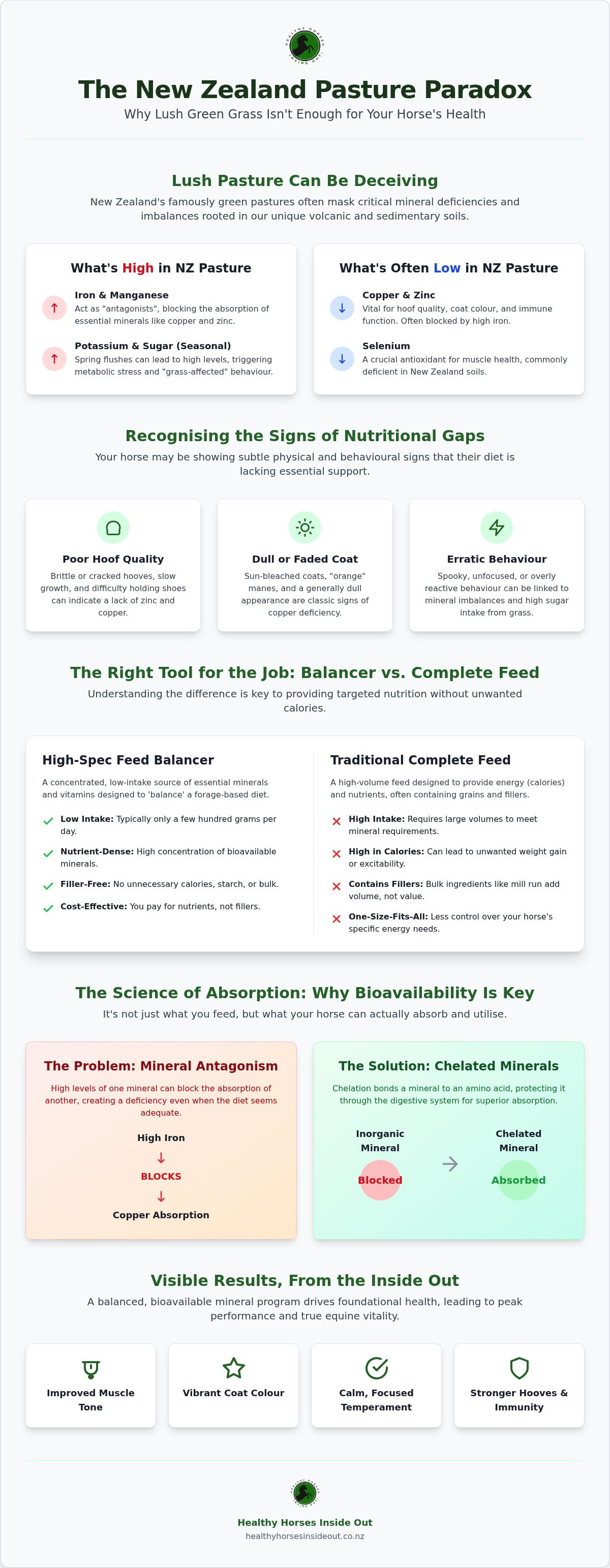
New Zealand's pasture is famously green, but "lush" does not equate to "balanced." Our volcanic and sedimentary soils are notoriously deficient in essential trace elements like Selenium, Copper, and Zinc. For a comprehensive overview of horse nutrition, one must understand how these soil-to-plant relationships dictate internal health. Beyond simple deficiencies, many regions face high levels of Iron and Manganese. These act as mineral antagonists, actively blocking the absorption of the minerals your horse actually needs to maintain healthy connective tissue and immune function.
Seasonal shifts also complicate the "grass-only" approach. Spring flushes often lead to high sugar and potassium levels, which can trigger "grass-affected" behaviour or metabolic stress. This is why "good doers" are at particular risk. While they might look fat and shiny on pasture, they often suffer from hidden malnutrition because their grass intake is restricted to manage their weight, further reducing their access to vital minerals. A balancer provides these horses with nutritional peace of mind by delivering what's missing without adding what's already in excess.
Balancer Pellets vs. Complete Feeds: What is the Difference?
Traditional "complete" or "hard" feeds are designed to provide energy through large volumes of grain, often containing fillers like mill run or hominy. If you follow the bag's instructions to get the full mineral dose, you're often overfeeding calories and starch. This can lead to unwanted weight gain or excitability. In contrast, a high-spec balancer provides those same nutrients in a fraction of the volume. HHIO Pellets focus on high-quality mineral ratios without the unnecessary bulk, allowing you to maintain control over your horse's energy intake.
This "filler-free" approach offers significant economic and physiological benefits. You aren't paying for bags of grain that your horse doesn't actually need to maintain its condition. By choosing a low-intake pellet, you simplify your feeding routine while ensuring every mouthful is nutrient-dense. This methodical approach to feeding prioritises systemic health as the primary driver of external performance, leading to better muscle tone, stronger hooves, and a more resilient animal.
The Science of Bioavailability: Correcting NZ Mineral Imbalances
The efficacy of any horse feed balancer NZ owners choose depends entirely on bioavailability. This term describes the proportion of a nutrient that is actually absorbed and utilised by the body, rather than simply passing through the digestive tract. In New Zealand, the challenge isn't just a lack of certain minerals; it's the overwhelming presence of others that act as blockers. Understanding the "Mineral Wheel" is essential here. This scientific model illustrates how minerals interact, where an excess of one element can effectively prevent the absorption of another, regardless of how much you feed.
New Zealand forage is frequently high in Iron and Manganese. These minerals are potent antagonists that compete for the same absorption pathways as Copper and Zinc. When Iron levels are disproportionately high, they "lock out" Copper, leading to systemic deficiencies. This biological conflict often manifests as visible health issues, such as sun-bleached coats, "orange" manes, or brittle hoof walls that struggle to hold a shoe. Maintaining a precise Copper to Zinc ratio is vital for the production of keratin and melanin, which are the building blocks of structural integrity and coat colour.
Chelated Minerals: Why the Source Matters
Chelation is a sophisticated process where a mineral is bonded to an amino acid or protein molecule. This creates a protective "shield" that allows the mineral to travel safely through the acidic environment of the stomach. Many mass-market supplements rely on inorganic salts, such as oxides or sulphates. These are often poorly absorbed and can be reactive within the gut. HHIO prioritises high-spec organic proteinates because they mimic the natural form of minerals found in plants. This intentional choice ensures that the nutrients in your Everyday Horse Supplements are actually available for cellular repair and metabolic function.
Addressing the Selenium Gap Safely
Most New Zealand soils are notoriously deficient in Selenium, a trace element that is foundational for immune function and muscle recovery. While supplementation is necessary for almost all NZ horses, it requires a methodical and cautious approach. Selenium is unique because the margin between a healthy dose and toxicity is incredibly narrow. Over-supplementing can lead to severe physiological distress, including the sloughing of hoof walls.
We recommend verifying your horse's current status through a blood test before introducing concentrated Selenium sources. A scientifically-backed horse feed balancer NZ horses can rely on will provide a safe, baseline level of Selenium that supports health without risking toxicity. This evidence-based strategy provides the peace of mind that you're supporting your horse's internal systems without exceeding safe biological boundaries.
Evaluating Your Options: Format and Management Styles
Selecting the ideal horse feed balancer NZ requires a balance between nutritional science and practical management. While the biological requirements remain constant, the delivery method can significantly influence whether those nutrients actually reach the horse. Owners generally choose between three formats: pellets, loose powders, or curated bundles. There isn't a single solution that fits every situation; rather, the choice depends on your horse's unique palate and your own daily constraints.
Pellets are often the preferred choice for fussy eaters who tend to sift through their feed. They ensure every mouthful contains the correct mineral ratio, which prevents the common issue of supplements being left at the bottom of the bucket. Loose powders, however, provide a high degree of flexibility. They allow for precise titration of specific minerals. This is particularly beneficial for horses with complex metabolic requirements or those on highly specific hay-based diets where you need to adjust levels based on forage analysis.
To determine the best fit for your stable, consider this short assessment:
- Does your horse consistently finish their hard feed without sifting?
- Are you looking for a low-calorie base that requires no additional grain?
- Do you need to address multiple health concerns, such as gut integrity and hoof strength, simultaneously?
- Does your daily schedule require a simplified "scoop and go" routine?
HHIO Pellets: The Foundational Base
For many busy owners, HHIO Pellets serve as a foundational base that removes the complexity of daily mineral balancing. These pellets are designed to deliver a high-spec mineral profile in a concentrated, low-calorie format. This makes them an excellent choice for horses that maintain weight easily on pasture but still require internal support. For a deeper look at these requirements, you can read The Ultimate Guide to Everyday Horse Supplements for New Zealand conditions.
Horse Supplement Bundles: Streamlining Complex Nutrition
Horse Supplement Bundles offer a methodical way to address multifaceted health goals without the risk of nutritional overlap. When owners mix multiple individual products, they often inadvertently double up on certain vitamins or minerals, which can disrupt the delicate internal balance. Curated stacks are designed to work synergistically, ensuring that gut health, hoof quality, and muscle recovery are supported through complementary ingredients. This approach is more effective for systemic health and provides the peace of mind that every nutritional base is covered with scientific precision.
Identifying Nutritional Gaps: Signs Your Horse Needs Support
Recognising that your horse requires a horse feed balancer NZ is often a matter of observing subtle physical cues before they escalate into chronic issues. While clinical tests provide a snapshot, the horse’s external condition serves as a living record of their internal mineral status. We encourage owners to monitor the Body Condition Score (BCS) regularly, as the Ministry for Primary Industries’ Code of Welfare suggests urgent action if a horse falls below a score of 2. However, even a horse with a healthy weight can suffer from "hidden hunger," where calories are abundant but essential micronutrients are absent.
Behavioural issues are frequently dismissed as training failures, but "spooky" or reactive behaviour often has a nutritional root. Magnesium plays a critical role in neuromuscular function; without it, horses may experience heightened sensitivity to external stimuli. When you correct these underlying gaps, you often see a significant shift in temperament. Most owners report a noticeable change in coat quality and "bloom" within three to six weeks, while structural changes in the hoof take longer, typically requiring a full growth cycle of six to nine months to become fully evident.
The "Inside Out" Connection: Coat and Hoof Health
Hoof structure is a direct reflection of internal health. Zinc and Biotin are essential for the production of keratin, the protein that gives the hoof wall its strength. If your horse suffers from persistent cracking or seedy toe, it's often a sign that the body lacks the building blocks for structural integrity. Similarly, a "sun-bleached" coat or an orange tinge to a dark mane is a classic indicator of Copper deficiency, as the body cannot produce enough pigment to protect the hair from UV damage. We recommend taking "before and after" photos when starting a new horse feed balancer NZ programme to objectively track these systemic improvements.
Metabolic and Digestive Red Flags
Gut sensitivity often dictates how well a horse can utilise their forage. If the digestive system is compromised, even the best nutrients won't be fully absorbed. Magnesium and specific amino acids support horses prone to muscle tension and metabolic stress, helping them maintain a steady internal environment. To understand which targeted solutions fit your horse’s specific profile, consult our 2026 guide on What Supplements Does My Horse Need in NZ?
If you're ready to bridge the nutritional gaps in your horse's diet and achieve peak vitality, browse our range of Everyday Horse Supplements today.
The Healthy Horses Inside Out Approach to NZ Nutrition
The HHIO philosophy is rooted in the conviction that external performance is a direct byproduct of systemic health. We don't believe in quick fixes or masking symptoms; instead, we prioritise the internal biological environment as the primary driver of vitality. As a Methodical Mentor, our role is to act as a guide, helping you understand the complex nutritional landscape of New Zealand. This approach moves away from the high-pressure tactics of traditional retail, focusing instead on evidence-based wellness that provides long-term security and peace of mind for the dedicated horse owner.
Integrity is the foundation of our work. Every horse feed balancer NZ horses receive from our range is the result of meticulous research into local soil conditions and forage profiles. We recognise that equine health is a partnership between science and care. By providing you with the tools to understand "the why" behind your horse's diet, we empower you to make intentional choices that support their longevity and happiness. This educational focus ensures that our relationship with customers is built on trust, transparency, and a shared passion for animal welfare.
Why HHIO Pellets and Supplements Are Different
Most commercial feeds are designed for a global market, often failing to address the specific mineral antagonists found in New Zealand's volcanic soils. Our formulations are different because they are highly targeted. We focus heavily on the Copper to Zinc ratio and the inclusion of bioavailable minerals that can actually bypass blockers like Iron and Manganese. This high-spec approach means our HHIO Pellets and supplements are free from unnecessary bulk, sugars, and fillers that often lead to metabolic stress or unwanted excitability.
By removing the "filler" and focusing on nutrient density, we offer a more efficient way to feed. Our direct-to-consumer model ensures that you aren't just buying a bag of feed; you are gaining access to expert support. If you have questions about mineral interactions or how to adjust your routine for seasonal shifts, our methodical guidance is always available to ensure your horse remains on the path to optimal health.
Taking the Next Step for Your Horse’s Health
Achieving peak vitality requires a holistic perspective that extends beyond the feed bucket. While a balanced diet is the cornerstone of health, it works in tandem with appropriate movement, stress management, and gut integrity. When the internal systems are functioning in harmony, the external results—the shiny coat, the strong hooves, and the calm temperament—become inevitable. We invite you to explore our comprehensive resource on the Best Horse Supplements New Zealand for a deeper dive into achieving this balance.
Your horse’s journey toward better health starts with a single, intentional change. By choosing a horse feed balancer NZ horses can truly utilise, you are investing in their future performance and comfort. Browse the HHIO range and start your horse’s journey today to experience the difference that an "Inside Out" approach can make.
Cultivating Long-Term Equine Resilience
Correcting the specific mineral gaps inherent in New Zealand forage is the fundamental first step toward achieving lasting structural and metabolic health. By prioritising bioavailability over sheer volume, you ensure your horse receives the targeted support they need to thrive without the unnecessary sugars and starches found in traditional hard feeds. This methodical approach to nutrition doesn't just improve the coat or hooves; it supports the internal systems that drive focus and performance.
Selecting a science-led horse feed balancer NZ horses can actually utilise is a significant investment in their future vitality. Our formulations are designed specifically for local conditions, providing high-spec mineral ratios without the use of fillers. As a proudly New Zealand owned and operated entity, we're committed to helping you achieve true peace of mind through evidence-based wellness. Invest in your horse’s foundational health with HHIO Pellets and witness the transformation that occurs when you support them from the inside out. Your horse's path to peak health is a journey we're honoured to guide.
Frequently Asked Questions
Does my horse really need a balancer if they are just on grass?
Yes, almost all horses on New Zealand pasture require a balancer to meet their baseline nutritional requirements. While our grass is often energy-dense, our soils are notoriously deficient in Selenium, Copper, and Zinc. A high-quality horse feed balancer NZ horses can utilise bridges these specific gaps without adding unnecessary calories. This ensures your horse isn't just full on grass, but is actually receiving the essential building blocks for internal health and immune function.
How long does a bag of horse feed balancer typically last?
The longevity of a bag depends on the horse's weight and the specific product's feeding rate. Typically, a standard 20kg bag of balancer pellets lasts between 40 and 80 days for a single horse. Most manufacturers recommend a daily dose of 250g to 500g for an average 500kg horse. This makes a concentrated balancer a highly cost-effective way to manage daily nutrition compared to feeding large volumes of traditional complete feeds.
Can I feed a balancer alongside my current hard feed?
You can certainly feed a balancer alongside a hard feed, provided you monitor the total nutrient intake. Many owners use a balancer to top up minerals when they are feeding less than the manufacturer's recommended amount of a complete feed. This prevents nutritional gaps without oversupplying energy or starch. It's a methodical way to ensure your horse receives a full mineral profile even when their workload and calorie requirements fluctuate throughout the year.
Is a balancer suitable for a horse prone to laminitis or EMS?
Yes, a high-spec balancer is often the ideal choice for horses with metabolic challenges like Equine Metabolic Syndrome (EMS) or laminitis. These horses require essential minerals and vitamins to support their systems, but they cannot tolerate the high sugar and starch levels found in traditional grains. A low-intake balancer provides concentrated nutrition in a safe, grain-free format, allowing you to support their health without risking a dangerous metabolic flare-up.
What is the difference between a balancer and a multi-vitamin?
The primary difference lies in the concentration and the inclusion of essential amino acids. A multi-vitamin is typically a small-dose powder focused only on vitamins and some minerals. In contrast, a balancer is a more comprehensive product that includes high-quality protein sources like lysine and methionine. These amino acids are vital for muscle development and hoof integrity. Balancers provide a more robust nutritional foundation than a simple vitamin supplement can offer.
How do I transition my horse onto HHIO Pellets?
We recommend a gradual transition over 7 to 10 days to allow your horse's digestive system to adapt. Start by adding a small handful of HHIO Pellets to their current feed and slowly increase the amount every few days while reducing their old supplement. This slow introduction is particularly important for fussy eaters or horses with sensitive guts. It ensures they accept the new taste and texture while maintaining a stable internal environment.
Will a balancer help with my horse’s spooky behaviour?
Nutritional support can significantly improve temperament if the spooky behaviour is linked to a mineral imbalance. Many New Zealand horses suffer from magnesium deficiencies or high levels of mineral antagonists in their pasture, which can lead to muscle tension and heightened reactivity. By providing a balanced mineral profile, you support the horse's nervous system. While it isn't a substitute for training, a balanced horse is often a much calmer and more focused partner.
Do I need to add extra salt or magnesium if I use a balancer?
While a high-spec balancer provides a baseline of minerals, you should still provide free-choice plain salt. Most balancers do not contain enough sodium chloride to meet a horse's daily salt requirement, especially if they are in work. Regarding magnesium, many HHIO products are formulated with high levels to counteract NZ pasture issues, so additional magnesium is often unnecessary. Always check the specific analysis of your horse feed balancer NZ to ensure you aren't doubling up.


