

What if the vibrant, emerald paddocks that define our landscape are actually masking a complex nutritional deficit in your horse? It's a common frustration for many owners who see their horses grazing on what appears to be premium forage, yet they still struggle with brittle hooves, sun-bleached coats, and those unsettling "grass-affected" behavioural shifts. The truth is that NZ horse pasture deficiencies are a byproduct of our unique geology, where high levels of iron and manganese often create a biological blockade, preventing the absorption of critical trace minerals like copper and zinc.
We understand the anxiety that comes with trying to decode complex soil reports or second-guessing your feeding routine when your horse just isn't quite right. This guide is designed to offer you peace of mind by bridging the gap between clinical soil science and daily equine care. You'll discover how to identify the subtle physical markers of deficiency in your own horse and learn the logic behind balancing mineral ratios to support foundational health. By shifting toward a methodical, evidence-based approach to supplementation, you can move beyond the frustration of trial and error and ensure your horse has the internal resilience to truly thrive from the inside out.
Key Takeaways
- Understand why lush green paddocks often hide significant nutritional gaps, as high iron and manganese levels can block the absorption of essential minerals.
- Learn how New Zealand’s volcanic soil and high rainfall contribute to chronic NZ horse pasture deficiencies, specifically in selenium, copper, and zinc.
- Identify the subtle physical and behavioural indicators of mineral imbalance, such as discoloured coats and unexplained spookiness, before they escalate into serious health issues.
- Discover why forage analysis often provides a more accurate picture of your horse's actual nutrient intake than standard soil testing alone.
- Establish a scientifically sound nutritional foundation using targeted pellets and supplements designed to balance the unique mineral ratios found in local grazing.
The NZ Pasture Paradox: Why Green Grass Isn’t Always Enough
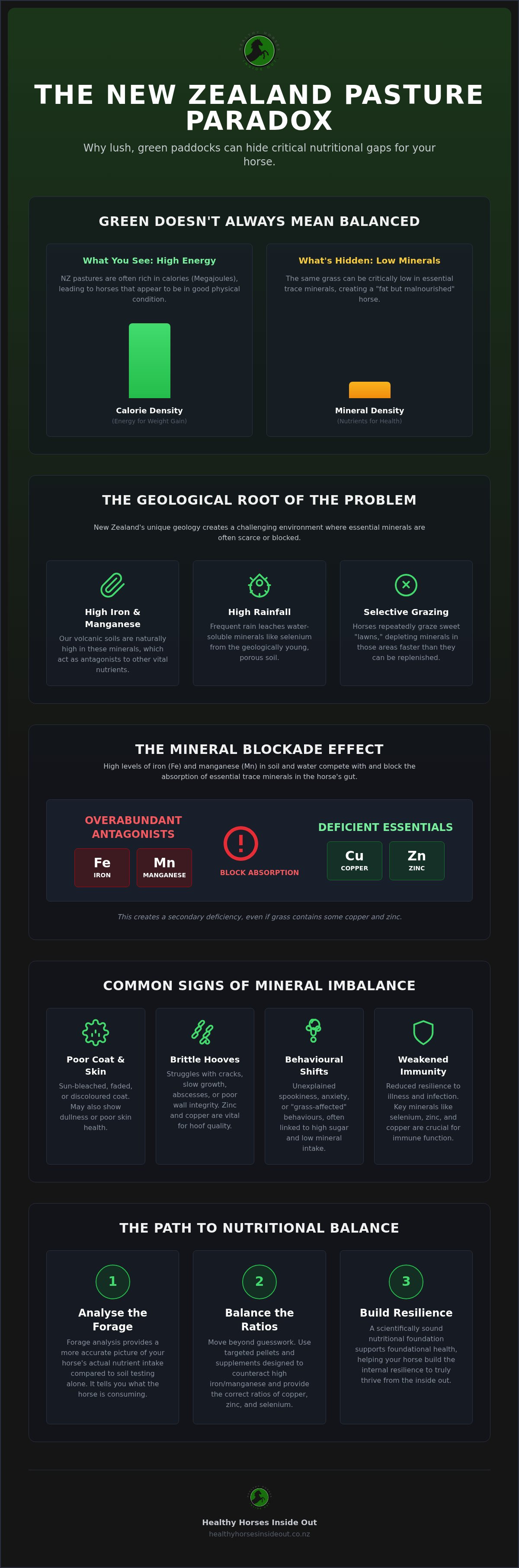
In New Zealand, we're often lulled into a false sense of security by the sight of rolling green hills. For a horse owner, however, "green" doesn't always equate to "balanced." We define a pasture deficiency as the fundamental gap between the nutrients provided by the grass and the specific requirements a horse needs for optimal physiological function. While the grass might provide enough bulk to maintain weight, it frequently fails to deliver the trace elements essential for enzyme function, bone density, and immune response. NZ horse pasture deficiencies often hide behind a lush, green appearance. Understanding foundational equine nutrition principles helps us see that visual abundance in the paddock is rarely a reliable indicator of internal health.
The Selective Grazing Trap
Horses are notoriously fussy eaters, a trait that creates a distinct "lawns and roughs" landscape in many Kiwi paddocks. They gravitate toward the shorter, sweeter "lawns," repeatedly grazing the same patches while leaving taller, coarser "roughs" untouched. This cycle of constant regrowth in the lawns puts immense pressure on the soil's mineral reserves. As the plant works overtime to produce new leaves, the concentration of trace minerals like copper and zinc often drops significantly. Simply resting a paddock might allow the grass to grow back, but it doesn't magically replenish the minerals that have been leached or extracted over years of grazing. Without intervention, these "lawns" become mineral deserts that look inviting but offer very little nutritional substance.
Calorie Density vs. Mineral Density
It's a common misconception that a horse in good condition is a horse in good health. In high-rainfall regions across New Zealand, forage can be incredibly calorie-dense, measured in Megajoules (MJ) of digestible energy, while remaining clinically poor in trace minerals measured in milligrams (mg). This results in "fat but malnourished" horses. These animals have plenty of fuel for weight gain but lack the micronutrients required for structural integrity and metabolic balance. During the spring, the surge of simple sugars in the grass can further complicate matters. High sugar levels can alter the hindgut environment, which potentially interferes with the efficient uptake of what few minerals are available in the diet. This imbalance is a primary driver behind many "grass-affected" behaviours, where the horse's system is overwhelmed by energy but starved of the minerals needed to process it calmly.
The Geological Foundation: Understanding NZ’s Unique Soil Deficiencies
NZ's spectacular landscapes are the result of intense volcanic activity and high annual rainfall, but these same forces create a challenging environment for equine health. Our soils are geologically young and frequently porous, meaning that essential trace elements are easily washed away through a process known as leaching. This geological reality is the primary driver behind NZ horse pasture deficiencies. Unlike older landmasses where minerals have stabilised, New Zealand’s soil profile is often characterised by extreme imbalances. While some minerals are scarce, others, like iron and manganese, are present in overwhelming quantities, creating a complex biological environment where "more" of one element often leads to "less" of another.
When we look at veterinary insights on pasture management, it becomes clear that regional variations play a massive role in what ends up in your horse's bucket. Understanding the soil beneath your feet is the first step in moving from guesswork to intentional, evidence-based nutrition.
The Copper and Zinc Deficit
High iron levels in both our soil and groundwater act as a biological "blockade" against the absorption of copper and zinc. In the horse's small intestine, these minerals compete for the same transport proteins. When iron is dominant, it effectively crowds out the others, leading to a secondary deficiency even if the grass technically contains some copper. This is particularly concerning because copper and zinc are foundational to the integrity of connective tissues, hoof quality, and immune system resilience. Most standard, off-the-shelf mineral mixes are formulated for international averages and simply don't provide the high-ratio dosages required to overcome the iron antagonism found in NZ conditions.
The Selenium and Iodine Challenge
New Zealand is globally recognised for its low selenium and iodine levels. Selenium deficiency is widespread across both the North and South Islands, with many pastures providing less than 0.01mg/kg of dry matter, far below the required 0.1mg/kg. This trace element is vital for muscle function and protecting cells from oxidative stress. Iodine is equally critical, serving as the cornerstone for thyroid function and metabolic regulation. However, supplementing these elements requires precision. Selenium has a notably narrow safety margin; the gap between a therapeutic dose and toxicity is small. This makes a methodical, science-led approach essential for correcting NZ horse pasture deficiencies safely. If you are looking to provide a balanced foundation, our Everyday Horse Supplements are designed to address these regional gaps with clinical accuracy.
Beyond the Surface: How Pasture Gaps Manifest in Equine Health
One of the most persistent challenges for owners is the sub-clinical nature of mineral imbalances. You might look at your horse and think they look "fine," but clinical health and optimal vitality are two very different states. Often, the outward signs of NZ horse pasture deficiencies only become obvious once the internal reserves are completely exhausted. By the time you notice a change in coat colour or hoof quality, the horse's system has likely been compensating for months. Recognising these early warning signs is essential for proactive management rather than reactive treatment.
The Impacts of mineral deficiencies in NZ pasture are well-documented, showing clear links between specific soil gaps and systemic health issues. When certain minerals are missing, the biological "machinery" of the horse begins to falter, leading to visible markers that many owners mistakenly attribute to age, genetics, or simply the weather.
Visible Indicators in Coat and Skin
A horse's coat is a direct window into their nutritional status. A classic sign of copper deficiency is the "orange" or ginger tinge on dark coats, particularly visible in the mane and tail. You might also notice "spectacles," which is a loss of pigment or thinning hair around the eyes. These aren't just aesthetic issues; they indicate that the horse's pigment-producing enzymes aren't functioning correctly due to a lack of copper. Zinc deficiencies often manifest as skin sensitivity, slow-healing wounds, or a general lack of "bloom." Integrating high-quality everyday horse supplements helps to bypass the iron blockade mentioned earlier, restoring a deep, natural shine and resilient skin barrier.
The Foundation: Hoof Integrity
The old adage "no hoof, no horse" remains a scientific truth. Hoof horn is a specialised tissue that requires a precise balance of zinc, copper, and biotin to maintain its structural integrity. When NZ horse pasture deficiencies are present, the hoof wall often becomes brittle, leading to crumbling edges and a high frequency of abscesses. You may also notice "grass-affected" hooves during seasonal growth spurts, characterised by rings or ridges on the hoof wall. This often happens when the surge of sugar in spring grass coincides with a lack of the minerals needed to build strong, dense horn. Without the correct mineral ratios in the hindgut, the hoof cannot withstand the physical demands of work or even the damp conditions common in New Zealand winters.
Behavioural Shifts and Muscle Function
It's common to label a horse as "spooky" or "fizzy," but these traits are often driven by mineral imbalances rather than temperament. Magnesium and calcium play critical roles in nerve transmission and muscle relaxation. In many NZ pastures, the ratio of these minerals is skewed, leading to a state of chronic muscular tension. A horse that is perpetually "tight" or over-reactive to its environment may simply be struggling with a nervous system that is chemically unable to relax. Addressing these gaps isn't about sedating the horse; it's about providing the metabolic tools required for a calm, focused response.
Managing the Deficit: A Step-by-Step Approach to Nutritional Balance
Correcting NZ horse pasture deficiencies requires a shift from reactive problem-solving to a structured, preventative programme. It's not enough to simply add a generic scoop of minerals; you need a strategy that acknowledges the unique chemistry of your land and the specific metabolic needs of your horse. By following a methodical progression, you can move away from the "hit and miss" approach of retail supplements and toward a foundation of long-term wellness. This intentionality ensures you aren't just feeding for maintenance, but for systemic resilience.
- Step 1: Visual Assessment. Regularly evaluate your horse’s coat colour, hoof wall integrity, and general demeanour. These are your primary data points.
- Step 2: Forage Analysis. Move beyond soil tests to understand exactly what nutrients are present in the grass your horse is consuming daily.
- Step 3: Foundational Supplementation. Implement a base mineral profile designed to overcome the high iron and manganese levels common in NZ soils.
- Step 4: Seasonal Monitoring. Adjust your routine as grass growth cycles and workloads change throughout the year.
Testing and Analysis
A common pitfall is over-relying on soil tests. While these reports provide a snapshot of ground chemistry, they don't reflect what the plant actually takes up or what the horse successfully absorbs. High soil iron, for instance, doesn't always show the full extent of the copper blockade in the hindgut. This is where understanding horse supplement ingredients NZ becomes vital. You need to know which mineral forms are most bioavailable for a horse already struggling with pasture imbalances. For critical elements like selenium, we recommend periodic blood testing to ensure levels remain within the safe therapeutic range.
Seasonal Adjustments
The nutritional landscape changes with the weather. During the spring flush, grass is often high in water and sugars but diluted in essential trace minerals. This rapid growth phase is when NZ horse pasture deficiencies are most likely to trigger behavioural issues or hoof sensitivity. Conversely, winter grazing often lacks the vitamin E and protein found in lush grass, requiring a different support profile. Utilising specific horse supplements allows you to bridge these seasonal gaps without over-supplementing what is already abundant. If you're ready to establish a science-led routine for your horse, you can explore our full range of Everyday Horse Supplements to find the right foundation for your paddock conditions.
Holistic Solutions: Supporting Your Horse from the Inside Out with HHIO
Addressing the systemic nature of NZ horse pasture deficiencies requires more than a casual addition to the feed bin; it demands a foundational shift in how we view equine nutrition. At Healthy Horses Inside Out (HHIO), we advocate for a science-led, "inside out" philosophy that prioritises long-term systemic health over the superficial "quick fixes" often found in retail environments. By focusing on the biological mechanisms that drive external performance, we provide owners with the peace of mind that comes from evidence-based wellness. Our role is that of a methodical mentor, guiding you through the complexities of mineral ratios to ensure your horse has the internal support required to thrive on New Zealand soil.
This commitment to integrity means we only use high-quality, bioavailable ingredients that are specifically selected for their ability to perform in the local environment. We don't believe in one-size-fits-all solutions; instead, we offer a structured framework that respects the horse's physiology and the owner's need for transparency and results.
The HHIO Pellet Advantage
For many owners, the primary challenge of supplementation is ensuring the horse actually consumes the prescribed dose. Traditional powders often sift to the bottom of the bucket or are blown away, leading to inconsistent intake of critical trace elements. HHIO Pellets solve this by serving as a highly palatable, foundational carrier that ensures your horse receives every milligram of its required mineral profile. These pellets are specifically formulated with high-dose copper and zinc to counteract the iron antagonism discussed in earlier sections. Beyond mineral delivery, the pelleted base supports metabolic stability and gut health, providing a steady nutritional baseline that remains consistent regardless of seasonal grass fluctuations.
Simplifying with Bundles
We recognise that managing a horse's diet can feel overwhelming, especially when you're trying to balance conflicting soil reports with visible health markers. To streamline this process, we've developed Horse Supplement Bundles that take the guesswork out of nutritional balance. The "Everyday Care" bundle, for example, is designed as a complete solution for the grass-fed horse, providing a precise ratio of minerals, vitamins, and amino acids to bridge common gaps. Other targeted bundles focus on specific physiological needs, such as hoof integrity or digestive sensitivity, allowing for a modular approach to health. Discover how the best horse supplements New Zealand has to offer can transform your horse’s wellbeing by addressing the root causes of NZ horse pasture deficiencies through intentional, high-quality nutrition.
Cultivating Long-Term Equine Vitality
Understanding the intricate relationship between New Zealand’s geologically young soils and your horse’s systemic health is the first step toward true wellness. We've explored how vibrant paddocks often mask significant NZ horse pasture deficiencies, where high levels of iron and manganese act as biological barriers to essential trace elements. By recognising the subtle physical markers of imbalance and adopting a structured, forage-focused nutritional plan, it's possible to shift from reactive care to proactive health management.
Our expert-led approach prioritises internal stability as the primary driver of external performance. Every formula we create is scientifically tailored for New Zealand soil conditions, ensuring your horse receives the precise mineral ratios needed for resilient hooves and a vibrant coat. This methodical focus on integrity and bioavailability provides the peace of mind that your nutritional foundation is both sound and sustainable. Explore our science-led horse supplements at Healthy Horses Inside Out and discover the difference that targeted, "inside out" nutrition can make for your horse's future.
Frequently Asked Questions
Is NZ grass really that different from pasture in other countries?
Yes, New Zealand’s pasture is geologically distinct because our soils are volcanic and relatively young. Unlike older continents with stable mineral profiles, our high annual rainfall causes significant leaching of essential trace elements. This creates a specific landscape of NZ horse pasture deficiencies, where grass may be energy-dense but lacks the foundational minerals required for long-term health. We must manage our horses based on local soil chemistry rather than international standards.
Can I just use a multi-vitamin block in the paddock?
Multi-vitamin lick blocks are generally insufficient for correcting established deficiencies because horses rarely consume them in consistent or adequate quantities. Most generic blocks don't contain the high-ratio dosages of copper and zinc necessary to bypass the iron antagonism found in NZ soil. Relying on a block often leads to inconsistent intake, which lacks the methodical precision required to support internal systemic health and metabolic stability over time.
How do I know if my horse has a selenium deficiency?
A veterinary blood test is the only reliable way to confirm selenium status due to the narrow margin between deficiency and toxicity. While muscle stiffness or a poor immune system can be indicators, these signs are often sub-clinical and easily missed. Because NZ pastures frequently provide less than 0.01mg/kg of selenium, regular testing ensures you can supplement safely without risking the dangerous effects of over-supplementation or clinical toxicity.
What are the most common NZ horse pasture deficiencies I should worry about?
The most prevalent NZ horse pasture deficiencies involve selenium, copper, and zinc. These three elements are consistently low across both islands, yet they are vital for everything from enzyme function to hoof horn integrity. Additionally, high levels of iron and manganese in our soil act as antagonists; this means even if some copper is present, your horse likely cannot absorb it without targeted, high-ratio supplementation to overcome the biological blockade.
Why does my horse’s coat change colour in the summer?
A shifting coat colour, such as a dark coat turning ginger or "sunburned," is often a clinical sign of copper deficiency rather than just sun damage. Copper is a primary component of the enzyme tyrosinase, which produces melanin for hair pigment. When copper levels are low, the hair shaft loses its structural integrity and pigment, leading to the faded, brittle appearance frequently seen in horses grazing on unbalanced NZ pasture.
Can too much iron in the water affect my horse’s mineral balance?
High iron concentrations in bore or tank water significantly interfere with the absorption of copper and zinc in the small intestine. Because these minerals share the same uptake pathways, an excess of iron effectively "locks out" the other essential trace elements. If your water is high in iron, your horse requires a mineral supplement with specifically balanced ratios to overcome this blockade and maintain foundational connective tissue and immune health.
How long does it take to see results after starting a mineral supplement?
You will typically notice improvements in coat shine and skin quality within three to six weeks of starting a balanced mineral routine. However, structural changes like hoof horn integrity take much longer to manifest, as the new, stronger horn must grow down from the coronary band. It usually takes six to nine months to see a completely new, resilient hoof wall that reflects the horse's improved internal nutritional status.
Do I need to supplement my horse if they are in good condition (fat)?
Yes, a horse in "good condition" can still be clinically malnourished in trace minerals. Caloric intake is entirely separate from mineral density. Many NZ horses are "fat but starved" because they consume high-energy, high-sugar grass that lacks the copper, zinc, and selenium necessary for metabolic function. Supplementing these horses ensures their internal systems work efficiently, supporting long-term wellness even when their total calorie intake must be restricted.


