

A horse that seems tense or reactive may need a closer look at its whole ration, not an automatic scoop of magnesium. Behaviour alone can’t establish a nutritional need. When comparing a magnesium supplement for horses NZ, start with what your horse already eats and what the full formula contains, rather than treating magnesium as a one-size-fits-all calming fix.
New Zealand forage conditions, including seasonal pasture flushes with high potassium, may also be relevant because potassium can interfere with magnesium absorption. Consider the ration as a whole, and seek appropriate professional advice if you’re unsure about your horse’s needs.
This guide explains what to assess before supplementing, how to read magnesium terminology and labels, and how to compare complete formulas. We’ll look at HHIO’s magnesium-containing formulas, proudly made in New Zealand, as examples of why the wider nutritional picture matters.
Key Takeaways
- Assess whether supplementation fits your horse’s individual circumstances before responding to behaviour with a new feed addition.
- Compare a magnesium supplement for horses NZ by reading the full label, not judging suitability by the magnesium form alone.
- Use a four-step check to review the ration, read the formula, consider its wider nutritional context and follow product directions.
- Compare HHIO Performance, HHIO Foundation and HHIO Restore as complete formulas, not as interchangeable sources of magnesium.
When might a magnesium supplement for horses be worth considering?
Think of supplementation as a decision about the whole diet, not a response to one difficult ride or a change in temperament. For New Zealand horse owners considering a magnesium supplement for horses NZ, begin by listing what the horse already receives through forage, feed and other supplements. Workload and individual circumstances also matter. A label or a behaviour change alone can’t show whether the total ration is appropriate.
Why owners search for magnesium support
Owners often look into magnesium when they hope to support calm behaviour, focus or muscle function. These concerns can have more than one explanation. A horse’s routine, workload, comfort and overall health all provide useful context; a supplement isn’t a quick fix or a promise to change behaviour. Magnesium has a role in normal muscle function, but tension or distractibility doesn’t establish that a horse is deficient.
Keep a simple record of what you observe, when it happens and what has changed in the horse’s feeding or routine. That context can make a discussion about equine nutrition requirements more useful than choosing a product based on a single sign.
What a supplement can and cannot tell you
A supplement can contribute nutrients to a ration. It can’t diagnose a deficiency, explain persistent behaviour or replace assessment of an ongoing health concern. Even a product that contains magnesium needs to be considered alongside its other ingredients and the horse’s existing diet, rather than viewed as a stand-alone answer.
If a change in behaviour or physical comfort persists, worsens or concerns you, seek guidance from a veterinarian or equine nutrition professional before assuming supplementation is the answer. Their advice can help determine whether the diet needs adjustment or whether another issue deserves attention. Start with evidence about the individual horse, not assumptions based on appearance or temperament.
Magnesium forms and labels: what should horse owners understand?
A label may name a magnesium compound, but that detail is only one part of the decision. The form alone doesn’t show whether a product suits an individual horse or how it fits the existing ration. The Merck Veterinary Manual guide to equine magnesium supplementation discusses common forms, including oxide, carbonate and sulphate. Use those names to identify what’s present, not to assume one form is universally superior.
How to read magnesium terminology
“Organic magnesium” is a marketing description, not a distinct scientific category of mineral. The site explains that an organic compound is bound to a hydrogen atom, while an inorganic mineral typically comes from the earth. The wording alone doesn’t establish that a form is more suitable or effective for your horse. Read the ingredient name alongside the product’s full composition and feeding directions.
| Label detail | What it tells you | What it doesn’t tell you |
|---|---|---|
| Magnesium oxide, carbonate or sulphate | The named magnesium compound in the formula | Whether the complete product suits your horse |
| “Organic magnesium” | A marketing description associated with an organic compound, rather than a separate scientific mineral category | Whether the product is suitable for your horse or a better choice than another formula |
| Other listed ingredients | What else the formula contributes | Whether those additions are needed in the existing ration |
Why the full ingredient panel matters
Magnesium may appear alongside vitamins, amino acids, trace minerals or other ingredients. Those additions change the formula’s nutritional context. Compare the full panel with what your horse already receives rather than choosing by the magnesium line alone. Check ingredient amounts and feeding directions where provided, and consider whether nutrients overlap with other parts of the ration. The horse supplement ingredients guide can help you read labels more confidently.
For a magnesium supplement for horses NZ, treat the label as a starting point, not a verdict. You can also explore magnesium-containing horse supplements and compare each complete formula.
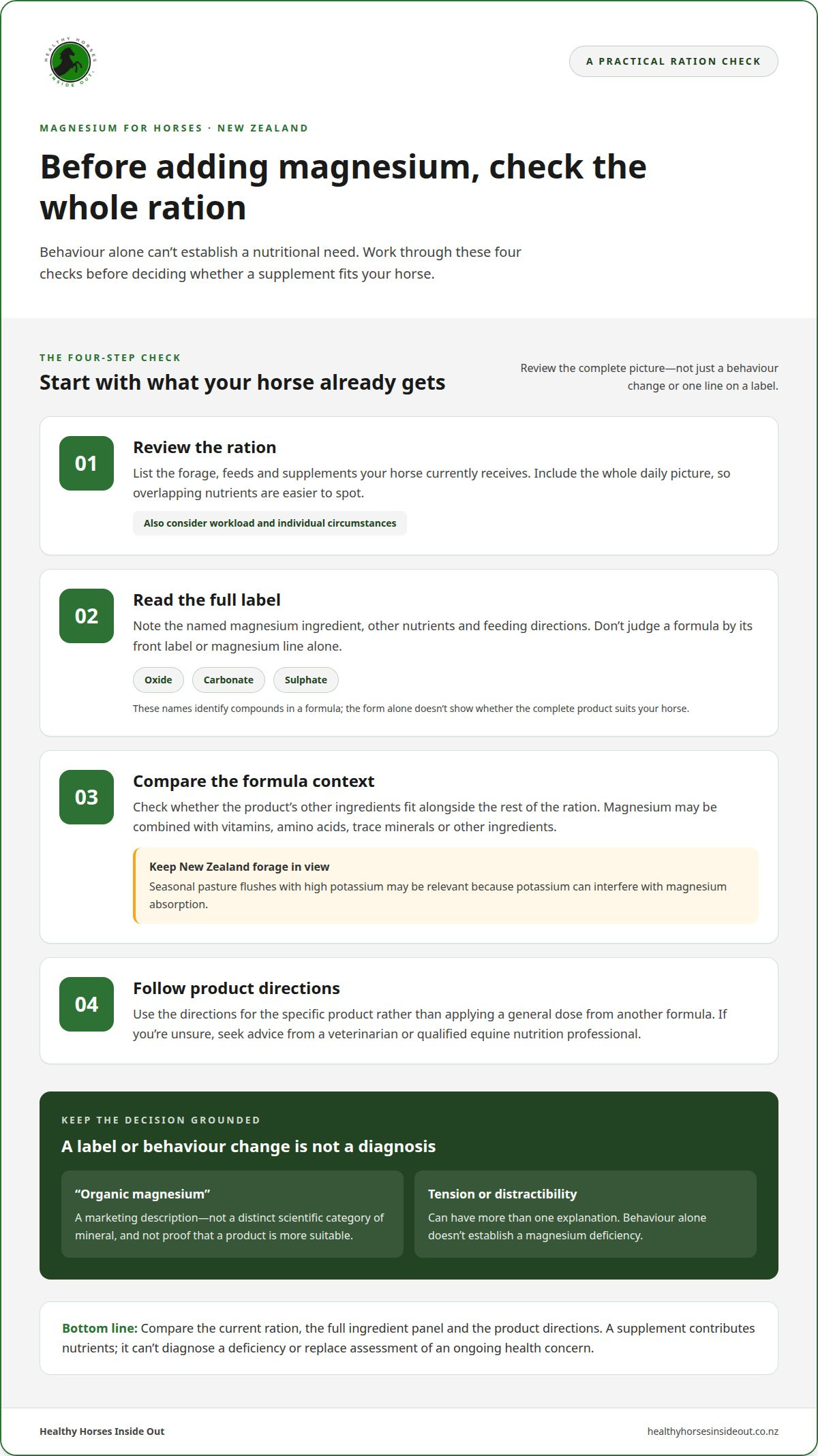
How to assess a magnesium supplement for your horse
A careful comparison starts with the ration, not the product claims. Behaviour alone can’t tell you that a horse needs magnesium, and adding a supplement without considering existing feeds can make the overall plan harder to assess. Use this sequence to work through the decision:
- Review the ration. List the forage, feeds and supplements your horse currently receives. The guide to everyday horse supplements can help you consider those inputs together.
- Read the full label. Note the named magnesium ingredients, other listed nutrients and the product’s feeding directions. Don’t judge the formula from its front label alone.
- Compare the formula context. Consider what else the product contributes and whether those ingredients fit alongside the rest of the ration. A product’s magnesium form or a change in behaviour can’t establish individual need.
- Follow product directions. Use the directions for the specific product rather than applying a general dose from another formula. If you’re unsure, seek advice from a veterinarian or qualified equine nutrition professional.
Review the ration before adding a supplement
Look at the complete daily picture, including other supplements that may provide overlapping nutrients. Keep product labels and feeding information with your ration notes, so you can compare like with like. Magnesium has a role in equine muscle and nerve function, but that doesn’t mean every horse with tension or reduced focus needs extra magnesium.
Before feeding, compare the current ration, named ingredients, full formula and product-specific directions. Seek professional advice if individual health concerns remain. That’s a more useful basis for assessing a magnesium supplement for horses NZ than behaviour alone or a generic dosage suggestion.
Ready to use this checklist? Compare magnesium-containing horse supplements by their full formulas and feeding directions.
Magnesium-containing HHIO formulas: compare the whole product
Once you’ve reviewed your horse’s ration and what you want a formula to contribute, compare the stated ingredients rather than treating magnesium as the only deciding factor. Healthy Horses Inside Out offers distinct magnesium-containing formulas. Their ingredient details aren’t interchangeable, and they don’t indicate which option is right for an individual horse.
Compare formula context, not a single ingredient
- HHIO Performance contains 1,000 mg magnesium. This is the amount stated in the product information, not a serving-size recommendation.
- HHIO Foundation includes non-organic magnesium.
- HHIO Restore includes magnesium described in the product information as organic and non-organic forms. Here, “organic” is a marketing description for an organic compound, not a separate scientific mineral category.
These are factual distinctions, not personalised health recommendations. Check each product’s full ingredient information and feeding directions, then consider them alongside your horse’s current ration. To organise that decision, the guide to choosing horse supplements offers further context for assessing what may fit into a broader feeding plan.
HHIO formulas are proudly made in New Zealand and contain no fillers or preservatives, and no sugar, added iron or ingredients high in iron. These shared formulation details help describe the range, but they don’t replace comparing individual product ingredients or considering your horse’s circumstances.
A considered next step with HHIO
Keep the same measured approach: review the full ration, read the product information, compare the complete formula and follow its directions. If your horse has an ongoing health concern or you’re uncertain about dietary changes, seek advice from a veterinarian or qualified equine nutrition professional. Consider a magnesium supplement for horses NZ in the context of the individual horse, rather than selecting one from a single ingredient claim.
When you’re ready to compare the range, explore HHIO horse supplements and review each formula with your horse’s whole diet in mind.
Make your next feeding decision with confidence
Choosing a magnesium supplement for horses NZ can be the start of a more deliberate feeding plan, not a commitment to keep adding ingredients indefinitely. Before changing the ration, write down what prompted the decision, what your horse currently receives and what you’d like to clarify. Include the product information you’re considering so any discussion about the plan can be specific to your horse rather than based on a general claim.
Keep those notes together and revisit them if the ration or your horse’s circumstances change. If you have ongoing health or behaviour concerns, take the information to your veterinarian or a qualified equine nutrition professional. This can help you decide on a considered next step, including whether supplementation belongs in the plan.
When you’re ready to explore formulas in the context of your horse’s needs, explore HHIO’s horse supplements. Take the next step with a clear rationale for what you choose to include in your horse’s daily ration.
Frequently Asked Questions
Is magnesium a calming supplement for every horse?
No. A magnesium product can’t be assumed to settle every horse; calmness and reactivity can be affected by several factors, and behaviour alone doesn’t prove a deficiency. If a horse is unsettled only in a particular setting, note when it happens and what else has changed rather than treating that observation as a diagnosis. Persistent or concerning changes warrant veterinary advice.
How do I know whether my horse needs a magnesium supplement?
A single sign can’t establish need. If comparing a magnesium supplement for horses NZ, start by listing the horse’s existing feeds and supplements, then note any changes in workload, routine or condition that prompted the question. This gives your veterinarian or a qualified equine nutrition professional useful context to assess whether a dietary adjustment is appropriate, rather than relying on a behaviour-based guess.
Can I feed a magnesium supplement alongside other supplements?
Potentially, but assess the combination first. For example, if two products both list trace minerals or vitamins, record both ingredient panels and follow each product’s directions so the full feeding plan is visible. Don’t assume separate products are automatically complementary. If your horse has a health condition, takes other products or the combined plan is unclear, discuss it with a veterinarian or qualified equine nutrition professional.
How much magnesium should I give my horse?
There isn’t a single amount that applies across all formulas. Use the feeding directions for the exact product you have, including any conditions or horse-size categories stated there. Don’t transfer a measurement from another brand or formula. If the label doesn’t address your horse’s circumstances, or you’re unsure how it fits the ration, pause and seek advice from a veterinarian or qualified equine nutrition professional.
Are all magnesium forms the same in horse supplements?
No. Labels can name different compounds, and “organic” in “organic magnesium” is a marketing description for an organic compound, not a separate scientific mineral category. That wording alone doesn’t establish suitability or superiority. Compare the ingredient panel and stated feeding information, then consider what else the formula contains. A familiar-sounding form name isn’t a substitute for assessing the complete product.


