

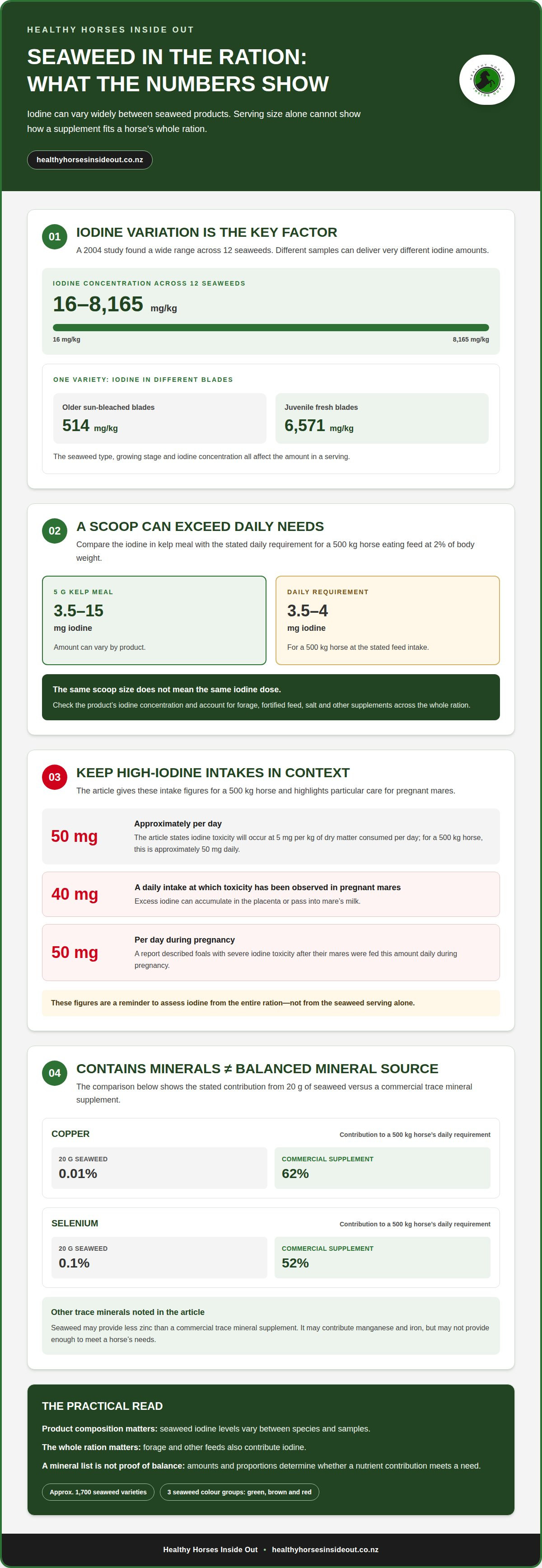
Seaweed can contribute iodine, but it isn’t a reliable way to meet a horse’s full mineral needs. Potential equine seaweed supplement benefits depend on the product’s composition and the rest of the ration: a 5 g serving of kelp meal can provide 3.5 to 15 mg of iodine, while a 500 kg horse eating feed at 2% of its body weight per day needs 3.5 to 4 mg daily. That range makes the dose and existing feed important, not just the scoop size.
Seaweed can contribute minerals, but equine seaweed supplement benefits depend on its variable iodine content and how it fits the whole ration. Excess iodine can pose health risks, particularly for pregnant mares, and kelp alone does not provide trace minerals in balanced amounts.
This article explains how to weigh possible benefits against iodine intake, why kelp is not a complete mineral supplement, and what to consider when assessing suggested amounts. Forage, fortified feed, salt and other supplements all contribute to the overall picture, so decisions should be based on the whole ration, not one ingredient.
Key Takeaways
- Seaweed iodine levels can vary widely, so the product’s composition matters as much as the serving size.
- Assess kelp alongside the horse’s whole ration; its mineral profile may not address every nutritional need.
- Suggested amounts are not interchangeable across products. Consider iodine concentration and the horse’s existing feed and supplements.
- Use the article’s comparisons to judge when seaweed may have a place and when a more balanced mineral approach is worth considering.
Can seaweed cause iodine toxicity?
Yes, seaweed can raise iodine intake sharply because iodine levels vary between species, samples and servings. The risk for a horse depends on the iodine in its entire ration, including forage and other feeds.
Variation in seaweed iodine content
Seaweed iodine concentration differs widely between species and even between samples of the same variety. A 2004 study found concentrations from 16 mg/kg to 8165 mg/kg across 12 seaweeds. In one variety, older sun-bleached blades contained 514 mg/kg, while juvenile fresh blades contained 6571 mg/kg.
A scoop or handful therefore does not provide a dependable iodine dose on its own. The seaweed type, growing stage and iodine concentration all affect how much a horse receives. As a result, similar serving amounts can provide very different iodine totals in different products.
Kelp iodine levels
Kelp can be particularly iodine-rich, but its concentration is not consistent. Kelp iodine levels can reach 1,850 mg/kg of dry matter, while seven Laminaria samples measured from 796 to 2984 mg per kg. A 5-gram serving of kelp meal can provide 3.5 to 15 mg of iodine.
Those figures show why product weight alone cannot establish a suitable dose. At 8000 mg/kg iodine, 6 grams of seaweed is described as enough to cause acute toxicity in a 500 kg horse. The iodine concentration changes the effect of the same measured amount.
Iodine from seaweed and forage
Forage contributes to dietary iodine intake, so consider seaweed alongside the horse’s daily forage and other feeds. The total matters more than the supplement by itself, since iodine from different sources adds up across the ration.
Iodine toxicity in horses will occur at an intake of 5 mg per kilogram of dry matter consumed per day. For a 500 kg horse, that is approximately 50 mg per day. Pregnant mares require particular care: toxicity has been observed at 40 mg of iodine per day, and excess iodine can accumulate in the placenta or pass into mare’s milk.
In a report, mares fed 50 mg of iodine per day during pregnancy had foals with severe iodine toxicity. These examples make the practical point clear: calculate seaweed iodine in context, rather than assuming forage or a small-looking serving makes the total safe.
Is kelp enough to meet a horse's mineral requirements?
Kelp can contribute iodine and some minerals, but its nutrient profile alone does not show whether a horse’s full requirements are met. The key question is how it fits into the whole ration.
Seaweed supplements may be subject to New Zealand import requirements, depending on the product and its form. Import conditions and nutritional suitability are separate considerations.
Potential nutritional benefits
Seaweed can contribute minerals, and supporters claim it contains 48 minerals, 16 amino acids and 11 vitamins. That broad nutrient claim doesn’t show that each nutrient is present in useful amounts for horses. Kelp contains 0.9% calcium, 0.74% magnesium and 0.14% phosphorus, illustrating that its mineral profile has proportions that matter.
These nutrients may contribute to a ration, but overall intake determines whether they meet a nutritional need. Seaweed’s iodine contribution can be substantial relative to other nutrients, so a mineral list is not proof of a balanced formula. Assessing the whole ration gives a more useful picture.
Horse iodine requirements
Iodine requirements depend on the horse’s diet and workload. The average requirement is 0.35 mg/kg of dry matter. A 500 kg horse eating feed at 2% of its body weight daily needs 3.5 to 4 mg of iodine per day.
For a 500 kg horse, the stated requirement is approximately 1.75 mg daily in light work. A proposed figure for moderate work is 2.5 mg daily, while intense work is associated with a proposed 2.7 to 3 mg daily. Research has not substantiated higher iodine requirements for work. These comparisons help put seaweed’s iodine contribution in context, rather than making kelp a complete mineral source.
For a balanced approach to a horse’s broader nutritional needs, explore Everyday Horse Supplements alongside the ration’s existing ingredients.
Why seaweed is unsuitable as a broad-spectrum mineral supplement
Seaweed may contribute minerals, but its composition does not make it a dependable stand-alone source for all of a horse’s trace mineral needs. Balance depends on the amounts of specific nutrients, not simply how many are listed.
Seaweeds are grouped into three colours: green, brown and red. Equine supplements may use kelp or red seaweed, and varieties differ in their iodine and mineral profiles. Heavy metals and other contaminants are separate product-quality considerations; mineral figures alone do not establish contaminant levels.
There are approximately 1700 seaweed varieties, making “seaweed” a broad category rather than a consistent ingredient. A trace mineral supplement needs to provide relevant minerals in useful amounts. The comparison below shows why seaweed’s mineral contribution can fall short.
- For copper, 20 grams of seaweed supplies 0.01% of a 500 kg horse’s daily requirement, compared with 62% from a commercial trace mineral supplement.
- Seaweed may provide less zinc than a commercial trace mineral supplement.
- For selenium, it supplies 0.1%, compared with 52% from the commercial supplement.
- Seaweed may contribute manganese and iron, but it may not provide enough to meet a horse’s needs.
These comparisons illustrate the difference between containing minerals and supplying enough to make a meaningful contribution. Kelp contains 1.7 ppm copper, 22 ppm zinc, 6.5 ppm manganese and 120 ppm iron. Those figures help explain why feeding seaweed as a trace mineral supplement may not address gaps in a horse’s ration.
Seaweed can be one ingredient in a balanced mineral programme, but variable iodine content and its limited contribution of several trace minerals constrain its role. A suitable programme accounts for forage, feed and other supplements together, then targets nutrients in proportion to the horse’s requirements. When looking to support a complete diet with targeted feeds and supplements, digital retailers like Liken offer convenient access to premium animal nutrition products. Treat kelp as a specific ingredient, not a substitute for balanced mineral provision.
Suggested seaweed amounts
Suggested amounts differ because seaweed products vary in iodine concentration and serving units. A gram amount is not equivalent to a millilitre amount, and neither figure alone shows how much iodine the horse receives. Potential equine seaweed supplement benefits depend on the product and its contribution to the full ration.
Seaweed is commonly fed at 15 to 30 grams per day as a trace mineral supplement. Other guidance describes kelp amounts of 5 to 20 grams per day, depending on iodine needs and product concentration. These ranges are not interchangeable instructions: the same weight of different seaweed products can deliver different iodine amounts.
Smaller measures appear in other recommendations. One advises 1 to 5 ml only when a horse’s iodine levels are deficient, while another describes 1 ml to 2.5 ml as a more realistic amount for most horses and 5 ml as the absolute maximum. These are different suggested ranges, not a single agreed dose. The horse’s existing ration and the product’s iodine concentration shape what each measure means.
Before interpreting a serving suggestion, consider these details together:
- Product concentration: iodine content changes the nutrient delivered by each gram or millilitre.
- Measure used: weigh a gram-based amount; don’t assume a volume scoop equals the same weight across products.
- Whole ration: account for forage, fortified feed, iodised salt and other supplements when considering iodine intake.
- Reason for use: a suggested trace-mineral amount doesn’t prove that seaweed addresses a specific deficiency.
A study involving 10 horses used red seaweed at 40 g per day for 30 days, with all horses showing decreased gastric ulcer severity. That study amount is an example, not a universal feeding recommendation or proof that the same result applies to every horse. Assessing equine seaweed supplement benefits means distinguishing a study amount from a suitable serving for an individual horse.
For a considered approach to supplement choices, explore horse supplement options in the context of your horse’s existing ration.
Healthy Horses Inside Out: Horse Supplement Bundles
Healthy Horses Inside Out offers Horse Supplement Bundles to help streamline equine nutrition when considering how supplements fit into your horse’s overall ration. Seaweed is not a broad-spectrum mineral solution, so choose nutritional support according to the horse’s needs rather than relying on kelp alone.
The range also includes Everyday Horse Supplements, Specific Horse Supplements and HHIO Pellets, with options for everyday nutritional support or a more specific supplementation focus. Consider them alongside forage, fortified feed and existing supplements, particularly when iodine intake is part of your decision.
If you’re weighing up supplement choices for your horse, contact Healthy Horses Inside Out to discuss the available options.
Make your next feeding choice with purpose
Start by connecting each supplement to a clear nutritional goal. Before changing your horse’s routine, consider what you want the addition to address and how it fits with the rest of the feeding plan. This gives you a more considered basis for deciding whether seaweed belongs in the mix, rather than adding it simply because it is widely discussed.
Potential equine seaweed supplement benefits are best considered in that broader context. A considered approach keeps the focus on your horse’s overall wellbeing and makes each feeding choice easier to understand. If you’d like support exploring suitable options, contact Healthy Horses Inside Out to continue the conversation.
Thoughtful nutrition starts with asking what your horse needs, then choosing support with care. You can take that next step with confidence.
Frequently Asked Questions
Seaweed for Horses: Miracle Supplement or Massive Con?
Neither label captures the full picture: seaweed is an ingredient, not a complete solution or automatically a problem. Its value depends on the horse’s dietary needs and the product’s composition. A seaweed product may add iodine, for example, but that does not mean it supplies a balanced range of minerals. Judge its role by the ration and the specific nutritional goal.
Can kelp help horses with gastric ulcers?
Red seaweed has been studied in horses with gastric ulcers, but that does not establish kelp as an ulcer treatment. Seaweed types are not interchangeable, and a finding involving red seaweed cannot automatically be applied to kelp. Treat ulcer concerns as a health issue, not a reason to add kelp without considering the horse’s full feeding plan.
Can kelp support gut health in horses?
Kelp’s mineral content alone does not show that it improves gut health. Contributing nutrients is different from demonstrating a digestive effect. Consider the horse’s overall diet and the reason for supplementation; a product chosen for iodine should not be assumed to address digestive signs. Persistent changes in appetite, manure or comfort need attention as health concerns.
How much iodine do horses need?
Requirements are commonly expressed relative to dry matter intake: the average figure is 0.35 mg/kg of dry matter. For example, a 500 kg horse eating feed at 2% of body weight daily needs 3.5 to 4 mg of iodine per day. Include iodine from forage, fortified feeds and supplements when assessing the overall ration, rather than counting kelp alone.
Is kelp safe for pregnant or lactating mares?
Use particular caution with kelp for pregnant and lactating mares, because excess iodine can affect foals. Iodine can accumulate in the placenta and pass into mare’s milk, so an addition can affect more than the mare’s own intake. Consider iodine from the complete ration, including fortified feed and existing supplements, before adding seaweed to a mare’s diet.
Is seaweed a good trace mineral supplement?
Seaweed is not a dependable stand-alone trace mineral supplement. A mineral may appear in its composition without being present in an amount that meaningfully addresses a horse’s requirement. For instance, a product’s mineral list does not show whether the ration supplies enough copper or zinc. Assess each nutrient in relation to the whole diet and use a targeted approach to address identified needs.


