

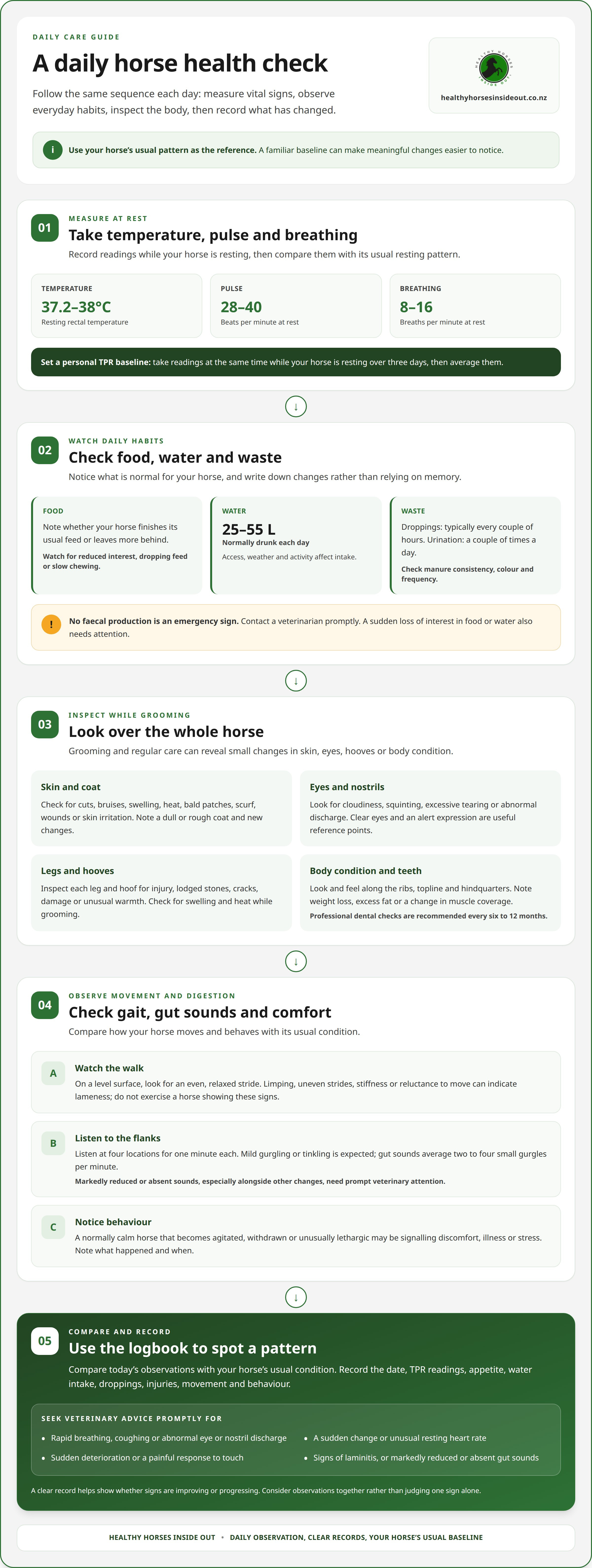
A horse can appear well while early signs of a problem are easy to miss. The health signs to check in your horse daily include its temperature, pulse and breathing, as well as appetite, drinking, droppings, appearance and behaviour. At rest, a horse’s rectal temperature is normally 37.2 to 38°C, its pulse is 28 to 40 beats per minute, and its breathing rate is eight to 16 breaths per minute.
It makes sense to watch for clear changes, but knowing your horse’s usual baseline makes them easier to recognise. To establish a resting TPR baseline, take readings at the same time while your horse is resting over three days, then average them.
This guide explains how to take and interpret TPR readings, what to observe around food, water and waste, and how to spot changes in your horse’s appearance or behaviour. A simple daily routine can help you recognise what’s normal for your horse and when a change needs attention.
Key Takeaways
- Track food and water intake alongside urination and droppings so you can spot meaningful changes in your horse’s routine.
- Use grooming and observation to notice changes in the eyes, coat, movement or behaviour.
- Build a consistent daily check that includes TPR, and compare readings with your horse’s usual resting pattern.
- Healthy Horses Inside Out offers everyday and specific supplements, bundles and HHIO Pellets to support equine nutrition.
Appetite, drinking, urination and faeces
Check what your horse eats, drinks and passes each day. Changes from its usual routine can be early clues to discomfort or digestive problems.
-
Check appetite and water intake
Observe your horse at feeding and watering times, and note whether it finishes its usual feed or leaves more behind. A horse normally drinks 25 to 55 litres of water each day, though access, weather and activity affect intake.
Take a sudden loss of interest in food or water seriously. Discomfort, illness or stress may be involved, and not drinking enough increases colic risk. Check for mouth pain, too: dental problems can make chewing difficult and alter eating habits.
-
Observe urination and droppings
During daily checks, look around the stable or paddock and note how often your horse passes urine and faeces. Horses typically pass droppings every couple of hours and urinate a couple of times a day.
Assess each pile for consistency, colour and frequency. Healthy manure is soft, intact and easy to pass; changes may signal digestive issues. No faecal production is an emergency sign, so contact a veterinarian promptly.
- Consider appetite changes alongside other signs. If your horse eats less and also breathes rapidly, coughs or has abnormal discharge from its eyes or nostrils, contact a veterinarian. Mouth discomfort may show up as dropping feed, chewing slowly or avoiding harder feed. Note whether these signs coincide with changes in drinking, droppings or demeanour.
- Record changes rather than relying on memory. Write down feed left uneaten, water intake, urine and droppings, then compare each day’s notes. For context, a resting horse’s normal breathing rate is eight to 16 breaths per minute; count flank movements without disturbing it. A stethoscope can help assess breathing, but unusual effort or a marked change matters more than a single observation.
Daily checks for changes in appearance or behaviour
Look at your horse as well as measuring vital signs. Small changes in movement, expression or routine can help reveal illness, infection or pain.
Check horses daily in New Zealand, including those living on pasture. Bad weather doesn’t remove the need to observe them. Keep a logbook of the date, TPR readings, appetite, water intake, droppings, injuries, movement and behaviour.
Contact a veterinarian about poor appetite, abnormal eye or nostril discharge, rapid breathing, coughing or another sudden change. An unusual resting heart rate may warrant prompt veterinary attention.
-
Check for injuries and lameness
Run your hands over your horse while grooming and check for cuts, bruises, swelling or heat. Inspect each leg and hoof, then watch your horse walk on a level surface. Limping, uneven strides, stiffness or reluctance to move can indicate lameness; don’t exercise a horse showing these signs.
- Inspect the eyes and nostrils for cloudiness, squinting, excessive tearing or abnormal discharge. Clear eyes and an alert expression offer useful reference points. Record changes from your horse’s usual appearance, especially if they occur with altered breathing or reduced movement.
-
Observe behaviour and signs of pain
Notice how your horse responds to people, feed and its surroundings. A normally calm horse that becomes agitated, withdrawn or unusually lethargic may be signalling discomfort, illness or stress. Record the behaviour and when it occurs, such as reluctance to move after turnout or unusual agitation during grooming.
- Compare today’s observations with the logbook, not just yesterday’s impression. Sudden deterioration, a painful response to touch or signs of laminitis warrant prompt veterinary advice. For nutritional support alongside consistent monitoring, explore everyday horse supplements.
What are the signs of a healthy horse?
Assess movement, digestion, coat, teeth and hooves during regular care. Compare what you observe with your horse’s usual condition and record any changes.
-
Assess gait and gut sounds
Watch your horse walk on a level surface, noting whether its stride is even and relaxed. Limping, stiffness or reluctance to move can indicate pain or injury.
Listen at four locations on the flanks for one minute each. Mild gurgling or tinkling is expected; gut sounds average two to four small gurgles per minute. Markedly reduced or absent sounds, especially alongside other changes, need prompt veterinary attention.
-
Check teeth, coat and body condition
While grooming, check the coat for bald patches, scurf, wounds or skin irritation. Record a dull, rough coat or a new skin change, particularly if it appears alongside a change in condition.
Assess the horse’s body condition by looking and feeling along its ribs, topline and hindquarters. Note weight loss, excess fat or a change in muscle coverage. Regular dental checks help identify issues that can affect chewing and eating; professional checks are recommended every six to 12 months.
-
Check hooves, temperature and digital pulses
Pick out each hoof and check for lodged stones, cracks, damage or unusual heat. Hooves need regular inspection and cleaning. Increased warmth can be associated with laminitis, among other causes.
Take and record your horse’s temperature while it is resting, then compare it with its usual readings. Feel beside the fetlock for the digital pulse: a weak pulse that is difficult to find is probably normal. A stronger, easier-to-find pulse, particularly with hoof heat or lameness, warrants attention.
- Consider the observations together rather than judging one sign alone. Uneven movement alongside a warm hoof, for example, may point to a problem needing prompt assessment. Record the affected leg, gait changes, hoof warmth and temperature. A clear pattern helps you track whether signs are improving or progressing.
Signs of a healthy horse
Look for consistent patterns across vital signs and daily observations. Your horse’s usual resting readings provide a useful baseline for spotting change.
- Take temperature, pulse and respiration readings while your horse is resting. A normal resting temperature is 37.2 to 38°C, pulse is 28 to 44 beats per minute, and respiration is eight to 16 breaths per minute. Establish an individual baseline by taking readings at the same time over three days and averaging them.
- Count the pulse for 15 seconds, then multiply the beats by four for a per-minute rate. Watch the flank for 30 seconds and multiply the breaths by two. Breathing should be steady, with the nostrils relaxed. For a digital temperature reading, hold the thermometer in place for 15 seconds or until it beeps.
- Check the gums and eyes as part of your horse’s daily health routine. Healthy gums are pink and moist; after light pressure, colour should return within one to two seconds. Eyes should be clear and bright, without discharge. A small amount of clear fluid at the nostrils may be normal, but note any new or unusual discharge.
- Compare today’s readings with your three-day baseline and record the results. A single reading can vary, so look at the combination of temperature, pulse, respiration and visible signs. Slightly out-of-range vital signs that persist for more than a few days warrant contacting a veterinarian. For nutritional support, explore specific horse supplements.
Healthy Horses Inside Out
If your daily observations raise questions about nutritional support, Healthy Horses Inside Out offers Everyday Horse Supplements, Specific Horse Supplements, Horse Supplement Bundles and HHIO Pellets. These products can be considered as part of your horse’s overall feeding plan.
Use your health log to spot patterns, such as changes in appetite, condition or energy, then consider whether nutritional support may be relevant. Supplements don’t replace veterinary assessment: sudden illness, pain or abnormal vital signs need attention from an equine veterinarian.
For nutritional support as part of your horse’s feeding plan, explore the range at Healthy Horses Inside Out.
Make daily care part of a lasting routine
A consistent routine turns observations into useful context for future decisions. Keep your notes somewhere accessible and record what has changed, not just what seems unusual. Over time, this builds a clearer picture of your horse’s individual patterns and makes conversations about its care more specific.
The health signs you check in your horse each day are one part of its wider wellbeing. Feeding, management and veterinary care all contribute, so consider how each meets your horse’s changing needs. Nutritional support may also be worth exploring when you review its overall care.
For guidance on nutritional support, contact Healthy Horses Inside Out. A thoughtful, consistent approach can help you feel more prepared to care for your horse, one day at a time.
Frequently Asked Questions
What is a normal TPR for a horse?
For a resting horse, a useful TPR reference is a temperature of 37.2 to 38°C, a pulse of 28 to 44 beats per minute, and respiration of eight to 16 breaths per minute. TPR means temperature, pulse and respiration. Include these among the health signs to check in your horse daily. Take readings when the horse is calm, since exercise or excitement can affect them.
How do you know if something is wrong with your horse?
A clear change from your horse’s usual behaviour, movement or vital signs can indicate a problem. For example, a horse that stops eating, becomes unusually withdrawn, or develops rapid breathing needs attention. No faecal production and a resting pulse of 60 to 80 beats per minute are emergency signs. Contact a veterinarian promptly if you see these or sudden deterioration.
What should you check in a horse's eyes, nose, mouth, and breathing every day?
Look for clear, bright eyes without squinting or excessive tearing, and check the nostrils for abnormal discharge. A small amount of clear nasal discharge may be normal. Notice whether your horse chews comfortably and is willing to eat. Watch its flank for steady breathing; effortful or unusually rapid breathing, especially with coughing, warrants veterinary attention.
What is a normal horse temperature, pulse, and respiration rate?
At rest, a horse’s temperature is normally 37.2 to 38°C, pulse 28 to 44 beats per minute, and respiration eight to 16 breaths per minute. Count pulse for 15 seconds and multiply by four; count breaths for 30 seconds and multiply by two. Record the readings while your horse is calm, then compare them with its usual baseline.
What are normal gum colour and capillary refill time in horses?
Healthy gums are pink and moist, and capillary refill time is usually one to two seconds. To check it, gently press a finger against the gum until it pales, release, then watch how quickly the colour returns. Note gums that look unusually pale, dark, dry or tacky, or colour that takes longer to return, and contact a veterinarian about concerning changes.
How should you check a horse's appetite, water intake, and manure daily?
Track these as part of the health signs to check in your horse daily: observe feeding and watering, note uneaten feed, and watch for changes in drinking. A horse normally drinks 25 to 55 litres of water each day and passes droppings every couple of hours. Check manure for changes in colour, consistency or frequency, and record urine output in a logbook.


