
Mineral support is a daily decision, not a seasonal one. Horse mineral pellets in NZ are recommended daily all year round, providing essential macro and trace minerals with co-factors for horses kept behind fences. They’re intended to give the best results alongside a high-fibre diet.
When comparing pellets, look beyond the label headline: the mineral profile, whether selenium is included and the feeding directions all matter. The right option should make sense as part of the whole ration, rather than being considered in isolation.
This guide explains what to consider in a mineral profile, how to assess selenium in the context of the full ration and how to compare feeding costs. It also covers how to build a consistent routine, so you can make a considered choice for your horse.
Key Takeaways
- Look for a mineral pellet designed to supply essential macro and trace minerals, and consider how it fits with a high-fibre diet.
- Assess product prices in context: feeding directions and your horse’s nutritional needs matter alongside the price label.
- Choose a selenium or non-selenium option with your horse’s overall mineral intake in mind.
- Plan for consistent daily feeding all year round, following the product’s directions.
Daily macro and trace minerals
HHIO Pellets are designed to provide nutritional support as part of a horse’s daily ration. To decide whether they fit, start with the full diet, including forage, hard feed and any other supplements.
Choosing by diet, workload and life stage
Begin by listing the forage, pasture, hard feed and supplements in the ration. Each contributes to the overall diet. Then consider your horse’s life stage and workload, as these shape the nutritional context. Choose a supplement whose stated contribution fits alongside what the horse already receives, rather than adding another source without considering the whole ration.
Comparing pellets, blocks, powders and balancers
Pellets are measured into feed, while a block relies on the horse licking it. Powders are mixed into feed, and balancers combine nutritional roles. Compare the label’s stated contribution and feeding directions, not the format alone. A horse eating fortified feed, for example, has a different overall ration from one eating forage and plain chaff. Check how each option fits with existing feed and supplements.
Pellets for pasture-fed horses
Yes, mineral pellets can suit pasture-fed horses in New Zealand. Pasture alone doesn’t establish whether the whole ration supplies the minerals required. Consider pasture, hay, concentrates and supplements together when selecting a pellet. The described pellets are intended for horses kept behind fences and work best alongside a high-fibre diet. This makes the rest of the ration relevant, even when pasture is the main feed.
Importing is a separate consideration: requirements may depend on ingredients and country of origin. Consult New Zealand’s current biosecurity import guidance before arranging shipment.
Combining pellets with fortified feed or other supplements can duplicate minerals and disrupt the intended balance. List each feed and supplement, then compare its mineral declarations and feeding directions before combining products.
Product price
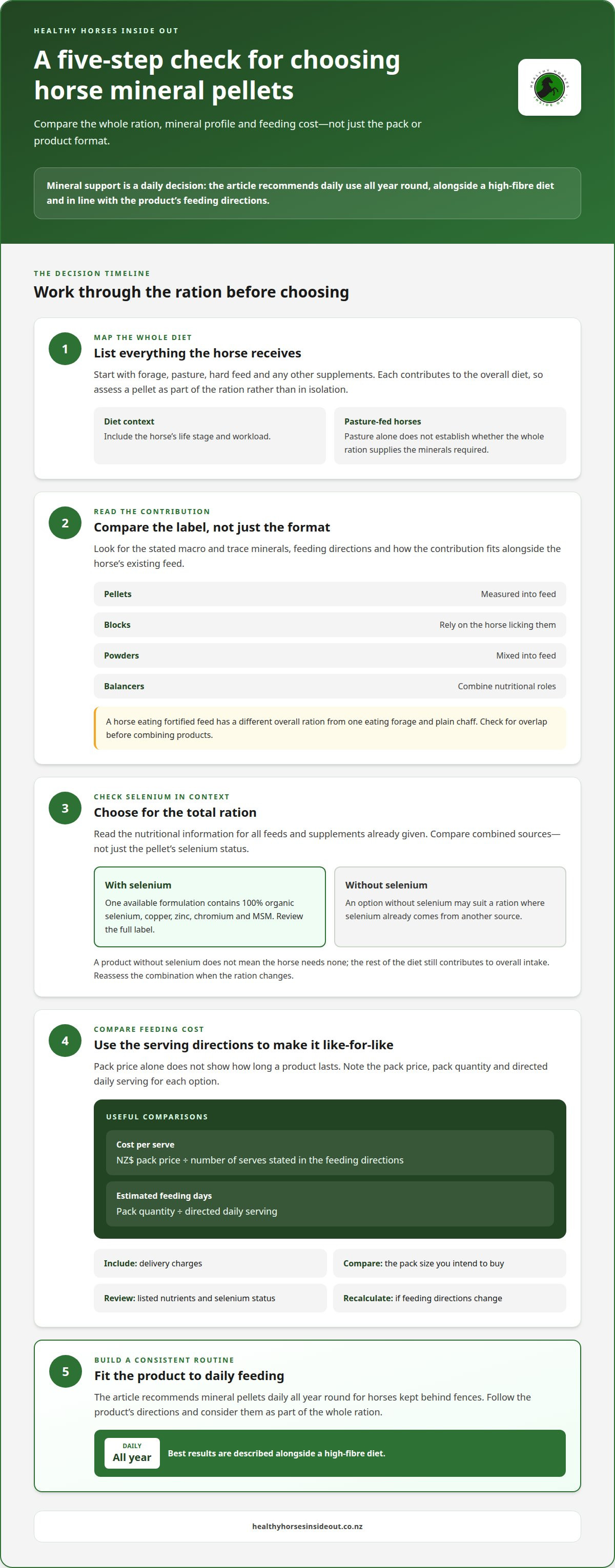
Compare horse mineral pellets by the cost of feeding them, not pack price alone. A larger pack may cost more upfront but provide more daily serves. To compare options, divide each NZ$ pack price by the number of serves stated in its feeding directions. This gives a more useful like-for-like figure than comparing package sizes.
Start with the label. Note the recommended daily amount and pack weight, then work out how many days the pack covers at that rate. If two products have different serving sizes, pack weight alone will not show which lasts longer. Use each product’s own directions rather than assuming equal portions.
Formulation matters too. Compare the listed nutrients and whether selenium is included, then weigh those details against your horse’s existing feed. A lower pack price may not be the best value if the formulation does not fit the ration. Paying more for nutrients already supplied elsewhere may also add little practical value.
For a clear comparison, record these details for each option:
- Pack price: the amount payable in NZ$.
- Pack size: the quantity supplied.
- Daily serving: the amount directed for one day.
- Estimated feeding days: pack quantity divided by the directed daily serving.
- Mineral profile: the listed nutrients and selenium status.
Include delivery charges when comparing total purchase cost, and check that you are comparing the pack size you intend to buy. Revisit the calculation if the feeding directions change. This helps you compare ongoing costs without treating the pack price as the full measure of value.
The product is described as producing its best results when used with a high-fibre diet. Keep this condition in view alongside the feeding directions when considering whether the product fits your horse’s ration. A price comparison is most useful when it reflects the way you intend to use the product, rather than pack cost alone. The stated best-results condition can therefore inform the value assessment without changing the per-serving calculation.
Selenium and non-selenium options
Selenium is a trace mineral, so consider the whole ration when choosing between a product that includes it and one that does not. Check the nutritional information for each feed and supplement already given. This helps you account for their combined contribution before adding another source.
One available formulation contains 100% organic selenium, copper, zinc, chromium and MSM. Selenium is not its only listed component, so compare the full label rather than choosing by one ingredient. The alternative is a formulation available without selenium, which may suit a ration where selenium already comes from another source.
Use a simple comparison before choosing:
- List current feeds: include pasture, conserved forage, hard feed and supplements.
- Read each label: note whether selenium is included and review the other declared minerals.
- Compare the full ration: consider combined sources, not just the pellet in isolation.
- Follow feeding directions: use the product’s stated serving rather than changing it to compensate for another feed.
A product without selenium does not mean a horse needs no selenium. It means that product does not add selenium, while the rest of the diet still contributes to the overall intake. Conversely, choosing a product with selenium without accounting for fortified feed or other supplements can create overlap. The relevant decision is about the total ration, not one label in isolation.
For horses in New Zealand, pasture and supplementary feeds can form different combinations across properties and seasons. Keep the product labels alongside your feeding notes, then reassess the combination whenever the ration changes. For example, adding a fortified hard feed can alter the mineral picture, even if the pellet serving stays the same.
Choose the option that fits the complete diet and its stated feeding directions. If the ration already includes selenium, a product without selenium avoids adding another source through that supplement. If it does not, compare a selenium-containing option’s full formulation against the rest of the feed.
Suggested feeding frequency
Feed Premium NZ Horse Minerals daily all year round, following the product directions. A regular daily routine keeps the mineral pellet within the horse’s planned ration, rather than treating it as a seasonal addition. Use the serving stated on the product label; don’t increase or reduce it to compensate for changes in another feed.
Build the routine around an existing feed time. Add the directed serving to the horse’s usual bucket feed, then record that it has been given. If the horse receives feed in more than one session, follow the product directions for providing its daily amount. Measure consistently rather than estimating by eye.
Keep a simple record of daily feed and supplements, including pellets, hard feed, forage changes and other mineral products. This gives you a practical reference when the ration changes, such as when you introduce a different hard feed or alter the amount of forage. Reassess the whole ration and continue to follow the product directions.
A daily routine does not mean every horse receives the same serving. The product label remains the guide, while the full ration provides important context. If pasture or workload changes, reassess the diet rather than changing the product’s stated feeding frequency without guidance from its directions.
For consistency, keep the product and feeding notes together, use the same routine each day, and mark missed or changed feeds in the record. That makes it easier to see whether the planned daily serving is being followed and to account for other supplements. If you’re reviewing your horse’s everyday routine, explore daily feeding options as part of the wider ration.
Healthy Horses Inside Out: HHIO Pellets
Healthy Horses Inside Out offers HHIO Pellets for horse owners considering nutritional support as part of a planned ration. Review the product information and feeding directions, then consider how the pellets fit with your horse’s existing feed and supplements.
If your horse’s needs extend beyond pellets, Healthy Horses Inside Out also offers Everyday Horse Supplements, Specific Horse Supplements and Horse Supplement Bundles. These provide different ways to consider nutritional support as part of your horse’s feeding plan.
Review the product information alongside your horse’s current diet, then choose the option that best fits your feeding plan. For help exploring the range, contact Healthy Horses Inside Out.
Make your next feeding decision with confidence
Treat your horse’s ration as an evolving plan, not a set-and-forget choice. When feed or supplements change, revisit how each product fits the overall diet. This simple habit keeps future decisions grounded in what your horse is actually receiving.
Choosing horse mineral pellets in NZ can prompt a broader look at nutritional support. Healthy Horses Inside Out offers Everyday Horse Supplements, Specific Horse Supplements and Horse Supplement Bundles, alongside HHIO Pellets. Consider each option in the context of the whole feeding plan.
If you’re ready to discuss your next step, contact Healthy Horses Inside Out. A thoughtful approach to daily nutrition can make the feeding routine feel clearer and more considered.
Frequently Asked Questions
What are horse mineral pellets and what nutrients do they provide?
Horse mineral pellets are a feed supplement formulated to provide minerals in a measured form. For horses kept behind fences, the pellets described here supply essential macro and trace minerals with co-factors. The label shows the specific nutrients in each formulation, so use it to distinguish the mineral profile and identify whether selenium is included.
What is the recommended daily feeding rate for horse mineral pellets in New Zealand?
Feed the product daily all year round, following its directions. The amount per day depends on the specific product, so use its label rather than applying a rate from another pellet. For a practical routine, measure the directed serving consistently and include it in the horse’s usual feed, accounting for any other supplements in the ration.
How much do horse mineral pellets cost in NZ, including price per day?
Prices vary by product and pack size, so there isn’t one reliable cost for every option. To work out a daily cost, divide the pack price in NZ$ by the number of daily servings stated for that pack. Use the product’s feeding directions to establish servings, and compare like with like rather than judging value by pack price alone.
What are the ingredients and guaranteed analysis of popular horse mineral pellets in NZ?
Premium NZ Horse Minerals provide essential macro and trace minerals with co-factors. The selenium-containing formulation includes 100% organic selenium, copper, zinc, chromium and MSM; a selenium-free option is also available.
Where can I buy horse mineral pellets in New Zealand, including online and local retailers?
Healthy Horses Inside Out offers HHIO Pellets, and Premium NZ Horse Minerals are intended for New Zealand orders only.


