

The next supplement your horse needs may be none at all. With horse dietary support NZ, a sound decision starts with the whole ration, not a product. Pasture, hay, hard feed, workload and your horse’s condition all help show what their diet already provides.
If you’re unsure whether the current ration is balanced or whether a supplement would fill a genuine gap, that’s understandable. Ingredients can overlap across feeds and supplements, and adding something without checking the full diet may not be the right next step. A measured review can help you decide what to do next.
This practical guide explains how to review your horse’s daily feed, identify when extra dietary support may be worth considering, and check product ingredients and feeding directions. You’ll also learn when to seek advice from an equine nutrition professional or veterinarian, particularly if you have concerns about your horse’s health. The first step is to understand the ration, then choose a suitable next step.
Key Takeaways
- For horse dietary support NZ, record forage, feeds, supplements and feeding directions to see what the current ration includes.
- Consider workload, life stage, forage access and management when deciding whether the ration needs a closer review.
- Compare options by purpose, confirmed ingredients and label directions. A product category alone doesn’t show that your horse needs it.
- If you make a change, record the starting ration, check the label, change one thing and review the result.
- If suitability is unclear, seek professional input before adding support and assess any product against the whole ration.
Horse dietary support in NZ: what it means and when to assess it
Horse dietary support NZ means reviewing a horse’s forage, feeds, supplements, workload and individual circumstances to decide whether its ration needs adjustment. It is nutritional planning, not veterinary diagnosis or treatment. Understand what the horse already receives before adding anything. Supplements aren’t automatically necessary: a suitable ration may need no extra product, while a specific concern may warrant a closer review.
Routine dietary planning means considering what the horse eats and whether it suits its current workload and circumstances. If something changes, ask whether that warrants reassessing the ration. The change alone doesn’t establish a nutritional deficiency. For an overview of digestion, nutrient requirements and feed types, see Equine nutrition basics.
What can dietary support include for a horse?
Start with the full feeding picture. Consider forage, such as pasture or hay, alongside any complete feed and supplements. Check each product’s purpose and current directions, then consider them in relation to everything else the horse eats. A supplement’s category or name alone doesn’t show whether it’s appropriate for an individual horse.
Dietary support doesn’t replace suitable forage, access to clean water or professional care. If you’re unsure whether a product fits the existing ration, pause before adding it and seek advice from an equine nutrition professional or veterinarian. For foundational context, read this everyday horse supplements guide.
When should a New Zealand horse owner review the ration?
Review the ration when something relevant changes. A shift in workload, daily routine, available feed or management may alter what the horse needs from its overall diet. Life stage and access to forage are also useful considerations when checking whether the current plan still makes sense.
Changes in condition or appearance can prompt a closer look at the whole situation, but they don’t diagnose a deficiency. Note what has changed, what the horse is eating and any other concerns. If the change is sudden, persistent or worrying, contact a veterinarian. Don’t try to resolve a possible health issue by adding a supplement without appropriate guidance.
Build horse dietary support around the whole ration
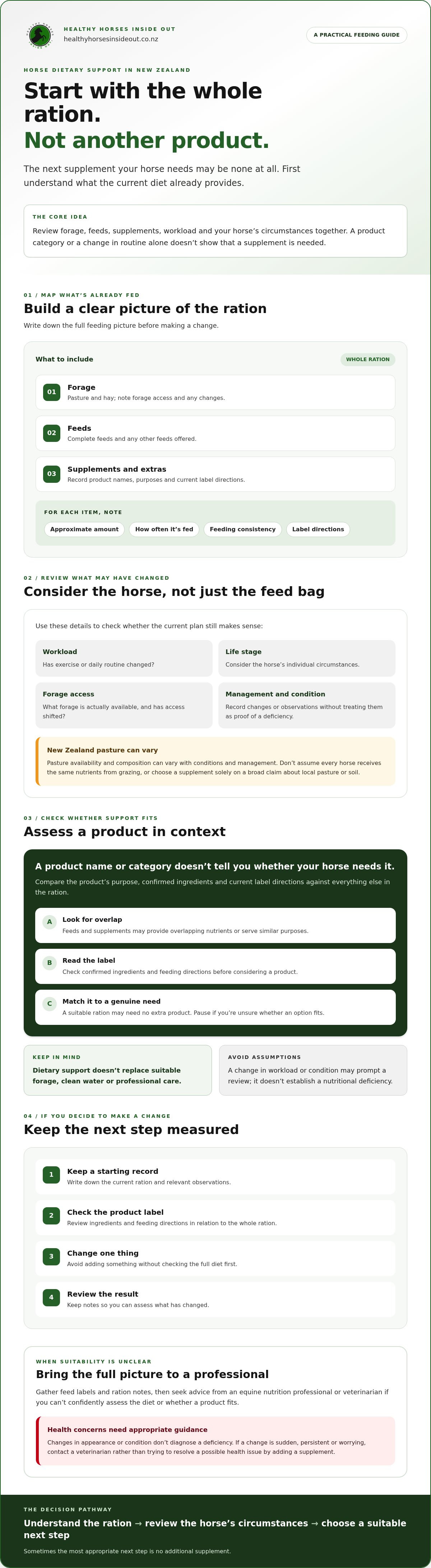
Before changing the feeding plan, write down everything your horse eats. Include pasture or hay, complete feeds, supplements and any extras. Record each product’s current feeding directions, approximate amounts and how consistently it’s fed. This gives you a clear starting point and makes potential overlaps easier to spot.
Reviewing the complete ration can help you avoid unnecessary duplication because feeds and supplements may provide overlapping nutrients or serve similar purposes. Assess a product in context, not in isolation. Rutgers’ Basics of Equine Nutrition offers broader information on equine digestion, feeding and nutrient sources, which can help put individual feed choices into perspective.
What to record before adding dietary support
Keep your notes practical and factual. Record product names, label directions, approximate amounts and feeding consistency. Add details about forage access and any recent change in routine. Workload, life stage and management can all inform a review. A change in exercise, for example, may be a reason to reassess the feeding plan rather than automatically add a supplement.
- List the pasture, hay, complete feeds and supplements currently offered.
- Note how much is fed and how often, using label directions as a reference.
- Record changes in forage access, workload, routine or condition.
- Describe what you observe without treating it as proof of a deficiency.
If you can’t confidently assess whether the ration provides appropriate nutrients, gather the feed labels and records and seek a reliable professional assessment. A complete record gives an adviser more useful context than a product list alone.
How New Zealand pasture fits into feeding decisions
Pasture availability and composition can vary with conditions and management, so don’t assume every horse in New Zealand gets the same nutrients from grazing. Consider the forage actually available to your horse, how access changes over time and what other feeds contribute. Avoid choosing a supplement solely on a broad claim about local pasture or soil.
For more background on the topic, read this New Zealand soil mineral guide, then relate any general information to your horse’s full ration. If your review suggests a supplement may be relevant, explore the horse supplement categories from Healthy Horses Inside Out and check each current label against the feeding plan before deciding.
Choose horse dietary support by need, evidence, and fit
Once you’ve reviewed the ration, compare options against a clear purpose rather than choosing by product category or broad promise. A supplement labelled for everyday use or a particular objective isn’t, by itself, evidence that your horse needs it. For horse dietary support NZ, ask whether the product’s stated role suits your horse’s circumstances and what their current feed already provides.
Use a simple comparison to keep the decision grounded:
- Purpose: What nutritional objective does the product state?
- Ingredients: Does the label clearly confirm the ingredients and relevant quantities?
- Directions: What amount and frequency does the label specify?
- Fit: Does it complement the existing ration, or could it duplicate something already fed?
Compare labels side by side, including those for complete feeds and existing supplements. If two products list the same ingredient, note the potential overlap and check the stated amounts and directions rather than assuming that combining them is appropriate. A New Zealand study of sport horse feeding practices provides local context for considering feeding decisions. Read the NZ sport horse feeding practices research paper.
How to assess a horse supplement label
Read the full ingredient information and feeding directions, not just the front-of-pack description. Check that the product’s stated purpose makes sense alongside the ration you’ve recorded, and follow its current label rather than relying on general assumptions about a product type. For more help interpreting ingredient information, see this horse supplement ingredients guide.
If a claim is unclear or key ingredient details or directions aren’t available, ask the supplier or an appropriately qualified adviser for clarification before deciding. Don’t infer suitability from marketing language alone.
When everyday or specific support may be considered
Everyday supplements are generally positioned for broader daily nutritional support, while specific supplements are intended for a more particular nutritional objective. These categories describe a product’s intended role, but don’t establish a need or confirm that it suits an individual horse. Check the label against the whole ration, and seek professional input if the objective relates to a health concern or you’re uncertain about suitability.
Introduce dietary changes carefully and review the result
A feeding change is easier to assess when you know what the horse received beforehand. Keep your ration notes and the product’s current label handy. Record the existing routine, check the directions, make one planned change and review what follows. This keeps the decision traceable, whether you’re adding a supplement or changing another part of the ration.
Changing one thing at a time makes your review clearer because you can better identify what changed, when it changed and what else was happening in the horse’s routine. It doesn’t prove that a product caused an observed difference, but it gives you more useful information to discuss with an adviser.
A measured process for changing the feeding routine
Before making a change, write down the current ration and how consistently each part is fed. Read the product label, including its feeding directions, and follow them rather than estimating an amount or borrowing instructions intended for another product. If the label is unclear, pause and ask the supplier or a suitable professional for clarification. There isn’t one transition period that applies to every product and horse, so use verified directions and professional advice where needed.
Keep a dated record as the routine changes. Note:
- What changed and the date it was introduced.
- The product directions followed and how consistently it was fed.
- Relevant observations, such as changes in routine, appetite or condition.
- Other factors that might help explain what you noticed.
Review your notes without assuming a particular outcome. If several things change at once, or feeding is inconsistent, it can be difficult to interpret observations. For horse dietary support NZ, a clear record can help you make a more informed decision or have a more productive conversation with an equine professional.
When to ask an equine professional for help
Contact a veterinarian if your horse is ill, deteriorates suddenly or shows signs that could have a medical cause. Don’t try to manage those concerns by adding a supplement. If you need help balancing a complex ration or understanding uncertain nutritional requirements, seek advice from a suitably qualified equine nutrition professional. Retail product information can explain a product’s stated purpose and directions, but it isn’t a substitute for diagnosis or treatment.
If you’ve assessed the ration and want to consider available options, explore horse supplement options from Healthy Horses Inside Out. Check the current product label and consider how it fits your feeding plan before deciding.
Explore horse dietary support options from Healthy Horses Inside Out
After reviewing your horse’s ration and identifying what you’re still unsure about, assess available products against that information. Healthy Horses Inside Out offers everyday and specific horse supplements, supplement bundles, and HHIO Pellets to horse owners across New Zealand. These are options to consider as part of an informed feeding plan, not a checklist every horse needs to complete.
How the confirmed product categories fit the decision process
Assess everyday supplements in light of your horse’s existing feed and individual circumstances. Specific supplements may be worth reviewing if you have a clearly defined nutritional objective. For bundles, check each included product against the current ration. Neither a category name nor grouping products together establishes suitability for your horse.
HHIO Pellets are another option to assess. Check the current label for ingredients and feeding directions before deciding whether they fit your horse’s feeding plan. Don’t assume their composition or intended use from the product name alone. Across all categories, compare verified product information with what your horse already receives, and seek professional advice if you’re uncertain about nutritional suitability.
Ask three questions: What is the product intended for? What does the label confirm? How would it fit alongside the existing ration? If reliable product information doesn’t answer those questions, pause before adding it. This keeps horse dietary support NZ focused on your horse’s actual needs rather than on choosing a product simply because it’s available.
A considered next step for New Zealand horse owners
Before browsing, have your ration notes to hand and identify any unanswered questions, such as whether a product’s stated purpose overlaps with an existing feed or supplement. For product-specific questions, contact the business for clarification about its product information and directions. If your concern is about illness or a change in your horse’s health, speak with a veterinarian. Product information isn’t a diagnosis or treatment plan.
If you’ve assessed the whole ration and would like to review the available categories, explore Healthy Horses Inside Out. Check the current label and consider each option in context. The right next step may be a product that fits a clear nutritional objective, further professional advice, or no additional supplement.
Make your next feeding decision with confidence
Good horse dietary support NZ starts with a clear view of the whole ration. Review what your horse already eats, check product labels and feeding directions, and weigh any possible addition against an identified need. If you decide to adjust the routine, make one measured change at a time and keep a record so you can review it thoughtfully.
Healthy Horses Inside Out offers everyday and specific horse supplements, supplement bundles and HHIO Pellets to horse owners across New Zealand. These are options to assess, not a reason to assume every horse needs extra support. Check current label details and consider how any product fits the existing ration. If you’re unsure about product suitability, ask for product information. For illness or health concerns, contact your veterinarian.
When you’re ready to review the available categories, explore Healthy Horses Inside Out and use your ration notes to guide your questions. Check the current label and consider each product against the whole ration before deciding.
Frequently Asked Questions
What does horse dietary support mean?
Horse dietary support means assessing a horse’s feeding plan in light of its forage, feeds, supplements, workload and individual circumstances. It may involve organising the existing ration or considering an additional product where there’s a clear nutritional reason. It doesn’t automatically mean giving a supplement, and it isn’t veterinary diagnosis or treatment. Forage access, life stage and changes in routine can all guide a review.
Does every horse in New Zealand need supplements?
No. A horse in New Zealand doesn’t automatically need supplements because of where it lives. Whether additional support is appropriate depends on the horse’s full ration, circumstances and any identified nutritional need. Review pasture or hay, other feeds and existing supplements together before deciding. If you’re unsure whether the ration is balanced, gather the feed labels and seek advice from a suitably qualified equine nutrition professional or veterinarian.
How do I know what dietary support my horse needs?
Start by recording what your horse eats, including forage, feeds and supplements, and check each product’s ingredients and feeding directions. Consider workload, life stage, forage access and management, then identify the question you’re trying to answer. The phrase horse dietary support NZ covers a range of options, but a product category alone doesn’t establish need. If the ration or a health concern is difficult to assess, ask an appropriate professional for advice.
Can I give my horse more than one supplement?
Possibly, but check how each product fits with the whole ration before combining supplements. Compare their labels and those of any complete feeds for overlapping ingredients, quantities and directions. The same ingredient may appear in more than one product, so adding products could result in duplication. Follow current label directions, and ask a qualified equine nutrition professional or veterinarian if you can’t confidently assess whether the combination is appropriate for your horse.
How should I introduce a new horse supplement?
First record the current ration, then check the new product’s label and follow its directions. Make one planned change at a time so you can keep a clearer record of what changed and when. Note feeding consistency and relevant observations, without assuming a particular result or cause. Don’t apply a universal dose or transition schedule. Use the product’s verified directions and seek professional input if the instructions or suitability are unclear.
When should I speak to a veterinarian about my horse’s diet?
Speak to a veterinarian if your horse is ill, deteriorates suddenly or shows changes that may have a medical cause. A supplement isn’t a substitute for diagnosis or treatment, and visible changes alone can’t confirm a nutritional deficiency. For help understanding a complex ration or uncertain nutritional requirements, you can also seek advice from a suitably qualified equine nutrition professional. Bring your feed labels and a record of the ration to support the discussion.
Are HHIO Pellets suitable for every horse?
Suitability can’t be assumed for every horse. Assess HHIO Pellets against your horse’s current ration and individual circumstances, and check the current product label for confirmed ingredients and feeding directions before deciding whether they fit. The product name alone doesn’t establish its composition or intended use. If you’re unsure about product-specific details, ask the business for clarification. Seek veterinary advice for health concerns.


