

What if unsettled behaviour is a clue to your horse’s wellbeing, rather than simply a temperament issue? Spookiness, tension or difficulty focusing can have several possible causes, from discomfort to changes in feed or management. That uncertainty can make choosing horse calming supplements NZ owners feel confident about a real challenge.
It’s understandable to want practical support while making sure you’re not masking pain, illness or an unsuitable routine. A supplement may have a role, but it isn’t a quick fix or a substitute for understanding what’s behind the behaviour.
This guide explains how to assess whether a calming supplement could suit your horse, what to look for on the label and how targeted nutrition fits into a broader wellbeing plan. It also covers when a veterinary assessment or a closer look at daily management should come first, so you can make a measured, horse-specific decision.
Key Takeaways
- Unsettled behaviour can have several possible influences, so consider your horse’s overall wellbeing before assuming a supplement is needed.
- Horse calming supplements NZ may be one part of a broader plan, but they can’t replace veterinary care or suitable management.
- Compare labels, intended use and daily feeding directions rather than relying on a product name or broad claims.
- Use a considered sequence to review behaviour, routine and feed, and recognise when veterinary advice may be appropriate.
- Targeted supplements and curated bundles can support horse-specific nutritional decisions.
Horse calming supplements NZ: what they may support, and what they cannot
Seeing a horse become tense, reactive or difficult to settle can be worrying, particularly when the behaviour is new or hard to predict. A reaction doesn’t automatically mean your horse needs a calming supplement. Behaviour can be influenced by surroundings, routine, discomfort, health and other factors, so consider the context before choosing a nutritional product.
A calming supplement is a nutritional product intended to complement thoughtful horse care, not diagnose or treat the cause of behaviour. For owners considering horse calming supplements NZ options, that distinction is a useful starting point. Nutritional support may have a place in an individual wellbeing plan, but it can’t replace veterinary assessment or suitable daily management.
What owners mean by a horse needing calming support
Owners might describe a horse as tense, spooky, reactive or unable to settle. These are observations, not explanations. A horse may react in a particular setting, during a change in routine or in response to something in its environment. The pattern alone doesn’t identify the cause. Background on horse behaviour and stress responses can help put natural reactions into context.
Keep a simple record of what you notice: when and where the behaviour occurs, what’s happening around the horse and whether anything has changed. Note how often it happens and whether it is becoming more pronounced. This record can help you describe the pattern clearly and identify whether routine, environment or wellbeing needs closer attention.
When a supplement is not the first step
If behaviour changes suddenly, persists or raises concern for your horse’s or anyone’s safety, seek veterinary advice. Discomfort or an underlying health issue may affect behaviour, and a supplement shouldn’t conceal signs that need investigation. A veterinarian can assess the horse and advise on appropriate next steps.
That doesn’t mean every unsettled moment signals a medical problem. It means responding thoughtfully rather than reaching for a product by default. Don’t use a supplement to make a horse appear calmer while a concerning change goes unexplored.
Once immediate concerns have been considered, assess nutritional support as one part of a broader, horse-specific plan. Look beyond the word “calming” on a label: consider what the product is intended to support, how it is fed and whether it suits the horse’s overall needs.
How calming supplements fit into a horse’s behaviour and nutrition
Nutritional support is one possible part of a horse-specific wellbeing plan, not a stand-alone explanation for behaviour. Review feeding routine, forage, workload, surroundings and consistency in daily handling alongside the horse’s individual needs. A change in behaviour may occur around a change in one of these areas, but that pattern alone doesn’t prove a particular cause.
Start with context. Record behaviour alongside changes in feed, grazing, exercise, turnout or surroundings. For horses on pasture, note seasonal or management changes too. Reviewing these details consistently can help clarify what deserves attention before you decide whether a targeted supplement is relevant. Avoid attributing behaviour to a single nutrient without suitable evidence or a clearer understanding of the horse’s overall diet.
The Merck Veterinary Manual on Horse Nutrition explains the nutrients horses need to support health. That broader nutritional picture matters: the presence of a particular ingredient in a calming formula doesn’t establish that the horse needs it or that the complete product will suit every horse.
Consider ingredients as information, not a promise
Magnesium and tryptophan are examples of ingredients marketed in some calming supplements. Their inclusion is a reason to look more closely at the formula, not a guarantee of a predictable change in behaviour. Assess product claims carefully and distinguish general information about an ingredient from evidence supporting the finished formula for your horse’s circumstances.
Read the label beyond the product name
For horse calming supplements NZ owners are comparing, a clear label gives more useful information than a name that suggests a calming effect. Look for named ingredients, the quantity supplied per serve and straightforward feeding directions. Check the recommended daily serving and consider how the product fits with the horse’s existing feed and supplements.
Ingredient names without quantities can make comparison difficult. A listed ingredient alone also doesn’t show whether a formula suits an individual horse. For more help interpreting labels, read this horse supplement ingredients guide.
After reviewing the horse’s wider routine and the label details, targeted nutrition may be considered as part of a broader plan. Explore horse supplements from Healthy Horses Inside Out while assessing options against your horse’s overall needs.
How to compare horse calming supplements in New Zealand
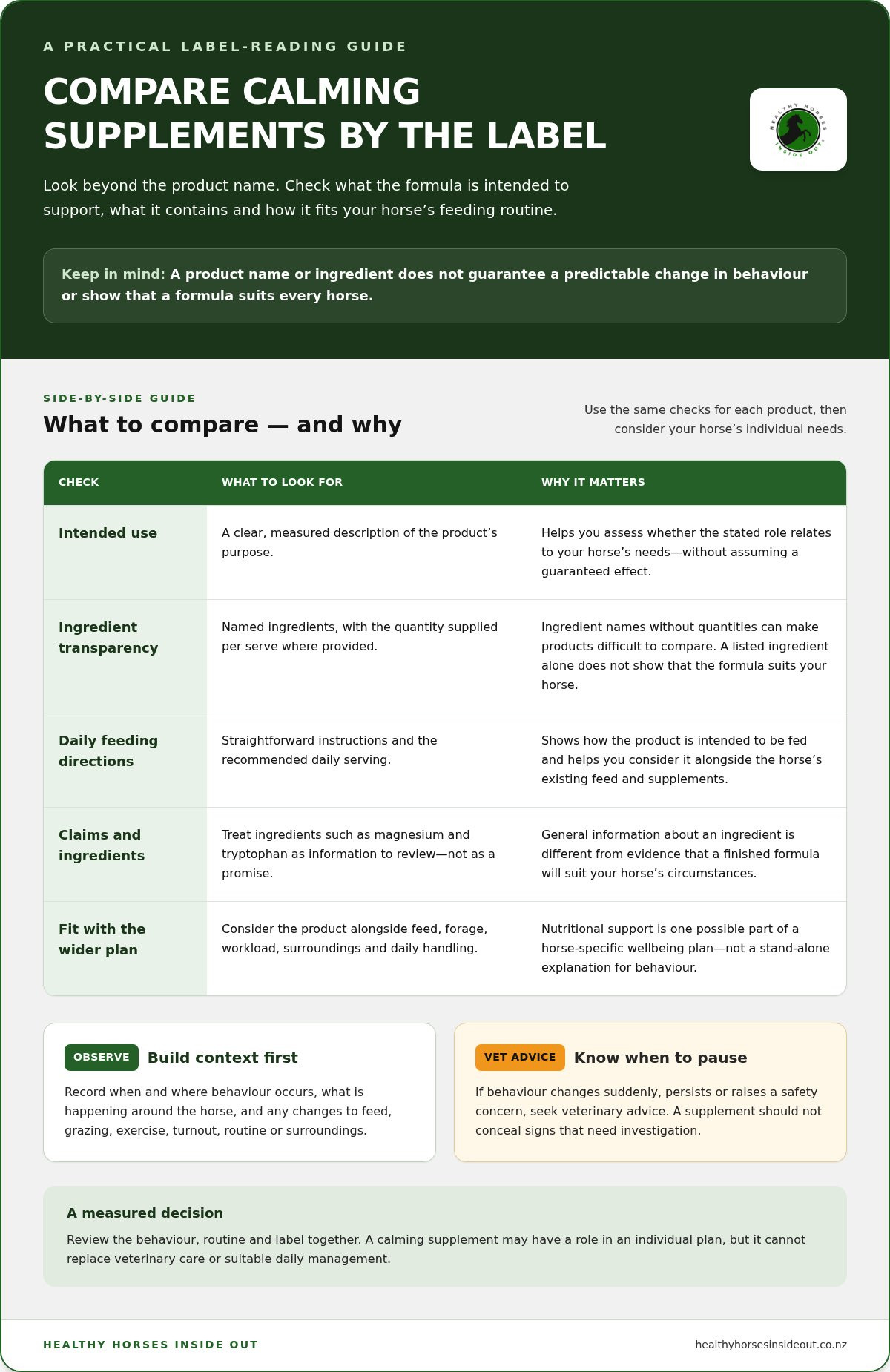
A product name can suggest a purpose, but the label and daily serving instructions tell you more about what you’re considering. Compare options against the same criteria, then weigh them against your horse’s needs and established feeding routine. This makes it easier to assess horse calming supplements NZ owners may encounter without treating broad claims as proof of suitability.
| What to compare | What to look for | Why it matters |
|---|---|---|
| Intended use | A clear, measured description of the product’s purpose. | Helps you judge whether the stated role relates to your horse’s needs without assuming a guaranteed effect. |
| Ingredient transparency | Named ingredients and, where provided, the amount per recommended serve. | Allows a more meaningful comparison than an ingredient name or product title alone. |
| Feeding directions | Clear daily serving instructions and guidance for use. | Shows how the product is intended to fit into a consistent feeding routine. |
| Format | A form that suits the horse’s usual feed and willingness to accept it. | Practicality can affect whether you can follow the directions consistently. |
Which label details deserve a closer look?
Check that the ingredient list and feeding directions are easy to understand. If amounts per serve are stated, compare like with like: products may use different serving sizes, so ingredient names alone can be misleading. Be cautious of absolute or guaranteed claims. A clearly stated intended use is more informative than a promise of a particular behavioural result, which may not be predictable for every horse.
Quick label check: What is the product intended to support? Are the ingredients named? Are amounts per serve provided? Are daily directions clear? Are claims measured rather than guaranteed?
How should owners assess format and feeding practicality?
Consider whether the format fits your horse’s established meals and is likely to be accepted. Feeding instructions should be workable within your horse’s usual routine and management. A product that’s difficult to feed consistently may be impractical, regardless of how appealing its name sounds.
Avoid changing several parts of the diet or routine at once, as this can make it harder to interpret what’s different. Suitability is individual, so use the label as a comparison tool, not a substitute for considering the horse’s overall needs.
A practical calming-support plan for horses across New Zealand
A measured process helps turn concern into useful next steps. Whether your horse lives out on pasture, follows a structured feeding routine or travels for competition, consider behaviour in the context of its everyday care.
- Observe. Note what the behaviour looks like, when and where it occurs, and any recent changes in routine, surroundings or workload.
- Review feed and management. Consider forage, feeding times, exercise, turnout and consistency. Record changes rather than assuming one factor explains the behaviour.
- Seek veterinary advice when warranted. If the change is sudden, persistent, worsening or concerning, consult a veterinary professional before treating it as a nutritional issue.
- Assess nutritional options thoughtfully. If appropriate, compare the label, intended use and feeding directions, then follow the product instructions.
This sequence gives you a clearer picture before deciding whether horse calming supplements NZ may have a place in your horse’s wellbeing plan. For more help considering your horse’s wider nutritional needs, see this guide to choosing supplements for your horse.
What should owners monitor before and after a change?
Keep a simple record of behaviour, setting, feed and any supplement or routine changes. If you introduce a nutritional product, follow its label directions and note what changes over time. A record can help you describe patterns, but timing alone doesn’t prove that a particular change caused a behavioural difference. If concerns persist or worsen, review them with an appropriate veterinary professional.
How do competition and everyday routines affect the decision?
Consistency matters. Avoid trialling an unfamiliar product immediately before an event, when travel, a new environment or a changed schedule can make it harder to judge how your horse is responding. Keep everyday feeding as steady as practical, and assess new options well ahead of competition.
Competition rules need their own check. The FEI Equine Prohibited Substances List took effect on 1 January 2026, and Equestrian Sports New Zealand adopts it for national competitions. Check current event and governing-body requirements for ingredients and product use. “Natural” doesn’t automatically mean permitted, and don’t assume a supplement is competition-safe without current, product-specific evidence. Valerian, for example, is often prohibited in competitive disciplines under these guidelines.
Once you’ve considered routine, veterinary advice where needed and any competition requirements, you can review targeted horse supplements as part of a considered nutrition plan.
Choosing nutritional support from Healthy Horses Inside Out
After considering your horse’s behaviour, routine and feeding information, assess whether nutritional support has a relevant place in the overall plan. Healthy Horses Inside Out is a New Zealand retailer of everyday and targeted equine supplements, with specific supplements and curated bundles available for horse owners nationwide.
The aim isn’t to choose a product simply because its name suggests a calming effect. First, define the nutritional support you’re considering and how it relates to your horse’s wider needs. Everyday nutrition provides a foundation; a specific supplement may be considered for a more focused support goal. Neither replaces careful management or veterinary advice when behaviour changes are concerning.
Where targeted supplements fit in a considered routine
Consider targeted support only after reviewing your horse’s existing feed, routine and individual circumstances. Check how the product is intended to be used, read the full ingredient information and follow the label’s feeding directions. If your horse already receives other supplements, consider the combined feeding routine rather than viewing each product in isolation.
For a broader look at everyday nutritional foundations in New Zealand, read the everyday horse supplements guide. It can help distinguish foundational nutrition from a more specific support goal, without assuming one formula suits every horse.
Curated bundles may also be relevant when considering more than one nutritional need. Assess the components and feeding directions carefully, keeping the horse’s overall diet and circumstances at the centre of the decision.
Next steps for New Zealand horse owners
Before exploring options, write down the concern you’re trying to address and gather useful context: what you’ve observed, when it occurs, recent routine changes and what your horse is currently fed. This gives you a clearer basis for comparing nutritional support and helps you avoid choosing based on a product name or a single observation.
Follow label directions for any supplement you choose. If behaviour changes suddenly, persists or becomes concerning, seek veterinary advice rather than relying on nutritional support to explain or mask it. For horses in competition, check current event requirements for ingredients and product use.
When considering a horse-specific nutrition plan, browse the Healthy Horses Inside Out range of everyday and specific supplements and curated bundles.
Make a considered next step for your horse
Choosing horse calming supplements NZ owners can feel confident about starts with understanding the horse, not the product name. Behaviour may have several influences, so observe patterns, review feed and routine, and seek veterinary advice when a change is sudden, persistent or concerning.
If nutritional support seems relevant, compare ingredient information, intended use and daily feeding directions. A supplement may complement a horse-specific wellbeing plan, but it can’t diagnose or treat the cause of behaviour or replace thoughtful care.
Healthy Horses Inside Out offers a New Zealand-focused range of everyday and specific horse supplements, alongside curated bundles and individual equine nutritional products. Consider how these options fit your horse’s needs and existing routine.
Explore Healthy Horses Inside Out to review the range and choose nutritional support with your horse’s needs in mind.
Frequently Asked Questions
Do calming supplements work for horses?
Some may offer nutritional support, but a calmer response isn’t guaranteed. A horse’s behaviour can reflect several influences, and a supplement won’t identify or resolve an underlying cause. Consider the horse’s routine, feed and overall wellbeing alongside any product, and assess changes thoughtfully rather than assuming the supplement was responsible. If behaviour is concerning or persistent, seek veterinary advice instead of relying on a supplement alone.
What ingredients are commonly used in horse calming supplements?
Ingredients commonly marketed for calming support include magnesium, tryptophan and herbs such as chamomile, valerian or passionflower. Their presence doesn’t prove that a product will suit every horse or produce a predictable behavioural effect. Compare ingredient names and amounts per recommended serve where provided, and read the label’s claims carefully. If your horse competes, check whether any ingredient is restricted under the relevant rules.
Can I give my horse a calming supplement every day?
Some products are intended for regular feeding, but daily use depends on the specific product, its label directions and your horse’s circumstances. Follow the recommended serving and don’t assume that increasing the amount will improve the result. Consider how it fits with your horse’s existing feed and supplements. If your horse has health concerns or receives other nutritional products, seek veterinary guidance about suitability.
How long do horse calming supplements take to work?
There isn’t one reliable timeframe for every product or horse. The intended use, ingredients, feeding directions and individual circumstances can all matter, so follow the label rather than assuming a supplement will act immediately. Keep a simple record of feeding and behaviour observations, and avoid changing several things at once. If the behaviour persists or worsens, discuss it with a veterinary professional.
Are horse calming supplements suitable before a competition?
Not automatically. Before using a supplement for a competition horse, check the current rules for the event and relevant governing body, including ingredient restrictions. The FEI Equine Prohibited Substances List took effect on 1 January 2026 and is adopted by Equestrian Sports New Zealand for national competitions. Valerian is often prohibited in competitive disciplines. Don’t assume a product is competition-safe without current, product-specific evidence.
Can a calming supplement help a horse that has suddenly become reactive?
A supplement shouldn’t be the first response to a sudden change in behaviour. Reactivity may have several possible influences, including discomfort or a health concern, so seek veterinary advice to assess what’s happening. Note when and where the behaviour occurs and any recent changes in routine or feed. Don’t use nutritional support to mask signs that may need investigation.
How do I choose horse calming supplements in New Zealand?
Compare intended use, named ingredients, quantities per serve where provided, format and clear daily feeding directions. Choose based on your horse’s needs and routine, not the product name or an absolute claim. In New Zealand, these products are regulated as oral nutritional compounds under the ACVM framework; most are exempt from formal registration but must still meet relevant requirements, including being fit for purpose and correctly labelled.


