

The neater-looking feed isn’t automatically the better choice for your horse. If you’re weighing up equine pellet feed vs sweet feed, the format can offer clues, but it can’t tell you whether a ration meets your horse’s needs.
It’s understandable to compare the two by appearance or convenience, especially when feed labels use unfamiliar terms and products can serve very different purposes. Pellet feed and sweet feed differ in form, but their ingredients, nutrient content and feeding directions vary between products. A pellet isn’t necessarily a complete feed, and a sweet feed’s appearance alone doesn’t reveal how it will fit into your horse’s diet.
This guide explains what each format can and can’t tell you, how to read labels and feeding directions, and how to assess a feed alongside forage, workload and your horse’s individual needs. You’ll also see why a measured decision matters more than choosing by looks, and when a qualified equine nutrition professional can help you review the whole ration, including options such as HHIO Pellets.
Key Takeaways
- In equine pellet feed vs sweet feed, the format describes how feed looks, not whether it’s nutritionally suited to your horse.
- Pelleting and grain processing can alter feed’s physical form and starch accessibility, but don’t by themselves prove a health or digestibility benefit.
- Compare ingredients, nutrient analysis, feeding directions and intended use rather than judging a feed by its appearance.
- Before changing feed, note what your horse currently eats and define the purpose of any addition or replacement.
- Consider HHIO Pellets by reviewing their current product information and how they fit into your horse’s overall ration.
Equine pellet feed vs sweet feed: what is the difference?
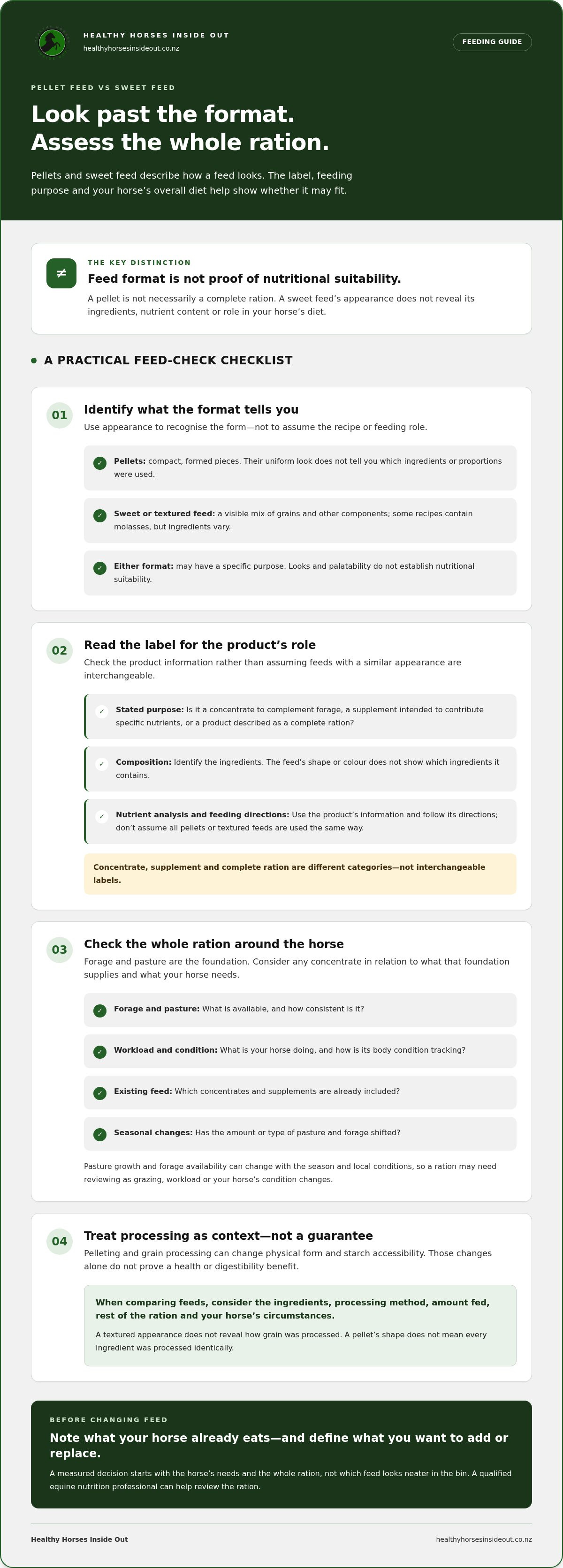
Pellets are feed ingredients formed into compact, consistent pieces; sweet feed, also called textured feed, is a visible mixture of grains and other components. That difference describes the feed’s form, not its nutritional value. In equine pellet feed vs sweet feed, neither appearance nor name confirms whether a product supplies a complete ration or suits a particular horse.
Recipes vary by manufacturer, product and feeding purpose. A pelleted product might be a concentrate intended to complement forage, a supplement, or a feed marketed as a complete ration. A textured mix may also have a specific role. The label, not the shape or colour of the feed, explains what the product is designed to provide.
For a general overview of feed categories, including concentrates, Horse feed offers background. For a practical choice, though, start with your horse: consider its condition, workload and forage, then assess how any additional feed fits the whole ration.
What does pellet feed mean for horses?
Pelleting presses ingredients into formed pieces, making a product look uniform. It doesn’t tell you which ingredients were used, their proportions or the nutrients supplied. Two pellet feeds can therefore have different formulations and intended uses, even if they look much the same in a scoop.
Read the product label for its stated purpose, composition, nutrient analysis and feeding directions. Check whether it is a concentrate to be fed alongside forage, a supplement intended to contribute specific nutrients, or a product described as a complete ration. Those categories aren’t interchangeable. Follow the directions for the product rather than assuming all pellets are fed in the same way.
What is sweet or textured feed?
Sweet feed is typically recognisable by its mixed texture: visible grain and other feed components may sit alongside pellets or smaller particles. Some recipes contain molasses, but ingredients differ between products, so the name alone doesn’t establish how much of any ingredient is present or what nutrients the feed supplies.
A horse may find a particular mix appealing, but palatability is not a measure of nutritional suitability. Nor does a textured appearance prove that the ration is more varied or better balanced. Use the label to identify ingredients, nutrient information, intended use and feeding directions, then consider those details in relation to the horse’s forage and existing feed.
The key distinction is simple: pellets and sweet feed describe formats, while formulation and purpose determine how a product may fit into a ration. Before choosing, establish what your horse already receives from forage and other feed, and what you’re seeking to add or replace. This keeps the decision focused on the horse’s actual needs, rather than on which feed looks more appealing in the bin.
How pellet and sweet-feed processing can affect digestion
Processing changes the physical form of feed and, depending on the ingredients and method, may also affect how accessible starch is to digestive enzymes. That doesn’t make one format automatically gentler or more suitable. For owners weighing up equine pellet feed vs sweet feed, the useful question is what processing was used, what the product contains and how it fits the horse’s whole ration.
Pelleting compresses a formulated mix into formed pieces. It describes how the feed is made into its final shape, not a single recipe or a guaranteed digestive effect. Sweet feeds can include grains processed in different ways, and the grain itself, particle size and processing method all influence how readily starch may be accessed during digestion. A textured appearance alone won’t reveal those details.
What pelleting and grain processing change
Grain may be rolled, cracked or otherwise processed before it’s included in a feed; these methods can alter its structure and starch accessibility. Pelleting then forms ingredients into compact pieces, but it doesn’t mean every ingredient has been processed identically or that every pellet has the same composition. The product label is the practical starting point for understanding the feed’s ingredients and intended use.
Changes in starch accessibility don’t, by themselves, establish a product’s overall digestibility or predict how an individual horse will respond. The amount fed, the rest of the ration and the horse’s own circumstances matter too. Feed format alone does not establish a product’s nutritional suitability.
Why the whole ration still matters
Horses are fibre-first feeders: forage and pasture provide the foundation of the ration, while concentrates are considered in relation to what that foundation supplies and what the horse needs. Fibre is also important to normal digestive function, so comparing two concentrates without considering forage leaves out essential context. A feed’s processing can’t compensate for a mismatch between the product and the overall feeding plan.
Before comparing formats, consider:
- Forage and pasture: What is available, and how consistent is it?
- Workload and condition: What is the horse doing, and how is its body condition tracking?
- Existing feed: What concentrates and supplements are already included?
- Seasonal changes: Has the amount or type of pasture and forage shifted?
For New Zealand horse owners, pasture growth and forage availability can change with the season and local conditions. A ration that made sense under one set of conditions may need reviewing as grazing, workload or the horse’s condition changes. Keep changes measured, follow the product’s feeding directions and monitor how the horse responds rather than switching based on texture alone.
If you’re considering a pellet-format option during that review, include HHIO Pellets in your label comparison and assess their current product information alongside the rest of the ration.
Pellet feed vs sweet feed: compare the label, not the look
A uniform pellet and a visibly mixed sweet feed can look very different yet serve similar purposes, or have entirely different nutritional roles. To make a fair comparison, read both labels side by side. The phrase equine pellet feed vs sweet feed describes a format comparison, but your decision depends on what each product provides and how it fits your horse’s existing ration.
| What to compare | Pellet feed | Sweet or textured feed |
|---|---|---|
| Format | Formed, compact pieces. | A mixture of visible grains and other components. |
| Visible ingredients | Ingredients usually aren’t distinguishable by appearance. | Some components may be visible, but appearance doesn’t show their proportions. |
| Label details | Check the ingredient list, nutrient information and directions. | Use the same checks; a textured mix may contain varied components. |
| Intended use | May be a supplement, concentrate or feed marketed for a specific role. | Purpose varies by product; don’t assume it is a complete ration. |
| Ration fit | Assess alongside forage, pasture and other feed. | Assess against the same whole-ration picture. |
Which label details should owners compare?
Start with declared ingredients, nutrient information, stated purpose and the manufacturer’s feeding directions. Compare like with like: check units and whether nutrient figures are given on the same basis before drawing conclusions. Terms such as “crude protein” describe a measured nutrient category, not a complete judgement of ingredient quality or suitability. If a term is unfamiliar, seek a reliable explanation rather than inferring a benefit from the wording alone.
Then consider the product’s recommended role alongside the horse’s current forage, pasture, concentrates and supplements. A label may position a product as a supplement or as part of a broader feeding programme; that distinction affects how you interpret its nutrient profile and directions. Don’t compare one feed’s analysis in isolation from what the rest of the ration already supplies.
Feeding directions matter, too. Follow the directions for each specific product, and measure portions consistently rather than relying on a scoop that may hold different weights of different feeds. Keep a note of what you offer so any ration review is based on actual amounts, not estimates. Don’t infer an ideal quantity simply from the feed’s format.
Does one format suit every horse better?
No single format is automatically healthier, safer or more digestible for every horse. Age, workload, body condition, forage and individual needs can all change what a product should contribute. Breed or a horse’s preference for a particular texture isn’t enough to establish suitability.
Choose the product for its verified formulation and role, not its shape. If a pellet-format product is under consideration, include HHIO Pellets in the label review and assess its current product information against the horse’s full ration.
How to choose between equine pellets and sweet feed
A sound choice starts with the horse, not the feed bin. Decide what you’re trying to achieve, check what your horse already receives, compare product information, then reassess after any change. This keeps the equine pellet feed vs sweet feed decision grounded in feeding purpose and the whole ration, rather than appearance or habit.
Start with the horse and current ration
First, define the practical goal. Are you addressing a specific gap in the ration, supporting a change in workload, or considering a supplement? A concentrate may not be necessary if forage and pasture already suit the horse’s needs. Consider body condition, age and workload alongside the available pasture, conserved forage, current feeds and supplements.
Before changing anything, write down what the horse eats and roughly how much. Include forage, pasture access, concentrates, supplements and any recent changes. This record gives you a useful baseline, helps avoid overlooking duplicate ingredients, and makes it easier to discuss the whole ration with an equine nutrition professional or veterinarian if individual concerns arise.
Use this sequence to keep the decision practical:
- Define the purpose: Be clear about what you want a feed or supplement to contribute.
- Review the ration: Record forage, pasture and all existing feeds.
- Compare labels: Check each product’s intended role, nutrient information and feeding directions.
- Reassess: Monitor the horse and review the ration if conditions or needs change.
Make and monitor a measured change
Compare candidate products by their stated purpose and label, not by whether they are pellets or a textured mix. Check that the product’s role makes sense alongside existing feed, and follow its manufacturer’s directions. If a change is appropriate, transition gradually in line with those directions and advice from a qualified professional. Avoid changing several parts of the ration at once where possible, so you can better observe what has changed.
Keep an eye on appetite, manure and general condition, and note any changes alongside the feeding record. If the horse has a health concern, a major change in condition, or a specialised dietary requirement, get individual advice from an equine nutrition professional or veterinarian before making adjustments. Careful observation supports a more informed review; it doesn’t replace professional guidance where that’s needed.
For broader context on how everyday supplements may fit into a feeding plan, explore the everyday horse supplements guide. If a pellet-format option is part of your comparison, explore HHIO Pellets and assess their current product information against your horse’s overall ration.
Where HHIO Pellets fit in a considered feeding plan
HHIO Pellets are Healthy Horses Inside Out’s named pellet offering. Their pellet form tells you how the product is presented, not what role it should play in every horse’s diet. As with any option in the equine pellet feed vs sweet feed comparison, the useful next step is to review current product information alongside your horse’s forage, other feeds and feeding goal.
Assess a pellet offering against your horse’s needs
Start with the current label. Use its stated intended use, ingredient list, nutrient information and feeding directions to understand how the product is meant to fit into a feeding plan. Avoid drawing conclusions from the word “pellets” alone, and don’t assume that a pellet product is a complete feed. That description should only be used when the current product information substantiates it.
Next, compare that stated role with your horse’s actual ration. Note the type and amount of forage and pasture, any concentrates or supplements already being fed, and the practical goal you’re considering. For example, if you’re looking at a product to address a particular feeding purpose, check whether its label supports that purpose and whether it overlaps with something already included. Where a horse has individual health or nutrition concerns, discuss the ration with an equine nutrition professional or veterinarian.
Build confidence before changing the feed routine
A considered decision follows a clear sequence: define the purpose, record the current ration, compare the product label, then follow appropriate transition guidance and observe the horse. Keeping a simple feeding record can help you track what changed and notice whether appetite, manure or general condition shifts. Follow the product’s directions, and seek qualified advice if you’re unsure how to adapt the ration.
This measured approach also applies to supplements. If you’re weighing up a supplement as part of the plan, use a guide to choosing suitable horse supplements to help clarify what you’re looking for and how it may fit with existing feed. The aim isn’t to add products by default, but to make each part of the ration purposeful and avoid overlooking what the horse already receives.
Take time to read the current product information and consider it in context, rather than treating pellet format as a recommendation on its own. If HHIO Pellets appear relevant to your feeding goal, explore HHIO Pellets as one option to assess within a thoughtful feeding plan.
Make your next feed decision with confidence
Use your next ration review as a chance to check whether each feed still has a clear purpose. Your horse’s needs can shift as workload, condition or grazing changes, so a choice that suited one period may be worth reassessing later. Keep the focus on what supports this horse now, rather than making a lasting rule about pellets or sweet feed.
The question of equine pellet feed vs sweet feed is best answered through considered label reading and attention to the individual horse. If you’re exploring a pellet option, HHIO Pellets are part of Healthy Horses Inside Out’s range. Take a moment to review the current product information and decide whether its stated role aligns with your feeding plan.
Explore HHIO Pellets and make a considered choice for your horse. A thoughtful next step can bring greater clarity to your feeding routine and help you move forward with confidence.
Frequently Asked Questions
Are pellet feed and sweet feed nutritionally the same?
No, their nutritional content can differ substantially because each product has its own formulation. A pellet might be a supplement or concentrate, while a textured feed may contain a different mix of ingredients and nutrients. For example, two feeds could both be intended to complement forage but supply different levels of protein or minerals. Compare the actual product information, rather than assuming the formats are equivalent.
Is pellet feed better for horses than sweet feed?
Not automatically. In the equine pellet feed vs sweet feed decision, a better fit depends on the horse’s needs and the product’s stated purpose, not simply whether it is pelleted or textured. A horse already receiving a balanced ration may not need either format; another may have a specific nutritional requirement to address. Consider workload, condition and current diet, and seek qualified advice for individual health concerns.
Can horses eat sweet feed every day?
Some products may be intended for regular feeding, but whether daily use suits a particular horse depends on the product directions and the rest of its ration. Check that the amount offered matches the label guidance, and account for other feeds or supplements that may provide similar nutrients. Daily feeding shouldn’t be based solely on the horse liking the taste. Ask an equine nutrition professional or veterinarian about individual concerns.
What should I look for on a horse feed label?
Look for the product’s intended purpose, ingredient list, nutrient information and feeding directions. Check the units and basis used for nutrient figures before comparing two labels, as figures presented differently may not be directly comparable. Note any handling or storage instructions, too. Keep the label available when reviewing the ration, so you can match the product’s stated role to the horse’s forage and other feeds.
How do I switch my horse from sweet feed to pellets?
Make a feed change gradually, following the new product’s directions and guidance from a qualified equine nutrition professional or veterinarian where appropriate. Don’t assume the same scoop size represents the same weight or feeding amount for both products; measure portions consistently. During the change, keep other parts of the diet stable where practical and monitor appetite, manure and general condition. Seek advice if you notice a concerning change.
Do pellets contain less sugar than sweet feed?
Not necessarily. Pellet form alone doesn’t reveal sugar content, and textured feeds vary in recipe. Check the product’s nutrient information for sugar or carbohydrate figures if provided, and read the ingredients for context. If the label doesn’t give the information you need, don’t infer a low-sugar profile from appearance or from the word “pellet”. For a horse with a specific dietary concern, seek individual nutrition advice.
Should New Zealand pasture be considered when choosing horse feed?
Yes. Pasture can contribute substantially to a horse’s intake, and its growth and availability may change with the season and local conditions. Consider grazing alongside conserved forage, workload, body condition and all additional feeds before deciding whether a concentrate is needed. If pasture conditions or the horse’s routine change, review the ration rather than automatically keeping feed amounts unchanged. A nutrition professional or veterinarian can help with individual concerns.


