

A horse with equine metabolic syndrome may need fewer calories, but simply cutting feed is not a safe plan. The dietary management of equine metabolic syndrome should be based on measured forage, suitable feed and veterinary guidance, with decisions tailored to the individual horse.
If you’re unsure whether hay, pasture access, bucket feed or treats could be affecting your horse’s risk, you’re not alone. It can also be difficult to assess “low-NSC” claims or decide whether a supplement belongs in the ration. The whole diet matters, and changes should support, not replace, veterinary care.
This practical guide explains how to build a forage-led feeding plan around your horse’s body condition, workload and available forage. You’ll learn what to check on feed labels, how to think about pasture and treats, and how to assess supplements cautiously rather than relying on cure-all claims. We’ll also cover what to monitor and when to ask your veterinarian to review the plan.
Key Takeaways
- Build the dietary management of equine metabolic syndrome around your horse’s needs, using veterinary advice to guide decisions about forage, energy and nutrients.
- Assess forage, commercial feeds and treats as parts of the complete ration, not in isolation.
- Compare supplements by their label information and intended purpose, and discuss suitability with your veterinarian before adding them.
- Review the current ration, agree on changes and track progress without making abrupt or multiple changes at once.
- Monitor relevant changes and ask your veterinarian to reassess the plan when your horse’s needs or condition change.
Dietary management of equine metabolic syndrome: what diet can and cannot do
Equine metabolic syndrome (EMS) is a collection of risk factors associated with insulin dysregulation and an increased risk of laminitis. A horse may also have excess or abnormal fat deposits, but appearance alone cannot confirm EMS. The Equine metabolic syndrome (EMS) overview provides background on the condition. Diagnosis and management decisions belong with your veterinarian.
Diet is an important part of veterinary management because the amount and type of energy in a horse’s ration can affect body condition and insulin responses. Insulin helps regulate blood glucose. In an insulin-dysregulated horse, the body’s response to insulin is abnormal, and persistently high insulin concentrations are associated with laminitis risk. A feeding plan matters, but it does not replace veterinary assessment, monitoring or medication if prescribed.
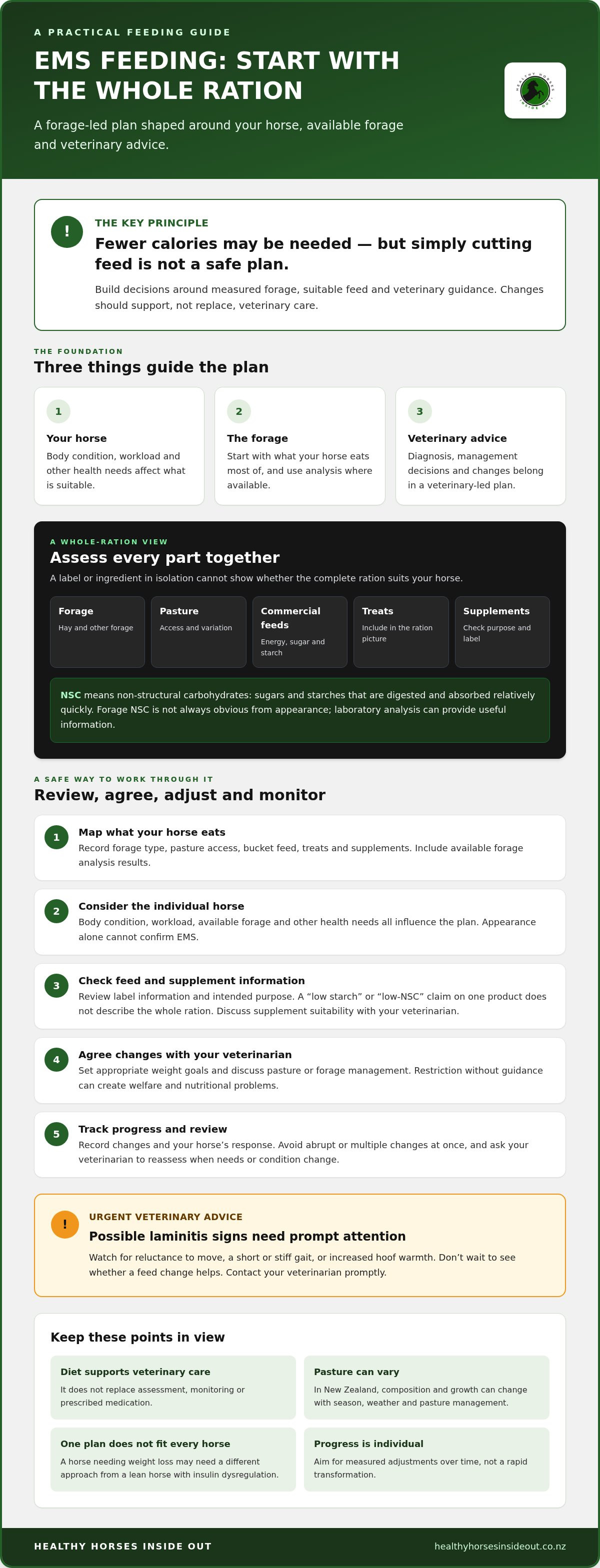
Assess the whole ration, not one ingredient. A feed labelled “low starch”, for example, doesn’t show on its own how the horse’s total intake, forage, pasture and other feeds fit together.
How EMS affects feeding decisions
Insulin dysregulation can occur in horses with different body types, so a horse that doesn’t look overweight may still need assessment. Weight gain or loss can also have other causes, and conditions such as pituitary pars intermedia dysfunction (PPID) may involve overlapping signs. Your veterinarian can consider the horse’s history, examination and appropriate tests rather than relying on appearance alone.
Act promptly if you notice possible laminitis signs, such as reluctance to move, a short or stiff gait, or increased hoof warmth. These signs need urgent veterinary advice. Don’t wait to see whether a feed change helps. Prompt assessment is important, and any dietary adjustments should be made with veterinary guidance.
Why one diet does not suit every horse
A suitable plan depends on more than an EMS diagnosis. Body condition, the type and analysis of available forage, pasture access, workload and other health needs all affect what a horse requires. A horse that needs to lose weight may need a different plan from a lean horse with insulin dysregulation. Restricting forage or pasture without guidance can create welfare and nutritional problems.
Work with your veterinarian to set appropriate weight goals and decide how pasture access should be managed. Record changes and your horse’s response, then review the ration over time. Progress is individual, so expect measured adjustments rather than a rapid transformation or a single plan that works for every horse. The aim of dietary management of equine metabolic syndrome is to support overall health alongside veterinary care.
Build an EMS feeding plan around forage, energy and nutrient balance
Start with what your horse eats most of: forage. Hay, pasture and other forage can provide much of the daily energy and nutrients, so the dietary management of equine metabolic syndrome should begin with a clear picture of the whole ration, not an isolated feed ingredient or claim on a bag.
Non-structural carbohydrates (NSC) are sugars and starches in feed that are digested and absorbed relatively quickly. They can contribute to a rise in blood glucose and insulin, but forage NSC content isn’t always obvious from its appearance. A laboratory forage analysis can provide useful information. Share the results with your veterinarian, who can interpret them alongside your horse’s condition and needs. The University of California, Davis School of Veterinary Medicine describes EMS as primarily treated through diet and exercise, reinforcing the value of including feeding decisions in a broader management plan.
A low-NSC claim on one feed cannot tell you whether the complete daily ration is suitable. Forage, pasture, concentrates, treats and supplements all contribute, so assess them together.
Assess forage, pasture and seasonal variation
Make a simple record of the forage type, how access is managed and any available analysis results. In New Zealand, pasture composition and growth can vary with season, weather and pasture management. There isn’t one profile that applies to every paddock or horse. An analysis of the forage actually being fed is more useful than relying on general assumptions about pasture or hay.
Take that information to your veterinarian before changing grazing access or restricting forage. Any adjustment needs to account for your horse’s welfare and the overall ration, not just a goal to reduce energy intake.
Review concentrates, treats and supplementary nutrients
Read feed labels for energy, sugar and starch information, ingredients and feeding directions. Energy describes the fuel a feed provides; sugar and starch are carbohydrate components that may matter when planning for a horse with insulin dysregulation. “Low NSC” or “low starch” wording alone may not give you the full picture. If key values aren’t listed, ask the manufacturer for details and review them with your veterinarian or an equine nutrition professional.
Include every treat, bucket feed and supplement in your daily record, even if each seems like a small amount. Don’t remove minerals or other nutrients across the board without advice: whether the ration is adequate depends on the forage, other feeds and the individual horse. If you’re reviewing supplementary options, Healthy Horses Inside Out’s horse supplements and pellets can be assessed by checking the labels against the complete ration and your veterinarian’s guidance. Don’t assume any supplement treats EMS.
Compare forage, commercial feeds and supplements for EMS suitability
Each part of the ration has a different role, so assess it in context rather than deciding on a single label claim. Use this comparison to prepare questions for your veterinarian as part of the dietary management of equine metabolic syndrome.
| Ration component | Role and label or analysis checks | Ration contribution and question for your veterinarian |
|---|---|---|
| Forage | Provides fibre and often a substantial share of daily intake. Record forage type and access; use available analysis results, including relevant sugar and starch information. | Can influence total energy and nutrient intake. Ask whether the analysis reflects the forage being fed and how it fits your horse’s needs. |
| Balancers or commercial feeds | May supply energy, protein, vitamins or minerals. Check ingredients, feeding directions and available nutrient data rather than relying on “low sugar” or “low starch” wording alone. | Even a small serving contributes to the total ration. Ask whether the feed’s purpose and nutrient profile suit your horse and its forage base. |
| Treats | Check ingredients and consider the amount and frequency given. Treats can add to daily energy and carbohydrate intake. | Include them in the ration record. Ask whether a preferred treat is appropriate or whether an alternative would better fit the plan. |
| Supplements | Check the full label, intended use, ingredients and feeding directions. Don’t assume a product is suitable because it is marketed for metabolic support. | Identify the specific dietary gap or management need first. Ask whether the supplement is necessary and how it affects the complete ration. |
How to evaluate a feed label and forage analysis
Look for ingredient details, feeding directions and relevant nutrient information, such as energy, sugar, starch or mineral content where provided. Labels vary in the information they present, so ask the manufacturer about missing details instead of filling gaps with assumptions. Forage analysis also needs context: consider the results alongside all other feeds, treats and supplements. Utah State University's guide to managing EMS offers further background on dietary management.
For help understanding ingredients listed on supplement labels, see this guide to horse supplement ingredients in New Zealand.
When a supplement may, or may not, fit
Before adding a supplement, identify the need it’s intended to meet. Check the label against the full ration and discuss suitability with your veterinarian. Supplements don’t replace appropriate forage management, a balanced ration or veterinary care. Adding several products at once can also make it harder to assess their contribution. For broader context, read about everyday horse supplements for New Zealand conditions.
Put dietary management into practice and monitor progress safely
A feeding plan is useful only if it’s safe, practical and reviewed as your horse’s needs change. Work through these steps with your veterinarian to create a routine you can follow and document:
- Consult your veterinarian. Confirm the diagnosis, discuss your horse’s health and agree on what the feeding plan should address.
- Record the current ration. List forage, pasture access, concentrates, treats and supplements, including how much is offered and how often.
- Assess the forage. Gather any forage analysis and note changes in forage type or grazing access. Ask your veterinarian how the results fit the whole ration.
- Agree on changes. Decide which adjustments to make, how to introduce them and what to monitor. Avoid abrupt feed restriction or changing several parts of the ration at once.
- Review and adjust. At agreed intervals, share your records with your veterinarian and decide whether the plan remains appropriate.
Measured changes make it easier to see what’s working and help avoid unnecessary disruption. In the dietary management of equine metabolic syndrome, monitoring gives your care team useful information to review, rather than guesswork. Monitoring helps your care team judge whether the plan needs review.
Create a practical feeding routine
Write down everything your horse consumes, including pasture, hay or other forage, bucket feeds, treats and supplements. Then agree with your veterinarian on forage access, feed choices and any weight-management approach. A sound routine should be manageable for everyone involved in daily care while supporting welfare and nutrient balance. If the plan is difficult to maintain, raise that early so it can be reviewed rather than quietly abandoned.
Keep a simple log at the interval your veterinarian recommends. Useful notes may include body condition, ration changes, activity or workload, and any relevant veterinary observations. Consistent records help distinguish a genuine trend from a short-term fluctuation.
Know when to review the plan
Set follow-up timing with your veterinarian to reflect your horse’s clinical status. Arrange a reassessment if body condition changes, the routine becomes impractical or new health signs appear. Don’t wait for a scheduled review if you’re concerned.
Suspected laminitis is urgent, not a routine nutrition issue. Contact your veterinarian promptly rather than trying a diet change first. If you’re reviewing supplementary options, explore horse supplements and HHIO Pellets and ask your veterinarian to check any product label against your horse’s complete ration. These products should not be assumed to treat EMS.
Choose ongoing nutritional support with evidence, labels and veterinary guidance
Ongoing support works best when every addition has a clear purpose. Before choosing a feed or supplement, identify the need it’s intended to meet, then assess its ingredients and contribution alongside the full ration. For dietary management of equine metabolic syndrome, marketing claims are no substitute for veterinary guidance or evidence that a product suits the individual horse.
Questions to ask before adding a product
Take the product label and your current ration record to your veterinarian. Ask whether the product fits your horse’s diagnosis, forage, overall feeding plan and other health needs. Check the ingredient list, feeding directions and nutrient information, then look for overlap with other feeds or supplements. Adding multiple products with similar ingredients may change the ration without addressing a specific need.
If you’re still working out whether a supplement has a place in your horse’s diet, this guide to choosing supplements for a horse offers broader questions to consider. It doesn’t replace professional advice for an individual horse.
A confident next step for horse owners
Keep a record of the ration, product labels and any changes, then review them with your veterinarian as part of ongoing care. This steady process helps you make informed decisions and notice when the plan may need another look. If no specific nutritional need has been identified, there may be no reason to add a product.
Healthy Horses Inside Out is a New Zealand retailer offering HHIO Pellets, horse supplements and supplement bundles online. Its products are nutritional products, not EMS treatments. Consider the range only after clarifying your horse’s needs, and check each label with your veterinarian before deciding whether it fits the ration.
Once you know what you’re looking for, explore Healthy Horses Inside Out and review the available products at your own pace. The aim is not to find a quick fix, but to make a considered choice that aligns with your horse’s complete feeding plan and veterinary care.
Build a feeding plan you can review with confidence
Sound dietary management of equine metabolic syndrome starts with the complete ration, not a single ingredient or supplement claim. Assess forage and pasture, check how feeds and treats contribute, and make measured changes with your veterinarian. Keep clear records so you can review your horse’s response and adjust the plan when needed.
Healthy Horses Inside Out offers everyday and targeted equine supplements, HHIO Pellets and curated bundles online to horse owners across New Zealand. These products aren’t EMS treatments. Check labels and discuss any option with your veterinarian before adding it to the feeding plan.
Review the Healthy Horses Inside Out range and consider whether anything aligns with an identified nutritional need. With thoughtful monitoring and veterinary guidance, you can support your horse’s wellbeing one considered change at a time.
Frequently Asked Questions
Is equine metabolic syndrome managed through diet alone?
No. Dietary management of equine metabolic syndrome is important, but it should be part of a veterinarian-led plan. Feeding changes can support your horse’s health, but they don’t diagnose EMS or replace clinical monitoring. Your veterinarian can assess the individual horse and determine whether other care, including medication, is recommended. The plan should reflect your horse’s condition and be reviewed over time, rather than treating diet as a cure or substitute for veterinary assessment.
What should a horse with equine metabolic syndrome eat?
There isn’t one fixed menu that suits every horse with EMS. Assess the complete ration, including forage, pasture, concentrates, treats and supplements, in light of your horse’s condition and needs. Forage analysis can help show what the horse is receiving, while feed labels provide details about ingredients and nutrients. Share both with your veterinarian to guide decisions. Avoid choosing a feed or removing foods based on a general list without considering the full ration.
Can horses with equine metabolic syndrome eat pasture?
Some horses with EMS may have pasture access, but the amount and management need individual assessment. Pasture composition and grazing conditions vary, and the right approach depends on the horse, its health and the overall ration. Discuss access, possible forage alternatives and welfare with your veterinarian before making changes. Don’t impose complete restriction or follow a universal grazing schedule without advice. If laminitis is suspected, contact your veterinarian promptly rather than relying on pasture changes alone.
How much forage should a horse with equine metabolic syndrome receive?
The appropriate forage amount depends on your horse’s body condition, the forage itself, health and management needs. Ask your veterinarian or a suitably qualified equine nutrition professional to set an individual plan using relevant measurements and forage information. Avoid applying a standard amount to every horse or cutting forage abruptly, as the plan must also support welfare and nutrient adequacy. If your horse’s condition changes or the routine is hard to maintain, arrange a review.
Are low-sugar feeds or supplements suitable for every horse with EMS?
No. A “low sugar” or similar label claim alone doesn’t establish that a feed or supplement is suitable. Consider the product’s ingredients, feeding directions and nutrient contribution alongside the complete ration and your horse’s clinical needs. Ask your veterinarian to review the label before introducing it, particularly if your horse already receives other feeds or supplements. Supplements don’t replace appropriate forage management, a balanced ration or veterinary care, and shouldn’t be assumed to treat EMS.
What happens if my horse with EMS shows signs of laminitis?
Contact your veterinarian promptly, as suspected laminitis needs urgent professional assessment. Don’t try to manage acute signs through dietary changes alone or wait to see whether a new ration helps. Follow your veterinarian’s instructions and provide details of your horse’s current forage, pasture access, feeds, treats and supplements. This information helps the care team assess the full context and decide what action is appropriate. Seek veterinary guidance promptly if you’re concerned about new signs.
How can I monitor whether an EMS feeding plan is working?
Keep consistent records of the ration, pasture access, body condition, activity and any observations your veterinarian asks you to track. Review the information at follow-up appointments, as progress and review timing vary between horses. Don’t rely on one visible sign to judge the whole plan. Arrange reassessment if your horse’s condition changes, new concerns arise or the routine is difficult to maintain. Clear records help your veterinarian decide whether the feeding plan needs adjustment.


