

The lowest-starch option isn’t automatically the best fit for your horse. Choosing a low-starch horse supplement in NZ means considering its full nutritional profile, including sugar, protein, fat and fibre, alongside what the rest of the diet provides.
It’s understandable to focus on starch and sugar when comparing feeds, especially when choosing what to include in your horse’s daily ration. But those figures are only part of the picture. Protein, fat and fibre also show what a feed contributes and whether it suits the role you need it to play.
This comparison explains how to assess low-starch and low-sugar feed options in New Zealand, what to look for in their nutrition information, and how to weigh protein, fat and fibre. Use this framework to compare options and choose one that complements your horse’s overall diet.
Key Takeaways
- Compare starch and sugar figures on a like-for-like basis, and consider how each feed fits into the horse’s full ration.
- Assess value by looking beyond the bag price to feeding rate and the nutritional contribution per serve.
- For horses with laminitis or EMS, focus on the overall diet and the feed’s nutritional profile rather than relying on a “low-starch” label alone.
- Forage-based diets may need targeted vitamin and mineral support; explore how supplement bundles can help organise that support.
Starch and sugar levels in popular NZ horse supplements
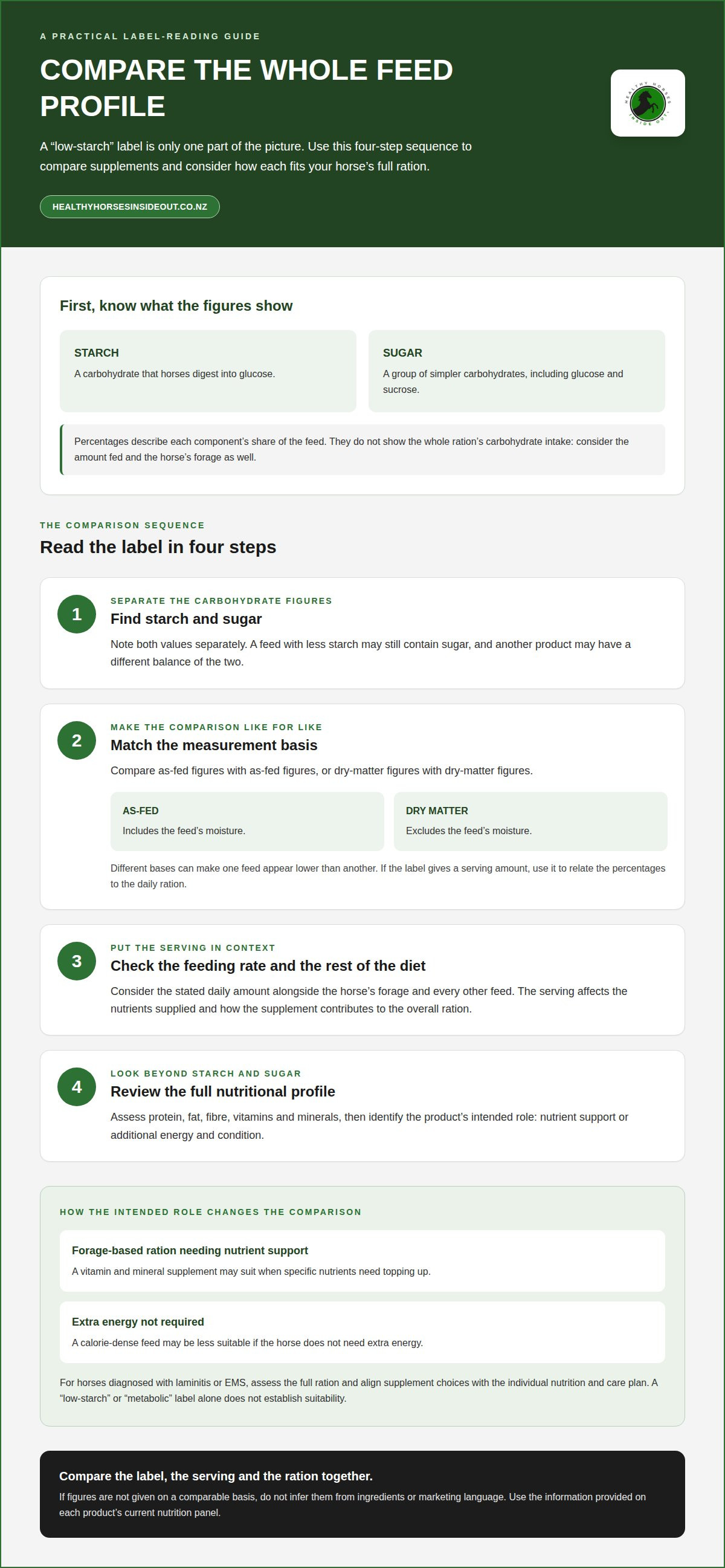
Starch is a carbohydrate that horses digest into glucose. Sugar is a group of simpler carbohydrates, including glucose and sucrose. A feed’s starch and sugar percentages describe their share of its composition, but they don’t show the whole ration’s carbohydrate intake. For a useful comparison, assess both figures alongside the amount fed and the horse’s forage.
There isn’t one starch or sugar percentage that applies to every supplement sold in New Zealand. Formulas differ, so compare the figures on each product’s current nutrition panel rather than relying on a “low-starch” description alone. A feed with less starch may still contain sugar, while another may have a different balance of the two.
Check the measurement basis before comparing products. A percentage reported on an as-fed basis includes the feed’s moisture; a dry-matter figure excludes it. Comparing different bases can make one feed appear lower than another. If the panel gives a serving amount, use it to work out how the percentages relate to the daily ration.
Use this simple label-reading sequence for a low-starch horse supplement in NZ:
- Find both figures: note starch and sugar separately, rather than treating one as a substitute for the other.
- Match the basis: compare as-fed with as-fed, or dry matter with dry matter.
- Check the feeding rate: consider the stated serving alongside the rest of the horse’s diet.
- Review the full profile: protein, fat and fibre also affect what the supplement contributes.
If a label doesn’t provide comparable percentages, don’t infer them from the ingredients or marketing language. Compare only the information each label gives, and note when figures use different measurement bases. This avoids assuming that a product name or category guarantees a particular carbohydrate profile.
Cost of low-starch horse supplements in New Zealand
The purchase price is what you pay for a pack of feed. In New Zealand, supplement prices vary with pack size, formulation and feeding rate. A larger pack may cost more upfront but provide more servings. Compare the cost of a daily serving, not just the shelf price.
Cost per serving is the pack price divided by the number of usable servings. Use the feeding directions to estimate how long the pack lasts, then compare that duration across products. A concentrated supplement fed in a smaller daily amount, for example, may last longer than a bulkier feed. The pack price alone won’t show this difference.
Cost per day estimates the cost of the recommended daily amount. Divide the price by the number of daily servings in the pack. If your horse receives different amounts as its workload or ration changes, recalculate using the amount actually fed. This is more useful than comparing products by bag weight.
- Note the pack price: use the current NZ$ amount shown by the retailer.
- Find the feeding rate: use the product’s directions for the horse’s relevant category.
- Estimate servings: divide the pack quantity by the daily amount fed.
- Compare daily costs: divide the pack price by the estimated number of servings.
- Assess the contribution: consider whether the feed supplies nutrients your horse’s ration needs.
Products with similar prices may serve different purposes. One may be a concentrated supplement, while another contributes more feed by weight. Review the feeding directions and nutritional profile together: a lower daily cost is no advantage if the product doesn’t suit the role required in the ration.
For a more considered comparison, match the product’s intended use with your horse’s needs before weighing pack price against daily serving cost. Exploring horse supplement options can help you consider how targeted support fits into that decision.
Which low-starch supplements are suitable for horses with laminitis or EMS?
Laminitis is a painful condition affecting the tissues connecting the hoof wall and pedal bone. EMS, or equine metabolic syndrome, describes a group of metabolic abnormalities associated with increased laminitis risk. For either concern, choose a supplement based on its full nutritional profile and intended role, not its front-label claim.
A suitable option complements the horse’s existing ration without adding unnecessary starch and sugar. A vitamin and mineral supplement may suit a forage-based ration when specific nutrients need topping up. A calorie-dense feed may be less suitable if the horse doesn’t need extra energy. The right choice depends on the forage, current feed and individual nutrition plan.
Use this label-led comparison when assessing a low-starch horse supplement in NZ:
- Read the carbohydrate figures: look for separate starch and sugar values, then compare products using the same measurement basis.
- Check the feeding rate: consider the amount fed each day, because the serving affects the nutrients supplied.
- Review the whole profile: assess protein, fat, fibre, vitamins and minerals alongside starch and sugar.
- Identify the purpose: distinguish a nutrient balancer from a feed intended to add energy or condition.
A forage-fed horse needing micronutrient support, for example, may have different needs from a horse receiving supplementary energy. A “low-starch” label alone can’t show whether a product suits either situation. Forage and every additional feed contribute to the overall ration, so assess them together.
For a horse diagnosed with laminitis or EMS, align supplement choices with its individual nutrition and care plan. Don’t assume a product marketed for metabolic horses is automatically suitable; its ingredients, serving directions and nutrient contribution still matter. If the ration changes, reassess the supplement’s role rather than simply adding another product. Focus on the complete diet, not a single label claim.
What low-starch supplements provide vitamins and minerals for horses on forage-based diets
A forage-based ration relies mainly on pasture or conserved forage. A vitamin and mineral supplement can add selected nutrients without requiring a large feed portion, but its suitability depends on the whole ration. A horse eating hay and pasture, for example, may need a different nutrient balance from one also receiving fortified feed.
A ration balancer is a concentrated feed designed to supply nutrients in a smaller serving. For a low-starch option, compare its starch and sugar information with the listed vitamins, minerals and feeding directions. Check whether the serving is intended to complement forage or assumes the horse also receives another fortified feed. These details affect how the supplement fits the daily ration.
Trace minerals are needed in small amounts and include copper, zinc and selenium. Their contribution varies between products, so read the label rather than assuming every supplement provides the same profile. A product listing copper and zinc, for instance, doesn’t establish that it supplies every nutrient the horse needs.
Use these steps to assess a supplement for a forage-based diet:
- Set the starting point: list pasture, hay, chaff and any fortified feed in the current ration.
- Review forage information: use an available forage analysis to identify nutrients it measures, then compare those results with the supplement’s profile.
- Read the full label: note the named vitamins and minerals, serving directions, and starch and sugar figures.
- Check for overlap: account for nutrients already supplied by other feeds before adding another source.
A horse eating forage alongside fortified feed, for example, may already receive some vitamins and minerals. Adding a balancer without reviewing both labels could duplicate nutrients. Conversely, choosing a product solely because it is marketed as low-starch may leave specific gaps in the forage ration unaddressed. Match the supplement to the ration’s purpose and follow the labelled serving directions.
To explore options for targeted nutritional support, review horse supplement choices alongside the forage and feeds in the ration.
Healthy Horses Inside Out: Horse Supplement Bundles
Healthy Horses Inside Out offers Horse Supplement Bundles to help organise nutritional support around your horse’s needs. They can be useful when you’ve identified a feeding goal and want to consider suitable supplements together.
Healthy Horses Inside Out also offers Everyday Horse Supplements, Specific Horse Supplements and HHIO Pellets. Choose according to the role a supplement needs to play, then assess its label and feeding directions alongside forage and other feeds. If you’re looking for low-starch options, review the product’s starch and sugar information rather than assuming its category determines its nutrient profile.
For a considered starting point, identify what the current ration provides and what support you’re seeking. Contact Healthy Horses Inside Out to discuss your horse supplement options.
Make your next feeding decision with clarity
A feeding choice is easier to maintain when it has a clear purpose. Before changing your horse’s ration, note the outcome you’re aiming for, the feeds already offered and the role a supplement should fill. This gives you a practical reference point when routines or forage change.
Choosing a low-starch horse supplement in NZ should be part of a wider decision, not a stand-alone response to one label figure. Set a specific goal, whether you’re seeking targeted nutrient support or adjusting an existing routine. Then consider whether the choice still fits the complete ration, not just the original reason for adding it.
Keep your notes simple: record what changed, why it changed and how the ration is currently fed. A clear record supports consistent decisions and helps prevent an old choice from becoming automatic when circumstances shift. A thoughtful adjustment starts with a clear question, not a quick swap.
For a considered next step, discuss your feeding goals with Healthy Horses Inside Out and move forward with greater clarity.
Frequently Asked Questions
What low-starch horse supplements are available in New Zealand?
New Zealand horse owners can choose from daily supplements, targeted formulas, pellets and supplement bundles. Healthy Horses Inside Out offers Everyday Horse Supplements, Specific Horse Supplements, Horse Supplement Bundles and HHIO Pellets. HHIO Foundation is intended for everyday nutrient support and is also described for metabolic horses. Compare each option’s feeding purpose and product information with the horse’s current ration before choosing a supplement.
Which NZ horse supplements have the lowest starch and sugar levels?
A reliable lowest-starch ranking requires comparable starch figures; a no-sugar claim alone doesn’t establish starch content. Healthy Horses Inside Out states, “Includes no fillers, preservatives, sugar or ingredients high in iron.” HHIO Foundation is described as suitable for metabolic horses, but that statement doesn’t provide a starch percentage. For a sound comparison, use matching starch figures and consider the intended feeding role rather than treating “no sugar” as equivalent to “lowest starch”.


