

More grain doesn’t automatically mean more usable energy for a performance horse. Getting horse nutrition myths busted starts with the basics: forage is the foundation, with a general daily guideline of 1.5-2.5% of bodyweight, and several smaller meals are preferable to one large meal. Large starch meals can overwhelm the small intestine, while starch reaching the hindgut can disrupt its microbial balance and contribute to digestive problems.
It’s understandable to look for a straightforward feeding rule, especially when your horse’s workload, condition and behaviour all matter. The more useful approach is to match the diet to the horse and understand how each feed choice affects digestion. This article separates fact from fiction on feeding schedules, forage access, alfalfa, sugar, bran mash and performance diets, including why a forage-focused diet supplemented with fat and fibre can provide energy while supporting gut health.
Key Takeaways
- Build feeding routines around forage and smaller meals, and make changes gradually to support comfortable digestion.
- Assess alfalfa, carrots and other feeds by their nutritional content rather than assuming they affect every horse’s behaviour in the same way.
- Think twice before using bran mash as a traditional fix; its mineral balance can matter more than its warmth or texture.
- For performance horses, consider how forage, fat and fibre can contribute energy without relying on large starch meals.
Feeding schedules and forage access
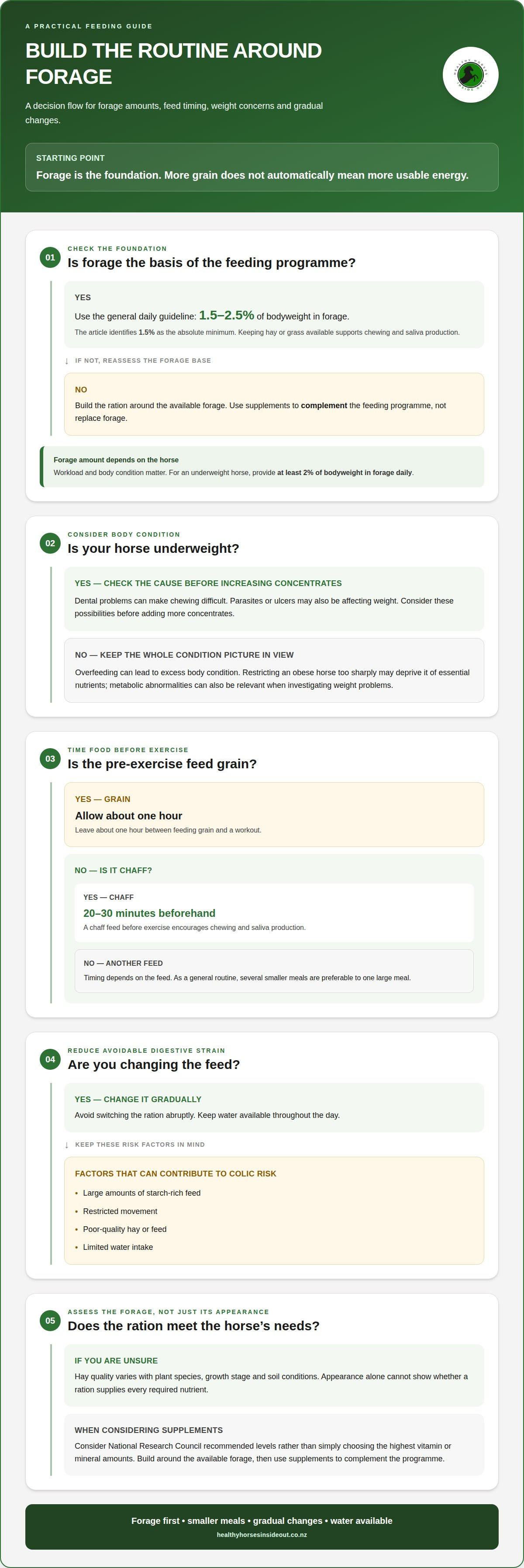
Forage is the foundation of a horse’s feeding programme. A general daily guideline is 1.5-2.5% of bodyweight in forage, with 1.5% the absolute minimum. Keeping hay or grass available supports chewing and saliva production. This matters because long gaps without forage can leave a horse with less opportunity to chew.
Before exercise, timing depends on the feed. A chaff feed 20-30 minutes beforehand encourages chewing and saliva production. Grain needs a different window: allow about one hour between feeding grain and a workout. Several smaller meals are preferable to one large meal, which can place a heavier digestive load on the horse.
To help reduce colic risk, change feeds gradually rather than switching the ration abruptly, and keep water available throughout the day. Large amounts of starch-rich feed, restricted movement, poor-quality hay or feed, and limited water intake can all contribute to risk.
For an underweight horse, provide at least 2% of bodyweight in forage daily. Before increasing concentrates, consider whether dental problems, parasites or ulcers could be affecting weight. Teeth can make chewing difficult, while parasites may also contribute to a horse becoming too thin. Overfeeding can lead to excess body condition; restricting an obese horse too sharply may deprive it of essential nutrients. Metabolic abnormalities are also relevant when investigating weight problems.
Hay quality varies with plant species, growth stage and soil conditions, so appearance alone cannot show whether a ration supplies every required nutrient. Ryegrass pasture is one forage source, but its nutrient contribution also depends on these conditions. Build the ration around the available forage, then use supplements to complement the feeding programme, not replace it. Consider National Research Council recommended levels rather than simply choosing the highest vitamin or mineral amounts. This helps New Zealand horse owners assess pasture, hay and supplementation without assuming one rule suits every horse.
Alfalfa, sugar, starch and behaviour
Busting horse nutrition myths starts with separating a feed’s reputation from its nutritional role. Alfalfa is low in sugar compared with other forage and hay sources, so calling it inherently “heating” oversimplifies the picture. Its suitability still depends on the whole ration, workload and body condition. A change in behaviour after adding alfalfa doesn’t, by itself, prove alfalfa caused it. Consider what else changed, such as exercise, routine or other feed.
Sugar and starch also need context. A 100 g serving of carrot supplies 5 g of sugar, which helps put a treat into perspective without making it the whole diet. Consider how treats and feeds contribute to the horse’s overall intake. Large starch meals can overwhelm the small intestine; starch reaching the hindgut can disrupt microbial balance and contribute to digestive problems. For example, review meal size and the full ration before blaming one ingredient for unsettled behaviour.
Protein provides amino acids that support body tissues, including structures involved in hoof growth. But more protein doesn’t automatically mean better hoof care. If hoof condition is a concern, assess the complete ration rather than adding one nutrient based on an assumption. The same careful reasoning applies to behaviour: busting horse nutrition myths means considering feeding alongside workload, health and routine, rather than treating one ingredient as a universal explanation.
Joint supplements aren’t a direct behaviour treatment. A horse that moves differently or resists work may be responding to discomfort, but behaviour alone doesn’t identify the cause. Note changes in movement, workload and feeding to give those observations context. For nutritional support, consider a balanced supplement approach alongside the horse’s existing diet. That’s a more useful way to keep horse nutrition myths busted than changing feeds in response to one unexplained behaviour.
Bran mash and phosphorus-to-calcium imbalance
A warm bran mash can feel like a comforting winter feed, but warmth doesn’t make wheat bran nutritionally balanced. Wheat bran contains much more phosphorus relative to calcium, so large amounts can upset the ration’s phosphorus-to-calcium balance. The concern is not the mash’s temperature or texture, but how repeated servings affect the minerals in the horse’s diet.
With a high-phosphorus ration, calcium may be drawn from bones to help maintain the body’s mineral balance. In horses eating large amounts of wheat bran, this imbalance can cause nutritional secondary hyperparathyroidism, a serious consequence that makes bran mash unsuitable as a casual routine. A traditional recipe also cannot account for the forage, concentrates and other feeds already in the diet.
Rice bran isn’t automatically a safer substitute. Its high phosphorus content may also cause severe mineral imbalances, so switching from wheat bran to rice bran doesn’t address the underlying issue. Consider the whole ration, including its mineral sources, rather than judging a feed by its name or energy content. Adding a vitamin or mineral supplement without accounting for existing feed can compound an imbalance, particularly when products overlap.
For a warm feed on a cold day, add warm water to the horse’s regular feed rather than introducing bran mash. To support warmth through winter feeding, provide more hay instead of relying on bran. For example, a horse already receiving a formulated ration doesn’t need bran just because it is customary. Make feeding changes gradually and assess the ingredients together, so a comforting ritual doesn’t undermine the ration’s calcium balance.
High-starch diets for performance horses
More grain doesn’t automatically mean better performance. Large starch meals can overwhelm a horse’s small intestine. Starch that reaches the hindgut may disrupt its microbial balance and contribute to digestive problems. For a competition horse, the aim is usable energy that supports workload without placing unnecessary strain on digestion. Choose feed according to the horse’s work, body condition and whole ration, not performance expectations alone.
Not every horse needs grain or concentrates. Some horses in light work maintain body condition on forage alone, but forage quality varies and may not supply every required nutrient. Assess the horse’s weight and condition alongside workload and forage intake, then identify whether the ration needs additional energy or nutrients. A complete feed fortified with vitamins and minerals may still need to be fed alongside forage.
For performance horses, a forage-focused diet supplemented with fat and fibre can provide energy while supporting gut health. This shifts the emphasis from a large starch serving to the balance of the whole ration. Before adding more grain, consider whether forage and suitable fat and fibre sources meet the horse’s workload. Make feed adjustments gradually, not abruptly.
Starch is only one factor in colic risk. Large amounts of starch-rich feed can contribute, along with restricted movement, poor-quality hay or feed, limited water intake, some medicines or supplements, and environmental or management factors. Removing grain alone therefore won’t address every risk. Consider feeding, forage quality, movement and water access together when thinking about digestive health.
For horse owners managing a hard-working horse, the takeaway is clear: prioritise forage, match energy intake to workload, and monitor weight and condition as the ration changes. To complement a forage-led feeding programme, explore horse supplement options suited to everyday or specific nutritional support.
Healthy Horses Inside Out
Healthy Horses Inside Out offers nutritional support for horse owners considering how supplements fit into a balanced feeding programme. Its Everyday Horse Supplements, Specific Horse Supplements, Horse Supplement Bundles and HHIO Pellets provide options for different nutritional needs. Supplements should complement the overall ration, not replace forage or a balanced feeding plan. Before adding anything, consider the horse’s existing feed, workload and condition, and avoid stacking products with overlapping nutrients. This measured approach helps keep feeding decisions focused on the horse rather than on a single claim or ingredient. For support with your horse’s nutritional needs, contact Healthy Horses Inside Out.
Make your next feeding decision with confidence
Once you’ve busted horse nutrition myths, turn sound principles into a consistent routine. Keep a simple feeding record, noting ration changes alongside appetite, manure, energy and body condition. This can help reveal patterns over time, rather than prompting a reaction to one unsettled day or several feed changes at once. When adjusting the programme, make one considered change and record what follows.
Use your record to guide future decisions while keeping the horse’s overall diet in view. If you’re considering nutritional support, Healthy Horses Inside Out offers options designed to complement a feeding programme. Thoughtful choices based on your horse’s needs provide a practical foundation for ongoing care.
Contact Healthy Horses Inside Out to discuss your horse’s nutritional needs and take your next step with confidence.
Frequently Asked Questions
What are common horse nutrition myths and what does research say?
Common myths include that grain is essential for performance, alfalfa always makes horses excitable, and bran mash is automatically beneficial. Feeding decisions work better when based on the whole ration, the horse’s workload and condition, and the forage available. For example, a horse in light work may maintain condition on forage, while a performance horse’s energy needs require a broader assessment than simply adding grain.
How much hay or pasture should a horse eat daily as a percentage of body weight?
A general daily guideline is 1.5-2.5% of bodyweight as forage, including hay or pasture. The appropriate amount depends on forage availability, quality and the horse’s condition. To apply the guideline, establish the horse’s bodyweight and measure the hay offered; pasture intake is harder to quantify. Keep changes gradual, and consider the full ration rather than treating the percentage as a complete measure of nutritional balance.
Do horses need salt, mineral supplements, or a vitamin supplement?
Horses need a balanced supply of minerals and vitamins, but the right supplement depends on what the existing ration provides. A mineral block alone cannot supply sufficient minerals for a horse, and plain salt should be provided separately. HHIO recommends HHIO Foundation pellets as a complete mineral source, with a 70 g dose for horses over 350 kg. Avoid combining products without accounting for overlapping nutrients, particularly selenium.
Is feeding sugar or starch always harmful for horses?
No. Sugar and starch aren’t automatically harmful in every amount or feeding situation; the horse’s total diet and workload matter. A small treat, for example, is different from relying on large starch-heavy meals for energy. Consider how all feeds contribute to carbohydrate intake, especially for horses with metabolic concerns, and don’t assume one ingredient explains a change in behaviour or condition.
Are bran mashes and dietary oil beneficial for horses?
Bran mash isn’t automatically beneficial, because regular or large servings can upset the balance between phosphorus and calcium. Dietary oil can provide energy as part of a carefully balanced ration, including for horses whose workload raises energy needs. Introduce any ration change gradually and consider how it fits with existing feed, forage and body condition. Neither bran nor oil is a universal solution for every horse.
What are the risks of overfeeding, obesity, and equine metabolic syndrome?
Overfeeding can lead to excess body condition, while sharply restricting an obese horse may deprive it of essential nutrients. Metabolic abnormalities should also be considered when investigating weight problems.


