

More supplements do not automatically mean better nutrition. A horse supplement selector tool helps compare options against your horse’s lifestyle and characteristics, while screening out choices that could exceed safe nutrient limits. It offers a clearer starting point than choosing a product based only on its advertised purpose.
Start by looking at the whole feeding picture. Forage, existing feed and supplements all contribute to the ration, so overlapping nutrients can add up. Each supplement should have a clear purpose within a balanced feeding plan, rather than being used to compensate for gaps in feeding or management.
This guide explains how a selector can use factors such as workload to rank options and why nutrient limits matter. You’ll also learn how to review the full ration, decide when targeted support may be appropriate, and consider everyday and specific supplements as part of a considered feeding plan.
Key Takeaways
- Start with the whole ration, including forage and existing feed, so added nutrients don’t duplicate what your horse already receives.
- Use workload and routine to clarify which nutritional functions may matter, from recovery support for active horses to maintenance for easier keepers.
- Consider body condition and life stage alongside lifestyle; these details can change which dietary options are the best fit.
- Look for a clear purpose and suitable nutrient levels, then explore supplement options that complement your horse’s feeding plan.
Excluding products that exceed upper safe nutrient limits
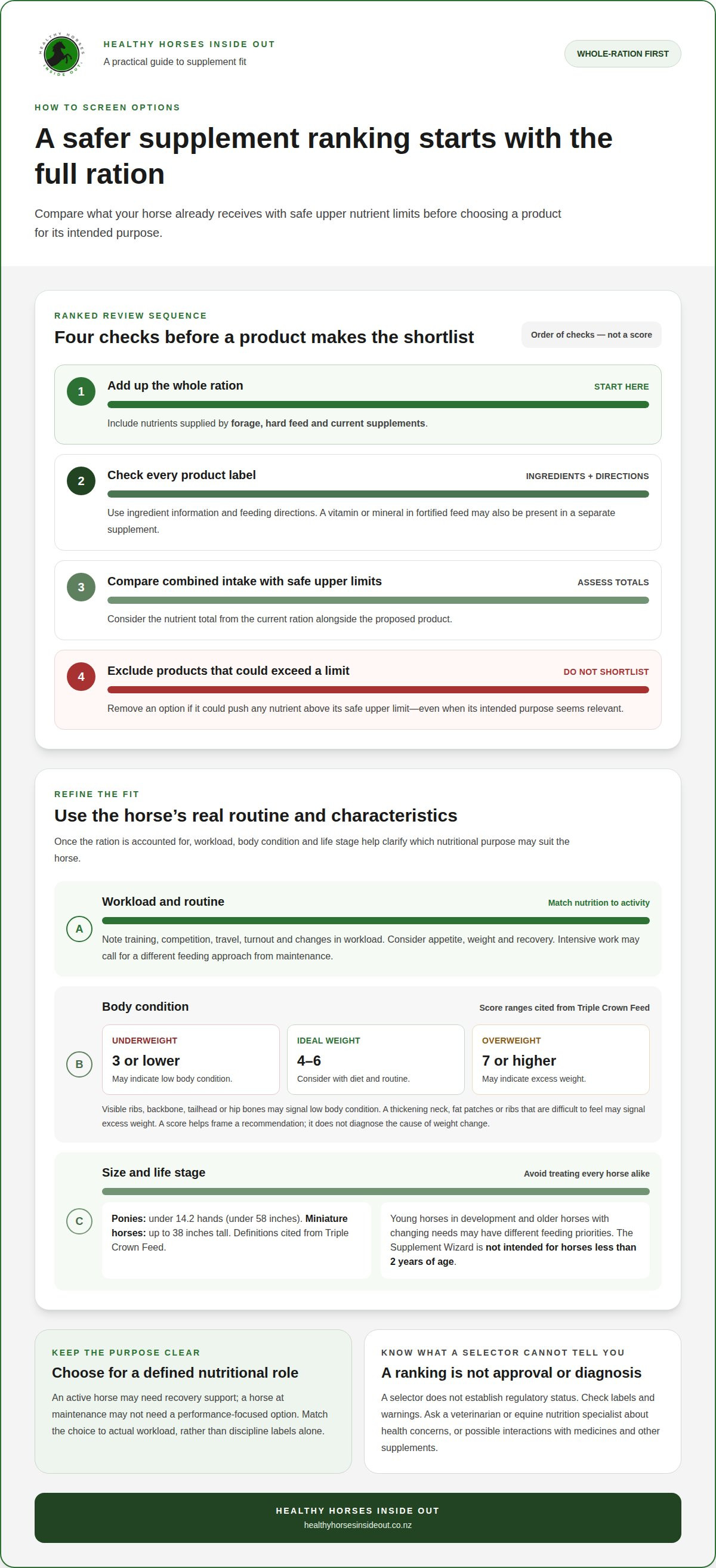
A useful selector takes the whole ration into account before ranking products. Add the nutrients supplied by forage, hard feed and current supplements, then compare the combined intake with safe upper limits. Exclude any product that could push a nutrient above its limit, even if its intended purpose seems relevant. For example, a vitamin or mineral in fortified feed may also be present in a separate supplement. Use the feeding directions and ingredient information on each label when reviewing totals.
Which supplements suit different ages, workloads and health needs? Choose by purpose: an active horse may need support for recovery, while a horse at maintenance may not need a performance-focused option. Young horses in development and older horses with changing metabolism may have different needs; the Supplement Wizard is not intended for horses less than 2 years of age. A veterinarian or equine nutrition specialist can help assess supplements alongside health concerns.
How are horse supplements regulated and labelled in New Zealand? A selector can compare dietary fit, but it does not establish a product’s regulatory status. Check the label for ingredients, feeding directions and warnings, and don’t treat a ranking as regulatory approval.
How do you choose supplements using forage or pasture analysis? Start with an analysis of hay or pasture to identify nutrients that may be low or already abundant. Then include hard feed and current supplements before choosing a product to address a potential gap. A horse supplement selector tool can help organise the comparison, but forage results are useful only when considered as part of the full ration.
How can you check whether a supplement is safe with medicines or other supplements? Make a list of current products and their ingredients, then ask the prescribing veterinarian to assess possible interactions in light of the medicine and your horse’s health needs. This is particularly important when a new product shares ingredients with an existing supplement.
Which selector tools are available in New Zealand? The Supplement Wizard is one named option. Use it as a dietary guide, not as a substitute for reviewing the ration, product labels and your horse’s needs.
Feed selection by horse lifestyle
Workload can help distinguish performance feeding from maintenance feeding. A horse in intensive work may have different nutritional demands from one at maintenance. Consider the horse’s actual activity and recovery needs when comparing options, rather than assuming a particular supplement suits every horse in a discipline. The aim is to match nutrition to the horse’s workload, not just its label or activity type.
Build a clear picture of your horse’s routine before comparing feeds. Note regular workload, turnout, travel and competition, then consider changes in appetite, weight and recovery. A horse that travels frequently may respond differently to routine changes than one on a steady home schedule. Record what the horse does each week rather than describing it only as “active” or “quiet”.
What should you ask an equine veterinarian or nutritionist? Ask what nutritional purpose suits the horse’s workload, whether the current ration already supplies relevant nutrients, and what signs would mean the plan needs review. For a horse in training, discuss its recovery needs; for an easy keeper at pasture, discuss maintenance and weight management.
- How often does the horse train, compete or travel?
- Does its workload change across the season?
- What do pasture and existing feeds contribute to daily intake?
- Is there a specific function the supplement should support?
Travel and competition can influence physiological responses and gut microbiota balance, so include these demands in the feeding picture. A horse that travels for events may need a different plan from one exercising at home, even if both appear to have similar workloads. Keep the intended function clear, such as supporting recovery, rather than adding a product without a defined role.
For a practical next step, compare the horse’s routine with everyday horse supplement options and focus on dietary fit. A clear workload profile helps narrow choices without treating every active horse alike.
Triple Crown Feed says performance horses doing riding, training, pulling or carrying loads need more calories as activity increases. Pleasure or maintenance horses, including easy keepers often pastured, maintain weight and do well on maintenance feeds.
Horse characteristics used to guide feed recommendations
Body condition helps distinguish which feeding priorities may suit an individual horse. According to Triple Crown Feed, a body condition score of 3 or lower indicates an underweight horse, while a score between 4 and 6 indicates ideal weight. A score of 7 or higher indicates overweight. These ranges help frame a recommendation, but they don’t identify the cause of weight change or establish a diagnosis.
Physical signs add context to the score. Visible ribs, backbone, tailhead or hip bones may indicate low body condition; a thickening neck, fat patches or ribs that are difficult to feel may indicate excess weight. For example, a horse scoring 7 with a thickening neck needs a different feeding focus from one scoring 3 with visible ribs. Consider these observations alongside the horse’s current diet and routine.
Size also matters. Triple Crown Feed defines ponies as horses under 14.2 hands, equivalent to under 58 inches, and miniature horses as up to 38 inches tall. A selector can use these characteristics to refine its recommendations, rather than treating every equine as an average-sized adult. Size alone, however, doesn’t identify a nutrient gap or a suitable supplement.
Life stage can influence nutritional priorities. A young horse in development and an older horse with changing needs may call for different feeding plans. Ask what the plan should support, such as maintaining condition or supplying a specific nutrient. Matching ingredients to a clear purpose keeps decisions tied to the horse’s needs rather than broad assumptions about age.
Follow the individual product’s feeding directions, taking the horse’s weight and existing ration into account. Don’t increase a serving simply because a horse appears underweight, as body condition can have several causes. If the directions are based on weight, use the horse’s current weight category and the stated serving guidance. A veterinarian or equine nutrition specialist can help assess a horse whose condition is changing.
Ranking supplements by dietary fit
A useful ranking starts with suitability, not popularity or a broad benefit claim. First, identify the intended purpose, such as everyday nutrition or a specific need. Then compare that purpose with the horse’s forage, current feeds, lifestyle and supplements. A product that duplicates nutrients already supplied by the ration may be a weaker fit, even if its label seems relevant to the horse’s activity.
Next, screen for safety before ranking the remaining options. Add up nutrients from forage, feeds and supplements using the feeding directions and ingredient information on product labels. Exclude any option that would take the combined ration above a safe upper nutrient limit. A product may suit a particular goal yet still add too much of a nutrient already in the ration.
After screening for safety, compare how closely each option fits the horse’s actual needs. A horse in intensive work may benefit from a different feeding focus than an easy keeper at pasture. A veterinarian or equine nutrition specialist can help review the whole ration when health concerns or unclear ingredient totals complicate the decision.
- Purpose: Does the product support a defined function?
- Ration fit: Do forage and current horse feeds already provide the same nutrients?
- Safety: Does the combined intake remain within safe limits?
- Lifestyle: Does the option match workload, travel and feeding routine?
Keep comparisons in perspective. A horse feed comparison tool may display a selection of feeds, but its results are estimates for demonstration purposes. Treat rankings as a way to organise options, not as a diagnosis or a substitute for sound feeding decisions. A strong match is a safe option that addresses a clear need without adding unnecessary ingredients.
Use these criteria to narrow the field, then explore supplements matched to your horse’s dietary needs.
Healthy Horses Inside Out: Horse Supplement Bundles
Healthy Horses Inside Out offers Horse Supplement Bundles for owners looking to bring suitable support together around a horse’s feeding needs. If your comparison points to a clear purpose, such as everyday nutritional support or a specific dietary focus, consider whether an Everyday Horse Supplement, Specific Horse Supplement or bundle best fits the ration. HHIO Pellets are another option within the available range.
Use the ranking as a starting point, then match the product’s purpose to your horse’s current feed and supplement routine. Healthy Horses Inside Out offers everyday supplements, targeted formulas, HHIO Pellets and supplement bundles. Choose an option that fits a clear nutritional purpose, and explore the range on the Healthy Horses Inside Out website.
Make your next feeding decision with confidence
A considered feeding plan can change as your horse’s routine, condition and needs change. Use a horse supplement selector tool as a starting point, then base your decision on the current ration and a clear nutritional purpose. If circumstances change, reassess the fit instead of automatically adding another supplement.
Make the next step practical: keep a simple record of feeding changes, appetite, body condition and workload. These observations provide a useful reference when reviewing whether the plan still suits your horse. For health concerns or uncertainty about a changing condition, discuss the situation with your veterinarian.
For help exploring supplement options that align with your horse’s needs, contact Healthy Horses Inside Out. A thoughtful choice begins with good information and a clear purpose.
Frequently Asked Questions
What is a horse supplement selector tool?
A horse supplement selector tool uses details about a horse to rank potentially suitable dietary options. It can organise choices around factors such as workload, age and body condition, helping you focus on products with a relevant purpose. For example, a horse in regular competition may need a different feeding focus from a pasture-kept horse at maintenance. Treat the result as a comparison aid, not a diagnosis.
What ingredients and nutrient levels should I compare in horse supplements?
Compare the ingredient list, the nutrients supplied by the recommended daily serving and the product’s feeding directions. Check vitamins and minerals such as copper, selenium and magnesium against the horse’s existing feed and supplements. Compare daily totals rather than assuming equal scoop sizes provide equal amounts. Look for a clear purpose and transparent ingredient information, so each addition has a reason within the feeding plan.


