

A Thoroughbred’s build can make weight gain harder, but breed alone doesn’t tell you whether a horse is under-conditioned or simply suited to its workload. Feeding hard keeper Thoroughbreds starts with assessing body condition and forage intake: a general target is at least 2% of body weight per day in forage, with any dietary changes made gradually.
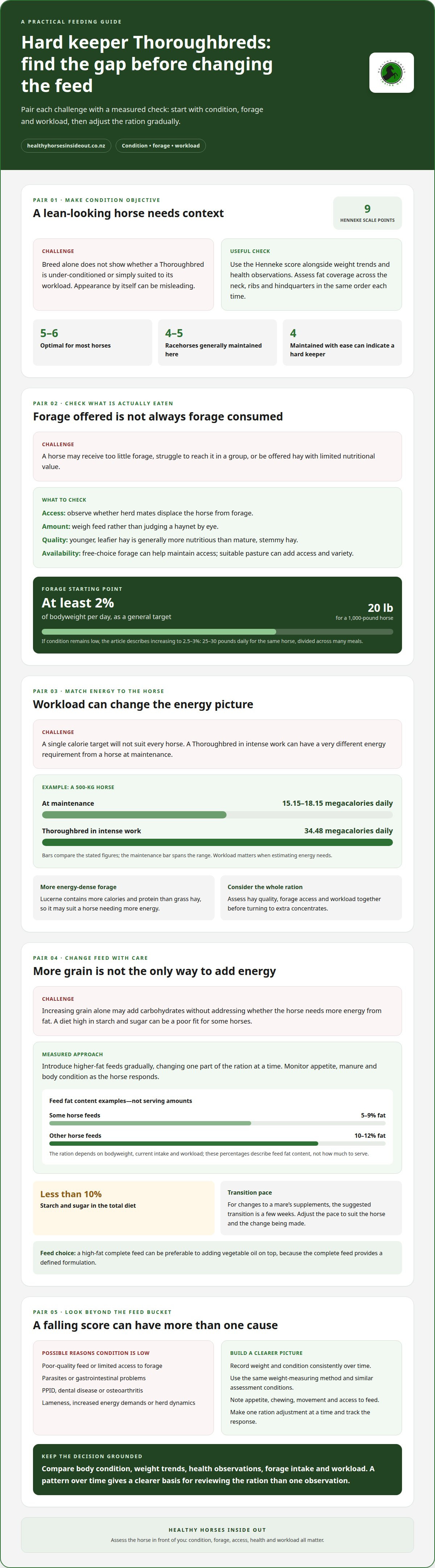
If your horse seems to lose condition despite eating well, it’s understandable to wonder whether you’re feeding enough or choosing the right feed. Body condition scoring helps make that assessment more objective. The Henneke system uses a nine-point scale, with a score of 5 to 6 considered optimal for most horses; a horse that maintains a score of 4 with ease is generally considered a hard keeper.
In this guide, you’ll learn how to recognise hard keepers, assess condition and consider factors that can affect weight. You’ll also see how forage quality and a gradual introduction of higher-fat feeds can support a measured approach for Thoroughbreds and other horses prone to difficulty maintaining condition.
Key Takeaways
- Assess forage amount and quality first, as leafy, energy-dense hay may better support a horse that struggles to maintain condition.
- Introduce higher-fat feeds gradually and monitor how your horse responds rather than making abrupt diet changes.
- Use body condition alongside workload, health and eating behaviour to understand why a horse may be losing or not gaining weight.
- Thoroughbreds and other horses bred for racing can have higher energy demands, so their feeding plan should reflect their individual workload and condition.
How to Identify Hard Keeping Horses?
Start with the feed a horse actually eats, not just what’s offered. A hard keeper may receive too little forage, struggle to access it in a group, or be eating hay with limited nutritional value. In equine nutrition, forage is the foundation: it supports digestive health, behavioural needs and mental wellbeing. Free-choice forage can help horses maintain access to this essential part of their diet.
How many calories should a hard-keeping Thoroughbred eat per day? It depends on bodyweight and workload. A 500-kg horse at maintenance requires 15.15 to 18.15 megacalories daily, while a 500-kg Thoroughbred in intense work requires 34.48 megacalories daily. These examples show why workload matters when estimating energy needs.
Forage amount provides a practical starting point. A general target for hard keepers is at least 2% of bodyweight daily. For a 1,000-pound horse, that equals 20 pounds of forage. If condition remains low, the amount can be increased to 2.5% to 3% of bodyweight: 25 to 30 pounds daily for the same horse, divided across many meals. Weighing feed makes the amount clearer than judging a haynet by eye.
Quality matters as much as quantity. Younger, leafier hay is generally more nutritious than mature, stemmy hay. Legume hays such as lucerne contain more calories and protein than grass hays, so they may suit a horse that needs more energy. If grass hay makes up most of the ration, consider whether a more energy-dense forage would better meet the horse’s needs.
Turnout adds access and variety when pasture is suitable, while social interaction can provide mental enrichment and physical stimulation. Observe whether the horse can reach forage without being displaced by herd mates. When feeding hard keeper Thoroughbreds, assess forage access, hay quality and workload together; a low intake or energy-poor forage may explain poor condition before extra concentrates are considered.
Gradually introducing higher-fat feeds
Higher-fat feeds can add energy without simply increasing grain. Introduce new feed gradually, changing one part of the ration at a time so you can monitor appetite, manure and body condition. For changes to a mare’s supplements, the suggested transition period is a few weeks; adjust the pace to suit the horse and the change being made.
What are the risks of feeding too much grain or starch to a Thoroughbred? A diet high in starch and sugar can be a poor fit for some horses, so the total diet should supply less than 10% starch and sugar. Increasing grain alone may also add carbohydrates without addressing whether the horse needs more energy from fat.
For owners considering a higher-fat feed, check its nutritional profile and introduce it in measured stages. Some horse feeds contain 5-9% fat, while others contain 10-12%. These figures describe feed fat content, not the amount to serve; the ration depends on body weight, current intake and workload. A high-fat feed can be preferable to adding vegetable oil on top, because the complete feed provides a defined formulation.
How should a feeding plan change with workload, age, pasture quality and season? Match energy intake to activity and available forage. A horse in intense work needs more energy than one at maintenance, while growing horses, pregnant or lactating mares, and breeding stallions at work have higher requirements. Reassess the ration as pasture quality and seasonal conditions change instead of assuming it will suit the horse year-round.
An ex-racehorse may have received as much as 15 pounds of grain per day. After racing, reduced work can lower energy demand, so owners should adjust the ration gradually instead of carrying on with the same grain allowance. Monitor body weight and condition as the horse’s activity changes, and make one adjustment at a time. For a considered approach to horse nutrition support, base each change on the whole ration, not a single feed label.
Identifying hard keepers and assessing body condition
Body condition scoring can help distinguish a naturally lean horse from one losing condition. Use the Henneke scale alongside weight trends and health observations, rather than judging by appearance alone.
Assessing Body Condition
The Henneke Body Condition Scoring system rates fat accumulation on a nine-point scale. A score of 5 to 6 is considered optimal for most horses, while racehorses are generally maintained between 4 and 5. A horse that maintains a score of 4 with ease is generally considered a hard keeper. Scoring gives owners a consistent way to describe condition and assess whether weight gain is needed.
Tracking Weight and Condition
Track weight and body condition consistently over time. Use the same weight-measuring method and assess the horse in similar conditions, noting changes alongside its score. Keeping a record can show whether a feeding adjustment is supporting weight gain or condition is still declining. One observation can be misleading; a pattern gives a clearer basis for reviewing the ration.
Assess the horse’s shape as well as its score. The Henneke scale considers fat coverage across areas such as the neck, ribs and hindquarters. Check those areas in the same order each time to make changes easier to spot. Visible ribs alongside a low score may indicate reduced fat cover, but interpret the score in context with workload and health.
Low weight or a falling score can have causes beyond insufficient calories. Poor-quality feed, parasites, gastrointestinal problems, PPID, dental disease, osteoarthritis and lameness can all affect condition. Increased energy demands and herd dynamics may also play a part. Note changes in appetite, chewing, movement and access to feed, as these can help explain why a horse is not maintaining weight.
Use the full picture to guide your next decision: compare the horse’s score and weight trend with its workload, feeding pattern and general health. If condition worsens despite a suitable ration, consider possible underlying causes rather than simply increasing feed. This keeps weight-gain goals grounded in the horse’s actual needs.
Thoroughbreds and other breeds prone to being hard keepers
Thoroughbreds can be naturally lean, but breed alone does not show whether a horse is underweight. Horses bred for racing, including Thoroughbreds and Standardbreds, tend to be hard keepers. Each horse’s energy needs still depend on workload, feed intake and body condition, so use its progress over time rather than breed as your guide.
A similarly sized Thoroughbred may burn more calories each day than an American Quarter Horse. This helps explain why the same ration might maintain one horse while another loses condition, but it is not a rule for every individual. An active horse in demanding work uses more energy than one at maintenance, so account for exercise when assessing whether intake meets need.
A horse’s racing history can shape expectations, too. A retired racehorse may arrive with a lean frame and feeding habits formed around training. That history does not mean it should stay lean or receive the same ration indefinitely. Match nutrition to its current activity and condition, then observe how it responds as its workload changes.
Look beyond breed when a horse struggles to maintain weight. Even with adequate intake, a Thoroughbred may lose condition because of dental problems, gastrointestinal issues, parasites, lameness or competition for feed. These factors can affect how much the horse eats, digests or uses. Changes in appetite, chewing, movement and herd access can help distinguish a feeding mismatch from another problem.
The practical takeaway is to treat breed as context, not diagnosis. Compare actual intake and workload with changes in condition; do not assume every Thoroughbred needs more concentrate. A Standardbred in light work and a Thoroughbred in intense work have different needs, even if both are naturally lean. Keep forage and digestive health central to any adjustment.
For nutrition support that complements a considered feeding plan, explore horse supplements suited to your horse’s needs.
Healthy Horses Inside Out
Healthy Horses Inside Out offers supplements to complement a considered feeding plan for hard keepers. Everyday and targeted supplements, bundles and HHIO Pellets provide options for equine dietary support, whether you are refining an existing routine or considering what may suit your horse.
Consider workload, forage intake and body condition when choosing supplements. A supplement can support the wider ration, but it does not replace suitable forage or explain unexplained weight loss. Keep the whole diet in view and choose products for a clear nutritional purpose.
For a considered next step, contact Healthy Horses Inside Out to discuss your horse’s nutritional needs.
Make the next feeding decision with care
A feeding plan works best when it responds to the horse, rather than repeating a familiar approach by default. When feeding hard keeper Thoroughbreds, treat each adjustment as a chance to learn: keep the routine consistent, observe your horse’s response and use it to guide the next decision. This makes feeding a considered process, rather than a cycle of adding more whenever condition seems slow to improve.
Keep the horse’s comfort and overall wellbeing at the centre of your decisions. If weight continues to fall or eating behaviour changes, consider whether an underlying issue needs attention alongside the diet. A steady, informed approach can help you make confident decisions and support your horse over time.
For help considering nutritional support that fits your horse’s needs, start a conversation with Healthy Horses Inside Out. Each thoughtful adjustment is a step towards a feeding routine that works for your horse.
Frequently Asked Questions
What Causes Low Body Weight in Horses?
Low body weight can result from insufficient calorie intake, poor-quality feed, parasites or gastrointestinal problems. Dental disease may make chewing difficult, while PPID, osteoarthritis and lameness can also contribute. During demanding work, energy needs may exceed intake, and herd dynamics may restrict access to feed. If weight loss continues despite adequate feeding, consider these possible causes rather than simply adding more feed.
What is a Hard Keeper?
A hard keeper is a horse that struggles to maintain body condition despite receiving suitable feed and care. A horse maintaining a body condition score of 4 with ease is generally considered a hard keeper, although the score alone doesn’t explain why. For example, feed competition, poor dentition or increased workload may affect condition, so consider the horse’s individual circumstances alongside its build.
What does “hard keeper” mean in Thoroughbreds?
For a Thoroughbred, “hard keeper” describes difficulty maintaining condition; it is not a diagnosis based on breed alone. Horses bred for racing, including Thoroughbreds and Standardbreds, tend to be prone to this pattern. A similarly sized Thoroughbred may burn more calories each day than an American Quarter Horse, but workload, intake and health still shape each horse’s needs.
What is the ideal body condition score for a Thoroughbred?
It depends partly on the horse’s work. Racehorses are generally maintained at a Henneke body condition score between 4 and 5, while 5 to 6 is considered optimal for most horses. A score should be interpreted alongside workload and visible changes over time. For instance, a lean Thoroughbred in race training may have different requirements from one doing light work.
What high-calorie feeds are suitable for hard-keeping horses in New Zealand?
Energy-dense forage, such as lucerne hay, pellets or cubes, may be an option, as may higher-fat horse feed. Alfalfa, also called lucerne, is among the forage options with the highest caloric content. Compare nutritional profiles with the existing ration and introduce changes gradually. The best fit depends on forage intake, workload and overall condition.
How much hay or pasture should a Thoroughbred receive daily?
A practical starting target for a hard keeper is forage totalling at least 2% of body weight daily, including hay and pasture. Weigh hay rather than estimating by eye, and account for how much pasture the horse can actually access and eat. If more forage is needed, increases can be divided across many meals, with amount guided by condition and the horse’s overall ration.


