

What if the right hoof supplement isn’t the first thing your horse needs? It’s understandable to look for nutritional support when hooves become brittle, crack or grow slowly, but changes can also reflect trimming, footing, workload or an underlying health issue. Choosing horse hoof supplements NZ-wide starts with understanding the whole picture, not chasing a quick fix.
Nutrition provides the building blocks for hoof growth and structure, yet adding a supplement without reviewing the full ration can mean duplicating nutrients already supplied by feed. A measured approach helps you compare ingredients and claims, while setting realistic expectations: hoof growth takes time, so visible changes won’t happen overnight.
This guide explains how key nutrients support hoof health, what to assess in your horse’s feed and routine, and how to compare supplement labels. You’ll also learn when a farrier or veterinarian’s input matters, so you can make a considered plan to support your horse’s wellbeing from the inside out.
Key Takeaways
- Hoof supplements provide dietary support, but they can’t instantly repair existing hoof horn or guarantee a particular result.
- Understand how ongoing hoof growth works to set realistic expectations for nutritional changes.
- When comparing horse hoof supplements NZ, look beyond ingredient lists. Consider the intended use, feeding directions and overlap with your horse’s existing ration.
- Build a measured plan by recording the concern, reviewing the full feeding routine and tracking hoof condition consistently.
- Choose nutritional support for a clear purpose, and seek professional advice if hoof changes raise concerns beyond the ration.
Horse hoof supplements in NZ: what nutrition can, and cannot, change
Cracked, brittle or slow-growing hooves can prompt a fair question: could nutrition be contributing? Horse hoof supplements NZ owners consider are dietary support designed to complement the overall ration. They aren’t topical treatments, instant repairs or guaranteed remedies. Hoof changes can have more than one cause.
The visible hoof wall is made of horn that grows gradually from the coronary band. A supplement can’t mend a crack in existing horn. Any effect of improved dietary support would appear in new growth over time. For a clear overview of hoof anatomy, see the structure of the hoof.
What do horse hoof supplements aim to support?
Dietary nutrients contribute to normal tissue formation and the horse’s overall nutritional balance. A useful way to frame their role is: “Adequate nutrition can support the normal growth of healthy hoof horn, but it can’t guarantee a particular hoof outcome.” The National Research Council’s Nutrient Requirements of Horses is a key reference for assessing equine nutrient needs.
That’s nutritional support, not treatment for a diagnosed hoof condition. Supplements also can’t replace consistent hoof care or veterinary assessment. If your horse is lame, has a painful hoof, or shows sudden or worsening changes, seek professional advice rather than relying on a supplement alone.
Why New Zealand horses still need an individual assessment
There isn’t one feeding pattern for every horse in New Zealand. Pasture and conserved forage vary, while supplementary feed, grazing access and workload differ between properties and individual horses. These differences affect the overall ration, so a supplement that suits one horse may be unnecessary or unsuitable for another.
Before adding anything, consider what your horse already eats and the concern you’re trying to address. This helps avoid duplicating nutrients from existing feed and keeps the decision focused on a genuine dietary need. For wider context on feeding horses in New Zealand, read our New Zealand horse nutrition guide.
How hoof growth works, and where nutrition fits
A hoof isn’t a single block of material. The hoof wall is the hard outer covering; the sole and frog form other visible parts, while structures inside the hoof support its shape and function. Understanding this helps explain why dietary support works gradually, rather than changing every part of the hoof at once.
From the coronary band to visible hoof wall
New hoof wall forms at the coronary band, the hairline-like area at the top of the hoof. As new horn forms, it pushes older horn down towards the ground. This movement is gradual, and the rate can vary between horses and hooves.
A change to the diet can support the conditions needed for normal new tissue growth, but it can’t alter horn that has already formed. A crack or brittle section won’t become healthy simply because a supplement has been added. Any difference associated with improved nutritional support can only appear as newer horn grows down and becomes visible. How long that takes depends on the rate of growth and the position and extent of the affected area, so a fixed timeline isn’t realistic.
Nutrition is one part of a wider hoof-health picture
A balanced ration provides the foundation for normal tissue formation, but it’s not the only influence on the hoof. Genetics, environment, workload and routine hoof care all contribute. For example, consistently wet or dry conditions may affect the hoof’s external condition, while trimming and shoeing routines influence how it’s maintained. These factors don’t work in isolation, and no single one explains every change.
That’s why choosing horse hoof supplements NZ owners can use thoughtfully starts with looking at the horse, its full ration and its care routine together. If you’re comparing specific nutrients or label claims, our horse supplement ingredients guide offers more context for assessing what an ingredient is intended to contribute.
Explore everyday and targeted horse supplements as part of your horse’s wider feeding routine, not as a substitute for consistent hoof care.
How to compare horse hoof supplements without chasing quick fixes
Comparing horse hoof supplements NZ owners can buy is easier when you start with the reason for considering one, then check how its label fits your horse’s existing feeding routine. A product with more ingredients isn’t automatically more effective or better suited to your horse. Focus on whether its stated purpose and directions make sense for the individual animal and the whole ration.
Which label details deserve a closer look?
Use this framework to compare options without relying on bold claims or popularity alone:
| What to compare | What to look for |
|---|---|
| Intended use | A clear explanation of the nutritional purpose, rather than a promise to fix every hoof concern. |
| Ingredient transparency | Ingredients are identified clearly enough for you to understand what the supplement provides. |
| Feeding directions | Practical instructions are provided, and you can follow them consistently for your horse. |
| Ration overlap | You can compare the supplement with existing feeds and supplements to spot nutrients that may be duplicated. |
Compare the purpose, label clarity, feeding directions and your horse’s whole ration before choosing a supplement. A long ingredient list may simply combine more components; it doesn’t show, by itself, that the product is more suitable. No supplement can guarantee sound hooves or replace investigating a persistent or painful hoof problem. Treat broad “all-in-one” promises with care, and seek veterinary advice if there’s lameness, pain or a concerning change.
When does a supplement make sense for your horse?
Start with your horse’s current diet, body condition, workload and the specific hoof concern you’ve noticed. Consider what’s already supplied by forage, feed and other supplements before adding another source of nutrients. This keeps the choice purposeful and reduces the risk of unnecessary overlap.
Individual suitability matters more than a product’s popularity. A supplement that fits one horse’s ration or circumstances may not be appropriate for another. If you’re weighing broader nutritional needs alongside a hoof concern, our guide to choosing horse supplements can help you think through the whole routine.
When considering nutritional support, explore everyday and specific horse supplements in the context of your horse’s full feeding plan.
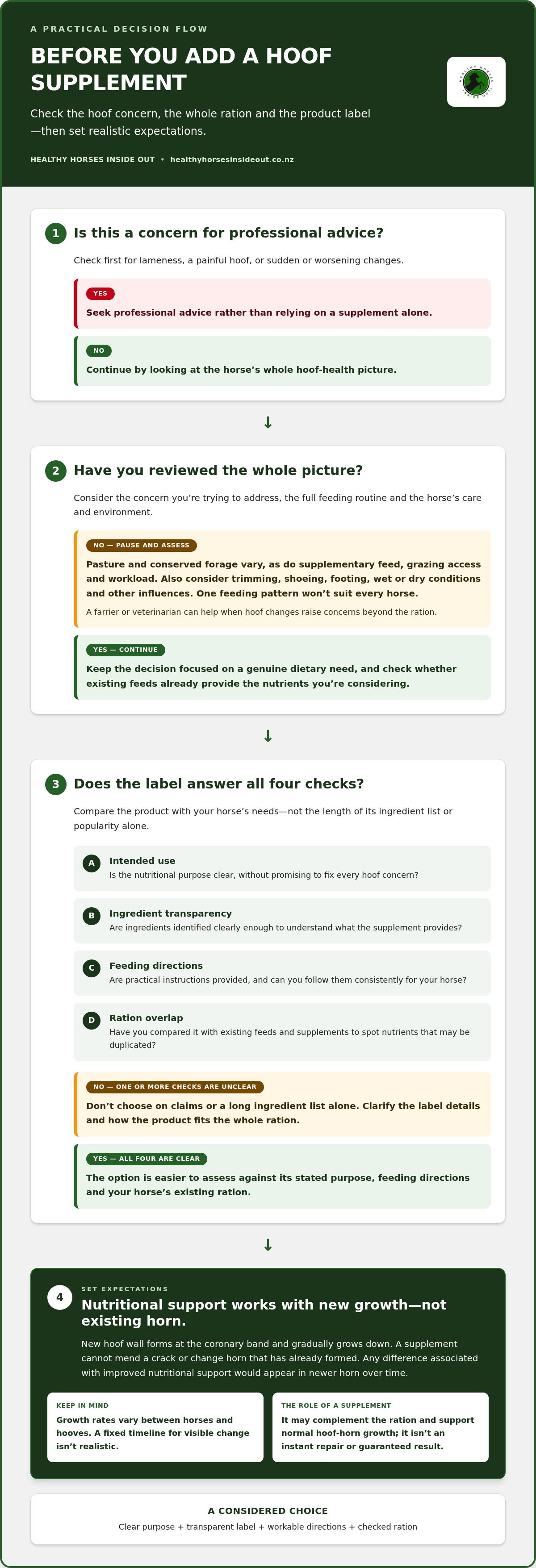
A practical NZ horse hoof supplement plan: assess, introduce and monitor
A steady plan makes it easier to decide whether a dietary change is relevant and to notice what happens over time. If you’re considering horse hoof supplements NZ-wide, use these steps to keep the decision grounded in your horse’s needs:
- Document the concern. Note which hoof is affected and what you’ve observed, such as a crack, chipping or a change in growth. Record when you first noticed it. Seek professional advice promptly if the horse is lame, in pain or getting worse.
- Review the whole ration. List the horse’s pasture, forage, hard feed and existing supplements, along with their feeding directions. Check whether similar nutrients are already being provided, and consider body condition and workload as part of the overall picture.
- Choose a suitable approach. If the ration review suggests nutritional support may be useful, select a supplement for a clear purpose and follow its label directions. If the feed plan is complex or the concern needs individual assessment, involve an appropriate equine nutrition or veterinary professional.
- Monitor consistently. Use repeatable observations and photographs to track hoof condition, and note changes to feed, environment, workload and hoof-care routine. This makes it easier to review progress without treating a single observation as a diagnosis.
Review the whole ration before adding anything
Write down what the horse actually receives, not just the supplements you’re thinking about changing. Include grazing or pasture access, hay or other forage, hard feed, every current supplement and the amount fed according to its directions. This overview can reveal where nutrients may overlap and gives a nutrition professional useful context if you need help assessing the ration. Avoid adding several products at once, as that can make it harder to identify what has changed.
Monitor change with realistic expectations
Take photographs from a similar angle and in comparable lighting, and make brief notes at regular intervals. Record meaningful management changes too, such as a different forage source, a change in turnout or an adjustment to trimming. The hoof wall grows out gradually, so any visible difference associated with nutrition depends on new growth and the horse’s individual circumstances. Your records can help show patterns, but they can’t identify the cause of a hoof problem.
As you review the feeding routine, explore everyday and specific horse supplements and assess how any nutritional support fits your horse’s complete ration.
Choosing horse hoof supplements in NZ: a considered next step with HHIO
The most useful next step isn’t choosing a product on the strength of a bold claim. First define the hoof concern, review what your horse already eats and decide whether a supplement has a clear nutritional purpose within that ration. This gives you a more informed basis for comparing horse hoof supplements NZ owners may be considering, while keeping your horse’s individual needs at the centre of the decision.
How HHIO fits into a thoughtful feeding routine
Healthy Horses Inside Out offers everyday and specific horse supplements, supplement bundles and HHIO Pellets as part of its equine nutrition range. These provide nutritional support, not guaranteed hoof solutions. The key question is how any option fits your horse’s full feeding routine, including pasture, forage, hard feed and existing supplements.
Read the label carefully and use the product only in line with its feeding directions. Consider the stated purpose, ingredients and any potential overlap with nutrients already present in the ration. If the horse’s diet is complex, or hoof changes are ongoing or worsening, an appropriate equine nutrition or veterinary professional can help assess what’s needed. A supplement shouldn’t distract from investigating a persistent problem.
Make a confident, measured choice
Before settling on an approach, work through a simple check:
- Define the concern: note what you’ve observed and whether it’s changing.
- Review the ration: account for pasture, forage, hard feed and current supplements.
- Check suitability: compare the supplement’s purpose, ingredients and feeding directions with your horse’s needs.
- Monitor consistently: record hoof observations and relevant changes to feeding or care.
This measured process can help you avoid adding nutrients without a clear reason and keep nutritional support in perspective. If you’d like to explore the available categories, browse the HHIO horse supplement range and consider how an option could fit into your horse’s overall ration.
Thoughtful nutrition can support normal growth as part of a wider care plan. It works alongside routine hoof care, not in place of it, and the best choice is one made with a clear purpose and realistic expectations.
Make your next hoof-care decision with confidence
Healthy hooves depend on more than a supplement. Nutrition can support normal hoof growth, but visible change takes time. Feed choices should be considered alongside routine hoof care and any signs that need professional assessment.
Before choosing horse hoof supplements NZ, define the concern, review your horse’s full ration and compare a product’s purpose, ingredients and feeding directions. Then monitor consistently, noting hoof condition and relevant changes to feed or management. This measured approach helps you avoid unnecessary overlap and keep expectations realistic.
Healthy Horses Inside Out offers equine supplements, HHIO Pellets and supplement bundles through an online range for horse owners across New Zealand. Explore HHIO’s horse supplements and nutritional support to find options to consider within your horse’s feeding routine.
Small, informed decisions can make the care plan clearer. Keep observing, seek advice when a hoof concern persists or worsens, and support your horse with patience and consistency.
Frequently Asked Questions
Do horse hoof supplements work?
They may support normal hoof growth when they address a genuine nutritional gap, but they aren’t a guaranteed fix for every hoof concern. The value of horse hoof supplements NZ owners consider depends on the horse’s overall diet, the supplement’s purpose and whether nutrients are already supplied by other feed. Hoof quality can also be influenced by genetics, environment and routine care, so assess the whole picture rather than expecting a supplement to work alone.
How long do horse hoof supplements take to show results?
There’s no reliable fixed timeline, because supplements can only influence new growth, not change hoof horn that has already formed. New hoof wall grows down gradually from the coronary band, and growth varies between horses. The location and extent of the concern also affect when newer horn may become visible. Track changes with consistent observations or photographs, and allow time for growth rather than expecting an immediate difference.
What ingredients should I look for in a horse hoof supplement?
Look for a clear ingredient list and consider nutrients in the context of the horse’s full ration. Biotin, methionine, zinc and copper are among the nutrients discussed in relation to hoof health, but their presence alone doesn’t prove a product is suitable or that more is needed. Compare label information and feeding directions with current feed and supplements, and seek equine nutrition advice if you’re unsure about the ration’s balance.
Can a hoof supplement repair cracked or damaged hooves?
No. A dietary supplement can’t repair a crack or transform damaged hoof horn that has already grown. If nutritional support is appropriate, its potential contribution is through the formation of new tissue as the hoof grows. Cracks can have different causes, so persistent, deep or worsening damage should be assessed by an appropriate equine professional. Continue routine hoof care, and don’t rely on a supplement as a substitute for investigating the problem.
Are horse hoof supplements suitable for every horse?
No single supplement is automatically right for every horse. Suitability depends on the animal’s current diet, condition, workload and specific concern, as well as what nutrients are already present in its feed. Check the product’s stated purpose, ingredients and feeding directions before adding it. If your horse has a complex ration, an existing health concern or ongoing hoof changes, get individual advice before making a dietary adjustment.
Can New Zealand pasture provide everything a horse needs for healthy hooves?
Not necessarily, and pasture shouldn’t be assumed to have the same nutrient profile everywhere. Nutrient supply can vary with pasture and forage, supplementary feed and the horse’s individual needs. Consider the complete ration rather than relying on a broad assumption about New Zealand pasture. If you’re concerned about whether the diet is balanced, an equine nutrition professional can help assess the feed plan and identify whether any adjustment is appropriate.
When should I seek professional advice about my horse’s hooves?
Seek advice if your horse is lame, appears painful, or has a hoof problem that persists or worsens. Sudden or concerning changes deserve attention too. A farrier can help assess hoof-care needs, while a veterinarian can investigate health concerns. An equine nutrition professional can review the ration if diet may be contributing. Supplements shouldn’t delay assessment or be used to diagnose the cause of a hoof problem.


