

More feed isn’t automatically the answer for a performance horse. A high spec feed balancer for horses can provide vitamins, minerals and protein, but it isn’t necessarily a complete performance ration. For horses in hard work or competition, a performance-formulated balancer should provide higher protein to support muscle development and tissue repair; a typical feeding rate is 100 g per 100 kg of bodyweight.
It’s reasonable to be cautious about adding feed, particularly if your horse is an easy keeper or prone to laminitis. Choosing a high spec feed balancer for horses still means considering the whole ration: pasture, hay, treats and other feeds all contribute to daily intake. A balancer is not a significant source of calories, so feeding one does not necessarily cause weight gain.
This guide explains which nutrients to look for, how to assess a suitable feeding amount and how to fit a balancer alongside forage and other feeds. You’ll also learn what to consider for good-doers and laminitis-prone horses, helping you make a more informed decision about your horse’s daily nutrition.
Key Takeaways
- Assess your horse’s body condition and workload before adding calories; a balancer may suit a good-doer when the aim is nutritional support rather than weight gain.
- Forage remains the foundation of the ration: aim for at least 1.5% of bodyweight by weight, and avoid leaving a horse without forage for more than 4 hours.
- Adjust the balancer amount to the concentrated feed already being fed, rather than simply adding it on top of the current ration.
- Introduce the balancer alongside pasture, hay or haylage, and consider how its nutrients fit with the rest of the feed plan.
Balancers for good-doers and laminitis-prone horses
A balancer can provide nutritional support without adding substantial calories. For a good-doer, that distinction matters: the aim may be to supply nutrients, not increase energy intake. Still, assess the whole ration. Pasture, hay, treats and other feeds all contribute to your horse’s daily intake, so adding a balancer doesn’t make the rest of the diet irrelevant.
For a horse prone to laminitis, focus on the complete feeding plan rather than the product category alone. Review what the horse eats each day, including pasture access, hay and concentrates. Then compare the balancer’s recommended amount with the current ration. Keep changes measured and consistent, and monitor body condition as the routine changes. A balancer’s low calorie contribution does not make every overall ration suitable.
Forage remains central to this assessment. A horse’s forage intake should not fall below the equivalent of 1.5% of its bodyweight by weight, and it should not go longer than 4 hours without forage. These measures help frame decisions about concentrates and supplements. If the horse is a good-doer, avoid using a balancer as a weight-gain feed. A conditioning feed is a more effective and cost-effective way to increase dietary calories when considerable weight gain is needed.
Mares can be fed a balancer from conception onwards, making it relevant across life stages. The appropriate choice still depends on the mare’s existing ration and nutritional needs. Assess forage and other feeds before adding a balancer, rather than increasing the total feed without a clear purpose. This helps distinguish nutrient support from adding calories, especially when managing an easy keeper or a laminitis-prone horse.
Balancers’ vitamins, minerals and protein
A balancer provides concentrated nutrients in a horse’s ration. Compare its label with the forage and feeds already being provided.
Vitamin content
A balancer supplies vitamins, but the specific types and amounts depend on its formulation. Read the product label to identify each vitamin and the quantity supplied at the recommended daily feeding rate. This makes comparisons more useful than relying on terms such as “high spec” alone.
Next, consider the horse’s current ration. Pasture, hay and concentrates can all contribute nutrients, so adding another source may change the overall balance. Compare the balancer’s stated vitamin content with other feeds before choosing it, and keep the assessment relevant to the horse’s workload and life stage.
Mineral content
Minerals are another part of a balancer’s nutrient profile. Check which minerals appear on the label and how much the recommended serving provides. A product name alone cannot show whether its mineral profile suits a particular ration; the listed amounts give you a more practical basis for comparison.
Use the same step-by-step review for forage and every other feed. Note the mineral information shown for each product, then consider the combined ration rather than one ingredient in isolation. This is especially relevant for a growing horse, whose nutrient needs include support for bone and other tissue development. For more equine nutrition options, compare the available support with your horse’s overall feeding plan.
Protein content
Protein deserves particular attention for horses in hard work or competition. A balancer formulated for performance horses should provide higher protein levels to support muscle development and tissue repair. Compare the stated protein content and recommended serving, then consider how they fit with the horse’s existing feeds.
A growing young horse also needs nutrients to support tendon, muscle, bone and other tissue development. That makes life stage as important as workload when assessing protein. A competition horse and a youngster, for example, may need different nutritional emphasis. Match the stated profile to the horse’s needs rather than assuming every concentrated formulation serves the same purpose.
Feeding amounts and example feed regime
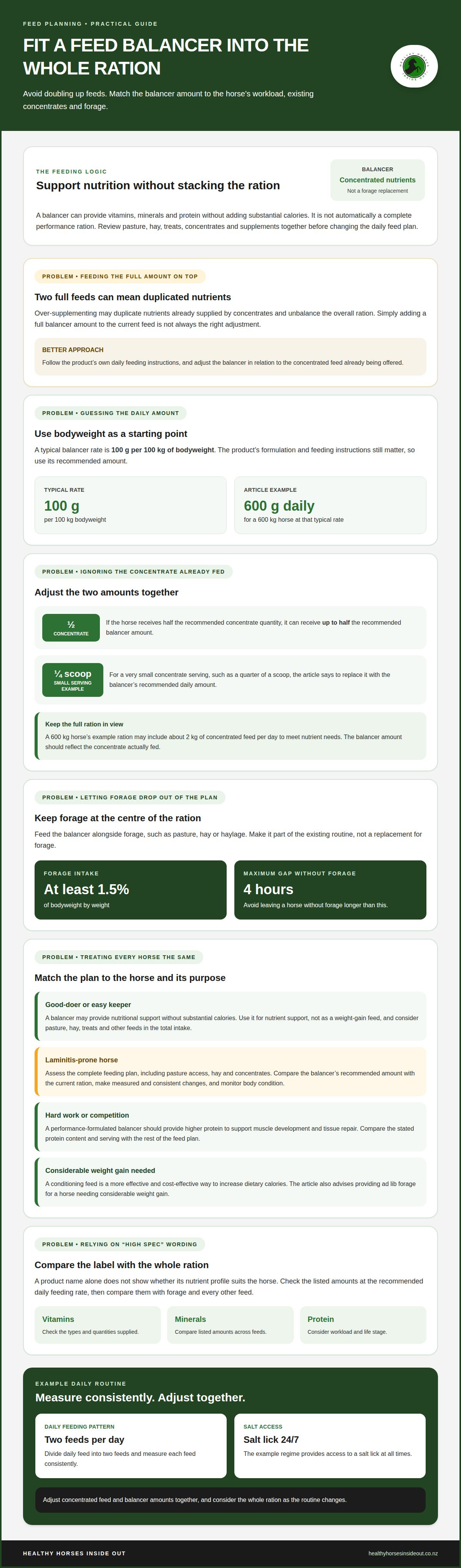
Over-supplementing can duplicate nutrients already supplied by concentrates and unbalance the overall ration. Follow the balancer’s daily rate and account for every feed.
Feeding amounts
A typical balancer rate is 100 g per 100 kg of bodyweight. For a 600 kg horse, that works out to 600 g daily, using that typical rate. Always use the product’s own feeding instructions because formulations and recommended amounts differ.
Adjust the amount to the concentrated feed already offered. If a horse receives half the recommended concentrate quantity, it can receive up to half the recommended balancer amount. For a very small concentrate serving, such as a quarter of a scoop, replace it with the balancer’s recommended daily amount.
These adjustments prevent simply stacking the full amounts of two feeds. A 600 kg horse’s example ration may include about 2 kg of concentrated feed per day to meet nutrient needs, but the balancer quantity should reflect the concentrate actually fed.
Introducing balancers with other feeds
Feed a balancer alongside forage, such as pasture, hay or haylage. Keep forage intake at or above the equivalent of 1.5% of bodyweight by weight, and avoid gaps longer than 4 hours without forage. Make the balancer part of the existing routine rather than treating it as a replacement for forage.
An example regime divides daily feed into two feeds per day and provides access to a salt lick 24/7. Measure each feed consistently, then adjust concentrated feed and balancer amounts together. This makes the total ration easier to manage.
For a horse needing considerable weight gain, provide ad lib forage. Additional fibre sources, such as beet or alfalfa, may also be included. When substantial weight gain is needed, a conditioning feed is a more effective and cost-effective way to increase dietary calories than a balancer.
How should I introduce a feed balancer and combine it with forage or other feeds?
Plan the change around the horse’s existing routine. A balancer is designed to be fed alongside forage such as pasture, hay or haylage.
First, write down what the horse eats on a typical day. Include forage, concentrates, treats and supplements, so you can see where the balancer fits. Then use this practical sequence:
- Keep forage in the plan. Pasture, hay and haylage remain the forage foundation; a balancer does not replace them.
- Read the balancer’s feeding directions. Use its stated daily amount, rather than estimating by eye.
- Review concentrated feeds. Check the ration for other feeds that supply similar nutrients before adding another product.
- Make one clear change at a time. This helps you identify which part of the ration has changed if appetite or feeding routine shifts.
- Measure each serving. A consistent scoop or weighed amount makes daily feeding more reliable.
For example, if a horse receives pasture, haylage and a small concentrate feed, maintain the forage when adding a balancer. Check the concentrate’s role in the ration, then adjust the combined feed plan according to the balancer’s directions. Don’t treat the balancer as an extra serving to add automatically on top.
Keep feeding times and preparation consistent. If the horse receives two feeds, plan how the daily routine is divided between those meals and include the balancer as directed. Record the feeds and amounts used to compare the current ration with the revised one. This simple written check can prevent missed or duplicated servings.
For a clearer match between your horse’s routine and its nutritional support, explore horse supplement options suited to its feeding plan.
Healthy Horses Inside Out: Everyday Horse Supplements
Healthy Horses Inside Out offers Everyday Horse Supplements to support your horse’s nutritional routine. When comparing a balancer with other forms of dietary support, consider your horse’s needs, current ration and the nutrients you want to provide.
The range also includes Specific Horse Supplements, Horse Supplement Bundles and HHIO Pellets. These options offer different ways to consider nutritional support alongside your horse’s existing feed plan. A bundle may suit someone looking to bring relevant supplements together, while a specific supplement may better match a particular nutritional focus.
Use the feeding principles in this guide to clarify what you want to support, then explore the available options with that goal in mind. Visit Healthy Horses Inside Out to browse the range and choose nutritional support for your horse.
Make your horse’s feeding plan work as a whole
A high spec feed balancer for horses is one part of a broader nutritional plan, not a substitute for considering the horse’s workload, condition and existing diet together. Before changing the routine, identify the main goal: supporting performance, filling a nutritional gap or meeting a specific need. That purpose can help you assess whether a balancer fits or another form of nutritional support is more appropriate.
Use a written record of the current ration as your starting point. Note what your horse receives and what you want to improve, then use that information to guide your next choice. A clear plan makes it easier to keep feeding consistent and review whether each addition still has a useful role.
Healthy Horses Inside Out offers support through its horse supplement range. Contact Healthy Horses Inside Out to explore options for your horse’s nutritional routine and take the next step with confidence.
Frequently Asked Questions
Is a balancer enough for my performance horse?
A balancer can support a performance horse’s nutrient intake, but it may not provide all the energy needed for hard work. Consider the horse’s condition, workload and full ration together. A horse maintaining condition, for example, may need a different feed plan from one losing weight during competition. A performance-formulated balancer should provide higher protein to support muscle development and tissue repair.
What do they contain?
Feed balancers provide concentrated nutritional support, typically including vitamins, minerals and protein. The exact nutrient profile varies by formulation, so check the product label for the nutrients listed and the amount provided at the recommended serving. Compare that information with other feeds in the ration to assess whether a balancer complements the existing diet or duplicates nutrients already supplied elsewhere.
What is a balancer?
A balancer is a concentrated feed intended to provide nutritional support alongside a horse’s usual forage. It differs from a feed designed mainly to increase calorie intake. An owner might consider one when the forage-based ration needs additional nutrients but not extra energy. A balancer does not replace forage, and its role depends on the horse’s overall feeding plan.
When might I feed one?
Consider a balancer when you want targeted nutrient support for a horse’s life stage or workload. Examples include a young horse developing tendon, muscle and bone, a horse in competition, or a mare from conception onwards. Review the ration if the horse’s workload or life stage changes to keep the product’s purpose aligned with current nutritional needs.
Which one do I choose?
Choose a balancer by matching its stated nutrient profile and feeding directions to your horse’s workload, life stage and existing ration. A competition horse may need a performance formulation with higher protein, while a growing youngster needs support for developing tissues. Read the label carefully and compare it with other feeds already offered. The most suitable option is the one that fits the purpose of the whole ration.
Why choose a balancer instead of concentrated feed for your horse?
A balancer can suit a horse needing nutritional support without a substantial increase in calories. Concentrated feed may be more appropriate when the aim is to increase dietary energy, such as for considerable weight gain. These feeds serve different purposes, so one is not automatically a substitute for the other. Base the choice on whether the horse needs nutrient support, additional calories or both.


