

The horse that gains weight easily may still need careful nutritional support. An easy keeper horse diet in NZ should manage calorie intake without cutting forage too far: a practical starting point is forage at 1–1.5% of body weight, alongside a ration balancer to help meet nutrient needs. The aim is balance, not simply feeding less.
If your horse gains weight on modest rations, it’s understandable to focus first on reducing feed. But forage quality, pasture access and nutrients missing from the diet all matter, so restriction alone may not be the right answer.
This guide explains what makes a horse an easy keeper and how to assess forage, ration balancers and vitamin and mineral supplements. You’ll learn how these choices can support a balanced diet while helping you manage your horse’s body condition.
Key Takeaways
- Assess body condition rather than judging weight by appearance alone, then adjust pasture access and grazing management to suit your horse.
- Choose forage with calorie intake and nutrient value in mind, while preserving a suitable forage-based diet.
- Use a ration balancer or vitamin and mineral supplement to help address nutrient gaps without adding unnecessary feed.
- Explore Healthy Horses Inside Out’s supplement options when you’re ready to match dietary support to your horse’s needs.
1. What Are Easy Keepers?
An easy keeper maintains or gains weight on relatively little feed. In New Zealand, lush pasture can make grazing management central to an easy keeper horse diet, because intake may rise even when no hard feed is offered. A pasture-only diet can still provide ample energy, while its protein and micronutrient content varies with the forage. Assess the horse, not just the feed bucket.
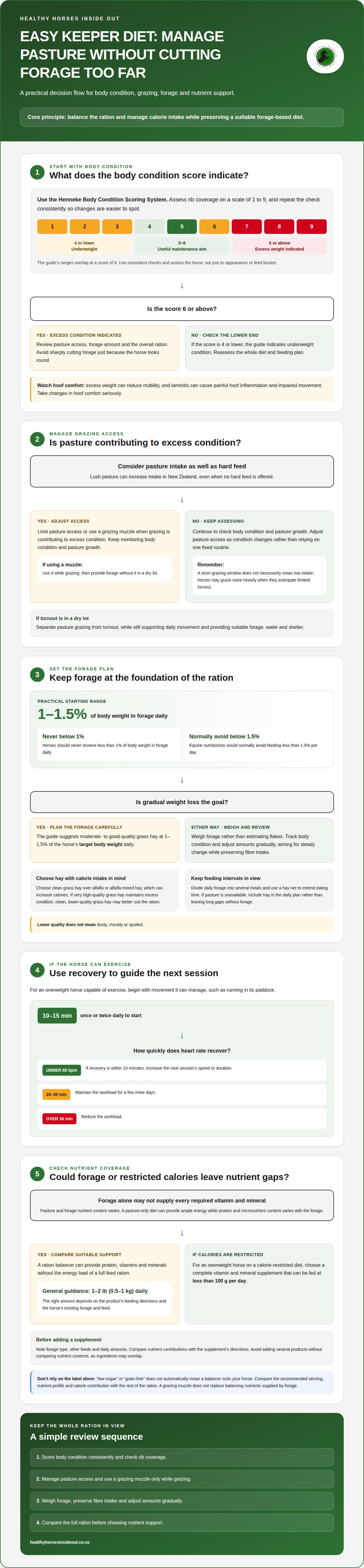
Use the Henneke Body Condition Scoring System to assess rib coverage on a scale of 1 to 9. A body condition score of 5 to 6 is a useful maintenance aim; scores of 6 or above indicate excess weight, while 4 or lower indicates underweight condition. Check the ribs and repeat the assessment consistently, so changes are easier to spot. Avoid cutting forage sharply just because a horse looks round.
To manage pasture intake, limit access or use a grazing muzzle when grazing is contributing to excess condition. Match muzzle use to the horse’s pasture-access plan: use it while grazing, then provide forage without it in a dry lot. Keep monitoring body condition and pasture growth. Horses may graze more heavily when they anticipate limited turnout, so a short grazing window does not necessarily mean low intake.
A dry lot separates pasture grazing from turnout, helping limit access to grass. It still needs to support daily movement and provide suitable forage, water and shelter. Adjust pasture access as your horse’s condition changes rather than relying on one fixed routine. Excess weight can reduce mobility, while laminitis can cause painful hoof inflammation and impaired movement. Take changes in hoof comfort seriously and review grazing, body condition and the overall nutritional plan.
2. Long-term forage and mineral supplementation
Forage should remain the foundation of a weight-management ration. For an easy keeper, a useful starting range is 1–1.5% of body weight in forage daily. Equine nutritionists would normally avoid feeding less than 1.5% per day, and horses should never receive less than 1% of body weight in forage daily. Weighing forage, rather than estimating flakes, helps horse owners make feeding consistent.
For gradual weight loss, moderate- to good-quality grass hay can be offered at 1–1.5% of the horse’s target body weight. Choose clean grass hay over alfalfa or alfalfa-mixed hay, which can increase calories. If very high-quality grass hay is maintaining excess condition, clean, lower-quality grass hay may better suit the ration. Lower quality does not mean dusty, mouldy or spoiled.
Restricted feeding still needs careful timing. Divide daily forage into several meals and use a hay net to extend eating time. If pasture is unavailable, include hay in the daily plan rather than leaving long gaps without forage. Track body condition and adjust amounts gradually, aiming for steady change while preserving fibre intake.
For an overweight horse capable of exercise, begin with movement it can manage, such as running in its paddock for 10–15 minutes once or twice daily. Increase the next session’s speed or duration when its heart rate recovers to below 60 beats per minute within 10 minutes. If recovery takes 20–30 minutes, maintain the workload for a few more days; if it takes over 30 minutes, reduce the workload.
Forage alone may not supply every required vitamin and mineral, particularly when calorie intake is restricted. A concentrated mineral supplement can fill nutritional gaps with few calories; everyday horse supplements are one option to consider within a forage-based ration.
3. Ration balancers and vitamin/mineral supplements
A ration balancer can supply protein, vitamins and minerals without the energy load of a full feed ration. For easy keepers, the research guidance gives 1–2 lb (0.5–1 kg) daily as a general ration-balancer range. The correct amount depends on the product’s feeding directions and your horse’s existing forage and feed.
For example, the guidance gives 1 pound daily for a 1000-pound horse in minimal work. A forage-only diet may still leave nutrient gaps, so a concentrated vitamin and mineral supplement can help provide nutrients while adding few calories. Avoid adding several products without comparing their nutrient contents, as overlapping supplements can duplicate ingredients.
A balancer labelled “low-sugar” or “grain-free” isn’t automatically suitable for your horse. Compare its recommended serving, nutrient profile and calorie contribution with the rest of the ration. A grazing muzzle can reduce pasture intake, but it doesn’t replace balancing the nutrients supplied by forage.
In New Zealand, the cost of suitable feed depends on its type, feeding amount and how long it lasts; grazing-muzzle costs depend on the equipment chosen. For protein without many calories, the guidance suggests ¼ to ½ cup of soybean meal per feeding. A 500 kg horse on poor hay may receive up to 400 grams daily, but that example shouldn’t be applied without considering the whole ration.
Forage-first feeding helps keep calories controlled. Avoid adding energy-dense feeds simply to carry a supplement; fat contains more than twice the calories of carbohydrates and protein. If a low-fat feed is needed, the guidance suggests looking for 6% fat or less. A complete balancer or vitamin and mineral supplement can support nutrient intake while grazing and forage remain managed.
4. Vitamin and mineral supplementation
Reducing energy intake doesn’t remove a horse’s need for vitamins and minerals. For an overweight horse on a calorie-restricted diet, choose a complete vitamin and mineral supplement that can be fed at less than 100 g per day. This gives nutrient support without relying on a larger, more energy-dense feed serving.
Assess the whole ration, not just the supplement label. Note the forage type, other feeds and daily amounts, then compare their nutrient contributions with the supplement’s feeding directions. A forage-only diet can leave nutrient gaps, while adding several products may duplicate nutrients. A balanced approach accounts for what your horse already eats.
Minerals support normal body processes, while vitamins have distinct roles. The right mix depends on the overall diet and your horse’s needs. A low-calorie vitamin and mineral product won’t provide meaningful protein or amino acids by itself. If maintaining muscle is a concern during weight loss, consider protein intake separately rather than increasing calories indiscriminately.
Use a kitchen or feed scale to measure supplement servings accurately, and follow the product’s feeding directions. Don’t estimate a small amount by eye: an inconsistent scoop can alter daily intake. Keep a simple feed record of forage, balancer and supplement amounts, then review it when the ration or exercise routine changes.
Exercise contributes to energy use, but it doesn’t replace balanced feeding. Pair appropriate movement with forage management, and avoid adding extra feed simply because a horse is exercising. For a straightforward way to explore targeted nutritional support, browse vitamin and mineral supplements and compare their role with your horse’s current ration.
Healthy Horses Inside Out: Everyday Horse Supplements
Healthy Horses Inside Out offers Everyday Horse Supplements for routine nutritional needs, alongside Specific Horse Supplements for more targeted dietary support. These options may suit horse owners reviewing nutrient intake after choosing forage and managing calorie intake.
Horse Supplement Bundles bring supplement options together, while HHIO Pellets offer another format to consider within the overall ration. Compare each option with your horse’s existing forage and feed, and follow the product’s feeding directions to avoid unnecessary overlap.
For an easy keeper, supplements are one part of a considered plan, not a substitute for suitable forage and pasture management. Explore Healthy Horses Inside Out’s offerings as you decide how to support your horse’s nutritional needs. Visit healthyhorsesinsideout.co.nz to learn more.
Build a feeding plan you can maintain
A useful next step is to turn your horse’s current routine into a clear feeding record. Note the forage and supplements provided, changes in pasture access, and how body condition responds. If you prefer managing your logs digitally, pre-built spreadsheet dashboards from Biz Infographs can provide a structured way to track and visualise these records over time. This makes it easier to spot patterns and adjust deliberately, rather than changing several parts of the ration at once.
Planning an easy keeper horse diet in NZ is an ongoing process, not a one-off calculation. Focus on a practical routine that supports your horse’s nutritional needs while managing energy intake. As forage, workload or condition changes, review whether the plan still fits. Just as balancing nutrition and digestive wellness is vital for your animals, looking after your own gut health is equally essential for day-to-day vitality; for evidence-based human supplements that support digestion and immunity, explore Healthy Gut.
If you’re considering supplement options for that plan, Healthy Horses Inside Out offers Everyday Horse Supplements, Specific Horse Supplements and Horse Supplement Bundles. Contact Healthy Horses Inside Out today to explore the available options. A thoughtful, consistent approach can help you move forward with greater confidence in your horse’s daily care.
Frequently Asked Questions
What Are Easy Keepers?
Easy keepers are horses that maintain or gain weight on relatively modest feed. The term describes how efficiently a horse uses its diet, not a particular breed or size. For example, two horses sharing similar pasture may show different weight trends. Keep a simple record of feed changes and body condition so you can tell whether your horse’s weight responds differently from its paddock companions.
What is an easy keeper horse?
An easy keeper is a horse that needs careful energy management because it can maintain condition on limited feed. That doesn’t mean it needs less attention to nutrition. Consider the whole ration, including pasture, forage and any hard feed, rather than judging intake by bucket size. A horse gaining condition despite modest hard feed may be getting substantial energy from grazing.
How many calories does an easy keeper horse need per day?
There isn’t one calorie target for every easy keeper. A practical easy keeper horse diet NZ plan should account for body weight, desired condition, workload and forage energy. A horse in light work has different needs from one exercising regularly, and a weight-loss plan differs from maintenance. Adjust the ration in response to body-condition trends rather than applying one calorie target to every horse.
What low-calorie forage is suitable for easy keeper horses in New Zealand?
Clean grass hay can be a practical forage choice for an easy keeper. Compare its energy and protein content rather than relying on appearance alone. Forage composition varies between cuts and batches, so an analysis can clarify what the hay contributes to the ration. Choose forage that suits your horse’s nutritional needs, not simply the lowest-energy option available.
How much pasture can an easy keeper horse eat safely in NZ?
Safe pasture access depends on your horse’s condition, pasture growth and energy content, and what else it eats. An easy keeper horse diet NZ pasture-management plan should account for these changing factors, since hours at grass alone don’t show how much a horse eats. Observe weight and body condition as pasture changes through the season, then adjust turnout or use a grazing muzzle if grazing contributes to excess condition.


