

Performance supplements don’t automatically translate into better results in the arena. Reviews of equine performance supplements need to be read alongside the evidence: one horse study found slightly lower blood lactate and heart rate during treadmill exercise after nine weeks of branched-chain amino acid supplementation, but more recent studies haven’t demonstrated an effect in exercising horses. Evidence also doesn’t support L-carnitine as an ergogenic aid in horses.
It’s understandable to look for nutritional support when your horse’s workload, recovery or condition is a concern. The key is to distinguish support for a nutritional need from claims of a direct performance boost. An ingredient may have a role in a balanced feeding programme without being proven to make a horse faster or stronger.
This guide explains what equine performance supplements may contain, the health areas they target and what the evidence says about performance claims. You’ll also find a practical way to assess supplement reviews, so you can focus on your horse’s needs rather than promises on a label.
Key Takeaways
- Match joint-support ingredients to the horse’s needs, and look beyond broad claims to understand what each formula is intended to support.
- Consider how digestive, hoof, coat and muscle health fit into your horse’s overall nutrition, rather than treating performance as a single issue.
- Assess performance claims by looking for evidence in exercising horses and separating general nutritional support from a direct performance effect.
- Use feeding directions suited to the specific supplement and your horse’s existing ration to keep daily nutrition organised.
Ingredients in joint-support formulas
Joint-support labels may list ingredients such as glucosamine, chondroitin, MSM, hyaluronic acid, collagen or green-lipped mussel. These names describe different ingredients, not guaranteed results. A formula’s purpose depends on its full composition, amounts and intended use, so assess the label rather than relying on one prominent ingredient.
Start with the complete ingredient list. Note each active ingredient, its amount per serving and the recommended daily serving. For example, a label that names glucosamine but doesn’t state the amount gives you less information for comparing formulas. Distinguish active ingredients from carriers, flavourings and other components that may appear on the same list.
- Glucosamine and chondroitin: record whether either appears, and how much the label provides.
- MSM: note its stated amount and whether it sits alongside other named ingredients.
- Hyaluronic acid: check its listed quantity rather than relying on the ingredient name alone.
- Collagen or green-lipped mussel: identify the ingredient and its place in the formula.
Then compare like with like. Two tubs may list the same ingredients but provide different amounts per serving, making a front-label comparison incomplete. Keep your horse’s current feed and supplements in view, too. This gives you a clearer picture of the overall ration and helps identify ingredients that appear in more than one product.
Reviews can add practical details, such as palatability or how an owner manages feeding. One testimonial describes a 30-year-old horse ridden three to four times a week, weather permitting. That account reflects an individual experience, not a controlled comparison proving an ingredient’s effect. Read it alongside the formula and the specific outcome described.
A useful review identifies the ingredient, feeding context and observed change. Separate those details from broad claims about joint comfort or mobility. A clear ingredient list helps you make an informed decision, while lameness or pain calls for veterinary assessment.
Joint, muscle, hoof, coat and digestive health supplements
Each supplement should address a defined nutritional need, not a vague promise of better performance. Your horse’s workload, current ration and specific health priorities can help you distinguish relevant support from unnecessary additions.
Joint health supplements
Joint formulas are intended to support mobility and connective tissue, but a label alone can’t show whether a product suits a particular horse. Compare its stated purpose, full ingredient list and daily serving with your horse’s existing feed. An older horse and one in regular work, for example, may have different management priorities. Persistent stiffness or lameness should be assessed as a health concern, not addressed simply by adding another supplement.
Muscle health supplements
Muscle products may be marketed for development, recovery or exercise capacity, so identify the specific claim before assessing a formula. Research in horses found that up to 60 grams per day of L-carnitine did not alter muscle L-carnitine levels. That result cautions against assuming that a larger dose necessarily changes muscle stores. Consider the horse’s whole ration and workload when evaluating a muscle-support product.
Hoof and coat formulas target different visible outcomes. A hoof product is intended to support hoof quality, while a coat supplement focuses on skin and coat condition. Look for a clear purpose and ingredient information, then consider whether your horse’s existing feed already provides similar nutritional support. Changes in hoof condition take time to show as new growth develops.
Digestive support deserves attention because the digestive tract is closely connected with overall health. An estimated 70-80% of a horse’s immune system lives in its digestive tract. That makes digestive function relevant to the broader feeding picture, rather than a separate performance shortcut. Consider how a supplement fits alongside the horse’s regular forage and feed.
For a practical starting point, explore Everyday Horse Supplements when you’re considering general nutritional support.
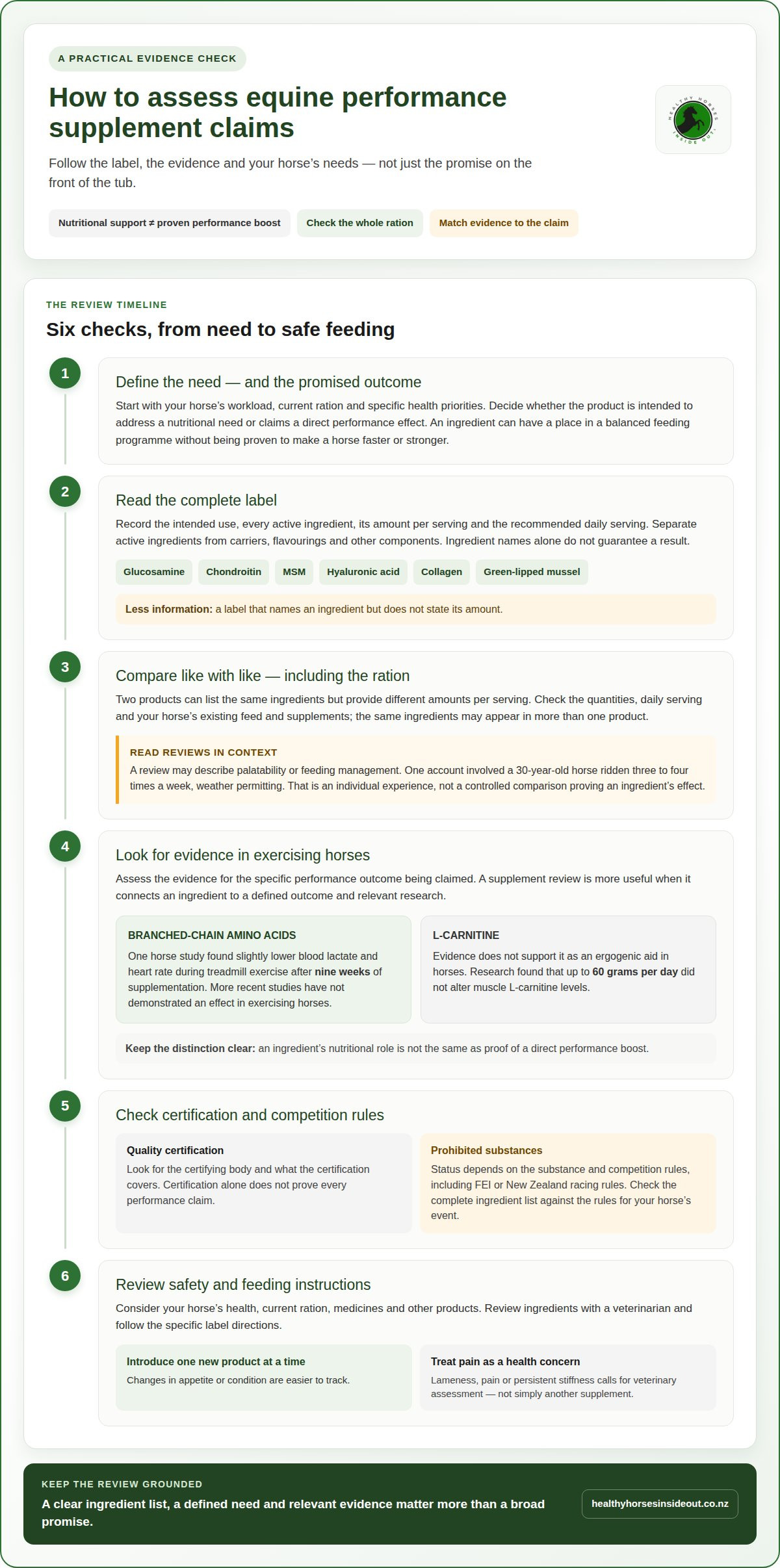
Performance-enhancement claims for equine supplements
Equine performance supplements reviews are most useful when they connect an ingredient to a defined outcome and relevant evidence.
Quality certifications and label claims
Read the full label, including ingredient amounts, feeding directions, intended use and manufacturer details. Treat claims such as “supports stamina” as a stated purpose, not proof of improved performance. Look for a named quality certification only if the label identifies the certifying body and explains what it covers. Certification alone doesn’t prove every performance claim.
Prohibited status depends on the substance and competition rules, including FEI or New Zealand racing rules. Before feeding a product, assess its complete ingredient list against the rules that apply to your horse’s event.
Safety depends on your horse’s health, current ration and other products. Review ingredients alongside medicines and existing supplements with a veterinarian, and follow the label’s feeding directions. Introducing one new product at a time makes changes in appetite or condition easier to track.
Benefits for different horses
Racehorses, sport horses and horses returning from injury have different workloads and nutritional priorities. A supplement may address a specific dietary need, but discipline alone doesn’t establish a benefit. For a horse in recovery, nutritional support is distinct from treatment and doesn’t replace diagnosis or a rehabilitation plan.
Evidence for direct performance effects is mixed. One horse study reported slightly lower blood lactate and heart rate during treadmill exercise after nine weeks of branched-chain amino acid supplementation. More recent studies haven’t demonstrated an effect in exercising horses. Evidence doesn’t support L-carnitine as an ergogenic aid in horses, although fat-supplemented diets might make it relevant for nutritional reasons.
John O’Shea described supplements as playing a supporting nutritional role in preparing Maison Louis to win the Queensland Derby. That example doesn’t establish that supplementation caused the win. Use equine performance supplements reviews to compare the outcomes reported, the horse’s context and the strength of the evidence. Changes in workload or feed can also affect performance, so a testimonial can’t isolate those factors.
What are the recommended doses and feeding instructions for common horse performance supplements?
There isn’t one dose that suits every horse supplement. The product label gives the serving for that specific formula, while your horse’s existing ration determines how it fits into daily feeding. Check the directions before measuring, and don’t transfer a scoop size or dose from one product to another.
Use this simple routine for each new supplement:
- Read the serving instructions: note the amount, frequency and whether the product is given with feed.
- Measure as directed: use the stated unit, such as a scoop or weight, rather than estimating by eye.
- Keep a record: write down the product, daily amount and start date alongside the horse’s usual feed.
- Review the whole ration: check other feeds and supplements for overlapping ingredients.
For example, if a joint formula and a general balancer both list the same nutrient, consider their combined contribution. The ingredient name alone doesn’t show total intake; compare the amount per serving and feeding directions on both labels. Keep the packaging handy so you can refer to the full product details.
Follow the label’s instructions for mixing and storage. A powder intended to be mixed into feed may need even distribution, while a liquid may require careful measuring before you add it. Keep your horse’s routine consistent, and record feed or supplement changes so you can relate observations to a clear timeline.
Introduce one new product at a time. This makes changes in appetite, acceptance or condition easier to track than starting several products together. If your horse takes medication or has a diagnosed health concern, have a veterinarian review the supplement and feeding plan. Competition horses also need ingredient checks against the rules for their event.
For help choosing a formula that fits your horse’s nutritional priorities, explore specific horse supplements.
Healthy Horses Inside Out: Horse Supplement Bundles
Healthy Horses Inside Out offers Horse Supplement Bundles to help organise nutritional support around your horse’s needs. A bundle can suit owners looking to bring relevant supplements together, while Everyday Horse Supplements and Specific Horse Supplements offer options for general or targeted nutritional priorities. HHIO Pellets are also part of the range.
Choose based on the health area you want to support, then consider how the supplement fits with your horse’s current feed and routine. Bundles can make sense when you’re addressing more than one nutritional priority, but the ingredients still need to suit the individual ration. For a specific concern, a targeted supplement may be a more direct starting point than a broad performance claim.
To explore supplement options for your horse, contact Healthy Horses Inside Out.
Make your next feeding decision with purpose
Let your horse’s needs, not a promise on a label, guide your next step. Choose one clear nutritional priority and use it to assess reviews of equine performance supplements: does the review describe a comparable horse, explain the feeding context and identify an observable change? This focus can help separate useful experience from broad claims while keeping your horse’s overall ration in view.
Then consider what would make a supplement relevant to your horse’s daily care. A targeted choice should fit the intended health area and feeding routine, rather than add complexity without a clear reason. If your horse has a health concern or takes medication, include that context in your decision and seek veterinary guidance before changing the diet.
Healthy Horses Inside Out offers Everyday Horse Supplements, Specific Horse Supplements and Horse Supplement Bundles to support different nutritional priorities. Contact Healthy Horses Inside Out to discuss which option may suit your horse. A thoughtful, needs-led approach is a positive place to start.
Frequently Asked Questions
Do Ergogenic Supplements Work?
Some ingredients may influence a measurable process, but that doesn’t automatically mean a horse performs better. The relevant question is whether research demonstrates a meaningful effect in exercising horses under conditions resembling the intended use. A change in a laboratory measure alone may not translate into improved competition results. Treat an ergogenic claim as a specific hypothesis, not a general promise.
Science Or Hype?
A claim is grounded in science when it’s tied to a defined ingredient, outcome and relevant evidence. It leans towards hype when marketing promises broad performance gains without those details. For example, a review describing improved appetite offers a different kind of evidence from a controlled exercise study. Check whether the claim concerns general nutritional support or a direct change in speed, stamina or recovery.
What about creatine for horses?
Human findings about creatine don’t establish a performance benefit for horses. Research in people has examined muscle stores and different exercise demands, but those results can’t simply be transferred across species. For horses, consider whether a product makes an equine-specific claim and whether that claim has been tested in horses doing comparable work.
Which ingredients in horse performance supplements have scientific evidence for improving performance?
No ingredient discussed here has a clearly established, consistent performance effect across exercising horses. Branched-chain amino acids have produced mixed findings, while evidence doesn’t support L-carnitine as an ergogenic aid. A possible role for L-carnitine in horses on fat-supplemented diets isn’t proof of enhanced performance. Assess each ingredient against the specific outcome claimed.
Are equine performance supplements safe, and what side effects or interactions should owners know about?
Safety depends on your horse’s health, current ration and other products. Review ingredients alongside medicines and existing supplements with a veterinarian, follow label directions, and introduce one new product at a time so changes in appetite or condition are easier to track.
What are the best-reviewed equine performance supplements in New Zealand?
Healthy E Oil has 6 reviews, and Maxum HA has 5.


