

What does the word “probiotic” on a supplement label actually tell you? Choosing equine pre and probiotics NZ can be confusing because prebiotics, probiotics and synbiotics refer to different ingredients and roles. The category name alone won’t tell you what is in a formula, how much it contains or whether it suits your horse.
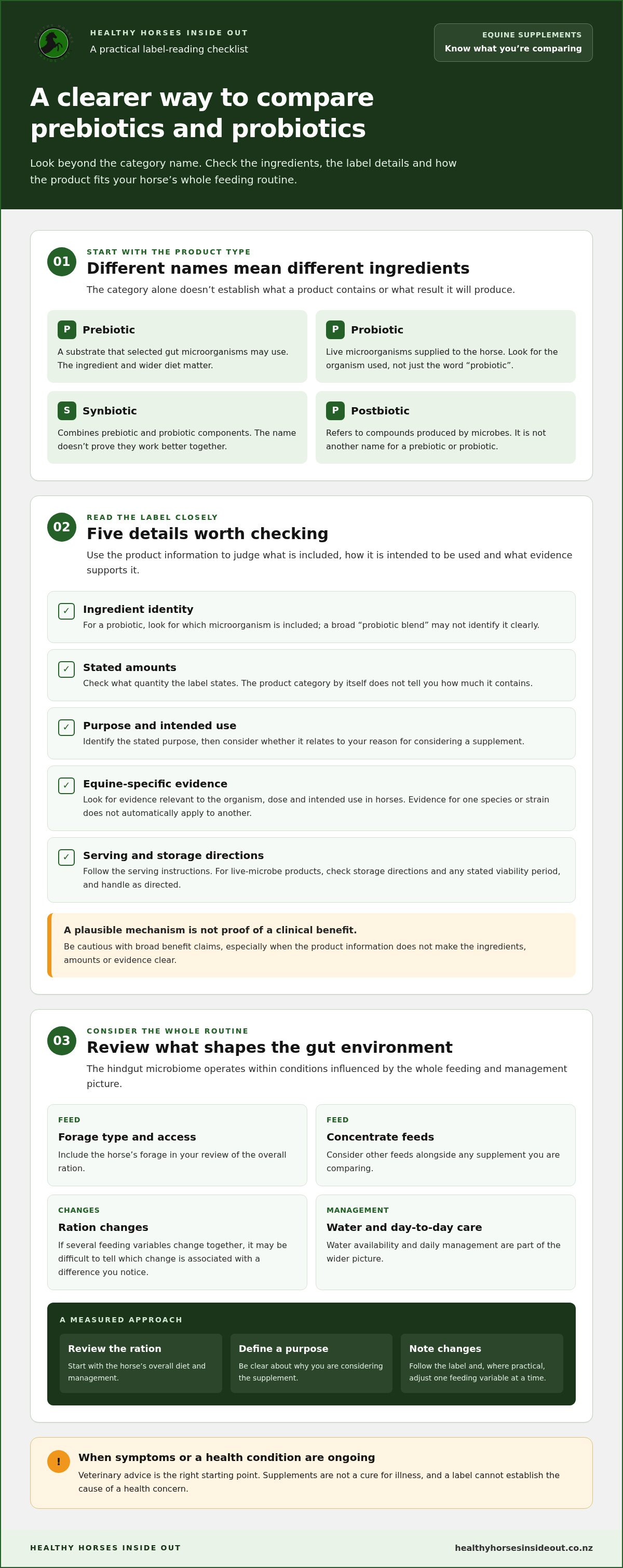
A considered choice starts with a clear purpose, useful label information and a review of the whole ration. Prebiotics provide substrates that selected gut microbes may use; probiotics supply live microorganisms. A synbiotic combines prebiotic and probiotic components, while postbiotics refer to compounds produced by microbes. These terms aren’t interchangeable, and supplements aren’t a cure for illness.
This 2026 buying guide explains the differences, what to compare on a label and where evidence has limits. You’ll learn to check ingredient identity and amounts, consider existing feed and define a reason for using a supplement. If your horse has ongoing symptoms or a health condition, veterinary advice is the right starting point.
Key Takeaways
- Prebiotics, probiotics and synbiotics describe different ingredients or combinations. The category alone doesn’t prove a particular health outcome.
- When comparing equine pre and probiotics NZ, check ingredient identity, purpose, stated amounts, serving directions and storage instructions.
- Feed substrates, gut microbes and fermentation are connected, but a plausible biological mechanism is not the same as evidence of clinical benefit.
- Take a measured approach: review the ration, define your goal, follow the label and note changes. Where practical, adjust one feeding variable at a time.
- Healthy Horses Inside Out offers everyday and specific supplements, bundles and HHIO Pellets to explore as part of your horse’s overall feeding routine.
Equine pre and probiotics in NZ: what are they, and why compare them?
When choosing a gut supplement, start by asking what you’re comparing: a prebiotic, a probiotic or a product combining both? These terms describe different ingredients, not a guaranteed result. If you’re comparing equine pre and probiotics NZ, knowing the difference helps you assess what a label tells you, and what it leaves unanswered.
In brief: prebiotics are substrates intended to support selected gut microorganisms; probiotics are live microorganisms supplied to the horse. Either type may have a plausible biological purpose, but that doesn’t demonstrate that a finished product will produce a specific health outcome. The ingredient, amount, intended use and evidence for the product all matter.
What is the difference between a prebiotic and a probiotic for horses?
A prebiotic is a substance that selected microorganisms in the gut may use as a substrate. In practical terms, it is intended to provide resources for particular microbes. A probiotic supplies live microorganisms. To assess its relevance, look for product-specific details, including which microorganism is used and whether there is evidence for its use in horses. The word “probiotic” alone doesn’t identify a strain or establish an effect.
A synbiotic combines prebiotic and probiotic components. It may bring together a microbial ingredient and a substrate intended to support selected microbes, but the name doesn’t prove that the ingredients work better together or deliver a clinical benefit. Compare the components and their stated purposes instead of relying on the category name.
Why does the equine hindgut matter?
Horses rely on microbial fermentation in the hindgut, particularly in the caecum and colon, to process fibrous parts of feed that aren’t fully digested earlier in the digestive tract. Microorganisms break down this material through fermentation, producing compounds the horse can use. This is a normal part of equine digestion, not evidence that a supplement will improve a particular sign or prevent a health problem.
The microbial community operates within conditions shaped by the whole feeding routine. Forage type and access, concentrate feeds, changes to the ration, water availability and day-to-day management can all be relevant when considering digestive support. A supplement shouldn’t distract from these foundations. For example, if you’re considering a product after changing feeds, it may be difficult to tell which change is associated with any difference you notice.
Start by reviewing the horse’s overall diet and management, then consider whether a supplement has a clear purpose within that picture. The equine gut health guide provides further context on digestive wellbeing. For ongoing signs of illness or discomfort, seek veterinary advice rather than relying on a supplement label to explain or treat the cause.
How prebiotics and probiotics interact with the horse gut microbiome
The horse’s gut microbiome is a community of microorganisms living along the digestive tract. In the hindgut, microbes use fermentable parts of fibrous feed as substrates. Fermentation produces compounds the horse can use, while the type and amount of available feed help shape the conditions those microbes live in. A prebiotic ingredient may provide a substrate for selected microorganisms; a probiotic supplies live microorganisms. Neither role, on its own, proves that a supplement will improve a specific sign or prevent a health problem.
A generic “probiotic” label isn’t enough to judge evidence. Look for which microorganism is included, whether it remains viable when handled as directed, and whether relevant equine research supports that specific product. Evidence for one species or strain can’t automatically be applied to another. Findings in people or other animals don’t, by themselves, demonstrate the same effect in horses.
What do live microorganisms do in an equine supplement?
Probiotic products may contain different microbial species or strains. These details help you judge whether the formulation and its evidence are relevant to a horse. Check whether the label identifies the organism clearly, rather than relying on a broad “probiotic blend” description. Storage directions and any stated viability period also matter, because a live-microbe product needs to be handled as instructed. These details help you assess the product, but don’t establish a health benefit by themselves.
Look for evidence relevant to the organism, dose and intended use in horses, rather than a general statement that microbes support gut balance. A result observed with one formulation may not apply to another if the organisms, amounts or preparation differ. If the label or supporting information doesn’t make these distinctions clear, treat broad benefit claims cautiously. Don’t assume the product has been shown to address your horse’s particular concern.
How can prebiotic ingredients support gut microbes?
Prebiotic substrates are inputs that selected gut microorganisms may use. Their potential effect depends on the substrate, the microbes present and the wider diet. So the term “prebiotic” alone doesn’t tell you which organisms may use an ingredient or what change to expect. Ingredient identity and equine-specific evidence are more useful than a general claim about feeding beneficial bacteria.
Think of the mechanism as a possible link, not a promised result. A substrate may be available to certain microbes, but that doesn’t prove a finished supplement will produce a measurable clinical improvement. For a closer look at prebiotic ingredients and their use in horses, the prebiotics for horses guide explores the topic in more depth.
If you’re weighing up equine pre and probiotics NZ, assess the stated ingredients and evidence, then consider how the product fits your horse’s full feeding routine. For broader nutritional support, explore everyday and specific equine supplements as part of a considered approach.
Comparing Equine Pre and Probiotic Supplements in NZ
A useful label tells you what’s in the product, why each ingredient is included and how to use it. Compare the details, not just the front-of-pack wording. A product name or broad claim may introduce a formula, but it can’t tell you whether its ingredients and intended use fit your horse.
| Label detail | What to look for | Why it matters |
|---|---|---|
| Ingredient identity | Named prebiotic ingredients, or microbial species and strains for probiotic components. | Specific identities are more informative than terms such as “gut blend” or “probiotic complex”. |
| Purpose and amounts | The stated role of each ingredient and its amount per serving, where provided. | Amounts help you understand the formulation and compare products on a like-for-like basis. |
| Serving directions | Daily amount, method of feeding and intended horse or use context. | Directions help you assess how the product fits your horse’s routine. Don’t guess if the instructions are unclear. |
| Storage instructions | Any handling or storage requirements, especially for products containing live microorganisms. | Following the label helps you handle the product as intended; don’t assume viability is maintained under every condition. |
| Claims and evidence | Specific promised outcomes and information supporting those claims. | A biological explanation or marketing statement is not, by itself, evidence of a clinical result. |
Which details should a horse owner look for on the label?
Start with the named ingredients. Then check whether the label gives amounts, identifies microbial species or strains, and explains the intended purpose. Review serving directions and storage requirements before adding the product to the ration. Unclear wording or a claim promising a particular outcome is a reason to look more closely, not automatic proof that a product is poor quality. Wider horse supplement label-reading guidance can help you assess ingredient information in context.
Where details are missing, don’t fill the gaps with assumptions. “Contains probiotics”, for example, doesn’t tell you which microorganisms are present. A named ingredient without a stated amount may also make it difficult to compare its contribution with another formulation. For any specific outcome claim, look for relevant evidence and check that it relates to horses and the product or ingredient described.
Is a combined pre- and probiotic always the better choice?
No. Combined wording doesn’t establish that a formula is more suitable or better supported by evidence than a product in one category. Compare each component, its stated purpose and amount, and any relevant evidence. Then consider the existing ration: another supplement may duplicate ingredients already being fed. Reviewing the full feeding routine before adding anything can help you make a more informed choice. A simple written comparison of labels makes differences easier to spot.
When comparing equine pre and probiotics NZ, a careful label review helps separate formulation facts from promotional language. For broader nutritional support, explore Healthy Horses Inside Out’s supplement range with your horse’s overall ration in mind.
When to Use and How to Introduce Supplements
Consider a gut-health supplement within a clear feeding plan, not as an automatic response to every change in manure or behaviour. Before choosing from equine pre and probiotics NZ, work through a simple sequence: record the current ration, define what you want to support, assess the label, follow the product’s directions and observe your horse. This makes the decision more deliberate and any changes easier to interpret.
- Review the ration. Note the forage, feeds, supplements and feeding routine your horse already has. Include recent changes that might be relevant to what you’re seeing.
- Define the goal. Be specific about why you’re considering a product rather than adding one because it makes a broad gut-health claim.
- Select by label. Compare ingredients, stated purpose, serving directions and storage instructions. Consider whether the product fits the whole ration.
- Follow directions. Use the selected product according to its label. Don’t assume one product’s amount or introduction instructions apply to another.
- Monitor consistently. Keep brief notes on appetite, manure consistency and general wellbeing, along with the date the product was introduced.
Where practical, change one feeding variable at a time. If you introduce a supplement while also changing forage or feed, it becomes harder to judge what may be associated with any difference. A simple record of the ration and changes can provide a clearer picture to discuss with your veterinarian if concerns arise. Observations are useful, but they aren’t a diagnosis.
How should owners introduce a new gut-health supplement?
Record the existing ration and any concurrent changes first, then read the product’s feeding and storage directions carefully. Follow its instructions rather than applying a universal dose or transition period. As you introduce it, observe appetite, manure consistency and general wellbeing under the horse’s usual routine. Keep notes factual: describe what you notice and when, without treating an observation as proof that the supplement caused it.
When should a veterinarian assess digestive signs?
Persistent, worsening or concerning digestive signs need prompt veterinary assessment. A supplement shouldn’t delay an examination, replace a diagnosis or take the place of prescribed treatment. If you’re uncertain whether a change is routine or concerning, seek veterinary advice rather than trying to manage unexplained signs by adding products. This keeps nutritional decisions in their proper place and prioritises your horse’s welfare.
Use supplements as part of a considered feeding plan; rely on a veterinarian to assess persistent, worsening or serious signs. This distinction helps keep routine nutrition choices separate from the assessment and treatment of illness.
Once you’ve reviewed your horse’s needs and feeding routine, explore everyday and specific equine supplements as part of a measured approach to nutritional support.
Choose a considered equine supplement approach with Healthy Horses Inside Out
A useful buying decision starts before you browse. Define what you’re aiming to support, assess the label for ingredients and directions, and consider how a product fits the whole ration. Seek professional advice if health concerns are driving the search. This keeps the focus on your horse’s needs rather than on a supplement category or a promise on the packaging.
If you’re comparing equine pre and probiotics NZ, use this guide’s framework to narrow your options. Before choosing, take stock of:
- Forage, current feeds and supplements
- Your horse’s workload and individual circumstances
- The product’s ingredients, stated purpose and feeding directions
- Any overlap with ingredients already in the ration
Healthy Horses Inside Out offers everyday and specific horse supplements, supplement bundles and HHIO Pellets for horse owners across New Zealand. Explore these as part of broader nutritional planning, while keeping a particular need in view and seeking veterinary care where appropriate.
How does a whole-ration view support a better buying decision?
Consider forage, existing feeds, supplements and workload together. A new product may duplicate an ingredient already being fed, while a change in workload or routine may affect what you’re reviewing. Look across the full ration before adding another item, and keep a record of what your horse receives. This makes it easier to compare options and understand the overall feeding routine.
For foundational context, the everyday horse supplements guide can help you think about routine nutritional support alongside a specific supplement decision. The aim is a suitable overall approach, rather than a growing list of products without a defined purpose.
What is a sensible next step for New Zealand horse owners?
Use the comparison checklist to shortlist products before browsing: identify the ingredient, understand its stated purpose, review amounts where provided, and check serving and storage directions. Then consider whether it fits the ration and whether evidence relates to the intended use in horses. If persistent or concerning signs are involved, keep veterinary guidance central instead of trying to address them through supplement selection.
Once you’ve worked through those points, explore Healthy Horses Inside Out’s wider range. Everyday and specific supplements, bundles and HHIO Pellets are options for horse owners making considered feeding choices. Explore the Healthy Horses Inside Out range and use the information on each product to decide what may fit your horse’s routine.
Make your next feeding decision with confidence
A supplement choice doesn’t need to be permanent. Treat it as one considered part of your horse’s feeding plan, and revisit whether it still fits if their routine, workload or wider ration changes. This perspective can help keep nutritional decisions purposeful rather than adding products by habit.
As you compare equine pre and probiotics NZ, let a clear need guide your search and give the product label more weight than a broad promise. If health concerns are shaping the decision, keep veterinary advice at the centre. A measured approach supports informed choices without expecting a supplement to diagnose or treat illness.
When you’re ready to explore options for your horse’s broader nutritional routine, explore the Healthy Horses Inside Out range. Consider how each option fits the whole ration and choose a purposeful next step for your horse.
Frequently Asked Questions
What is the difference between prebiotics and probiotics for horses?
A prebiotic is a feed component intended to support selected gut microorganisms, while a probiotic provides live microorganisms. A synbiotic combines both types of component. These terms describe what ingredients are intended to do, not a guaranteed result. If a label says “synbiotic”, look for the actual components and their amounts rather than assuming the combination has a proven advantage for your horse.
Are equine pre and probiotics suitable for every horse?
No supplement suits every horse by default. Consider the horse’s current ration, health history and reason for adding it. A horse already receiving several feeds may have different needs from one on a simpler ration. Choose a product with directions you can follow. If digestive signs persist, worsen or concern you, ask a veterinarian to assess the horse rather than trying additional supplements.
Can probiotics improve a horse’s gut health?
Some probiotic products are intended to support gut microbial balance, but that intention doesn’t establish that a particular product will help a particular horse. When comparing equine pre and probiotics NZ, look for evidence relevant to the named microorganism, formulation and intended use, rather than relying on a general claim. A visible change isn’t proof of cause. Ongoing digestive symptoms warrant veterinary assessment to investigate what may be behind them.
What should I look for in an equine probiotic supplement?
Check whether the label names the microorganisms or strains, states amounts, and gives clear feeding and storage instructions. Then consider whether the evidence relates to horses and the product’s stated purpose. Compare the ingredients against those in your horse’s existing feed and supplements; overlapping ingredients may affect whether another product is needed. Broad phrases such as “gut support” don’t provide enough detail to judge fit on their own.
Is a combined prebiotic and probiotic better than either one alone?
Not necessarily. A combined product may be convenient, but its name alone doesn’t show that it is more suitable or better supported than a product containing one category. Compare each component, its stated amount and why it’s included. Also consider what your horse already receives through the ration. If health concerns are prompting the search, discuss the situation with a veterinarian before treating a combined supplement as the solution.
How long does it take for a horse supplement to work?
There’s no reliable timeframe that applies to every product and horse, and some supplements may not lead to an obvious change. Follow the product’s directions and any veterinary guidance. Don’t increase the amount or add another product to try to speed things up. Keep other feeding and management routines steady where practical, and note what changes. If digestive signs continue or worsen, arrange veterinary assessment rather than waiting for a supplement to work.


