

Joint support is a long game, not a quick fix. An equine joint care powder may provide nutrients that support joint health and cartilage development, and some ingredients may help decrease inflammation. Longer-term supplementation may also support the ongoing management of existing joint issues, alongside suitable movement and everyday care.
If you’re considering joint support, it makes sense to look beyond a quick change in how your horse moves. The ingredients, their intended roles and the reason for using a supplement all matter. This guide explains how joint care may benefit your horse, what common ingredients such as glucosamine and chondroitin are used for, and what to consider when supplementation becomes part of a longer-term routine. You’ll also see how movement and daily management fit into the picture, so you can make a more informed decision about supporting your horse’s mobility over time.
Key Takeaways
- For mature horses, consider how nutrition fits alongside movement and daily management when supporting joint health.
- Learn what glucosamine may contribute to joint support, and why its role matters during training and competition.
- Recognise common ingredients such as chondroitin, MSM, amino acids, vitamins and minerals, and what to consider when assessing a formula.
- Weigh the potential role of ongoing supplementation in supporting joint health over time, particularly for horses in regular work.
How Can Joint Care Benefit Your Horse?
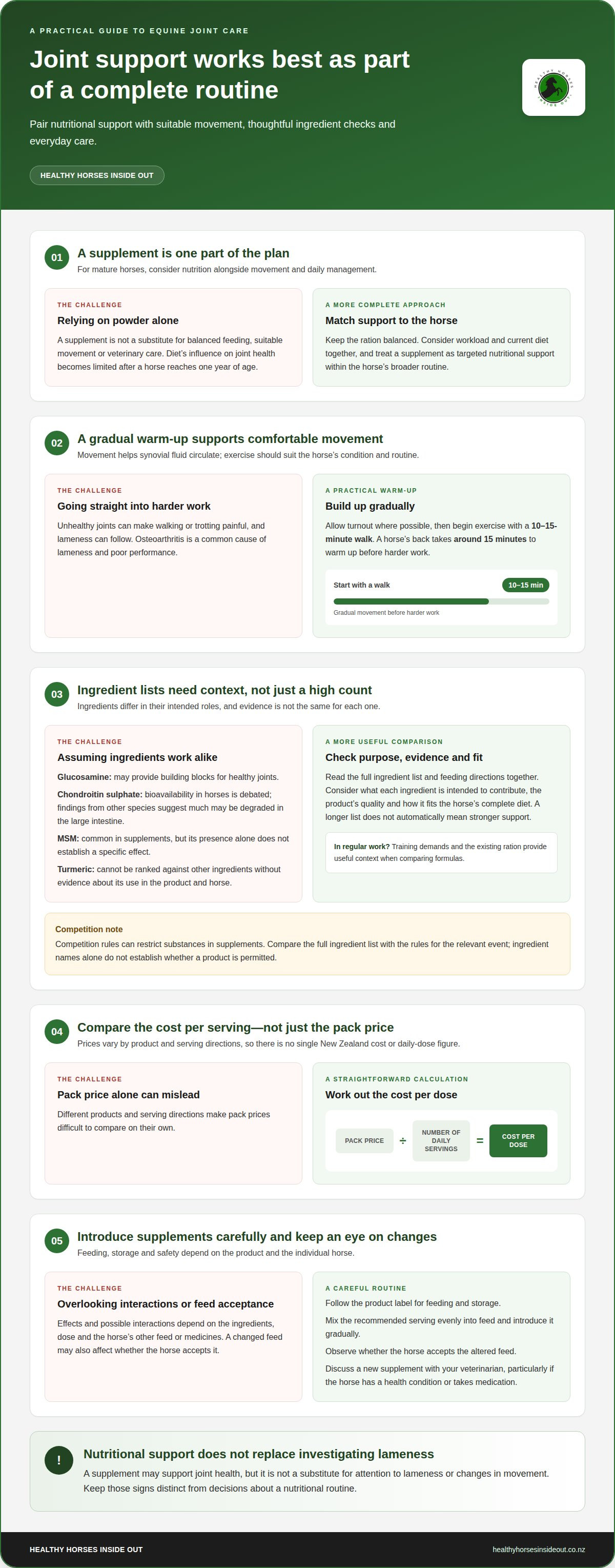
Joint care involves suitable nutrition, movement and daily management. For mature horses, a supplement is only one part of this broader approach.
Diet and Joint Health in Mature Horses
Diet supplies nutrients that support joint tissues, but its influence on joint health becomes limited after a horse reaches one year of age. A balanced ration remains important for a mature horse’s overall health, while a supplement may provide targeted nutritional support. Consider the horse’s workload and current diet together, rather than treating a powder as a substitute for balanced feeding or veterinary care.
Why Equine Joint Health Matters
Healthy joints help cartilage, ligaments and synovial fluid cushion bones and support movement. If joints become unhealthy, walking or trotting may be painful, and lameness can follow. Osteoarthritis is a common cause of lameness and poor performance. Movement also matters: allow turnout where possible, and begin exercise with a 10 to 15-minute walk so synovial fluid can circulate.
A horse’s back takes around 15 minutes to warm up, so a gradual start supports comfortable movement before harder work. Keep exercise appropriate to the horse’s condition and routine.
Nutrients for Joint Health
Joint supplements can provide nutrients intended to support joint health and cartilage development, and may help decrease inflammation. Omega-3 fatty acids have been reported as beneficial in reducing joint inflammation. Ingredient combinations vary, so consider what each nutrient contributes and how it fits the horse’s complete diet. This helps keep supplementation purposeful rather than duplicating nutrients already supplied elsewhere.
Cost: Prices vary by product and serving directions, so there is no single New Zealand cost or daily-dose figure. Divide the pack price by the number of daily servings to calculate the cost per dose.
Risks and interactions: Effects and possible interactions depend on the ingredients, dose and the horse’s other feed or medicines. Follow the product label and discuss a new supplement with your veterinarian, particularly if your horse has a health condition or takes medication.
Introducing and storing powder: Follow the label’s feeding and storage directions, mix the recommended serving evenly into feed, and introduce the supplement gradually. Store it as directed and observe whether your horse accepts the altered feed.
Glucosamine in oral supplements
Glucosamine is commonly included in oral equine joint supplements. After ingestion, it is absorbed in the intestines and may provide building blocks for healthy joints. This is one reason it may be considered for horses in regular work, but it doesn’t mean every horse has the same nutritional needs.
Powder is one way to feed an oral supplement, often mixed into a horse’s feed. The ingredients matter more than the format: check whether glucosamine is listed and how the product describes its intended role. A supplement is nutritional support, not a substitute for investigating lameness or changes in movement. Those signs deserve attention in their own right.
Chondroitin sulphate may appear alongside glucosamine. Its bioavailability in horses is debated, and studies in other species suggest that much of it is degraded in the large intestine. Don’t assume the ingredients act identically: a formula containing both does not, by itself, show how much of either ingredient a horse absorbs.
When comparing oral formulas, read the ingredient list and feeding directions together. Note whether glucosamine is included, whether chondroitin is also present, and how the product is intended to be fed. Training demands and the horse’s existing ration provide useful context for that decision. If you’re exploring broader equine supplement options, consider how each formula fits the horse’s nutritional routine, rather than choosing by ingredient count alone.
Joint supplements are typically used for older horses with joint issues to help slow osteoarthritis progression and support joint health and function. This describes a broad intended role, rather than a particular glucosamine formula or a guaranteed outcome for an individual horse. To consider whether that role fits, relate it to the horse’s work, current ration and the product’s feeding directions. Keep nutritional support distinct from investigating lameness or changes in movement; choosing a supplement does not replace attention to those signs. Reviewing the full formula can also clarify whether glucosamine is being considered alone or alongside chondroitin.
Other common joint supplement ingredients
Joint formulas can combine several ingredients, but a longer list doesn’t automatically mean stronger support. Ingredient purpose, evidence and product quality all matter.
Comparing Joint Support Ingredients
Glucosamine, chondroitin, MSM and turmeric are different ingredients. Glucosamine may provide building blocks for joints, while chondroitin sulphate’s absorption in horses is debated. MSM is commonly included in joint supplements, but its presence alone does not establish a specific effect. Turmeric also can’t be ranked against these ingredients without evidence about its use in the product and horse.
Competition rules can restrict substances in supplements, so compare the full ingredient list with the rules for the relevant event. Ingredient names alone don’t establish whether a product is permitted.
Evidence for Joint Supplement Ingredients
Chondroitin, MSM, amino acids, vitamins and minerals commonly appear in joint supplements. Their presence describes a formula, but doesn’t prove that each ingredient will deliver the same benefit. Glucosamine may support healthy joints, while evidence about chondroitin’s bioavailability in horses remains debated. Findings from other species suggest much chondroitin is degraded in the large intestine, so species-specific evidence matters.
For a practical comparison, identify each ingredient’s stated purpose and distinguish that from evidence of its effects in horses. For example, consider a blend containing glucosamine, MSM and vitamins ingredient by ingredient, rather than judging it by its total ingredient count.
Product quality is another consideration. APVMA approval can help indicate that a joint product contains the ingredients and concentrations specified on its label and is made to GMP standard. For New Zealand readers, this is a quality-check consideration, not evidence that a product meets the rules of a particular competition. Keep label details available when assessing a formula.
Long-term joint supplementation
Joint supplements may form part of a routine to support ongoing management of existing concerns and future joint health. Their place in that routine depends on the horse’s needs, the formula and consistent use.
Dosage by Horse Weight
There isn’t one universal dose for every horse. The recommended serving depends on the product’s concentration and label directions, including any guidance based on body weight. Follow the directions for that specific formula rather than estimating from another product or scaling a dose by eye. Feed an equine joint care powder according to its own label, not a general dose copied from elsewhere.
Time to Effects and Assessing Results
There’s no single timetable for noticing a change. A horse’s response may depend on the ingredients, starting condition, workload and consistency of feeding. Track practical signs such as willingness to move, comfort during routine work and changes in performance. Keep observations consistent, since changes to exercise or daily management can also affect movement.
Daily supplementation is sometimes suggested for younger horses, particularly performance horses, to support joint health as they age. This is preventive nutritional support, not a replacement for responding to signs of discomfort. Consider whether an equine joint care powder fits the horse’s complete feeding routine and your intended purpose.
Keep the routine consistent. Follow the product’s directions, note changes in workload and assess movement during familiar activities. If a horse becomes lame or its movement changes, seek veterinary advice rather than relying on a supplement to resolve the problem. A consistent approach helps you evaluate whether the feeding routine suits your horse.
Explore joint-support supplement options to find a formula that fits your horse’s ongoing nutritional routine.
Healthy Horses Inside Out
Healthy Horses Inside Out offers horse owners a range of nutritional support to consider alongside a thoughtful joint-care routine. Everyday Horse Supplements, Specific Horse Supplements, Horse Supplement Bundles and HHIO Pellets provide options for different equine nutrition needs. The right fit depends on your horse’s existing ration, workload and the role you want supplementation to play over time.
When weighing up a supplement, focus on its ingredients, feeding directions and how it complements your horse’s overall diet. Explore the Healthy Horses Inside Out range to consider nutritional support for your horse. For changes in movement, lameness or suspected joint disease, seek veterinary advice. Contact Healthy Horses Inside Out to discuss your horse’s supplement needs.
Make joint support part of a thoughtful plan
Make supplementation purposeful. Before adding an equine joint care powder, consider what you want it to support, how it fits your horse’s existing feed and what changes you’ll observe over time. A clear routine makes it easier to judge whether the approach suits your horse, rather than changing several parts of their care at once.
Keep your horse’s comfort at the centre of that decision. If movement changes or lameness appears, seek veterinary advice instead of relying on a supplement alone. For nutritional support, Healthy Horses Inside Out can help you consider options in the context of your horse’s needs. Contact Healthy Horses Inside Out to discuss your horse’s supplement needs and take a considered next step.
Frequently Asked Questions
Are equine joint supplements regulated or approved in New Zealand?
Don’t treat APVMA approval as proof of New Zealand approval. APVMA is the Australian Pesticides and Veterinary Medicines Authority. Its approval can help check whether a product contains the ingredients and concentrations stated on its label and is made to GMP standard. For a supplement sold in New Zealand, consider its label and product claims in the New Zealand context.
How much do horse joint supplements cost in New Zealand, and what is the cost per daily dose?
Prices vary by product and serving directions, so there is no single New Zealand cost. Divide the pack price by the number of daily servings to calculate the cost per dose.


