

What if the supplement brand you’ve found is made for people, not horses? A search for zenutri.com can leave New Zealand horse owners with that question, especially when broad wellness language makes human and equine products sound alike. The similarly named Australian site, Zenutri.com.au, offers personalised human supplements; they aren’t formulated for horses.
It’s understandable to look for a clear answer before choosing what goes into your horse’s feed. Intended species matters: a human supplement isn’t an equine product simply because its claims sound relevant to general wellbeing. And for horses grazing New Zealand pasture, the nutritional context matters too.
This article explains what Zenutri offers, how human-wellness products differ from horse-specific supplements, and what to assess before making a choice. You’ll also learn why formulation for New Zealand pasture-based diets is relevant, and how to consider ingredients, intended use and product information without relying on unsupported promises. The aim is a more confident, informed decision for your horse.
Key Takeaways
- zenutri.com refers to human wellness supplements, so its broad health language shouldn’t be taken as evidence that products are intended for horses.
- Learn how to compare each brand’s stated intended user, formulation context and claims without treating Australian TGA information as New Zealand approval for equine products.
- Use a practical four-step check: define your feeding goal, review your horse’s full diet, read product directions and assess whether the product fits.
- See why New Zealand pasture-based diets are relevant when considering horse-specific supplements.
- Explore HHIO’s horse supplement range, including HHIO Performance, HHIO Rebuild, HHIO Foundation, HHIO Assist, HHIO Support and HHIO Restore.
What is Zenutri.com, and who are its supplements designed for?
Zenutri presents human wellness supplements, while Healthy Horses Inside Out (HHIO) focuses on horses. That distinction is central for New Zealand horse owners: the word “supplement” describes a broad product category, not a shared intended user. A human wellness product and a horse supplement shouldn’t be treated as equivalent simply because both contain nutrients or use similar language about wellbeing.
What does Zenutri.com offer?
The Australian site associated with the Zenutri name describes a personalised supplement approach for people. Customers can complete a health quiz, then receive recommendations in the form of human wellness supplement bundles. Its pages describe the products as Australian-made and TGA-listed. Those are claims about Zenutri’s own human products, not evidence that they’re formulated or intended for horses.
For a New Zealand reader, it helps to keep the context attached to each claim. “Australian-made” identifies where Zenutri says its products are made, while “TGA-listed” refers to the Australian regulatory context stated on its pages. Neither description should be read as an equine formulation claim or as New Zealand approval for use in horses. The products’ intended user remains the most relevant starting point when assessing whether they fit your horse’s feeding plan.
Why does intended species matter?
Products designed for different species can vary in formulation, serving directions and labelling because they’re intended for different users. A shared ingredient, such as a mineral, doesn’t by itself establish that the product is suitable for another species. Nor does broad language about energy, balance or general wellness answer questions about a horse’s diet and nutritional needs.
Human supplements are positioned for human wellness; equine supplements are formulated and labelled for horses. That’s the distinction to keep in view when comparing Zenutri with HHIO. HHIO’s horse supplements are made in New Zealand and formulated for New Zealand pasture-based diets, whereas Zenutri’s supplied product information describes human supplements. This is a comparison of purpose and product context, not a claim about clinical effectiveness.
Industry context can help explain why intended use and product information matter. For example, the American Feed Industry Association (AFIA) represents feed manufacturers, including those producing animal feed, and has a role in discussions about legislation and regulation. It’s a United States industry organisation, so it doesn’t establish whether a particular product is appropriate for horses in New Zealand. For that decision, focus on the product’s stated species, formulation and directions rather than relying on a familiar ingredient or a general wellness claim.
In the sections that follow, the comparison stays on those practical points: who each product is for, what its pages say about its purpose, and what horse owners can assess when choosing an equine supplement. Keeping those questions separate makes it easier to avoid confusing human-wellness positioning with horse-specific nutrition.
Zenutri bundles and horse supplements: compare purpose, formulation, and claims
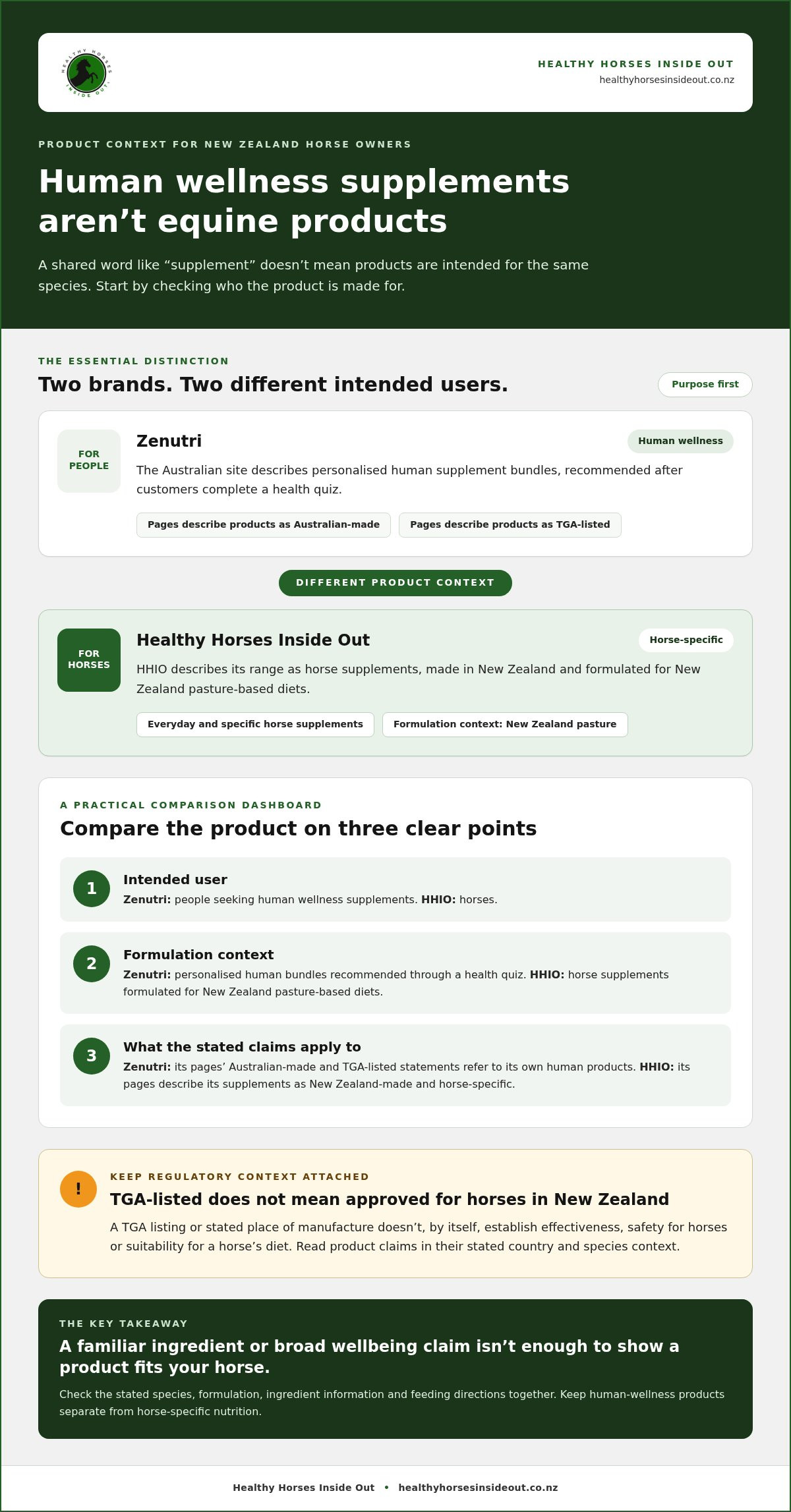
A useful comparison starts with the product’s intended user, then considers how its formulation and claims relate to that purpose. Zenutri’s pages describe personalised human wellness bundles, while HHIO’s range is made for horses and formulated for New Zealand pasture-based diets. These are different product contexts, so a listing or manufacturing statement for one brand shouldn’t be transferred to the other.
| Comparison point | Zenutri | HHIO |
|---|---|---|
| Intended user | People seeking human wellness supplements | Horses |
| Product context | Personalised bundles recommended through a health quiz | Everyday and specific horse supplements, formulated for New Zealand pasture-based diets |
| Claims stated on supplied pages | Zenutri describes its products as Australian-made and TGA-listed | HHIO describes its supplements as New Zealand-made and horse-specific |
How to read Zenutri’s TGA and manufacturing statements
Zenutri’s Australian-made and TGA-listing statements apply to its own products. If an AUST L identifier appears on a Zenutri product page, read it in that Australian context, not as a claim about HHIO or as New Zealand approval for an equine supplement. A listing or a stated place of manufacture doesn’t, by itself, establish effectiveness, safety for horses or suitability for a horse’s diet.
Product claims need to be read in their stated regulatory and species context. That principle helps prevent a human product’s regulatory terminology from being mistaken for evidence about a horse-specific product. Regulatory language can differ between countries and product categories, so compare like with like and avoid treating similar-sounding terms as interchangeable.
What differs in an equine supplement comparison?
For a horse supplement, look at the intended species, ingredient information, feeding directions and dose guidance together. These details help you understand what the product is designed for and how its use is described. HHIO’s New Zealand pasture-based formulation context gives horse owners a relevant point of comparison, without implying that a supplement diagnoses, treats or prevents a health condition.
Nutrition also depends on the horse’s overall circumstances, including forage, water, age and activity. The MSD Veterinary Manual’s guide to Nutritional Requirements of Horses explains why assessing the whole diet matters; a supplement should be considered as part of that wider picture, not in isolation.
For a closer look at ingredient labels, HHIO’s guide to horse supplement ingredients in NZ can help you interpret what’s listed and compare formulations more carefully. If you’re looking for a horse-specific option, you can also explore HHIO horse supplements with the product’s intended use and directions in mind.
Can human wellness supplements be compared directly with horse supplements?
No. Human wellness supplements and horse supplements are different product categories, with different intended users and directions for use. A broad claim about wellbeing, or an ingredient name that looks familiar, isn’t enough to establish that a product is appropriate for a horse. That’s why a direct comparison should focus on intended use and available product information, not assume that one product can stand in for another.
Why ‘similar ingredients’ does not mean ‘same product’
An ingredient name is only one part of a formulation. Species, ingredient form and concentration, serving directions, and the rest of the horse’s diet all affect how a product should be understood. For example, seeing a mineral named on a human supplement label doesn’t tell you whether its amount or feeding instructions are suitable for a horse. Don’t infer a horse dose from a human serving, or from the fact that the ingredient is also used in equine nutrition.
For any product under consideration, read the label and product information for the stated user and directions. Check that the product is explicitly intended for horses, and look for clear ingredient and feeding guidance. If the information describes human wellness use, as the supplied pages for zenutri.com do, treat that as its stated purpose rather than trying to adapt it for a horse.
A practical label check can help keep the decision grounded:
- Intended user: Does the product information name horses, rather than people?
- Ingredient detail: Are ingredients and relevant amounts described clearly?
- Directions: Are feeding instructions provided for the intended species?
- Diet context: Have you considered the horse’s existing feed and forage before adding another product?
These checks don’t determine whether a product will produce a particular result. They help you decide whether its stated purpose and information make sense for your horse, while reducing the risk of treating similar wording as proof of equivalent use.
When should a horse owner seek professional advice?
Supplement shopping isn’t a substitute for veterinary advice. If your horse is unwell, takes medication, or you suspect a nutritional problem, speak with a veterinarian before making decisions that could affect its care. A supplement shouldn’t be presented as a way to diagnose or treat illness, or as a replacement for prescribed treatment. Keeping those boundaries clear supports safer, more considered choices.
For general decision support, HHIO’s guide to what supplements a horse needs in NZ can help you think through your horse’s feeding context. Start with the overall diet and a defined nutritional goal, then assess horse-specific products on their own directions and ingredients. That gives you a more relevant basis for comparison than human wellness claims alone.
How to choose an equine supplement for your horse in New Zealand
A sound choice starts with your horse, not a broad wellness claim or a product trend. Use this four-step checklist to connect a clear feeding goal with your horse’s current diet and the product’s directions. That process helps you distinguish everyday nutritional support from a supplement intended for a more specific feeding objective.
- Define the feeding goal. Identify what you want to support through the diet. Is the aim general everyday nutritional support, or is there a specific, clearly defined feeding objective? Keep the goal practical and avoid treating a supplement as a way to diagnose a health issue.
- Review the whole diet. Consider the horse’s forage, pasture, any existing feed and supplements, life stage and work level. A product should be assessed in the context of what the horse already eats, rather than as an isolated addition. Forage and pasture can form a substantial part of a New Zealand horse’s diet, so account for them when thinking about overall nutritional fit.
- Read the directions. Check the product’s stated intended user, ingredient information, purpose and feeding instructions. Follow its specific dose-rate guidance; don’t assume every supplement uses the same amount or that a human serving can be adapted for a horse.
- Assess the fit. Consider whether the product’s stated purpose and directions align with your goal and the horse’s existing feeding routine. If illness or suspected deficiency is part of the concern, seek veterinary advice rather than trying to manage it through supplement selection alone.
Start with the horse’s diet and intended support
Start by looking at the full feeding picture. Pasture, forage and supplementary feed all contribute to the diet, while age and workload can influence what the horse needs. Separate routine nutritional support from a specific concern: a product chosen for everyday use has a different role from one selected to meet a defined feeding objective. Visible signs alone can’t confirm a deficiency, and a supplement shouldn’t be presented as treatment.
For foundational context, HHIO’s guide to everyday horse supplements discusses everyday feeding in New Zealand conditions. Use it to inform your questions about the diet, not as a substitute for individual veterinary advice.
Check directions, dose and product transparency
Directions matter because products aren’t necessarily dosed alike. HHIO describes its range as using concentrated 20 g or 40 g doses. Those figures describe the range’s dose formats, not a dose recommendation for every product; use the directions for the particular supplement you’re considering. Compare ingredient disclosure and stated purpose as well, so you can understand what the label says and how the product is intended to be fed.
Check the intended user, dose directions and fit with the whole diet before choosing. This simple checklist is more useful than matching broad wellness wording. If you’re ready to explore horse-specific options, browse HHIO’s horse supplements and compare their stated purposes with your feeding goal.
Why consider HHIO when you need horse-specific supplements?
When your goal is to choose a supplement for a horse, the most useful starting point is a range made specifically for horses. Healthy Horses Inside Out (HHIO) is a New Zealand business offering everyday and specific horse supplements, bundles and HHIO Pellets. Its products are formulated for New Zealand pasture-based diets, giving horse owners a relevant local context to consider alongside their horse’s existing feed and intended nutritional support.
That’s a different purpose from the human wellness products described by zenutri.com. Rather than judging by general claims or familiar ingredient names, compare the intended user, the product’s stated purpose and its feeding directions. These details help you work out whether an equine product fits the feeding goal you’ve identified, without assuming it will deliver a particular health outcome.
What distinguishes Healthy Horses Inside Out?
HHIO products are manufactured in New Zealand by the country’s largest animal-supplement manufacturer, with registrations and certificates. Across the range, products contain no fillers, preservatives, sugar or ingredients high in iron. Organic minerals are used where indicated, including organic zinc, copper, iodine and selenium; this isn’t a claim that every product contains every mineral.
These are product and manufacturing details to weigh alongside the label, ingredient information and directions for the specific supplement. They offer useful context, but they don’t replace an assessment of your horse’s overall diet or guarantee a particular result. If a health concern or suspected deficiency is influencing your choice, keep veterinary advice separate from supplement selection.
Explore a horse-focused range
HHIO’s range includes named options across its horse-specific supplements. The names below help you identify the range, but aren’t a substitute for checking each product’s stated purpose and feeding directions:
- HHIO Performance
- HHIO Rebuild
- HHIO Foundation
- HHIO Assist
- HHIO Support
- HHIO Restore
With everyday and specific supplements, bundles and HHIO Pellets, owners can explore different product formats while keeping the horse’s feeding needs at the centre of the decision. HHIO also reports more than 350 five-star customer ratings. These reflect customer feedback, not guaranteed results for every horse; individual needs and feeding routines differ.
Take a measured approach: define the feeding goal, review the full diet and compare the product’s stated use and directions. If you’re ready to consider horse-specific options, explore HHIO horse supplements and assess the range against your horse’s feeding needs.
Make your next supplement choice horse-specific
Let your horse’s feeding needs guide the next step. If you’re weighing up zenutri.com, keep its human wellness products distinct from supplements intended for horses, and assess any equine option against your horse’s full diet and the product’s directions.
HHIO offers New Zealand-made equine supplements formulated for New Zealand pasture-based diets. More than 350 customers have given HHIO five-star ratings, a useful indication of customer experience rather than a promise of results for every horse. The best choice still depends on your horse’s individual circumstances and a clear feeding goal.
Take time to explore the horse-specific range and consider which option aligns with your feeding plan. Explore horse-specific supplements from Healthy Horses Inside Out and take your next step with care and confidence.
Frequently Asked Questions
What is Zenutri.com?
Zenutri.com presents personalised vitamin and mineral supplements for people, including bundles recommended through a health quiz. The supplied Zenutri pages describe the products as Australian-made and TGA-listed. The quiz is designed around human wellness information, so its recommendations don’t establish what a horse needs. If you’re researching a product for an equine, use its own label and product directions to identify the intended user.
Is Zenutri a horse supplement brand?
The supplied Zenutri pages describe human wellness supplements and bundles, not a horse supplement range. A horse owner browsing those pages should treat the stated user and instructions as the guide, rather than assuming the word “supplement” applies equally to people and horses. Product packaging and directions are useful first checks. If they identify people as the intended users, don’t infer equine suitability from general wellness wording.
Can I give a human supplement to my horse?
Human and equine supplements shouldn’t be treated as interchangeable. An ingredient name alone can’t establish whether a product is appropriate for a horse: formulation, concentration, dose and the horse’s complete diet all matter. Seek veterinary advice before considering a human product for your horse, particularly if the horse is unwell or taking medication. Don’t use a human serving size as a guide to feeding a horse.
What does TGA-listed mean on a Zenutri supplement?
TGA-listed is wording Zenutri uses for its products; TGA stands for Australia’s Therapeutic Goods Administration. Read that statement within its Australian context. It doesn’t mean a product has New Zealand approval for horses, establish equine suitability or guarantee a particular outcome. For a horse-related decision, check the product’s stated intended user and label directions rather than treating a regulatory term as a substitute for species-specific information.
How do I choose a supplement for my horse in New Zealand?
Start with the horse’s current diet and routine, including pasture, other feed, life stage and workload, then define the nutritional objective. Review whether the product is intended for horses, what its ingredients are, and its dose-rate guidance and feeding directions. Keep a record of what’s already in the ration to support a clear assessment. If you suspect a health problem, seek veterinary advice rather than trying to diagnose it with a supplement.
What is the difference between HHIO supplements and Zenutri bundles?
They’re positioned for different users: HHIO offers horse supplements, while the supplied Zenutri pages describe human wellness products. HHIO’s equine range is New Zealand-made and formulated for New Zealand pasture-based diets; Zenutri describes its products as Australian-made and TGA-listed. These manufacturing and listing statements aren’t equivalent approvals. Compare the brands by intended species, product purpose and directions, rather than ranking products designed for different users.


