

What if the best ration for a performance pony isn’t the one with the most feed, but the one that matches the work it actually does? It’s easy to assume that a competition pony needs more concentrate, yet extra calories can contribute to weight gain or unwanted energy when the ration doesn’t reflect its workload. That’s why feeding a performance pony NZ starts with the individual, not its height or competition label.
If you’re unsure how to balance forage, body condition and supplementary feed, you’re not alone. A pony’s needs can shift with the intensity and frequency of its work, while access to New Zealand pasture adds another factor to consider. More feed isn’t automatically better, and a supplement can’t replace a sound forage foundation.
This guide will help you build a measured routine around your pony’s workload, condition and everyday needs. We’ll look at how to assess the whole ration, when a pellet or targeted supplement may have a place, and why reading labels helps you avoid unnecessary duplication. The aim is a practical plan that supports appropriate body condition without overlooking nutritional needs.
Key Takeaways
- For feeding a performance pony NZ, assess the pony’s regular workload and body condition rather than relying on its competition label.
- Compare forage-led feeding, added energy and targeted nutritional support by their purpose and the pony’s individual needs.
- Record every feed and supplement, then review the ration as workload or body condition changes.
- Read ingredient lists and feeding directions to spot overlap and consider where HHIO Pellets or supplements may fit.
Feeding a performance pony in NZ starts with its workload
A pony doesn’t need a competition record to be working, and entering competitions doesn’t automatically mean it needs a concentrate. For feeding a performance pony NZ, the useful starting point is the work the pony regularly performs, alongside its forage access, body condition and individual needs. A pony in light work may maintain condition on a different ration from one doing frequent, demanding sessions, even if they share the same discipline.
Pasture is part of that picture, but it isn’t a fixed feed with the same nutritional profile year-round. Growth, season and pasture management can affect what’s available, while the amount a pony can access also matters. Keep a practical record of grazing and other forage sources rather than assuming green pasture alone tells you what the ration provides. For a broad overview of feed types and digestive physiology, see Horse nutrition on Wikipedia.
What counts as work for a performance pony?
Light schooling or relaxed hacking places different demands on a pony from frequent, sustained or more intense work. Describe the routine in practical terms: how often sessions happen, how long they last, how demanding they are, and how the pony recovers before the next one. A short schooling session followed by several quiet days is not the same pattern as regular, challenging work.
Discipline alone won’t settle the feeding question. Two ponies doing the same activity can differ in fitness, temperament, body condition, forage access and how much work they actually complete. Track the pattern over time, including changes in training or competition schedules, so the ration reflects the pony’s real routine rather than its label.
Why body condition matters alongside workload
Body condition scoring gives you a repeatable way to monitor whether the pony is maintaining, gaining or losing condition. Use the same scoring approach consistently and note changes alongside workload and feeding records. Regular assessment is more useful than relying on a single impression, particularly when coat changes or seasonal pasture growth make visual comparisons harder.
If an easy-keeping pony is carrying more condition than is appropriate for it, adding energy simply because it competes may not suit its needs. The priority is to review the whole ration and its energy sources while maintaining suitable forage and nutritional adequacy. Don’t try to diagnose obesity or illness from appearance alone; seek veterinary input if you’re concerned about the pony’s health or condition.
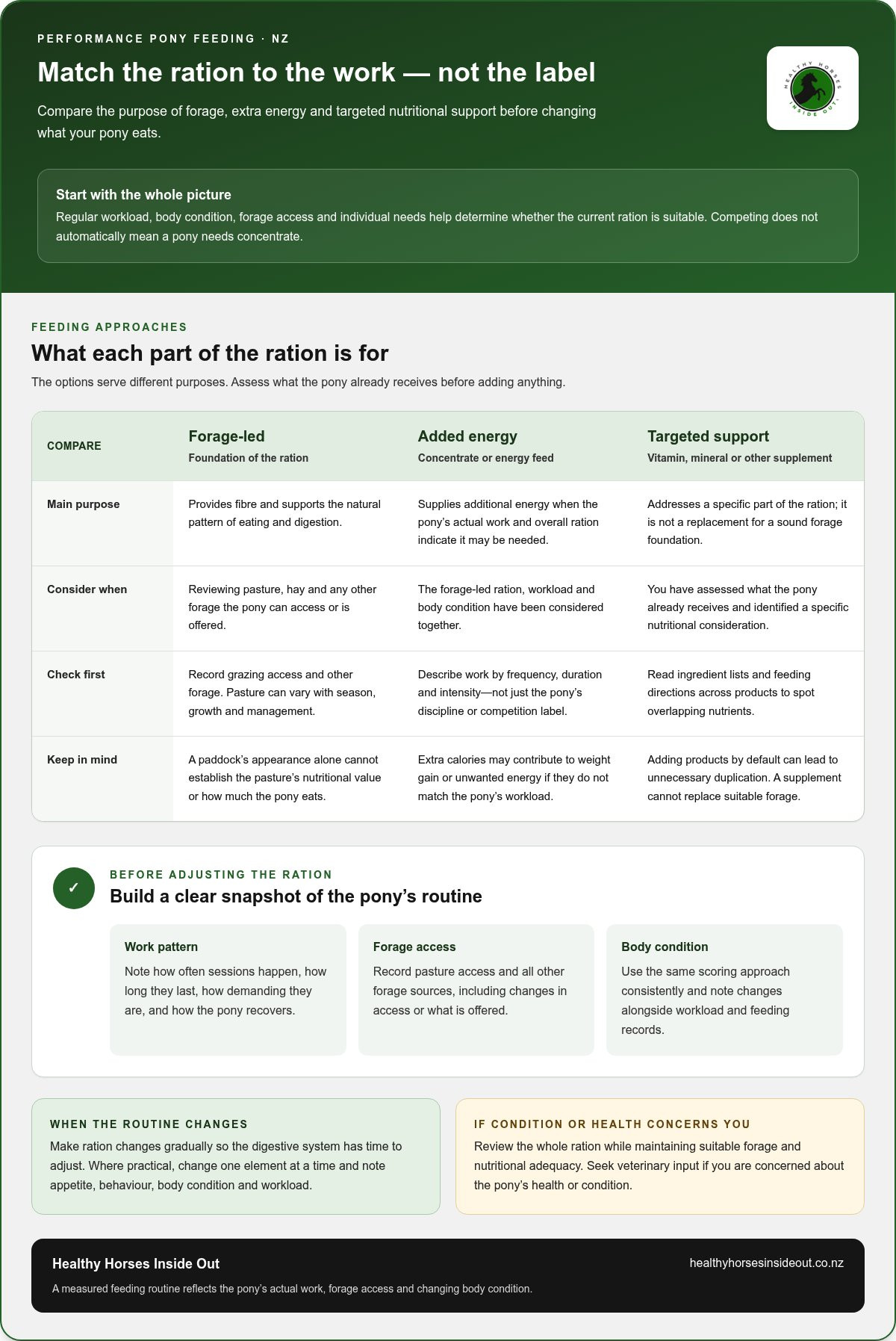
Before changing feed, gather a clear snapshot of the current routine:
- Describe the pony’s usual work, including frequency, duration and intensity.
- Record pasture access and all other forage sources.
- Track body condition consistently and note changes over time.
That picture helps distinguish a genuine need for extra dietary energy from the assumption that a “performance” pony must receive more concentrate. The next step is to consider how forage, energy and digestion fit together.
How forage, energy and digestion support a working pony
Forage is the foundation of a ration because it supplies fibre and supports the natural pattern of eating and digestion. The right amount and type depend on the individual pony, its condition, workload and what else it can graze or eat. New Zealand pasture can vary with season, growth and management, so a paddock’s appearance alone can’t establish its nutritional value. Consider the whole ration rather than relying on a universal quantity or assumption about pasture.
Forage first: assess what the pony actually eats
Include pasture, hay and any other forage in your daily review. Note how long the pony has access to grazing, whether that access changes, and what forage is offered when it’s stabled or away from pasture. A knowledgeable equine professional can help estimate intake and interpret the ration in context, particularly when it’s difficult to judge how much the pony is eating.
Forage also supports the digestive processes that matter throughout the day. Horses are adapted to digest fibre, and the British Horse Society’s guide to equine digestion explains how the digestive system processes feed. Keeping an accurate forage record gives you a more useful starting point for assessing any additional feed. For a closer look at everyday supplementation, the everyday horse supplements guide can help you consider supplements within the wider ration.
Match extra energy to effort, not expectation
Concentrate isn’t automatically necessary because a pony competes. Consider whether its current forage-led ration supports its actual work and body condition before adding a feed intended to supply more energy. A pony doing demanding, regular work may have different requirements from one attending occasional events or doing light schooling, but the decision should be based on the full picture, not the discipline’s name.
Energy feeds and targeted nutritional support serve different purposes. A feed may add energy, while a vitamin, mineral or other supplement is intended to address a specific part of the ration. Review ingredients and feeding directions across all products so you can spot overlapping nutrients instead of adding items by default. If you’re considering options as part of feeding a performance pony NZ, explore the HHIO range of horse supplements only after assessing what the pony already receives.
Make ration changes gradually, so the pony’s digestive system has time to adjust and you can observe how it responds. Change one element at a time where practical, and keep notes on appetite, behaviour, body condition and workload. Sudden changes in any of these deserve attention; seek appropriate veterinary or equine nutrition advice rather than treating feed as a diagnosis.
Compare feeding approaches for a performance pony
There’s no single ration that suits every working pony. A useful comparison starts with the role each feed is meant to play, then asks whether that role fits the pony’s workload, condition and existing diet. A competition schedule alone doesn’t mean a pony needs a high-energy ration. In feeding a performance pony NZ, the aim is to meet real nutritional needs without adding feed simply because the pony has a performance label.
| Approach | Intended role | May suit when | Questions to assess |
|---|---|---|---|
| Forage-led ration | Provides the dietary foundation, with pasture and other forage considered as part of the whole ration. | Work is light or moderate, and the pony maintains suitable condition on its current diet. | What forage is available and eaten? Is the pony’s condition stable? Are its nutritional needs being met? |
| Added energy feed | Supplies additional dietary energy where the existing ration may not match the demands of the work. | Work is regular and demanding, and the pony’s condition and full ration support considering more energy. | Is extra energy needed, or could another part of the ration be adjusted? How will condition and behaviour be monitored? |
| Targeted nutritional support | Addresses a specific nutritional consideration rather than automatically adding energy. | A review of the full ration identifies a reason to consider particular vitamins, minerals or other support. | What purpose does the product serve? Are its ingredients already supplied elsewhere in the ration? |
When a forage-led approach may be enough
A forage-led approach may be appropriate if suitable forage is available, the pony’s workload is considered and its body condition remains stable. That doesn’t mean pasture alone meets every pony’s needs, or that a light workload removes the need to review the ration. Look at what the pony actually eats and how its condition changes; the assessment should remain individual, not based on a general rule about ponies.
When to consider pellets or targeted supplements
Consider a pellet or supplement only when it has a clear role in the overall ration. Check its intended use and ingredients against all other feeds and supplements, so you can identify possible overlap before adding another product. For help interpreting labels and ingredients, use the horse supplement ingredients guide.
Keep the decision practical: define the need, compare it with what the pony already receives, then monitor condition and response if the ration changes. A high-energy feed isn’t automatically the best choice for a pony that competes, and targeted nutritional support isn’t a substitute for assessing forage. If the reason for adding a product is unclear, pause and review the whole ration with a knowledgeable equine professional.
How to build and adjust a performance pony feeding routine
A feeding routine is easier to assess when you have a clear baseline. Keep a simple record of what the pony eats, its condition and the work it does, then review these together before making changes. This repeatable process helps you make decisions based on patterns rather than reacting to a single busy week or one change in appetite.
Record the baseline before changing the feed
Write down pasture access, hay and other forage, every feed and supplement, and how each is offered. Note the pony’s body condition using the same scoring approach each time. Include its work pattern and observations such as appetite, energy during sessions and recovery afterwards. Don’t set a target weight or ration without considering the individual pony and its circumstances.
- Record current feed. List forage, pasture access, feeds and supplements, including any changes in what is offered. Recording everything makes it easier to spot ingredients or nutrients that may overlap.
- Assess condition. Use a consistent body condition scoring method and note whether the pony appears to be maintaining, gaining or losing condition. A written record can help distinguish a gradual trend from a short-term fluctuation.
- Describe workload. Note how often the pony works, session length and intensity, and how the routine has changed. A shift from occasional schooling to frequent, demanding sessions may prompt a ration review, but doesn’t automatically mean more feed is needed.
- Review the ration. Compare the recorded diet and workload with condition and observations. Identify the specific reason for any proposed change, then make adjustments gradually and monitor the response rather than changing several things at once.
Review changes with the right support
An equine nutrition professional can help assess the ration as a whole, particularly if the pony’s workload, forage access or condition has changed. A veterinarian should advise on unexplained weight loss, discomfort, appetite changes or other health concerns; these signs shouldn’t be treated as a feeding problem alone. Keep your records handy so the discussion is based on the pony’s actual routine.
If you have a separate question about joint support, consider it independently from the general ration review. The horse joint supplements guide can help you explore that topic without assuming a supplement is the answer to a change in comfort or movement.
Repeat the routine after a workload change: record the diet, assess condition, describe the new work, then review the whole ration. That steady approach supports thoughtful feeding a performance pony NZ, without frequent reactive adjustments. If you’re considering a supplement as part of a reviewed plan, explore horse supplement options and assess their ingredients and intended use alongside the pony’s current feed.
Where HHIO products fit in a performance pony’s feeding plan
Once you’ve assessed workload, forage access and body condition, you can consider whether a product has a useful place in the ration. HHIO Pellets, everyday and specific horse supplements, and supplement bundles are options to assess as part of the whole diet. They aren’t replacements for forage, and choosing one simply because a pony competes doesn’t establish that it’s needed.
Choose products by purpose and the whole ration
Start with the question you’re trying to answer. Is there a defined nutritional consideration to address, or are you looking for a feed component that fits the pony’s current plan? A clear purpose helps you compare options with the forage and other feeds already being provided, rather than adding products by habit.
Read the product information and consider its intended use and ingredients alongside the full ration. This is especially useful if the pony already receives a pellet, fortified feed or another supplement, as products can have overlapping ingredients. Keep a note of what each item contributes, and avoid stacking products without a reason. The goal is a considered ration, not the longest supplement list.
For example, if you’re weighing up a supplement bundle while the pony also receives other feeds or supplements, review each item together before making a change. Equally, a product shouldn’t be selected on the assumption that it will improve performance or resolve a health concern. If the need is uncertain, discuss the ration with an equine nutrition professional; health concerns call for veterinary advice.
A considered next step for New Zealand pony owners
Keep the decision sequence simple: assess the pony’s workload, review its forage and existing ration, monitor body condition, then consider whether targeted support has a clear role. If work changes, revisit the assessment rather than automatically increasing feed. This keeps product choices grounded in the pony’s actual needs and helps you notice where ingredients may already overlap.
For feeding a performance pony NZ, a pellet or supplement is one possible component of a carefully reviewed plan, not a shortcut around assessing the diet. Check the product information against what your pony eats and the purpose you’ve identified. If you’re ready to compare options, explore HHIO horse nutrition products at your own pace.
Make your next feeding decision with confidence
A feeding plan doesn’t have to be perfect on the first try. Treat it as an ongoing record of what suits your pony, then revisit it when its training routine or circumstances shift. That steady, observant approach keeps feeding a performance pony NZ focused on the individual, rather than assumptions about what a competition pony should eat.
If your review points towards additional support, HHIO Pellets, everyday and specific horse supplements, and supplement bundles are options to consider alongside the existing ration. Take time to compare each option’s purpose and ingredients with what your pony already receives. Products should complement a considered plan, not replace forage or veterinary care.
Explore HHIO horse nutrition products and consider which options may fit your pony’s assessed needs. Small, thoughtful decisions can help you build a feeding routine with greater confidence over time.
Frequently Asked Questions
How much should I feed a performance pony each day?
There isn’t one daily amount that suits every performance pony. The right ration depends on factors such as bodyweight, condition, workload, forage type and access to pasture. Weigh feeds rather than estimating by scoop, and check the product’s feeding directions against the pony’s full ration. For an individual amount, an equine nutrition professional can help assess the pony’s needs and the feed’s nutrient contribution.
Can a performance pony do well on forage without concentrate?
Yes, some ponies can maintain suitable condition and meet their needs on a forage-based ration without concentrate. That depends on the quality and amount of forage available, the pony’s workload and whether its overall nutrient requirements are met. For example, a pony doing occasional light schooling may have different needs from one completing regular demanding work. Review the whole ration rather than using competition participation as the reason to add concentrate.
Is a high-energy feed suitable for every pony that competes?
No. Competing doesn’t automatically mean a pony needs extra energy, and a high-energy feed may not suit an easy keeper or a pony already maintaining condition. Consider the demands of the actual work and the pony’s current ration before choosing a feed. If you’re unsure whether a change is appropriate, record the pony’s condition and routine, then discuss those details with an equine nutrition professional.
How should I change my pony’s feed when its workload increases?
Review the ration when the increase becomes a regular pattern, rather than changing feed for a single harder session. Note what has changed, such as more frequent schooling or longer work, and monitor appetite, condition and recovery. If a feed adjustment appears warranted, make it gradually and avoid changing several parts of the ration at once. This gives you a clearer picture of how the pony responds.
What should I check before adding a supplement to my pony’s ration?
Check the supplement’s intended purpose, ingredients and feeding directions, then compare them with every feed and supplement your pony already receives. For example, if a fortified feed and a separate supplement both provide similar nutrients, adding both without reviewing their contribution may be unnecessary. In feeding a performance pony NZ, a supplement is best considered as one part of the ration, not a substitute for reviewing the diet as a whole.
Can New Zealand pasture provide everything a working pony needs?
Not necessarily. Pasture’s nutritional contribution can vary with season, growth and management, so a lush-looking paddock doesn’t by itself show whether a pony’s needs are met. Access and intake also differ between horses, even in the same paddock. Consider pasture alongside hay, other forage and any supplementary feed. If you’re concerned about specific nutrient gaps, seek an individual ration assessment rather than assuming every pony needs the same supplement.
When should I ask a veterinarian or equine nutrition professional about my pony’s feeding?
Ask an equine nutrition professional for help assessing the ration, especially if you’re unsure how forage and feeds meet the pony’s needs as its work changes. Contact a veterinarian about unexplained weight loss, discomfort, a sudden appetite change or other signs of ill health. These changes can have causes that feed adjustments alone won’t address. Keeping a record of diet, workload and observed changes can make the discussion more useful.


