

What if the best supplement for mareish behaviour NZ isn’t a calming formula, at least not before you understand what may be driving the change? When a mare’s behaviour becomes unpredictable, it’s natural to look for nutritional support. But pain, health, environment and training can all play a part, and a supplement may not address the underlying cause.
This guide will help you assess what’s changed, recognise when veterinary advice is the sensible next step and compare supplement claims without relying on promises of a quick fix. You’ll learn how to consider nutritional support in the context of a New Zealand pasture-based diet and why competition rules matter if your mare competes.
Healthy Horses Inside Out makes everyday and specific equine supplements in New Zealand, formulated for pasture-based diets. That context can inform your decision, but no supplement should be assumed to treat mareish behaviour. Start with the mare in front of you: observe the pattern, consider possible causes and choose support accordingly.
Key Takeaways
- “Mareish” describes an owner’s observation, not a diagnosis. Note what has changed and when, rather than assuming behaviour has a hormonal cause.
- Pain, health, workload, social setting and management may all influence behaviour. Consider the wider picture before choosing nutritional support.
- To assess the best supplement for mareish behaviour NZ, compare the stated purpose, full ingredient list, feeding directions and cautions. Distinguish nutritional support from evidence of a behaviour-specific effect.
- Use a dated log to record behaviour, context, routine and feed or management changes. Assess one change at a time where practical.
- Healthy Horses Inside Out offers everyday and specific nutritional support, made in New Zealand and formulated for pasture-based diets, as one part of a broader care plan.
What does mareish behaviour look like, and when should you take it seriously?
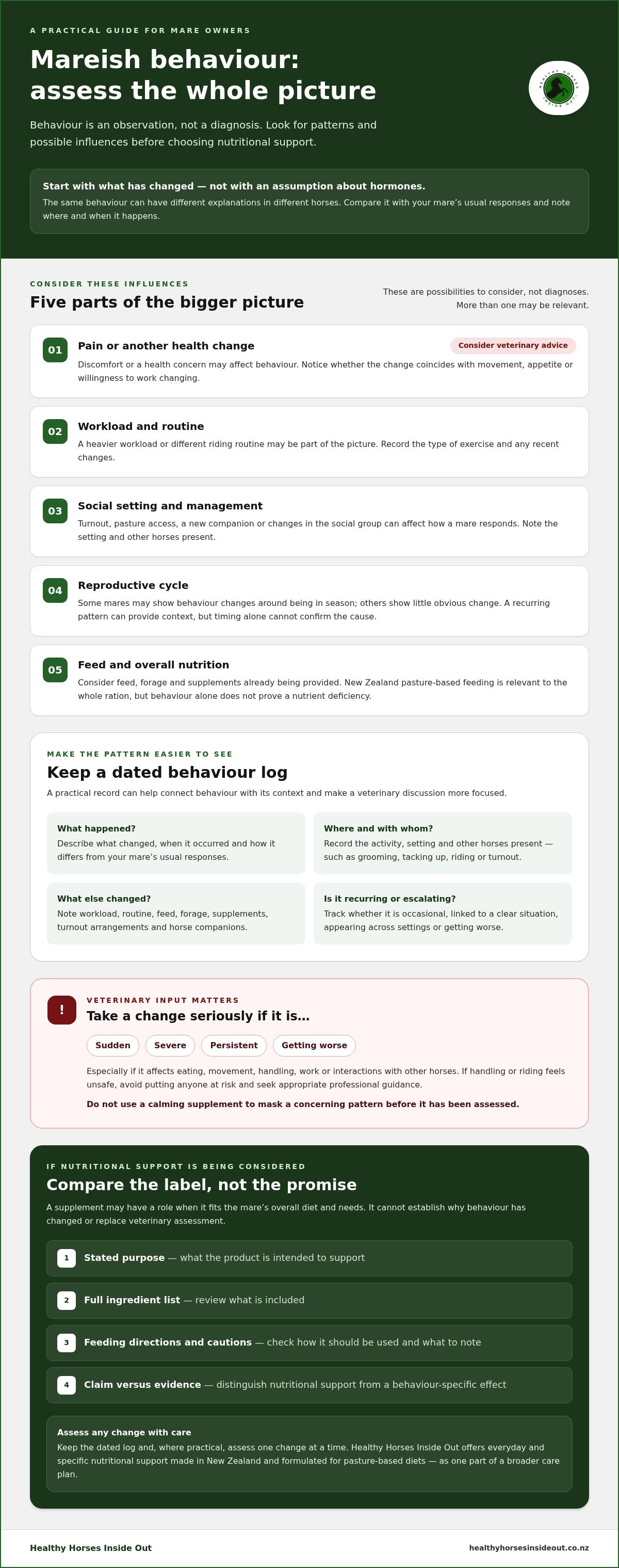
“Mareish” is an owner-used label for behaviour that seems different or difficult to manage. It describes what you observe, not why it’s happening. The word can be useful shorthand, but it isn’t a diagnosis and doesn’t prove hormones are the cause. Consider what’s usual for your mare, what has changed and where or when the change occurs.
That distinction matters when you’re weighing up the best supplement for mareish behaviour NZ. If a change reflects discomfort or another health concern, trying to quiet the behaviour with a supplement could delay attention to the underlying issue. Start with observation, not assumptions.
Which behaviour changes do owners commonly describe as mareish?
Owners may use the term for altered sociability, increased irritability, reluctance during handling or a change in how a mare responds to other horses. These are descriptions, not diagnostic signs. A mare that pins her ears in one situation, for example, may be reacting to a particular horse, uncomfortable tack or an unfamiliar routine. The same behaviour can have different explanations in different horses.
Look for patterns rather than relying on a single moment. Note whether a change happens during grooming, tacking up, riding, turnout or contact with a particular horse. Is it occasional and linked to a clear situation, or does it appear across several settings? Compare it with your mare’s own baseline, not with a general idea of how mares “should” behave. Reproductive cycles can be relevant for some mares, but behaviour alone doesn’t establish a hormonal cause. For general background, see this overview of the mare reproductive cycle and behaviour.
When does a behaviour change call for veterinary input?
Take a change seriously if it’s sudden, severe, persistent or getting worse, especially if it affects eating, movement, handling, work or interactions with other horses. Pain or another health concern may be possible, but behaviour alone can’t identify the cause. A veterinarian can assess the mare and advise whether further investigation is needed.
Safety comes first. If handling or riding feels unsafe, avoid putting yourself or others at risk and seek appropriate professional guidance. Don’t punish a mare for a change you don’t understand, and don’t use a calming supplement to mask a concerning pattern before it has been assessed.
- Record what happened and when, including the activity, setting and other horses present.
- Note recent changes to routine, workload, feed or management.
- Describe how the behaviour differs from your mare’s usual responses, and whether it is recurring or escalating.
These observations can make a veterinary discussion more focused. They also provide a sound starting point for considering nutritional support later, if it’s appropriate to your mare’s needs.
What can influence mareish behaviour beyond hormones?
Behaviour is an outcome, not a label for a single cause. Reproductive hormones may influence some mares, but they shouldn’t be the default explanation whenever a mare seems unsettled or less tolerant. Pain, other health changes, workload, social dynamics and daily management can all form part of the picture. More than one factor may be relevant, so observing the circumstances around a change is often more useful than immediately choosing a “calmer”.
This matters if you’re considering the best supplement for mareish behaviour NZ. Nutritional support may have a role if it fits the mare’s overall diet and needs, but it can’t establish why her behaviour has changed or replace a veterinary assessment.
How might reproductive cycles relate to behaviour?
Estrus, commonly called being in season, is a phase of a mare’s reproductive cycle. Some mares may show behaviour changes around this time, while others show little obvious change. Noting whether a pattern seems to recur alongside cycle signs can provide useful context, but timing alone can’t confirm hormones are responsible. Cycles and behaviour vary between individuals. If signs are persistent, concerning or affecting welfare, have a veterinarian assess your mare before pursuing targeted support.
How can health, management and nutrition shape the picture?
Consider what else changed around the same time. A heavier workload, a different riding routine, altered turnout, a new companion or a change in the social group may affect how a mare responds. Discomfort or a health issue may also be worth investigating, particularly if behaviour shifts alongside changes in movement, appetite or willingness to work. These are points to consider, not diagnoses you can make from behaviour alone.
Keep a practical record that connects behaviour with its context. Include:
- Workload, type of exercise and any recent changes in routine.
- Turnout arrangements, pasture access and changes in horse companions.
- Feed, forage and any supplements already being provided.
- When the behaviour occurs and whether other changes are present.
Diet belongs in the review, but it isn’t a shortcut to a conclusion. New Zealand pasture-based feeding is relevant when considering the whole ration, since pasture and intake can vary. It doesn’t prove that an individual mare has a nutrient deficiency. A targeted nutrition review should account for what she eats overall, rather than treating one behaviour as evidence of a particular shortfall.
Healthy Horses Inside Out makes everyday and specific equine supplements in New Zealand, formulated for pasture-based diets. This can be relevant when considering nutritional support as one part of a broader plan, not as an explanation or treatment for behaviour. Explore New Zealand-made equine nutritional support with your mare’s overall needs in mind.
How to compare supplements for mareish behaviour without trusting every claim
A product marketed for “calm” or “hormonal balance” may sound like a direct answer, but the wording alone doesn’t show that it will change a particular behaviour or suit your mare. Compare labels systematically, keeping a product’s stated nutritional purpose separate from evidence for a specific behavioural effect. The best supplement for mareish behaviour NZ isn’t automatically the one with the strongest claim or the longest ingredient list.
Use this checklist to compare the details that can guide a decision:
| What to compare | What to look for |
|---|---|
| Stated purpose | Is the product described as nutritional support, general wellbeing support or as changing a particular behaviour? These are different claims. |
| Full ingredient list | Can you see all listed ingredients and their amounts, where provided? A familiar ingredient name alone doesn’t show whether the amount or combination is suitable. |
| Feeding directions | Are directions clear, and do they explain how the product is intended to be fed? Follow the label rather than estimating or combining directions from different products. |
| Relevant cautions | Look for warnings, suitability information and considerations that matter for your mare, her existing diet or other products she receives. |
An ingredient’s presence doesn’t establish effectiveness, suitability or safety for an individual horse. Only describe a proposed mechanism where ingredient-specific evidence supports it. Don’t infer that an ingredient will alter behaviour simply because it appears in a calming formula. For a closer look at reading labels, use this horse supplement ingredients guide.
Which ingredient and product details deserve close attention?
Read the complete label, not just the front-of-pack summary. Check whether the stated purpose matches the nutritional need you’re trying to address, then follow the feeding directions. More ingredients don’t necessarily make a better match. A longer list can make it harder to judge which components are relevant to your mare. If an ingredient’s proposed effect is central to a claim, look for reliable evidence specific to that ingredient and context.
How should owners think about calming claims and evidence?
General support for wellbeing or calm behaviour is not the same as evidence that a product changes a particular behaviour. Neither should be treated as a diagnosis or treatment. Read absolute promises, guaranteed results and vague phrases such as “balances hormones” critically. Look for a clearly stated purpose and transparent label information instead. Don’t assume herbs or nutrient combinations are safe or suitable simply because they’re described as natural.
In New Zealand, nutritional supplements are distinct from veterinary medicines and shouldn’t be relied on to diagnose or treat a cause of behaviour. If a product seems nutritionally relevant, consider it as one part of a broader plan, alongside your mare’s full diet and individual circumstances. If concerns persist, seek veterinary guidance rather than using a supplement to mask them.
How to assess a supplement trial and keep your mare’s care safe
A useful trial is an organised observation, not a promise that a product will change behaviour. Before you start, decide what you’re trying to understand and how you’ll judge whether anything has changed. This makes it easier to distinguish a possible pattern from the effects of a new routine, workload or social arrangement.
Use the same simple process throughout:
- Record a baseline. Note your mare’s usual behaviour before changing her feed routine.
- Review concerns. If behaviour is sudden, worsening or associated with possible health changes, seek veterinary advice before treating a supplement as the next step.
- Make one change. Where practical, avoid introducing several feed or management changes at once, so you can interpret your observations more clearly.
- Reassess. Set a review point and compare your notes with the baseline, without assuming a particular response or timeframe.
What should owners record before changing the feed routine?
Use a dated log rather than relying on memory. For each observation, write down what happened, where it happened, how long it lasted and what came immediately before it. Keep descriptions factual, such as “moved away during girthing” rather than “was difficult”. Record workload, turnout, companions, feed, supplements and routine changes too. Consistent notes help you see whether behaviour varies with context or remains similar across different situations.
How can owners review a supplement trial responsibly?
Follow the product label’s feeding directions, and don’t alter the amount based on guesswork. If your mare has health concerns, takes medicines or receives multiple supplements, discuss the plan with your veterinarian. This keeps a nutrition decision connected to her wider care. Continue recording observations during the trial, including any changes that could make a comparison less clear.
Choose a review point that suits the product directions and your mare’s circumstances, but don’t treat a set period as proof that a supplement should work. Compare like with like where possible, such as similar activities, handling situations and management conditions. If signs worsen or new concerns arise, stop relying on the supplement as the answer and seek veterinary guidance. Welfare and safe handling come first.
This measured approach can help you decide whether nutritional support is relevant, rather than simply asking which option is the best supplement for mareish behaviour NZ. Healthy Horses Inside Out makes everyday and specific supplements in New Zealand, formulated for pasture-based diets. Explore New Zealand equine nutritional support as one part of a considered plan for your mare.
Choosing New Zealand nutritional support with Healthy Horses Inside Out
Once you’ve observed the pattern and considered whether it needs veterinary assessment, review nutrition as one part of your mare’s wider care. Healthy Horses Inside Out (HHIO) offers equine supplements for nutritional support, not veterinary diagnosis. Its products are made in New Zealand and formulated for New Zealand pasture-based diets, giving owners local context when considering how supplementary nutrition fits alongside their horse’s existing feed.
That context can inform a choice, but it doesn’t make any supplement a specific answer to mareish behaviour. The best supplement for mareish behaviour NZ depends on the individual mare, the reason for considering support and the full diet, not simply the product category or a claim on the packaging.
What does HHIO’s nutritional approach offer horse owners?
HHIO’s range includes everyday and specific supplements, HHIO Pellets and selected pairings. Named products include HHIO Performance, HHIO Rebuild and HHIO Foundation, with HHIO Performance + HHIO Rebuild available as a bundle. The range also includes HHIO Foundation pellets, with a 70 g pellet dose. These options support equine nutrition across different needs; they aren’t intended to diagnose or treat a behavioural cause. Product information describes ingredients that support calm behaviour among other areas of equine wellbeing. That should not be read as evidence that a particular product will change mare-specific behaviour or address its cause.
For a useful comparison, use the current product information for formulation, ingredients and feeding details. Consider those details alongside what your mare already receives and the purpose for adding support. This is the practical meaning behind HHIO’s mission, “Caring for your horse from the inside out”: make considered nutritional decisions as part of attentive, whole-horse care.
How can owners take the next step with confidence?
Start with what you know about your mare. Keep clear observations, seek veterinary advice for concerning changes, and then consider whether a nutritional gap or other identified need makes supplementation relevant. If you’re reviewing an option, compare its stated purpose and current product information with your mare’s overall ration. Don’t assume “calming” means a proven effect on every behaviour or every horse.
A considered choice may support nutritional wellbeing, but it shouldn’t replace assessment or become a reason to overlook worsening signs. If your review points towards nutritional support, HHIO’s New Zealand-made range offers everyday and specific options formulated with pasture-based diets in mind. Explore the products with your mare’s individual needs in view.
Explore Healthy Horses Inside Out
Take the next step with a considered plan
Choosing the best supplement for mareish behaviour NZ starts with a practical question: what kind of support, if any, fits this mare’s needs? Let your observations guide the next step, and keep nutritional choices in perspective alongside her overall care. If behaviour is concerning, veterinary input should come before relying on a supplement.
When you’re ready to explore nutritional options, Healthy Horses Inside Out offers New Zealand-made products formulated for NZ pasture-based diets. More than 350 customers have given the brand five-star ratings, reflecting the experiences of horse owners who have chosen its range. Review product information alongside your mare’s individual diet and circumstances, rather than expecting a supplement to guarantee a behavioural result.
Explore Healthy Horses Inside Out to review the range and choose nutritional support with your mare’s needs in mind.
Frequently Asked Questions
Is mareish behaviour always caused by hormones?
No. Hormones may be one influence, but behaviour can also reflect discomfort, health, workload or changes in a mare’s surroundings. For example, a mare who becomes unsettled only when mounting may need a different assessment from one whose behaviour shifts across daily handling and turnout. Note what has changed and in which situations. A behaviour pattern alone can’t confirm a hormonal cause.
Can a supplement stop a mare from being mareish?
No supplement can be relied on to stop behaviour or resolve its cause. Nutritional support may be relevant if it suits an identified need, but a product described as “calming” isn’t proof it will change a particular response. If you’re looking for the best supplement for mareish behaviour NZ, focus first on your mare’s circumstances and the product’s stated purpose, rather than expecting a guaranteed result.
How long should I trial a supplement before judging whether it helps?
There isn’t one trial length that suits every product or mare. Follow the current label directions and use any review period provided there. Don’t assume a set number of days is appropriate for every formula. Before starting, decide what you’ll observe, such as responses during a familiar handling task. If there’s no clear change, or concerns increase, discuss the next step with your veterinarian rather than extending or adjusting use by guesswork.
Can diet or New Zealand pasture affect a mare’s behaviour?
Diet and pasture are relevant context, but pasture alone doesn’t show that a mare has a deficiency or explain a behaviour change. A practical review includes the full ration, including forage, hard feed and existing supplements, as well as recent changes in grazing or feed routine. For instance, note whether a behaviour shift coincided with a feed change, then discuss the overall diet with an equine nutrition professional or veterinarian.
Is chaste tree berry suitable for every mare?
No. An ingredient’s presence in a supplement doesn’t establish that it’s suitable or safe for every mare, and its name alone doesn’t show that it will address her behaviour. Suitability can depend on the horse’s health, other products she receives and the reason for considering it. Before using chaste tree berry, review the current label and seek veterinary advice, particularly if your mare has health concerns or takes medicines.
Can I combine a calming supplement with other supplements?
Don’t assume combining products is appropriate just because each is sold as a supplement. Ingredients may overlap, making total intake harder to assess and any response more difficult to interpret. List everything your mare receives, including amounts and label directions, and review it with your veterinarian or an equine nutrition professional before adding another product. Avoid changing several supplements at once.
What should I do if my mare’s behaviour changes suddenly?
Contact your veterinarian for advice, especially if the change is severe, persists or comes with signs such as reduced appetite, altered movement or reluctance to do familiar tasks. These signs don’t identify a cause, but they’re useful details to report. Keep your mare and handlers safe, avoid demanding activities that feel unsafe, and note when the change began and what else shifted. Don’t try to cover a sudden change with a supplement.


