
More feed isn’t always the answer. Choosing the right horse feed in NZ starts with making forage, including pasture and hay, the foundation. Then match any additional feed to your horse’s life stage, body condition, calorie needs and workload. A horse with access to good-quality forage will generally need less concentrate, depending on its activity level.
It’s understandable to focus on the feed bag when you want to support your horse’s health and performance. But the right choice depends on the whole diet and the work your horse does, not just the type of feed or its energy content.
This guide explains how to assess forage first, then consider protein, vitamins and minerals alongside your horse’s age, condition and activity. You’ll also learn how to assess calorie needs and make dietary changes gradually, so you can choose more confidently for your horse’s everyday needs.
Key Takeaways
- Match the balance of protein, vitamins and minerals to your horse’s life stage, body condition and activity level.
- Build the feeding programme around pasture and hay, then consider whether additional concentrate is needed for your horse’s workload.
- Use lucerne hay as a possible source of extra energy for horses with higher calorie needs, including those in heavier work.
- Assess body condition alongside workload before adjusting feed, so changes address your horse’s needs rather than assumptions.
- Introduce dietary changes gradually and follow the feeding guidelines on the feed bag.
Balancing feed for life stage and activity level
For laminitis, insulin resistance or metabolic syndrome, no single feed suits every horse. Base the ration on the horse’s condition, body condition, forage intake, workload and the feed’s nutrient profile. A veterinarian can guide condition-specific restrictions.
Introduce a new feed gradually over several days, monitoring your horse closely, according to the Ministry for Primary Industries. Make one change at a time so you can observe how your horse responds.
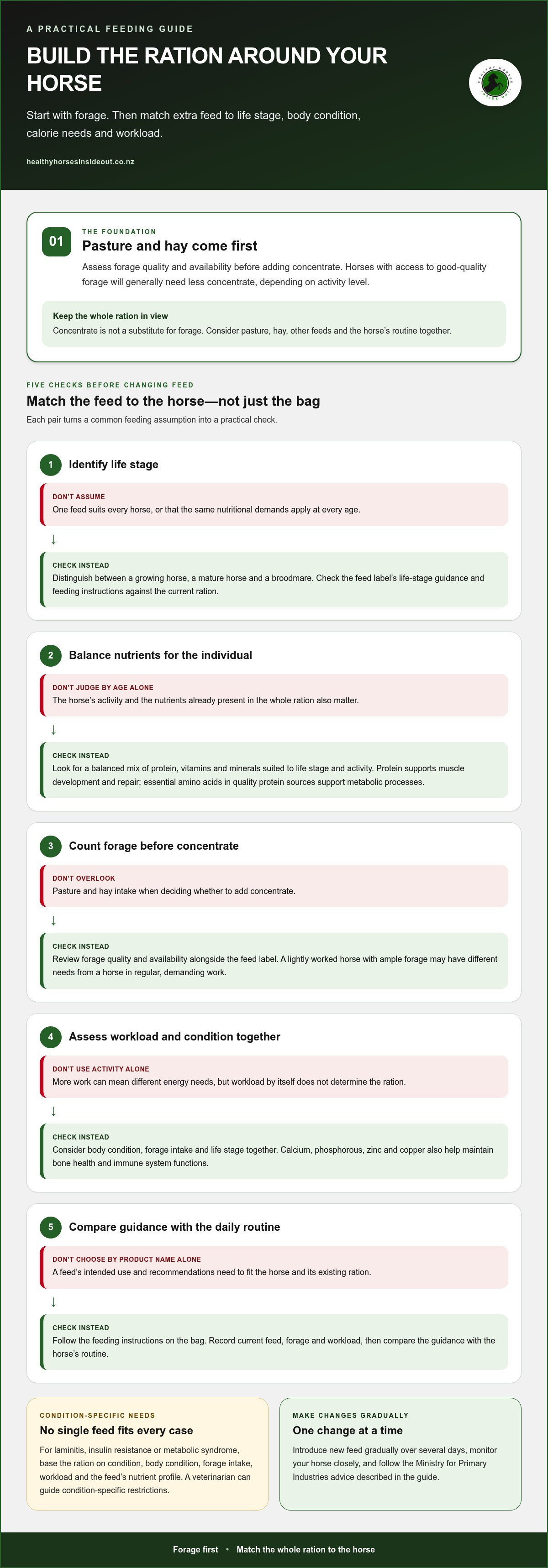
- Identify your horse’s life stage before comparing feeds. A growing horse, a mature horse and a broodmare have different nutritional demands, so choose a feed intended for the relevant stage. Check the label’s life-stage guidance and feeding instructions, then compare them with your horse’s current ration.
- Match nutrients to the horse, not just its age. Feed should provide a balanced mix of protein, vitamins and minerals suited to life stage and activity. Protein supports muscle development and repair, while essential amino acids in quality protein sources support metabolic processes. Consider the whole ration when assessing nutrient balance.
- Account for pasture and hay before adding concentrate. Horses with access to pasture and good-quality hay will generally need less concentrate, depending on activity level. A lightly worked horse with ample forage, for example, may have different needs from one in regular, demanding work. Review forage quality and availability alongside the feed label.
- Use workload to assess energy needs. A horse doing more work may need a different nutritional balance from one at rest, but activity alone doesn’t determine the ration. Consider body condition, forage intake and life stage together. Calcium, phosphorous, zinc and copper also help maintain bone health and immune system functions.
- Compare feeding guidance with your horse’s daily routine. Follow the instructions on each feed bag, choosing recommendations that suit your horse. Record its current feed, forage and workload before making changes. Then introduce the new feed gradually over several days, as advised by the Ministry for Primary Industries, and monitor your horse closely.
Choose a feed based on the horse’s body condition, forage intake, workload and the feed’s nutrient profile, and have a veterinarian advise on any condition-specific restrictions. The section does not identify particular New Zealand feeds.
Feeding your horse: How to choose the right food?
Build the ration around forage, then compare any additional feed with your horse’s needs and the product’s feeding guidance.
-
Build Feeding Around Forage
Start with pasture and hay as the foundation of the feeding programme. Horses are herbivores with digestive systems designed for foraging, so fibre-rich forage supports their natural feeding pattern. Assess the forage your horse can access and whether its quality and availability meet the horse’s needs.
Dietary fibre helps maintain healthy digestion, prevent colic and promote dental health. Don’t treat a concentrate as a substitute for forage; consider it only as part of the whole ration. Compare your horse’s pasture and hay intake before deciding whether additional feed is needed.
-
Compare Available Feed Types
Compare the role of each feed type rather than choosing by name alone. Pasture and hay provide forage; concentrates can add nutrients and energy, while digestible fibre ingredients offer another way to support digestion and provide energy. The right balance depends on your horse’s forage intake, life stage and workload.
Read each feed’s label and feeding recommendations before deciding. Choose a product whose intended use and guidance match your horse, then consider how it fits alongside existing forage and other feeds. A high-energy concentrate, for example, serves a different purpose from a fibre-based feed ingredient.
-
Review Forage-Based Ingredients
Look for digestible fibre sources such as beet pulp or soy hulls when comparing ingredients. They can support a healthy digestive system and provide additional energy. Consider each ingredient’s role in the overall ration rather than assuming one ingredient makes a complete feed suitable for every horse.
Check the product label for feeding directions and intended use. Then compare those instructions with the forage already available to your horse. A fibre-based feed may be relevant when assessing additional energy, but the whole ration still matters.
-
Check Feed Guidance and Costs
For overseas feed, follow applicable New Zealand import requirements and assess the ingredient list and label before incorporating it into the ration. Store feed in a clean, dry place, protect it from pests, and follow the manufacturer’s storage instructions. Follow the feeding guidelines on the bag and choose recommendations that suit your horse.
There is no single monthly feeding cost. It depends on the forage and additional feeds used, their purchase prices and the amounts fed. To estimate your total, calculate the monthly cost of the quantity used for each feed, then add the amounts together.
Use horse supplement options as a separate consideration when targeted nutritional support is relevant; supplements don’t replace forage as the ration’s foundation.
Lucerne hay as a source of additional calories
Carbohydrates from grains and forages provide horses with energy. To compare feed labels, review the stated energy, protein, fibre, sugar and starch values together, using the same units and basis where shown.
- Assess whether your horse needs extra calories before adding lucerne hay. Consider its body condition, current forage and workload together. Lucerne hay has more protein and energy than some grass hays, so it can increase the ration’s nutrient and energy contribution. It isn’t automatically the right addition for every horse.
- Match lucerne to your horse’s circumstances. It can add calories to feeding programmes for moderately to very heavily exercised horses, broodmares and growing animals. If a growing horse needs more energy, for example, consider how lucerne fits alongside its existing forage and feed rather than adding it without reviewing the whole ration.
- Compare the energy figures on feed labels before choosing an additional feed. Check that the values are expressed on the same basis, then consider how much your horse will actually receive. A feed with a higher energy value may contribute differently depending on the amount fed and the rest of the ration.
- Review protein and fibre alongside energy. Lucerne hay provides more protein than some grass hays, while fibre content helps show how the feed fits with forage. Read the label as a whole: don’t judge suitability from one value when your horse’s existing forage also contributes to its diet.
- Check sugar and starch values where the label provides them. Compare those figures on the same basis, alongside energy, protein and fibre, rather than treating one number as the whole picture. A feed’s energy contribution and its listed sugar or starch values, for example, describe different aspects of its composition.
- Use the feed bag’s guidelines to assess how an additional feed fits into the daily ration. Follow the recommended feeding instructions and include existing pasture, hay and other feeds in your review. If considering lucerne for a broodmare or a horse in heavier work, assess its contribution against the horse’s overall calorie needs.
- Reassess the ration after making a change. Record the forage and feed being offered, then observe your horse’s body condition and workload as part of your review. Lucerne can be a useful calorie source for some horses, but its higher energy and protein compared with some grass hays make it essential to assess the whole ration.
Assessing body weight and condition
For ulcers, poor teeth or weight-management needs, match the ration to your horse’s condition and ability to eat. Consider forage texture, energy contribution and the horse’s clinical plan together.
- Assess body condition before changing the ration. Look at your horse’s overall shape, feel along its body and compare your observations over time. A horse carrying excess condition needs a different calorie balance from one losing condition. Record what you see alongside its current forage, additional feeds and workload.
- Use weight and condition as separate clues. A weight estimate can help track direction, but it doesn’t show where your horse carries condition. Note changes in topline, ribs and general shape, then relate them to the amount and type of feed offered. If weight is increasing, for example, review the total ration rather than automatically removing one ingredient.
- For a horse with poor teeth, assess what it can chew comfortably. Consider forage texture and whether the horse manages its current hay or pasture. If chewing becomes difficult, include that in the feeding plan and choose feed forms the horse can eat. Don’t assume an energy-dense feed will solve the underlying feeding challenge.
- For a horse with ulcers, base feed decisions on its clinical needs and existing ration. Review the forage, feed types and feeding routine as a whole rather than relying on one product or ingredient. Note the feeds the horse currently receives and any changes in condition or appetite, so those details can inform the plan.
- For weight management, compare your horse’s total calorie intake with its activity and condition. Account for pasture, hay and every additional feed, because even a small change to one part can affect the overall balance. Avoid adding lucerne or concentrate solely to improve appearance without first checking whether extra energy is appropriate.
- Keep a simple feeding record to make decisions more precise. Write down each feed, forage source, amount offered and any changes in your horse’s condition. Review the record when workload, pasture access or body shape changes. This helps distinguish a gradual trend from a short-term observation and gives you a clearer basis for adjusting the ration.
- Make adjustments in a planned sequence. Choose a ration change that addresses the observed need, keep other parts of the routine consistent, then monitor your horse’s condition and ability to eat. A horse with poor teeth and declining condition, for example, needs both an accessible feed texture and an energy assessment, not simply a larger serving of its existing feed.
Matching feed to the horse's workload
- Describe the work your horse actually does before adjusting its ration. Note the activity, intensity and regularity. A horse taking occasional easy rides has different energy demands from one doing consistent, strenuous exercise. For owners choosing the right horse feed NZ has available, workload is a practical starting point, but it must be considered alongside forage and body condition.
- Separate exercise from general movement. Paddock activity and purposeful training place different demands on a horse. A horse moving freely between grazing areas, for example, may have a different workload from one completing focused schooling sessions. Include routine movement and ridden work in your assessment, rather than relying on a broad label such as “riding horse”.
- Look for changes in condition alongside performance. If your horse loses condition as work increases, review its total energy intake and forage access. If it maintains condition and work quality, extra concentrate may not be needed. Record changes in appetite and performance as useful observations, not automatic reasons to add feed.
- Match additional calories to the work performed. Carbohydrates from grains and forages provide energy, while lucerne hay has more protein and energy than some grass hays. Lucerne can add calories for moderately to very heavily exercised horses. Assess its contribution within the complete ration rather than treating it as a universal performance feed.
- Distinguish a temporary increase in activity from a sustained workload change. A horse preparing for a demanding event after a quieter routine needs a different assessment from one regularly training at that level. Revisit the ration as the work pattern changes, considering whether forage and other feeds provide an appropriate energy contribution.
- Compare the feed label with the amount actually offered. An energy value alone doesn’t show how much energy your horse receives; serving size and the rest of the ration also matter. Choosing the right horse feed NZ has available means comparing label guidance with current intake and workload, rather than selecting by energy figures alone.
- Keep a workload record to guide future feeding reviews. Note changes in exercise, condition, forage and additional feed, then look for patterns rather than reacting to one ride. If the ration is balanced but you’re considering additional nutritional support, explore horse supplement options as a separate part of the plan.
Healthy Horses Inside Out: Everyday Horse Supplements
Healthy Horses Inside Out offers Everyday Horse Supplements, Specific Horse Supplements, Horse Supplement Bundles and HHIO Pellets to complement your horse’s feeding programme. These options may be useful when considering nutritional support beyond pasture, hay and feed, while keeping the whole ration in view.
Start by identifying the need you’re addressing, such as supporting everyday nutrition or choosing a specific supplement. Compare the option with your horse’s current feed and follow its product guidance. Supplements don’t replace forage or veterinary care when a health concern needs assessment.
For information on the available options, visit Healthy Horses Inside Out online.
Make your next feed decision with confidence
A feeding plan isn’t fixed. Your horse’s routine, condition and nutritional needs can change, so keep observing and let those changes guide future decisions. A practical approach to choosing the right horse feed in NZ is to treat each adjustment as a considered step, not a quick reaction. Note what has changed, identify the need you’re addressing, and review whether your current plan still fits.
When you’re considering nutritional support beyond the daily ration, Healthy Horses Inside Out offers Everyday Horse Supplements, Specific Horse Supplements and Horse Supplement Bundles. Explore the options and decide what may complement your horse’s existing feeding programme.
Contact Healthy Horses Inside Out to take the next step. With careful observation and a clear reason behind each choice, you can keep building a feeding plan around your horse’s needs.
Frequently Asked Questions
How do I choose horse feed based on age, workload, body condition and health in New Zealand?
Choose a feed whose label matches your horse’s life stage and nutritional needs, then consider its workload, condition and health together. A horse returning to work after a quiet period, for example, may need a different ration from one maintaining regular exercise. Compare the feed’s intended use with the horse’s current ration, and account for changes in pasture access that alter what it eats day to day.
What forage and pasture should make up a horse’s diet in New Zealand?
Use suitable pasture and hay as the forage base, assessing what your horse can access and eat consistently. New Zealand pasture conditions vary, so observe whether your horse is grazing readily and whether hay is needed to maintain a steady forage supply. A horse with limited grazing access, for example, may rely more on stored forage. Consider forage quality and availability together rather than judging the diet by pasture alone.
How much feed should a horse eat per day based on body weight?
There isn’t one daily amount that suits every horse at the same body weight. The appropriate ration depends on the feed’s nutrient density, forage intake, workload, life stage and body condition. Follow the chosen product’s feeding directions, and weigh the feed rather than estimating with an unmeasured scoop. Include pasture, hay and other feeds in your daily assessment, since concentrate is only one part of the total ration.
What supplements or minerals do horses in New Zealand need, and when should they be avoided?
Supplement minerals only to address a need in your horse’s overall ration. Calcium, phosphorous, zinc and copper support bone health and immune system functions, but adding them without assessing existing feed can create unnecessary overlap. Check whether fortified feeds or other supplements already provide these nutrients before adding another source. A diagnosed health issue or restricted diet calls for a supplement choice that fits the horse’s specific nutritional plan.
What are current prices for horse feed in New Zealand, and how much does feeding cost per month?
There is no single monthly feeding cost; it depends on the forage and additional feeds used, their purchase prices and the amounts fed. Estimate your monthly total by adding the cost of the quantities used for each feed.
Which New Zealand horse feeds are suitable for laminitis, insulin resistance or metabolic syndrome?
No single feed suits every horse with these conditions. Base the ration on the horse’s condition, body condition, forage intake, workload and the feed’s nutrient profile, and have a veterinarian guide any condition-specific restrictions.


