

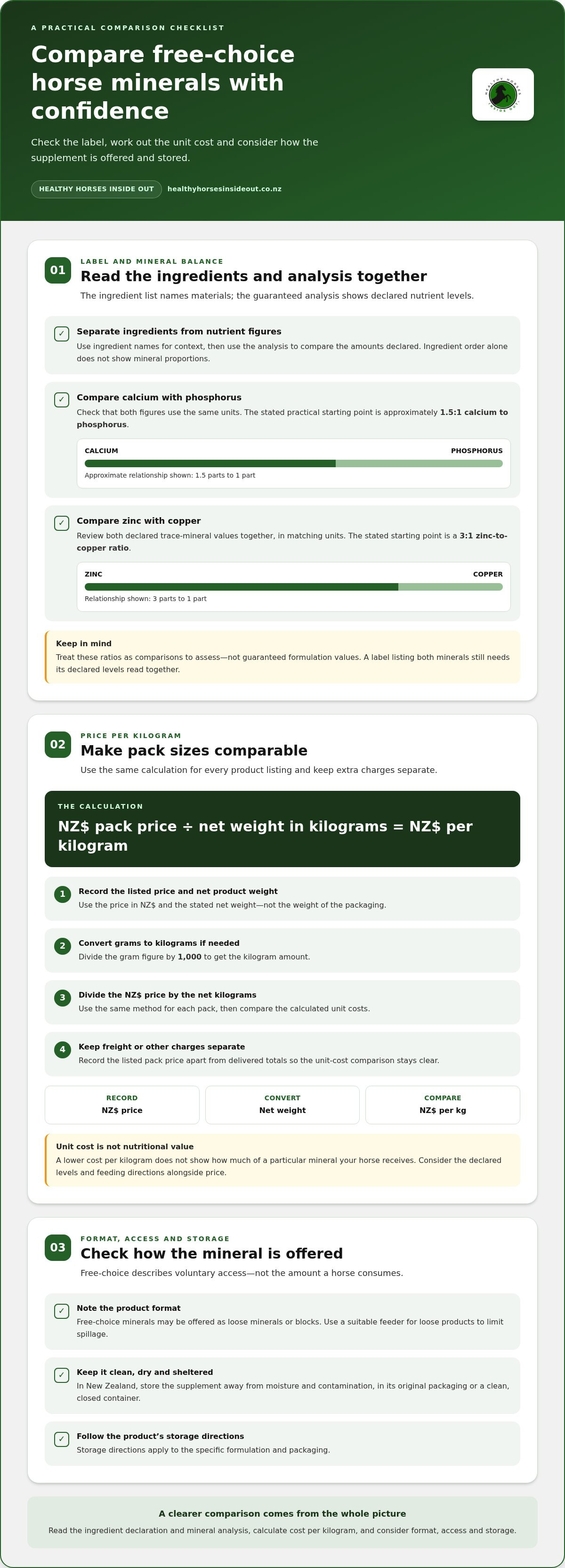
Mineral balance depends on nutrient ratios, not just a long ingredient list. For free choice horse minerals in NZ, calcium should be provided at approximately a 1.5:1 ratio to phosphorus, while zinc should be provided at a 3:1 ratio to copper. These figures offer a practical starting point for comparing formulations.
It’s sensible to look beyond the label and ask what’s in the mix, how it’s offered and whether the cost represents good value. Comparing cost per kilogram helps you assess different pack sizes, while the declared trace mineral levels show the nutrients each product supplies.
This guide explains what to look for in the ingredients and analysis, how free-choice minerals are offered, and how to calculate cost per kilogram from a product’s price and weight. It also explains how to compare declared mineral levels, helping you assess whether a mineral mix fits your horse’s overall feeding plan.
Key Takeaways
- Use the ingredient panel to assess the mineral mix as a whole, rather than judging it by the length of its ingredient list.
- Compare pack prices on a like-for-like basis by dividing the NZ$ price by the pack weight to calculate cost per kilogram.
- Distinguish a product’s formulation from where it is available: ensure you verify local stockists across New Zealand before purchasing.
- Compare trace minerals in relation to one another, as well as by their individual levels.
- Account for the horse’s overall diet and access to the supplement when considering free-choice intake.
Ingredients
An ingredient list names the materials used in a mineral supplement. Read it alongside the guaranteed analysis: they answer different questions. The ingredient list describes what the product contains; the analysis shows the declared nutrient levels. For example, calcium and phosphorus may appear as nutrient measures without explaining every ingredient source.
A macromineral is required in comparatively large amounts in the diet. Calcium and phosphorus are two examples relevant to a horse’s mineral balance. Their presence on a label doesn’t reveal their proportions. Check the declared levels and compare those figures rather than relying on ingredient order alone.
The calcium-to-phosphorus ratio compares the amount of calcium with the amount of phosphorus. The stated target for this topic is approximately 1.5:1, meaning calcium is compared with phosphorus at that proportion. Treat this as a ratio to assess, not a guaranteed formulation value. A label with both minerals listed still needs its levels read together.
A guaranteed analysis reports nutrient concentrations in a feed or supplement. It helps distinguish an ingredient name from the amount of a nutrient supplied. Compare the declared calcium and phosphorus levels using the same units. If the label gives percentages, use those figures to assess the relationship. Don’t compare a percentage with a weight in grams.
A trace mineral is a mineral needed in smaller amounts than a macromineral. Zinc and copper are examples, and their relative levels matter when assessing a mineral profile. The stated zinc-to-copper ratio is 3:1. Check both declared values together, rather than treating either figure as a standalone measure of suitability.
- Read the ingredient declaration: identify the listed materials, then distinguish them from nutrient values in the analysis.
- Find the mineral figures: note calcium and phosphorus, and check that their units match before comparing them.
- Assess the relationship: compare calcium with phosphorus against the approximate 1.5:1 ratio stated for this topic.
- Review trace minerals: compare zinc with copper against the stated 3:1 ratio, using the same units.
These steps make label comparisons more precise without assuming every product contains the same ingredients. When assessing free choice horse minerals in NZ, consider the full declared profile and how the mineral levels relate to one another. Ingredient names provide context; the analysis provides figures for comparing key nutrients. Use both to base your decision on what the label actually says.
Price per kilogram
Price per kilogram is the pack price divided by its net weight in kilograms. For a New Zealand comparison, record the price in NZ$ and use the stated net weight. This gives you a consistent unit for comparing different pack sizes, without assuming the cheapest pack offers the best value.
Use this calculation: price per kilogram = pack price in NZ$ ÷ net weight in kilograms. If the weight is listed in grams, convert it to kilograms before dividing. Use the pack price in NZ$; don’t substitute a price from another currency or market.
Net weight is the stated mass of product inside the pack. It provides the denominator for your calculation, so read the label carefully and distinguish product weight from packaging weight. If the listing gives the net weight in grams, convert it by dividing the gram figure by 1,000. Then divide the NZ$ pack price by that kilogram amount.
A comparison worksheet can have three columns: pack price in NZ$, net weight in kilograms, and calculated NZ$ per kilogram. Enter the figures shown for each product, then apply the same formula to every row. This prevents a larger-looking pack from seeming cheaper before you calculate its actual unit cost.
The listed price and delivered total are different comparison points. A product listing may show the pack price, while freight or other checkout charges affect the total paid. Record these separately rather than adding an unverified charge to the product price. This keeps the unit-cost calculation transparent and makes your spending comparison more useful.
Cost per kilogram doesn’t measure nutrient concentration or feeding value. Mineral mixes can differ in ingredients, declared mineral levels and feeding directions. A lower unit cost alone doesn’t show how much of a particular mineral your horse receives. Compare the label information alongside the calculated cost instead of treating price as a nutritional measure.
- Record: the listed NZ$ price and net product weight.
- Convert: grams to kilograms when the listing uses grams.
- Calculate: divide the pack price by net kilograms.
- Compare: keep freight separate, then consider the label and feeding directions.
For a consistent comparison of free-choice mineral options in New Zealand, use the same method for every product listing. A worksheet helps when pack formats differ: record each product’s stated price and weight, calculate the unit cost, and note the label details alongside it. This makes the NZ$ per kilogram figure part of a broader decision, not the only factor.
Product format and availability
Place free-choice minerals in a stable, sheltered spot, and keep the supplement dry and clean. In New Zealand, store it in its original packaging or a clean, closed container, away from moisture and contamination. Follow the product label’s storage directions, as these apply to the specific formulation and packaging.
A free-choice format lets a horse approach a mineral supplement voluntarily. It describes how the supplement is offered, not how much the horse consumes. Products may come in different forms, such as loose minerals or blocks. Use a suitable feeder for loose products to limit spillage and keep the minerals accessible. Place a block somewhere stable, where it won’t roll away or become contaminated.
A mineral feeder holds loose supplement for horses to access. Choose a stable spot where horses can reach it without obstructing gates, troughs or normal movement. Check it during routine yard or paddock tasks. Remove wet, dirty or compacted material, then replenish it according to the product directions. Keep the scoop clean, and don’t return spilled material to the container.
Availability means whether a product can be purchased through a particular seller or market. For a New Zealand purchase, review the local product listing and its details. Format, pack size and delivery information are separate considerations. Read the label and listing together to understand the intended use and packaging before choosing a mineral supplement.
Good storage helps keep a product clean and usable. Close the bag or container between refills, and store it under cover rather than exposed to rain. A dry feed-storage area helps protect unopened stock. Keep the label with the product so its directions and ingredient information remain available. Don’t transfer minerals into an unlabelled container.
In a shared paddock, consider whether every horse can reach the feeder. Observe whether horses approach calmly, and look for spillage or contamination during routine checks. If one horse blocks access, adjust the feeding arrangement. An open feeder doesn’t ensure equal access or equal intake for every horse.
- Choose the location: use a stable, sheltered position away from gates and troughs.
- Protect the contents: keep the product dry, closed and clean between refills.
- Check access: observe the horses and feeder during normal paddock routines.
- Read the label: follow directions for the product’s format, use and storage.
When considering free-choice horse minerals in NZ, assess format, storage and availability separately. A suitable feeder supports access, while dry storage helps protect the supplement from moisture. Read the product information before setting up a feeder, then observe how the horses use it during their normal paddock routine. These steps help you manage the product carefully and keep its directions close at hand.
Trace mineral levels
Trace mineral levels show the smaller-amount minerals in a horse’s ration. Compare them with macrominerals and the rest of the diet, rather than assessing them in isolation.
Free-choice and measured mineral provision
Free-choice provision lets a horse access a mineral source voluntarily, while measured provision supplies a planned amount. A mineral block is convenient to offer, but it doesn’t ensure that each horse consumes a consistent quantity. Balanced feed or a measured supplement provides a defined amount per serving, making the ration easier to assess.
Free-choice minerals aren’t automatically suitable for every horse or pony. Suitability depends on the complete diet, access to the product and individual intake. Salt, fortified feed and other supplements can also supply nutrients, so compare their labels before combining them. The total ration matters more than any single product.
A macromineral is a mineral needed in larger dietary amounts than trace minerals. For this comparison, calcium should be provided at approximately a 1.5:1 ratio to phosphorus. Zinc should be provided at a 3:1 ratio to copper. These relationships help assess a label, but don’t show how much each horse actually consumes.
Mineral imbalance occurs when nutrient amounts or relationships don’t suit the overall ration. Excess intake can contribute to imbalance, while insufficient intake can leave dietary gaps. Avoid combining products without comparing their declared nutrients. For example, a block offered alongside fortified feed adds another source to consider.
Supplement amounts and intake
Supplement intake is the amount a horse consumes from a mineral source. Free-choice access doesn’t provide a measured serving, so consumption can vary between horses and over time. Follow the product’s feeding directions, then observe whether the supply is being used steadily.
To assess intake, note how much product remains at each routine refill and watch for sudden changes. Rapid disappearance may indicate high consumption, spillage or access by multiple horses. Little change may reflect low interest, limited access or another source in the ration. These signs show how the product is being used, not the horse’s nutrient status.
Compare the label with the complete ration before changing how the supplement is offered. Include pasture, forage, fortified feed, salt and other supplements. Excess minerals or an imbalance can affect the suitability of the ration, so don’t increase access simply because a horse seems keen to consume the product.
Pasture and soil mineral deficiencies
A pasture mineral deficiency occurs when forage supplies too little of a nutrient for a horse’s dietary needs. New Zealand pasture and soil conditions vary, so don’t assume the same deficiency applies across every region or property. Soil, pasture species and forage management all influence the mineral content available to grazing horses.
For a property-specific assessment, use forage or soil analysis to identify the minerals present. Compare the results with the horse’s full ration and the product’s declared levels. A general description of pasture can’t establish a particular horse’s intake, especially when hay, fortified feed or other supplements also contribute.
Trace mineral comparisons are only one part of that assessment. Check zinc against copper at the stated 3:1 ratio, and review calcium against phosphorus at approximately 1.5:1. Those figures provide comparison points; they don’t establish that a specific pasture is deficient or that every horse needs the same supplement.
How much free-choice mineral supplement should a horse receive?
Free-choice intake is the amount a horse voluntarily consumes from an accessible mineral source. There’s no single measured serving that suits every product and ration. Follow the product’s feeding directions, then assess intake alongside the horse’s complete diet.
The recommended amount on a label applies to that specific formulation. Mineral concentrations vary, so the same scoop or access to a block can provide different amounts of nutrients. Read the directions before offering a supplement, and compare its mineral analysis with other feed labels. This is especially important when a horse already receives fortified feed.
The complete ration includes everything a horse eats or can access: pasture, hay, hard feed, salt and supplements. Each source can contribute minerals. For example, if you offer a free-choice mineral alongside fortified feed, include both products in the overall comparison. Looking at one product alone can miss overlapping nutrient sources.
Voluntary access makes actual intake difficult to measure. A horse may consume more or less than another horse sharing the feeder. Record how much product you add and what remains at each refill. Note spillage, weather exposure and access by other horses, as these can affect apparent consumption.
Changes in consumption are useful observations, but they don’t directly measure nutritional need. If a feeder empties faster, check for spillage or increased access before assuming the horse needs more. If use slows, consider whether the product is clean, dry and accessible. Keep the label directions in view when interpreting these changes.
Mineral balance depends on both the amount consumed and the nutrients already present in the ration. For example, the stated comparison points include calcium at approximately a 1.5:1 ratio to phosphorus, and zinc at a 3:1 ratio to copper. These ratios help assess relationships, but don’t establish an individual serving amount.
- Read the directions: use the guidance for the specific product, not another formulation.
- Review the full ration: include pasture, hay, fortified feed, salt and other supplements.
- Observe use: track refills, remaining product, spillage and shared access.
- Compare nutrients: assess declared levels alongside the rest of the diet.
For a horse receiving several products, write down each label’s directions and mineral contributions. This simple step makes overlapping sources easier to spot. If you’re comparing daily nutrition options, explore everyday horse supplements as part of your broader ration review.
Healthy Horses Inside Out: Everyday Horse Supplements
Healthy Horses Inside Out offers Everyday Horse Supplements to support your horse’s broader nutrition plan. When comparing mineral sources, consider how a supplement fits alongside pasture, feed and other additions, rather than treating one product as the whole ration.
For a more targeted nutritional focus, explore HHIO’s Specific Horse Supplements, Horse Supplement Bundles and HHIO Pellets. These options offer different forms of dietary support while keeping your horse’s overall feeding plan in view. Choose products based on the nutritional priorities you’ve identified, and continue to compare labels carefully.
Explore Healthy Horses Inside Out’s supplement range to find options for your horse’s nutrition plan.
Make your next feeding decision with confidence
Choosing free choice horse minerals in NZ is part of a broader decision about your horse’s daily nutrition. First identify your priority: general dietary support, a particular nutritional focus, or a simpler way to bring suitable supplements together. This gives you a clearer starting point for assessing options against your horse’s existing feed and routine.
Healthy Horses Inside Out offers Everyday Horse Supplements, Specific Horse Supplements and Horse Supplement Bundles. These categories give you different ways to explore equine nutrition, depending on the support you’re seeking. Focus on your horse’s needs and consider the whole ration carefully, rather than adding products without checking how they fit together.
Explore horse supplements and contact Healthy Horses Inside Out to take the next step. A thoughtful approach to nutrition can help you make choices with greater clarity and care.
Frequently Asked Questions
What are free-choice horse minerals and how do they work?
Free-choice horse minerals are supplements offered for horses to access voluntarily, rather than receiving a measured serving mixed into feed. In NZ, this format doesn’t control how much each horse consumes. For example, horses sharing a feeder may have different access and intake. Consider the product directions alongside the horse’s full ration, including pasture, hay, fortified feed and other supplements.
Which free-choice mineral products for horses are available in New Zealand?
New Zealand horse owners can explore different supplement formats, but a supplement category isn’t automatically a free-choice mineral product. Healthy Horses Inside Out offers Everyday Horse Supplements, Specific Horse Supplements, Horse Supplement Bundles and HHIO Pellets. These are equine nutrition options, not a claim that every product is intended for voluntary access. Match the format to its feeding directions and its place in the horse’s existing ration.
What are the ingredients and mineral analyses of popular NZ horse mineral products?
Compare each product’s ingredient declaration with its mineral analysis, rather than relying on product popularity or ingredient names alone. The ingredient list identifies materials, while the analysis gives nutrient levels. For comparison, calcium should be provided at approximately a 1.5:1 ratio to phosphorus, and zinc at a 3:1 ratio to copper. Check units match before comparing labels, and assess the overall profile.
How much do free-choice horse minerals cost in New Zealand?
Compare New Zealand listings in NZ$ per kilogram to assess pack costs consistently. Divide the listed pack price by its net weight in kilograms; convert grams to kilograms first if needed. Record the NZ$ price and pack weight for each option, then calculate each unit cost using the same method. Keep delivery charges separate from the product calculation, and weigh cost alongside the label and feeding directions.


