

More feed doesn’t automatically mean better nutrition. The common horse feeding mistakes in NZ often begin when concentrates are added without accounting for pasture, forage and workload; measure feed by weight, match supplementary calories to the horse’s needs, and introduce changes over seven to 10 days. A forage-first ration gives you a clearer starting point for balancing energy.
It’s understandable to reach for extra feed when a horse seems low on energy or has a heavier workload. But if pasture already supplies a significant share of daily energy, adding concentrates may not help as much as expected. Too much can also upset the balance of the ration.
This guide explains how to assess forage and grazing, match supplementary feed to workload, avoid excess concentrates and keep feeding routines consistent. You’ll also learn when a supplement may help address a nutritional gap, so you can make considered changes to your horse’s daily diet.
Key Takeaways
- Start by accounting for pasture and forage before adding supplementary calories, as extra feed may not increase total energy intake as expected.
- Measure concentrates by weight and match the amount to your horse’s workload rather than feeding more by default.
- Assess forage quality and access, and keep forage available throughout the day where practical.
- Keep feeding times consistent, then introduce hay or grain changes gradually over a seven- to 10-day transition period.
- Review the whole ration before adding supplements, so you can target a genuine nutritional gap and avoid unnecessary overlap.
1. Energy requirements and supplementary feed
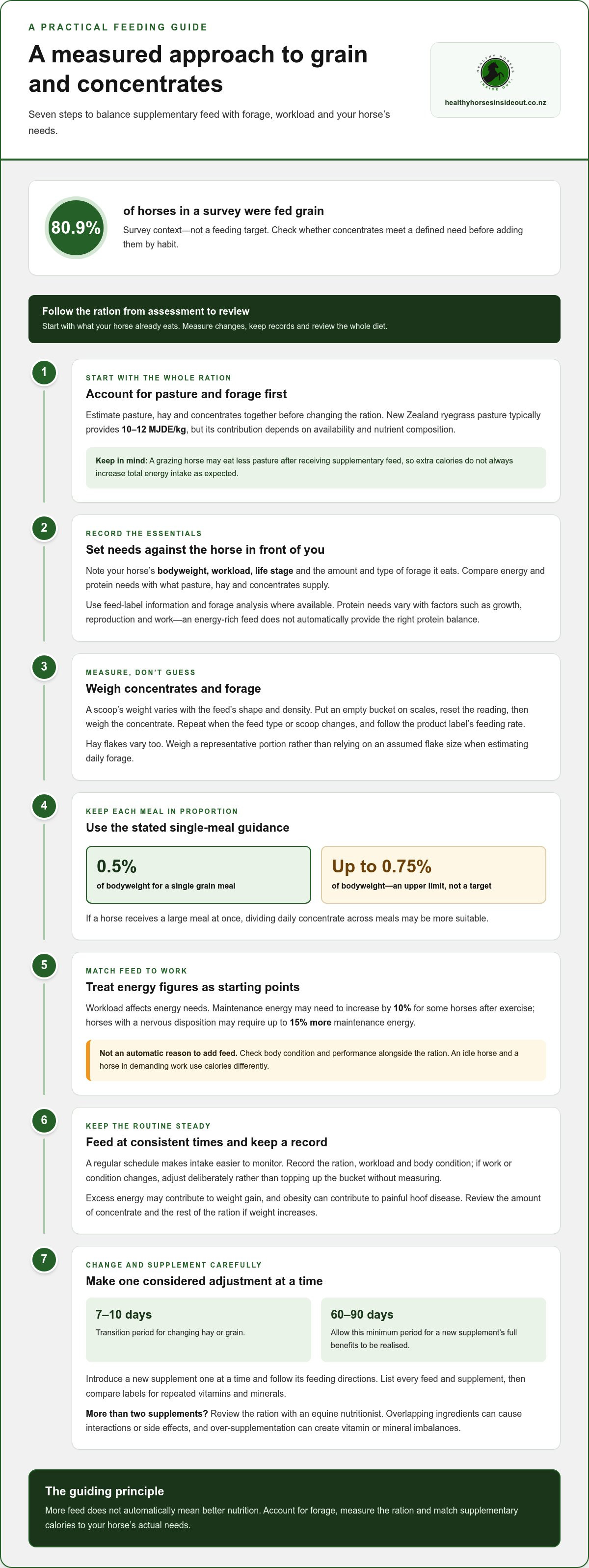
Start with the whole ration, not the feed bag. In New Zealand, ryegrass pasture typically provides 10-12 MJDE/kg of digestible energy, but its contribution depends on availability and nutrient composition. A grazing horse may eat less pasture after receiving supplementary feed, so extra calories do not always raise total energy intake. Estimate pasture, hay and concentrates together before changing the ration.
To estimate daily energy and protein needs, record your horse’s body weight, workload, life stage, and the amount and type of forage it eats. Compare those needs with the energy and protein supplied by pasture, hay and concentrates, using feed-label information and forage analysis where available. Protein needs vary with factors such as growth, reproduction and work, so don’t assume an energy-rich feed provides the right protein balance.
Workload can change energy needs. Maintenance energy may need to increase by 10% for some horses after exercise, while horses with a nervous disposition may require up to 15% more maintenance energy. These figures are starting points, not a reason to add feed automatically. Check body condition and performance alongside the ration; an idle horse and a horse in demanding work use calories differently.
Review supplement ingredients before adding another product. List every feed and supplement, then compare labels for repeated vitamins and minerals. More than two supplements is a reason to review the ration with an equine nutritionist, as overlapping ingredients can cause interactions or side effects. Over-supplementation can create vitamin or mineral imbalances, even when each product is fed at its stated rate.
New Zealand horses with sufficient pasture will generally get enough vitamins A and E without extra supplementation. Consider pasture access and quality when deciding whether a vitamin product has a role. Senior horses may need additional support if digestion becomes less efficient, but age alone doesn’t identify a nutrient shortfall. Assess the full diet before adding a targeted supplement.
Mineral requirements depend on a horse’s diet, activity and environment, so no single mineral combination suits every horse. Check what pasture, forage, concentrates and existing supplements provide before adding more. If the ration already supplies the required nutrients, a supplement may be unnecessary. Adding one anyway can duplicate ingredients without addressing a real gap.
Make changes deliberately. Introduce a new supplement one at a time, follow its feeding directions and allow a minimum of 60-90 days for its full benefits to be realised. Change hay or grain over a seven- to 10-day transition period. That measured approach helps you observe the response and avoid adjusting several parts of the ration at once.
2. Excess grain and concentrate feeding
Concentrates are useful when a horse needs extra energy, but a larger scoop isn’t automatically a better ration. In a survey, 80.9% of horses were fed grain. That figure makes it especially important to check whether concentrate meets a defined need, rather than adding it from habit. Pasture and forage already contribute energy, so assess the whole ration before increasing grain.
Meal size matters. A single grain meal should be offered at 0.5% of the horse’s body weight, and can be up to 0.75%. Treat that upper figure as a limit, not a target. A horse receiving a large meal at once may be better served by dividing its daily concentrate across meals, while maintaining a consistent feeding routine.
Offer concentrate meals at consistent times each day. A regular schedule makes intake easier to monitor, while frequent changes in meal size can make it harder to spot what your horse is eating. Keep a written feed record. If workload or body condition changes, adjust the daily ration deliberately rather than topping up the bucket without measuring.
Measure feed by weight, not volume. A scoop’s weight varies with the feed’s shape and density, so the same measure can deliver different amounts. Put an empty bucket on scales, reset the reading, then weigh the concentrate. Repeat when changing feed type or scoop, and follow the product label’s feeding rate.
Hay also varies by bale and flake. A slice of hay is estimated to weigh approximately 2.25 kilograms, but that estimate can’t replace weighing the amount actually fed. Weigh a representative portion, then use that measurement to calculate the daily forage allowance. This prevents an assumed flake size from distorting the balance between forage and concentrate.
Excess energy may contribute to weight gain, so monitor body condition alongside feed quantities. Obesity can contribute to painful hoof disease, so monitor body condition as well as feed quantities. If your horse gains weight while receiving grain, review the amount of concentrate and the rest of the ration before adding more. The feed label’s activity-based rate can guide your review, but actual intake matters too.
Make the change manageable: weigh the current ration, record the horse’s condition, then alter one measured amount at a time. If you’re comparing equine nutrition options, keep the horse’s workload and existing feed in view. That way, concentrate supports a clear energy need rather than becoming an unmeasured extra.
A flake of grass hay weighs 3 to 5 pounds on average, while a flake of alfalfa hay weighs 5 to 7 pounds on average. These differences make weighing especially useful when estimating forage intake, since flake size alone may not reflect the amount offered. Horse owners concerned about their horse’s diet can consult a veterinarian or equine nutritionist.
3. Forage quality and grazing behaviour
Forage supports digestion and gives horses a more natural pattern of eating. Horses consume 1.5 to 2.5% of their body weight in forage daily, while the minimum described is 1%. For a 1,000-pound horse, that minimum equals 10 pounds of dry forage per day; a safer guideline is 15 to 25 pounds. Use dry weight when comparing hay allowances.
Offer forage throughout the day and avoid long gaps between feeds. Regular access supports natural eating behaviour; if grazing is restricted, plan to provide adequate roughage. In New Zealand, make grazing decisions based on pasture availability, your horse’s body condition and forage intake. Don’t use paddock size alone as proof that feeding is adequate.
If grazing is restricted or you’re concerned about a feeding practice, consider your horse’s condition, forage access and daily behaviour. Seek veterinary guidance if its health or comfort changes. A feeding plan should not restrict pasture without accounting for the forage removed.
Check hay before feeding it. Look for visible mould, dampness, dust, unusual discolouration or an off smell. Remove suspect hay from the ration, as mould can make it dangerous for horses. For a clearer nutrition assessment, submit a representative sample for forage analysis. Store bales in a dry, well-ventilated place, protected from rain and ground moisture. Hay prices vary with region, season, type and availability, so compare delivered price, quality and usable feed, not just the bale price.
Pasture-associated laminitis calls for prompt attention to changes in comfort or movement. Don’t wait for your horse to become severely lame. Reduce risk by managing access to lush pasture, monitoring body condition and keeping forage intake in view. If signs appear, arrange a veterinary assessment; feed changes alone aren’t a substitute for care.
Inspect grazing areas for unfamiliar or potentially harmful plants. Prevent your horse from eating an unknown plant until it has been identified. Risk depends on the plant and the amount consumed, so don’t assume a paddock is safe just because it looks green or has been grazed before.
Keep clean water available at all times, including in hot weather and after exercise. Salt needs vary with activity, environmental conditions and sweat production, so consider these factors when reviewing the ration rather than applying the same amount to every horse. Insufficient dietary salt can contribute to pica, dehydration, reduced muscle coordination, decreased appetite and lack of sweat.
4. Consistent feeding schedules
Irregular feeding schedules can cause stress in horses, so keep daily feed times predictable. Offer concentrate at the same time each day and keep the order of chores steady. For example, record morning and evening feeds in a stable diary, including forage, concentrate and supplements. This helps anyone caring for your horse follow the same ration instead of making unplanned changes.
Consistent routines also make changes easier to interpret. If appetite, manure or behaviour shifts after a ration adjustment, a feeding record can show what changed and when. Note the feed type, measured amount and time offered, then record any change in your horse’s response. Avoid changing several ingredients at once, as that makes it harder to identify what may be affecting your horse.
Sudden changes to hay or grain can disrupt digestion and may contribute to problems such as colic. Rapidly increasing energy-rich feed can also upset the ration’s balance, so don’t treat a feed change as an instant fix for low energy or weight loss. Colic and laminitis can have multiple causes; a feed change alone doesn’t establish the cause of either condition.
Change hay or grain over a seven- to 10-day transition period. One gradual example is to offer 25% new feed and 75% old feed for two to three days, then 50% of each for two to three days. Next, use 75% new feed and 25% old feed for two to three days. Keep the total ration measured, and avoid adding another new ingredient during the transition.
Use the same measured approach when changing a concentrate brand or forage source. Compare the new feed’s label with the existing ration, including calories, protein and overlapping ingredients. Keep feeding times stable as you change the proportions. If your horse leaves feed uneaten, don’t double the next meal to compensate. Record what was eaten and maintain the transition plan.
After a change in carer or stable routine, write down each feed and its timing before handing over care. Include the type and amount of forage, concentrate portion and any supplements. This gives the next person a clear routine to follow and helps prevent missed meals, doubled portions or abrupt ration changes.
5. Matching feed to workload
Match supplementary calories to the work a horse actually performs, not its label as a “performance” horse. One guide classifies light work as 1-3 hours per week, moderate work as 3-5 hours, heavy work as 4-5 hours with significant cantering, and very heavy work as 6-12 hours. These categories help frame the discussion, but the horse’s condition and daily ration matter too.
For example, a horse in light work may not need extra calories if pasture and forage already meet its energy needs. By contrast, a performance horse may need additional calories to replace energy used during activity. On a mixed diet, pasture can provide approximately 50% of a performance horse’s daily digestible energy requirement, depending on pasture availability and nutrient composition. Include grazing when assessing the ration.
Use the feed label as a starting point. Feeding rates generally reflect activity level and age, so choose the rate that best matches your horse rather than copying another owner’s scoop. Check the label against your horse’s current forage and concentrate intake. A higher workload may call for a closer look at the whole ration rather than an automatic increase in concentrate.
Build a simple workload record. Note each week’s riding time, intensity and changes in the horse’s condition, then compare those details with feed amounts. A horse moving from moderate work at 3-5 hours weekly to very heavy work at 6-12 hours may have a different energy demand. Conversely, a reduced training routine can leave yesterday’s ration supplying more calories than today’s activity uses.
Look for patterns rather than making decisions after one ride. Record whether your horse maintains condition, recovers between sessions and has enough energy for its usual work. Workload, pasture access and forage quality all affect energy balance. If your horse loses condition despite suitable feed intake, or gains condition as work decreases, review the whole ration and the factors affecting it.
Keep the feeding routine aligned with the training routine. When work varies across the week, base the plan on the overall workload and adjust deliberately, rather than adding an unmeasured extra feed after every demanding session. That keeps energy intake connected to actual activity and helps avoid unnecessary concentrate. For a more targeted approach to supplementary feeding, explore horse nutrition support.
Feed amounts are only a starting point when assessing the complete ration. A performance horse feed designed for added calories may be fed at 3 to 7 pounds per day. In the selenium example, 5 pounds of performance feed containing 0.7 ppm selenium contributes 1.6 mg of selenium to the horse’s diet, illustrating why the label’s mineral contribution matters alongside calories.
Survey findings also show why pasture assumptions need checking: in the surveyed New Zealand horses, supplementary feed accounted for an average of 83% of daily digestible energy requirements, while pasture supplied approximately 17% of the surveyed horses’ energy requirement when calculating the energy deficit from known feed supply. Wild horse predecessors travelled 20 to 30 miles per day to meet their feed and water needs, but that distance is context, not a target for domestic workload planning.
Healthy Horses Inside Out: Everyday Horse Supplements
Healthy Horses Inside Out offers Everyday Horse Supplements to support owners considering supplementation as part of a balanced ration. Once forage, grazing, workload and existing feed are accounted for, a supplement may help address a specific dietary gap. The range also includes Specific Horse Supplements, Horse Supplement Bundles and HHIO Pellets, with options to consider in light of your horse’s nutritional needs.
Before choosing a supplement, note what your horse already receives and what you want the product to do. This helps you assess ingredients in context and avoid adding overlapping products without a clear purpose. Supplements complement a considered feeding plan; they don’t replace suitable forage or veterinary care when a health concern needs attention.
Explore the options at healthyhorsesinsideout.co.nz.
Make your next feed change with purpose
A feeding plan works best as an ongoing record, not a one-off calculation. Note what your horse eats, changes in workload and shifts in body condition. Over time, these observations can help you spot when the ration needs a thoughtful review, rather than reacting to one quiet ride or an uneaten meal.
Avoiding common horse feeding mistakes in NZ starts with choosing supplementary support for a clear reason and considering it alongside the whole diet. Healthy Horses Inside Out offers Everyday Horse Supplements, Specific Horse Supplements and Horse Supplement Bundles to explore as part of that process. The aim is to make informed choices, not add products without considering their place in the ration.
If you’re ready to explore options for your horse’s feeding plan, contact Healthy Horses Inside Out. Small, considered decisions can help you build a routine with greater confidence.
Frequently Asked Questions
What are the most common horse feeding mistakes in New Zealand?
Common horse-feeding mistakes in NZ include relying on scoops instead of weighing feed, overlooking what grazing contributes and adding supplements without checking for repeated ingredients. Write down everything offered, including treats and shared stable feeds, then compare the list with your horse’s condition and workload. Reviewing the whole ration can reveal small daily extras that are easy to miss.
How much pasture, hay and hard feed should a horse in New Zealand eat daily?
Forage should make up the foundation: a horse generally consumes 1.5 to 2.5% of its body weight in forage daily, with 1% described as the minimum. Pasture intake varies with growth and access, so hay may need to fill the gap. There isn’t one hard-feed amount for every horse; use workload, body condition and the feed label to set its place in the ration.
What are the risks of overfeeding grain or concentrates to horses?
Too much grain or concentrate can provide more energy than a horse uses, contributing to weight gain and equine metabolic syndrome. Obesity and equine metabolic syndrome can contribute to painful hoof disease. Excessive use of overlapping supplements can also create vitamin or mineral imbalances. Weigh the daily ration, monitor body condition and review the full feed list before increasing concentrate or adding another supplement.


